Celebrating Juneteenth
On June 19, 1865 slavery in America officially ended—honor this holiday by learning about the individuals and communities that have continued the fight for equality, safety, and justice for Black Americans.
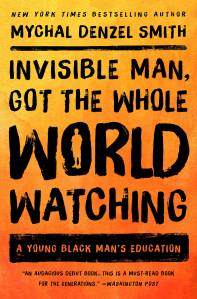
An unflinching account of what it means to be a young black man in America today, and how the existing script for black manhood is being rewritten in one of the most fascinating periods of American history.
How do you learn to be a black man in America? For young black men today, it means coming of age during the presidency of Barack Obama. It means witnessing the deaths of Oscar Grant, Trayvon Martin, Michael Brown, Akai Gurley, and too many more. It means celebrating powerful moments of black self-determination for LeBron James, Dave Chappelle, and Frank Ocean.
In Invisible Man, Got the Whole World Watching, Mychal Denzel Smith chronicles his own personal and political education during these tumultuous years, describing his efforts to come into his own in a world that denied his humanity. Smith unapologetically upends reigning assumptions about black masculinity, rewriting the script for black manhood so that depression and anxiety aren’t considered taboo, and feminism and LGBTQ rights become part of the fight. The questions Smith asks in this book are urgent — for him, for the martyrs and the tokens, and for the Trayvons that could have been and are still waiting.

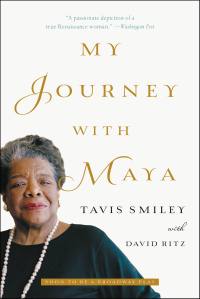
When Maya Angelou and Tavis Smiley met in 1986, he was twenty-one and she was fifty-eight. For the next twenty-eight years, they shared an unlikely, special bond. Angelou was a teacher and a maternal figure to Smiley, and they talked often, of art, politics, history, race, religion, music, love, purpose, and — more than anything — courage. Courage to be open, to follow dreams, to believe in oneself.
In My Journey with Maya, Smiley recalls a joyful friendship filled to the brim with sparkling conversation — in Angelou’s gardens surrounded by her caged birds, before lectures, sharing meals, and on breaks from it all, they sought each other out for comfort, advice, and above all else, friendship.
It began when he, a recent college graduate and a poor kid from a big family in the Midwest, was invited to join the revered writer on a sojourn to Africa. He would be handling her bags, but Maya didn’t let that stop a friendship waiting to happen. Angelou was generous, challenging, and inspirational. Like a mother to him, she was selfless.
Here Tavis Smiley shares his personal memories of Maya Angelou, of a decades-long friendship with one of history’s most fascinating women, one who left as indelible an imprint on American culture as she did on him.
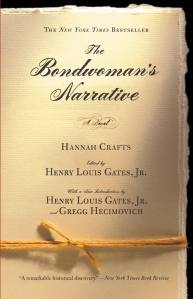
When her master is betrothed to a woman who conceals a tragic secret, Hannah Crafts, a young slave on a wealthy North Carolina plantation, runs away in a bid for her freedom up North. Pursued by slave hunters, imprisoned by a mysterious and cruel captor, held by sympathetic strangers, and forced to serve a demanding new mistress, she finally makes her way to freedom in New Jersey. Her compelling story provides a fascinating view of American life in the mid-1800s and the literary conventions of the time.
Written in the 1850's by a runaway slave,The Bondswoman's Narrative is a provocative literary landmark and a significant historical event that will captivate audiences.
Includes an updated preface adding additional context about the author's incredible life.
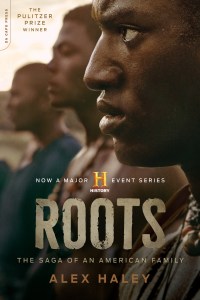
When Roots was first published forty years ago, the book electrified the nation: it received a Pulitzer Prize and was a #1 New York Times bestseller for 22 weeks. The celebrated miniseries that followed a year later was a coast-to-coast event-over 130 million Americans watched some or all of the broadcast. In the four decades since then, the story of the young African slave Kunta Kinte and his descendants has lost none of its power to enthrall and provoke.
Now, Roots once again bursts onto the national scene, and at a time when the race conversation has never been more charged. It is a book for the legions of earlier readers to revisit and for a new generation to discover.
To quote from the introduction by Michael Eric Dyson: “Alex Haley’s Roots is unquestionably one of the nation’s seminal texts. It affected events far beyond its pages and was a literary North Star…. Each generation must make up its own mind about how it will navigate the treacherous waters of our nation’s racial sin. And each generation must overcome our social ills through greater knowledge and decisive action. Roots is a stirring reminder that we can achieve these goals only if we look history squarely in the face.”
The star- studded cast in this new event series includes Academy Award-winners Forest Whitaker and Anna Paquin, Laurence Fishburne, Jonathan Rhys Meyers, Derek Luke, Grammy Award-winner Tip “T.I.” Harris, and Mekhi Phifer. Questlove of The Roots is the executive music producer for the miniseries’s stirring soundtrack.
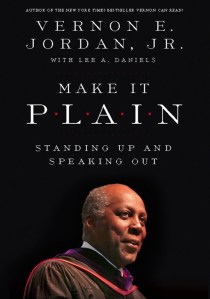
Vernon E. Jordan, Jr., one of the nation’s finest speakers, imbibed this tradition as a young man and has given it his own unique inflection from his work on the civil rights front lines, to the National Urban League, to positions of influence at the highest level of business and politics. A friend and confidant to presidents, Jordan has never forgotten the men and women — from Ruby Hurley to Wiley Branton to Gardner C. Taylor to Martin Luther King, Jr. — whose oratorical skill in service to social justice deeply influenced him. Their examples and voices, reflected in Vernon’s own, make this book both a history and an embodiment of black speech at its finest: Full of emotion, controlled force, righteous indignation, love of country, and awe in front of the God-given challenges ahead.
A Best Book of the Year: Washington Post, TIME, Los Angeles Times, and Christian Science Monitor
“A stunning look at what freedom really means.” —The New York Times
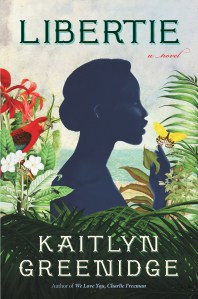
Coming of age in a free Black community in Reconstruction-era Brooklyn, Libertie Sampson is all too aware that her mother, a physician, has a vision for their future together: Libertie is to go to medical school and practice alongside her. But Libertie is hungry for something else—is there really only one way to be independent? And she is constantly reminded that, unlike her light-skinned mother, she will not be able to pass for white. When a young man from Haiti proposes to Libertie and promises a better life on the island, she accepts, only to discover that she is still subordinate to him and all men. As she tries to parse what freedom actually means for a Black woman, Libertie struggles with where she might find it—for herself and for generations to come.
Inspired by the life of one of the first Black female doctors in the United States, critically acclaimed and Whiting Award–winning author Kaitlyn Greenidge returns with an unforgettable and immersive novel that will resonate with readers eager to understand our present through a deep, moving, and lyrical dive into our past.
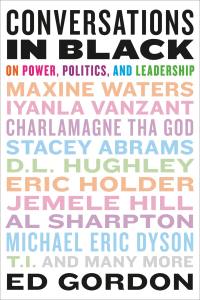
Hard-hitting, thought-provoking, and inspiring, Conversations in Black offers sage wisdom for navigating race in a radically divisive America, and, with help from his mighty team of black intelligentsia, veteran journalist Ed Gordon creates hope and a timeless new narrative on what the future of black leadership should look like and how we can get there.
In Conversations in Black, Gordon brings together some of the most prominent voices in black America today, including Stacey Abrams, Harry Belafonte, Charlamagne tha God, Michael Eric Dyson, Alicia Garza, Jemele Hill, Iyanla VanZant, Eric Holder, Killer Mike, Angela Rye, Al Sharpton, T.I., Maxine Waters, and so many more to answer questions about vital topics affecting our nation today, such as:
- Will the black vote control the 2020 election?
- Do black lives really matter?
- After the Obama presidency, are black people better off?
- Are stereotypical images of people of color changing in Hollywood?
- How is "Black Girl Magic" changing the face of black America?
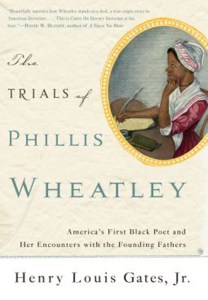
In The Trials of Phillis Wheatley, Henry Louis Gates Jr. explores the pivotal roles that Wheatley and Jefferson played in shaping the black literary tradition. Writing with all the lyricism and critical skill that place him at the forefront of American letters, Gates brings to life the characters, debates, and controversy that surrounded Wheatley in her day and ours.

Henry O’Toole sails to America in 1848 to escape the famine in Ireland, only to face anti-immigrant prejudice. Determined never to starve again, he changes his surname to Taylor and heads south to Virginia, seeking work as a traveling blacksmith on the prosperous plantations.
Torn from her home and sold to Jubilee Plantation, Sarah must navigate its intricate hierarchy. And now an enigmatic blacksmith is promising her not just the world but also her freedom. How could she say no?
Enslaved at Jubilee Plantation, Maple is desperate to return to her husband and daughter. With Sarah’s arrival, she sees her chance to be reunited at last with her family—but at what cost?
“I’m in trouble, Paris.” Paris Minton has heard these words before. They mean only one thing: that his neck is on the line too. So when they are uttered by his lowlife cousin Ulysses S. Grant, Paris keeps the door firmly closed. With family like Ulysses — useless to everyone except his mother — who needs enemies?
But trouble always finds an open window, and when “Useless” Ulysses’ mother, Three Hearts, shows up from Louisiana to look for her son, Paris has no choice but to track down his wayward cousin. Finding a con artist like Useless is easier said than done. But with the aid of his ear-to-the-ground friend Fearless Jones, Paris gets a hint that Useless may have expanded his range of enterprise to include blackmail.
Now he has disappeared, and Paris’s mission is to discover whether he is hiding from his vengeful victims — or already dead. Traversing the complicated landscape of 1950s Los Angeles, where a wrong look can get a black man killed, Paris and Fearless find desperate women, secret lives, and more than one dead body along the way.
Fear of the Dark is filled with the sheer-nerve plotting and brilliant characterizations that prompted The Nation to credit Walter Mosley for “the finest detective oeuvre in American literature.”
The remarkable emotional energy with which the Coatses wage their daily battles-as they negotiate with their former owner, as they assist escaped slaves en route to freedom, as they prepare for the encroaching war, and as they strive to love each other enough-is what propels Stand the Storm and makes the novel’s tragic denouement so devastating.

For a century Harlem has been celebrated as the capital of black America, a thriving center of cultural achievement and political action. As gentrification encroaches, Sharifa Rhodes-Pitts untangles the myth and meaning of Harlem's legacy. Examining the epic Harlem of official history and the personal Harlem that begins at her front door, Rhodes-Pitts introduces us to a wide variety of characters, past and present. At the heart of their stories, and her own, is the hope carried over many generations, hope that Harlem would be the ground from which blacks fully entered America's democracy.
Rhodes-Pitts is a brilliant new voice who, like other significant chroniclers of places — Joan Didion on California, or Jamaica Kincaid on Antigua — captures the very essence of her subject.
"No geographic or racial qualification guarantees a writer her subject . . . Only interest, knowledge, and love will do that — all of which this book displays in abundance." — Zadie Smith, Harper's
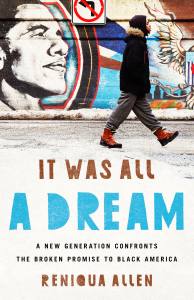
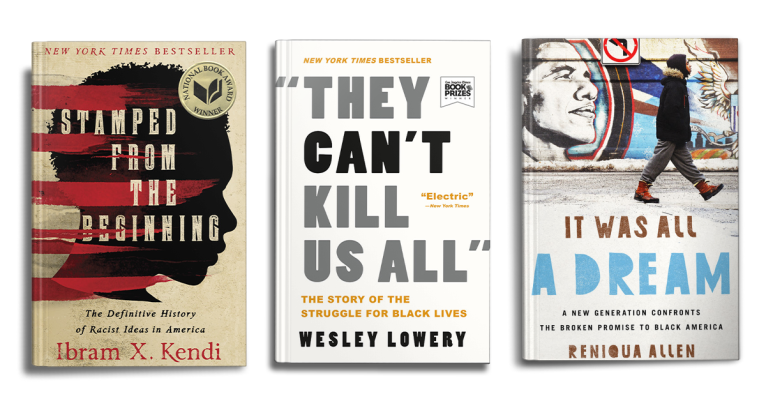
Young Black Americans have been trying to realize the promise of the American Dream for centuries and coping with the reality of its limitations for just as long. Now, a new generation is pursuing success, happiness, and freedom — on their own terms.
In It Was All a Dream, Reniqua Allen tells the stories of Black millennials searching for a better future in spite of racist policies that have closed off traditional versions of success. Many watched their parents and grandparents play by the rules, only to sink deeper and deeper into debt. They witnessed their elders fight to escape cycles of oppression for more promising prospects, largely to no avail. Today, in this post-Obama era, they face a critical turning point.
Interweaving her own experience with those of young Black Americans in cities and towns from New York to Los Angeles and Bluefield, West Virginia to Chicago, Allen shares surprising stories of hope and ingenuity. Instead of accepting downward mobility, Black millennials are flipping the script and rejecting White America’s standards. Whether it means moving away from cities and heading South, hustling in the entertainment industry, challenging ideas about gender and sexuality, or building activist networks, they are determined to forge their own path.
Compassionate and deeply reported, It Was All a Dream is a celebration of a generation’s doggedness against all odds, as they fight for a country in which their dreams can become a reality.
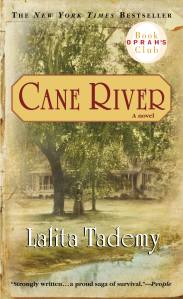
Beginning with her great-great-great-great grandmother, a slave owned by a Creole family, Lalita Tademy chronicles four generations of strong, determined black women as they battle injustice to unite their family and forge success on their own terms. They are women whose lives begin in slavery, who weather the Civil War, and who grapple with contradictions of emancipation, Jim Crow, and the pre-Civil Rights South. As she peels back layers of racial and cultural attitudes, Tademy paints a remarkable picture of rural Louisiana and the resilient spirit of one unforgettable family.
There is Elisabeth, who bears both a proud legacy and the yoke of bondage… her youngest daughter, Suzette, who is the first to discover the promise-and heartbreak-of freedom… Suzette’s strong-willed daughter Philomene, who uses a determination born of tragedy to reunite her family and gain unheard-of economic independence… and Emily, Philomene’s spirited daughter, who fights to secure her children’s just due and preserve their dignity and future.
Meticulously researched and beautifully written, Cane River presents a slice of American history never before seen in such piercing and personal detail.
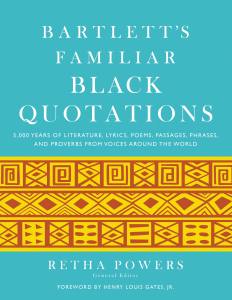
Bartlett’s Familiar Black Quotations paints a rich canvas of Black history through time. Five thousand quotes are culled from the time of Ancient Egypt through American slavery, Jim Crow, the Civil Rights Era, Apartheid, to the present day. With a foreword by Henry Louis Gates, Jr. and passages from authors, artists, scientists, philosophers, theologians, activists, politicians, and many others, Bartlett’s Familiar Black Quotations will appeal not only to quote aficionados and researchers, but also to history buffs. Aesop’s Fables and the Holy Bible are in the same company as Nelson Mandela and President Obama; Maya Angelou and Toni Morrison; Bob Marley and Jay-Z.
A wonderful reference tool and gift, Bartlett’s Familiar Black Quotations is sure to follow in the footsteps of Bartlett’s Familiar Quotations, becoming a beloved authority.
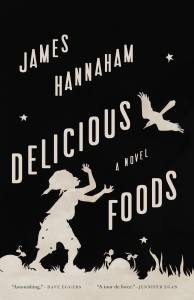
Darlene, once an exemplary wife and a loving mother to her young son, Eddie, finds herself devastated by the unforeseen death of her husband. Unable to cope with her grief, she turns to drugs, and quickly forms an addiction. One day she disappears without a trace.
Unbeknownst to eleven-year-old Eddie, now left behind in a panic-stricken search for her, Darlene has been lured away with false promises of a good job and a rosy life. A shady company named Delicious Foods shuttles her to a remote farm, where she is held captive, performing hard labor in the fields to pay off the supposed debt for her food, lodging, and the constant stream of drugs the farm provides to her and the other unfortunates imprisoned there.
In Delicious Foods, James Hannaham tells the gripping story of three unforgettable characters: a mother, her son, and the drug that threatens to destroy them. Through Darlene’s haunted struggle to reunite with Eddie, through the efforts of both to triumph over those who would enslave them, and through the irreverent and mischievous voice of the drug that narrates Darlene’s travails, Hannaham’s daring and shape-shifting prose infuses this harrowing experience with grace and humor.
The desperate circumstances that test the unshakeable bond between this mother and son unfold into myth, and Hannaham’s treatment of their ordeal spills over with compassion. Along the way we experience a tale at once contemporary and historical that wrestles with timeless questions of love and freedom, forgiveness and redemption, tenacity and the will to survive.