June Staff Book Report: Gabrielle Leporati
Each month we ask our staff to share their latest reading recommendations and give us a sneak peek into their reading habits by answering your favorite bookish questions. In June, we hear from Gabrielle Leporati, Publicist, Little Brown and Company. Read ahead for Gabrielle’s trusted reading recommendations, the book at the top of her TBR and more.

Gabrielle Leporati, Publicist, Little Brown and Company
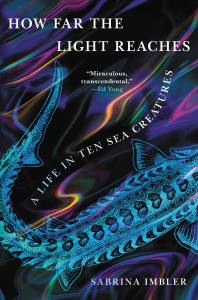
A fascinating tour of creatures from the surface to the deepest ocean floor: this “miraculous, transcendental book” invites us to envision wilder, grander, and more abundant possibilities for the way we live (Ed Yong, author of An Immense World).
A queer, mixed race writer working in a largely white, male field, science and conservation journalist Sabrina Imbler has always been drawn to the mystery of life in the sea, and particularly to creatures living in hostile or remote environments. Each essay in their debut collection profiles one such creature, including:
·the mother octopus who starves herself while watching over her eggs,
·the Chinese sturgeon whose migration route has been decimated by pollution and dams,
·the bizarre, predatory Bobbitt worm (named after Lorena),
·the common goldfish that flourishes in the wild,
·and more.
Imbler discovers that some of the most radical models of family, community, and care can be found in the sea, from gelatinous chains that are both individual organisms and colonies of clones to deep-sea crabs that have no need for the sun, nourished instead by the chemicals and heat throbbing from the core of the Earth. Exploring themes of adaptation, survival, sexuality, and care, and weaving the wonders of marine biology with stories of their own family, relationships, and coming of age, How Far the Light Reaches is a shimmering, otherworldly debut that attunes us to new visions of our world and its miracles.
WINNER OF THE LOS ANGELES TIMES BOOK PRIZE in SCIENCE & TECHNOLOGY
Finalist for the Lambda Literary Award One of TIME’s 10 Best Nonfiction Books of the Year • A PEOPLE Best New Book • A Barnes & Noble and SHELF AWARENESS Best Book of 2022 • An Indie Next Pick • One of Winter’s Most Eagerly Anticipated Books: VANITY FAIR, VULTURE, BOOKRIOT
In a few words, this book connects sea creatures, marginalized communities, and the queer experience together in beautifully moving essays. I simply love everything about it and I will follow Sabrina into battle, no questions asked.
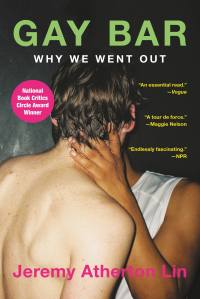
National Book Critics Circle Award Winner
NAMED ONE OF THE BEST BOOKS OF THE YEAR BY: The New York Times * NPR * Vogue * Gay Times * Artforum *
“Gay Bar is an absolute tour de force.” –Maggie Nelson
“Atherton Lin has a five-octave, Mariah Carey-esque range for discussing gay sex.” –New York Times Book Review
As gay bars continue to close at an alarming rate, a writer looks back to find out what’s being lost in this intimate, stylish, and indispensible celebration of queer history.
Strobing lights and dark rooms; throbbing house and drag queens on counters; first kisses, last call: the gay bar has long been a place of solidarity and sexual expression—whatever your scene, whoever you’re seeking. But in urban centers around the world, they are closing, a cultural demolition that has Jeremy Atherton Lin wondering: What was the gay bar? How have they shaped him? And could this spell the end of gay identity as we know it?
In Gay Bar, the author embarks upon a transatlantic tour of the hangouts that marked his life, with each club, pub, and dive revealing itself to be a palimpsest of queer history. In prose as exuberant as a hit of poppers and dazzling as a disco ball, he time-travels from Hollywood nights in the 1970s to a warren of cruising tunnels built beneath London in the 1770s; from chichi bars in the aftermath of AIDS to today’s fluid queer spaces; through glory holes, into Crisco-slicked dungeons and down San Francisco alleys. He charts police raids and riots, posing and passing out—and a chance encounter one restless night that would change his life forever.
The journey that emerges is a stylish and nuanced inquiry into the connection between place and identity—a tale of liberation, but one that invites us to go beyond the simplified Stonewall mythology and enter lesser-known battlefields in the struggle to carve out a territory. Elegiac, randy, and sparkling with wry wit, Gay Bar is at once a serious critical inquiry, a love story and an epic night out to remember.
To quote the New York Times Book Review, “Atherton Lin has a high-octave, Mariah Carey-esque range for discussing gay sex.” It’s a vital celebration of queer history and I can’t recommend it enough.

A fascinating exploration of how ecosystems are sculpted and sustained by animals eating, pooping, and dying—and how these fundamental functions could help save us from climate catastrophe.
If forests are the lungs of the planet, then animals migrating across oceans, streams, and mountains—eating, pooping, and dying along the way—are its heart and arteries, pumping nitrogen and phosphorus from deep-sea gorges up to mountain peaks, from the Arctic to the Caribbean. Without this conveyor belt of crucial, life-sustaining nutrients, the world would look very different. The dynamics that shape our physical world—atmospheric chemistry, geothermal forces, plate tectonics, and erosion through wind and rain—have been explored for decades. But the effects on local ecosystems of less glamorous forces—rotting carcasses and deposited feces—as well as their impact on the global climate cycle, have been largely overlooked. The simple truth is that pooping and peeing are daily rituals for almost all animals, the ellipses of ecology that flow through life. We eat, we poop, and we die.
From the volcanoes of Iceland to the tropical waters of Hawaii, the great plains of the American heartland, and beyond, Eat, Poop, Die, “compulsively readable” (Shelby Van Pelt), takes readers on an exhilarating and enlightening global adventure, revealing the remarkable ways in which the most basic biological activities of animals make and remake the world—and how a deeper understanding of these cycles provides us with opportunities to undo the environmental damage humanity has wrought on the planet we call home.
Named a Top-Ten Best Book of 2023 by Scientific American
I know, I know, I know…you’re sold by the title alone. Joe is a comically good writer; no one should be able to describe whale poop in such an intriguing and at times (dare I say) beautiful way. It’s all about how ecosystems are sculpted and sustained by animals quite literally eating, pooping, and dying.
What is the weirdest thing you’ve used as a bookmark?
I am so sorry to report that I dogear my books! Don’t fire me!
Do you have a go-to comfort read?
Not exactly but I do find myself re-reading THE SECRET HISTORY by Donna Tartt when fall comes around. Fantasy in general is my comfort genre, or anything escapist, really.
If you owned a bookstore, what would you call it?
This question made me wish I thought of Sweet Pickle Books (where you donate books for pickles) in NYC. With food on the mind, I would simply name my bookstore “Cheesy” and it would be stocked with cheesy books and the best gouda, brie, cheddar, etc. around.
What book is at the top of your TBR right now?
The second half of BABEL by R.F. Kuang (which was gifted to me by a dear colleague – you know who you are!) and BIG SWISS by Jen Beagin.

What is your favorite book cover from the past year why?
A riveting, cathartic literary debut about love, addiction, and what it does to us.
Wouldn’t I do anything to reverse my loss, the absence of him?
In the first scene of this provocative gut-punch of a novel, our unnamed narrator meets a magnetic writer named Ciaran and falls, against her better judgment, completely in his power. After a brief, all-consuming romance he abruptly rejects her, sending her into a tailspin of jealous obsession and longing. If he ever comes back to her, she resolves to hang onto him and his love at all costs, even if it destroys her …
Part breathless confession, part lucid critique, Acts of Desperation renders a consciousness split between rebellion and submission, between escaping degradation and eroticizing it, between loving and being lovable. With unsettling, electric precision, Nolan dissects one of life’s most elusive mysteries: Why do we want what we want, and how do we want it?
Heralding the arrival of a stunning new literary talent, Acts of Desperation interrogates the nature of fantasy, desire, and power, challenging us to reckon honestly with our own insatiability.
“A blistering anti-romance.” —Catherine Lacey, author of Biography of X
“Hot as viscera.” —The New Republic
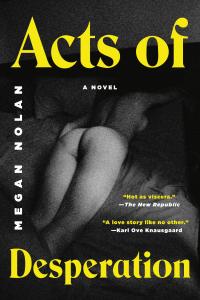
My favorite book cover from the past year is the paperback edition of ACTS OF DESPERATION by Megan Nolan. It’s just iconic. Period.