PublicAffairs & Bold Type Books – Ebook Deals – February 2024
MONTHLY DEALS
February 1, 2024 to February 29, 2024
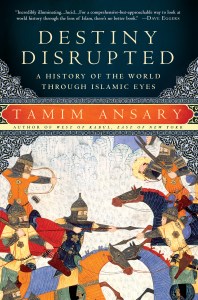
In Destiny Disrupted, Tamim Ansary tells the rich story of world history with the evolution of the Muslim community at the center. His story moves from the lifetime of Mohammed through a succession of far-flung empires, to the tangle of modern conflicts that culminated in the events of 9/11. He introduces the key people, events, ideas, legends, religious disputes, and turning points of world history, imparting not only what happened but how it is understood from the Muslim perspective.
He clarifies why two great civilizations—Western and Muslim—grew up oblivious to each other, what happened when they intersected, and how the Islamic world was affected by its slow recognition that Europe—a place it long perceived as primitive—had somehow hijacked destiny.
With storytelling brio, humor, and evenhanded sympathy to all sides of the story, Ansary illuminates a fascinating parallel to the narrative usually heard in the West. Destiny Disrupted offers a vital perspective on world conflicts many now find so puzzling.
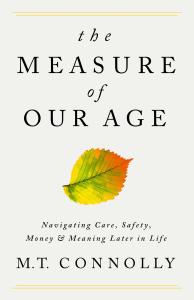
As tens of millions of Americans are living longer lives, longevity is creating challenges that cut across race, class, and gender. Caregivers help older relatives for “free,” but with high costs to themselves in time, money, jobs, and health. Scammers target countless seniors. The institutions built to protect older people—like nursing homes and guardianship—too often harm them instead. And epidemics of isolation and loneliness make older people vulnerable to all sorts of harm.
In The Measure of Our Age, elder justice expert and MacArthur “genius” grant recipient, M.T. Connolly investigates the systems we count on to protect us as we age. Weaving first-person accounts, her own experience, and shocking investigative reporting, she exposes a reality that has long been hidden and sometimes actively covered up. But her investigation also reveals reasons for hope within everyone’s grasp.
Connolly’s strategies and action plans for navigating the many challenges of aging will appeal to a wide range of readers—adult children caring for aging parents; policymakers trying to do the right thing; and, should we be so lucky as to live to old age, all of us. This book transforms how we think about aging.

Africa is the world’s poorest continent and, arguably, its richest. In The Looting Machine, Tom Burgis takes readers on a gripping journey into the world of the magnates and militiamen, the despots and jet-setting executives who gorge on Africa’s vast stocks of oil, gas, metals, and precious stones. Combining deep reporting with an action-packed narrative, Burgis presents a blistering investigation of the plunder of a continent and the terrible human toll.
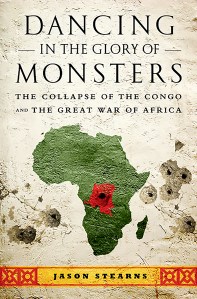
At the heart of Africa is the Congo, a country the size of Western Europe, bordering nine other nations, that since 1996 has been wracked by a brutal war in which millions have died. In Dancing in the Glory of Monsters, renowned political activist and researcher Jason K. Stearns has written a compelling and deeply-reported narrative of how Congo became a failed state that collapsed into a war of retaliatory massacres. Stearns brilliantly describes the key perpetrators, many of whom he met personally, and highlights the nature of the political system that brought these people to power, as well as the moral decisions with which the war confronted them. Now updated with a new introduction, Dancing in the Glory of Monsters tells the full story of Africa's Great War.
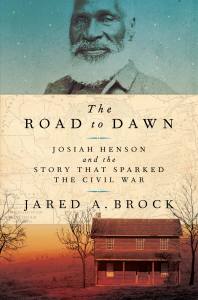
-He rescued 118 enslaved people
-He won a medal at the first World’s Fair in London
-Queen Victoria invited him to Windsor Castle
-Rutherford B. Hayes entertained him at the White House
-He helped start a freeman settlement, called Dawn, that was known as one of the final stops on the Underground Railroad
-He was immortalized in Harriet Beecher Stowe’s Uncle Tom’s Cabin, the novel that Abraham Lincoln jokingly blamed for sparking the Civil War
But before all this, Josiah Henson was brutally enslaved for more than forty years.
Author-filmmaker Jared A. Brock retraces Henson’s 3,000+ mile journey from slavery to freedom and re-introduces the world to a forgotten figure of the Civil War era, along with his accompanying documentary narrated by Hollywood actor Danny Glover.
The Road to Dawn is a ground-breaking biography lauded by leaders at the NAACP, the Smithsonian, senators, authors, professors, the President of Mauritius, and the 21st Prime Minister of Canada, and will no doubt restore a hero of the abolitionist movement to his rightful place in history.
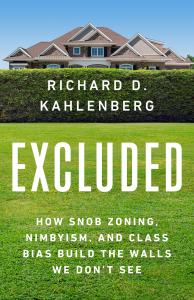
The last, acceptable form of prejudice in America is based on class and executed through state-sponsored economic discrimination, which is hard to see because it is much more subtle than raw racism.
While the American meritocracy officially denounces prejudice based on race and gender, it has spawned a new form of bias against those with less education and income. Millions of working-class Americans have their opportunity blocked by exclusionary snob zoning. These government policies make housing unaffordable, frustrate the goals of the civil rights movement, and lock in inequality in our urban and suburban landscapes.
Through moving accounts of families excluded from economic and social opportunity as they are hemmed in through “new redlining” that limits the type of housing that can be built, Richard Kahlenberg vividly illustrates why America has a housing crisis. He also illustrates why economic segregation matters since where you live affects access to transportation, employment opportunities, decent health care, and good schools. He shows that housing choice has been socially engineered to the benefit of the affluent, and, that astonishingly the most restrictive zoning is found in politically liberal cities where racial views are more progressive.
Despite this there is hope. Kahlenberg tells the inspiring stories of growing number of local and national movements working to tear down the walls that inflicts so much damage on the lives of millions of Americans.

“A moving, beautifully written account, by turns raw and tender.” —Los Angeles Times
A Washington Post Best Book of the Year
Between 1987 and 1989, Alepho, Benjamin, and Benson, like tens of thousands of young boys, took flight from the massacres of Sudan's civil war. They became known as the Lost Boys. With little more than the clothes on their backs, sometimes not even that, they streamed out over Sudan in search of refuge. Their journey led them first to Ethiopia and then, driven back into Sudan, toward Kenya. They walked nearly one thousand miles, sustained only by the sheer will to live.
They Poured Fire on Us From the Sky is the three boys' account of that unimaginable journey. With the candor and the purity of their child's-eye-vision, Alephonsion, Benjamin, and Benson recall by turns: how they endured the hunger and strength-sapping illnesses-dysentery, malaria, and yellow fever; how they dodged the life-threatening predators-lions, snakes, crocodiles and soldiers alike-that dogged their footsteps; and how they grappled with a war that threatened continually to overwhelm them. Their story is a lyrical, captivating, timeless portrait of a childhood hurled into wartime and how they had the good fortune and belief in themselves to survive.
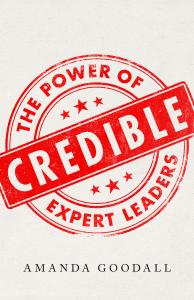
Amanda Goodall has spent a decade researching what makes organizations tick, everywhere from the business world to hospitals and healthcare systems, football and basketball teams, and Formula 1 organizations. By debunking the cult of managerialism (the notion that smart people can run anything and the emphasis on leadership personality), Goodall reshapes our understanding of bosses and the traits necessary for organizational success. She identifies the key characteristics of expert leaders and provides a real and grossly underappreciated model for career success: "go deep into a business, work hard, pay attention, and know your stuff." Those who run hospitals and healthcare systems, for example, should be physicians with deep clinical expertise, not financiers or people parachuted in from other industries. Those who run school systems and universities need to understand from experience the stress of balancing teaching, research, and student welfare
Credible demonstrates categorically that expertise matters more than ever and that we need our leaders to be experts with a deep, understanding of their organizations from many years spent learning the business and working their way up the ladder. The people who work for them are happier because they feel better understood and the organizations they lead are more successful.
WEEKLY DEALS
February 5, 2024 to February 11, 2024
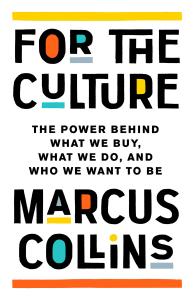
The architect of some of the most famous ad campaigns of the last decade marshals his expertise and “elegantly friendly writing style” (The Wall Street Journal) to reveal how our perspective is influenced by culture
In For the Culture, Marcus Collins argues that true cultural engagement is the most powerful vehicle for influencing behavior. If you want to get people to move, you must first understand the underlying cultural forces that make them tick.
Collins uses stories from his own work as an award-winning marketer—from spearheading digital strategy for Beyoncé, to working on Apple and Nike collaborations, to the successful launch of the Brooklyn Nets NBA team—to break down the ways in which culture influences behavior and how readers can do the same. With a deep perspective built on a century’s worth of data, For the Culture gives readers the tools they need to inspire collective change by leveraging the cheat codes used by some of the biggest brands in the world.
DAILY DEALS
February 1, 2024
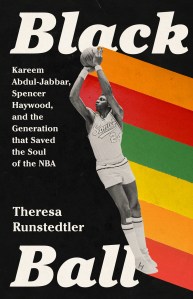
A vital narrative history of 1970s pro basketball, and the Black players who shaped the NBA
Against a backdrop of ongoing resistance to racial desegregation and strident calls for Black Power, the NBA in the 1970s embodied the nation’s imagined descent into disorder. A new generation of Black players entered the league, among them Kareem Abdul-Jabbar and Spencer Haywood, and the press and public were quick to blame this cohort for the supposed decline of pro-basketball, citing drugs, violence, and greed. Basketball became a symbol for post–civil rights America: the rules had changed, allowing more Black people onto the playing field, and now they were ruining everything.
Enter Black Ball, a gripping corrective in which scholar Theresa Runstedtler expertly rewrites basketball’s “Dark Ages.” Weaving together a deep knowledge of the game with incisive social analysis, Runstedtler argues that this much-maligned period was pivotal to the rise of the modern-day NBA.
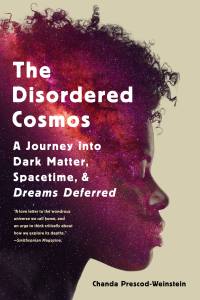
From a star theoretical physicist, “a love letter to the wonderous universe we call home, and an urge to think critically about how we explore its depths” (Smithsonian Magazine)
In The Disordered Cosmos, Dr. Chanda Prescod-Weinstein shares her love for physics, from the Standard Model of Particle Physics and what lies beyond it, to the physics of melanin in skin, to the latest theories of dark matter—all with a new spin informed by history, politics, and the wisdom of Star Trek.
One of the leading physicists of her generation, Prescod-Weinstein is also one of the first one hundred Black American women to earn a PhD from a department of physics. Her vision of the cosmos is vibrant, buoyantly nontraditional, and grounded in Black feminist traditions.
February 11, 2024
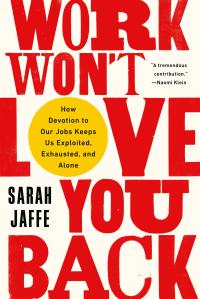
You're told that if you "do what you love, you'll never work a day in your life."
In Work Won't Love You Back, Sarah Jaffe, a preeminent voice on labor, inequality, and social movements, examines this "labor of love" myth—the idea that certain work is not really work, and therefore should be done out of passion instead of pay. Told through the lives and experiences of workers in various industries, Jaffe reveals how all of us have been tricked into buying into a new tyranny of work. Once freed from those binds, we can finally figure out what actually gives us joy, pleasure, and satisfaction.
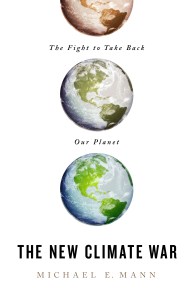
A renowned climate scientist shows how fossil fuel companies have waged a thirty-year campaign to deflect blame and responsibility and delay action on climate change, and offers a battle plan for how we can save the planet.
Recycle. Fly less. Eat less meat. These are some of the ways that we've been told can slow climate change. But the inordinate emphasis on individual behavior is the result of a marketing campaign that has succeeded in placing the responsibility for fixing climate change squarely on the shoulders of individuals.
Fossil fuel companies have followed the example of other industries deflecting blame (think "guns don't kill people, people kill people") or greenwashing (think of the beverage industry's "Crying Indian" commercials of the 1970s). Meanwhile, they've blocked efforts to regulate or price carbon emissions, run PR campaigns aimed at discrediting viable alternatives, and have abdicated their responsibility in fixing the problem they've created. The result has been disastrous for our planet.
In The New Climate War, Mann argues that all is not lost. He draws the battle lines between the people and the polluters-fossil fuel companies, right-wing plutocrats, and petrostates. And he outlines a plan for forcing our governments and corporations to wake up and make real change, including:
- A common-sense, attainable approach to carbon pricing- and a revision of the well-intentioned but flawed currently proposed version of the Green New Deal;
- Allowing renewable energy to compete fairly against fossil fuels
- Debunking the false narratives and arguments that have worked their way into the climate debate and driven a wedge between even those who support climate change solutions
- Combatting climate doomism and despair-mongering
February 18, 2024
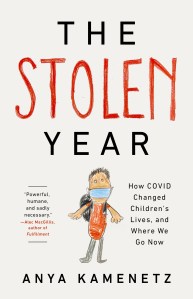
The onset of COVID broke a 150-year social contract between America and its children. Tens of millions of students lost what little support they had from the government—not just school but food, heat, and physical and emotional safety. The cost was enormous.
But this crisis began much earlier than 2020. In The Stolen Year, Anya Kamenetz exposes a long-running indifference to the plight of children and families in American life and calls for a reckoning.
She follows families across the country as they live through the pandemic, facing loss and resilience: a boy with autism in San Francisco who gains a foster brother and a Hispanic family in Texas that loses a member to COVID, and finds solace when they need it most. Kamenetz also recounts the history that brought us to this point: how we thrust children and caregivers into poverty, how we over-police families of color, how we rely on mothers instead of infrastructure. And how our government, in failing to support our children through this tumultuous time, has stolen years of their lives.