
Six Books to Read for Short Story Month

May is Short Story Month: celebrate with a selection of fiction collections to sample.
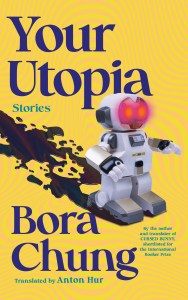
Bora Chung’s inimitable blend of horror, absurdity, and dark humor reaches its peak in these tales of loss and discovery, dystopia and idealism, death and immortality. In a thrilling translation by the acclaimed Anton Hur, readers will experience a variety of possible fates for humanity, from total demise via a disease whose only symptom is casual cannibalism to a world in which even dreams can be monitored and used to convict people of crimes.
In “The Center for Immortality Research,” a low-level employee runs herself ragged planning a fancy gala for donors only to be blamed for the chaos that ensues during the event in front of the mysterious celebrity benefactors hoping to live forever. In “A Song for Sleep,” an AI elevator in an apartment complex develops a tender, one-sided love for an elderly resident. “Seed” traverses the final frontier of capitalism’s destruction of the planet—but nature always creeps back to life.
If you haven’t yet experienced the fruits of Chung’s singular imagination, Your Utopia is waiting.
One of TIME Magazine’s 100 Must-Read Books of 2024, and Kirkus Reviews’ Best Fiction of 2024
“Chung builds out her stories with imagination, absurdity and a dry sense of humor, all applied with X-Acto knife precision.” ―Alexandra Kleeman, The New York Times Book Review
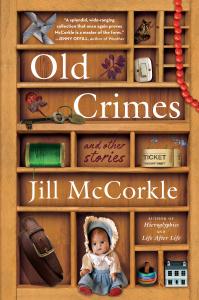
From a New York Times bestselling author (“One of our wisest storytellers”), a story collection that is funny and tragic in equal measure, about crimes large and small (Rebecca Makkai, author of The Great Believers).
Beloved author Jill McCorkle offers an intimate look at the moments when a person’s life changes forever. A woman uses her hearing impairment as a way to guard herself from her husband’s commentary. A telephone lineman strains to communicate with his family even as he feels pushed aside in a digital world. And a young couple buys a confessional booth for fun, only to discover the cost of honesty.
Moving and unforgettable, the stories in Old Crimes capture moments of great intensity, longing, and affection.
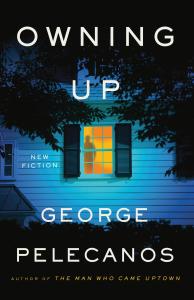
When the son of the Carusos is involved in a hold up, the family home comes under siege in the form of a no-knock warrant. Months after the cops destroyed their home, the Carusos struggle to return to normal. Elsewhere, two former inmates reunite by chance on the set of a TV production. Both have found their way on the straight and narrow path, that is, until one sees the potential for an easy grift. A teenage boy must step into the man he’d like to be as a hostage crisis grips his hometown. A woman adrift meets a man tied to her grandmother’s past, an encounter that awakens her to a bloody history that undergirds the place she grew up.
Pelecanos’ portraits are characterized by shades of grey, resisting the mold of heroes and villains, victims and perpetrators, good and evil. At once streetwise and full of heart, Owning Up grapples with random chance, the bind of consequence, and the forked paths a life can take.
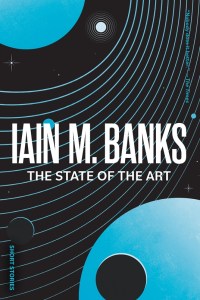
“Banks is a phenomenon…writing pure science fiction of a peculiarly gnarly energy and elegance.” –William Gibson
This is a striking addition to the body of Culture lore, and adds definition and scale to the previous works by using the Earth of 1977 as contrast. The stories in the collection range from science fiction to horror, dark-coated fantasy to morality tale. All bear the indefinable stamp of Iain Banks’s staggering talent.
“Few of us have been exposed to a talent so manifest and of such extraordinary breadth.” –New York Review of Science Fiction
“[Banks] can summon up sense-of-wonder Big Concepts you’ve never seen before and display them with narration as deft as a conjuror’s fingers.” –scifi.com
The Culture series:
Consider Phlebas
The Player of Games
Use of Weapons
The State of the Art
Excession
Inversions
Look to Windward
Matter
Surface Detail
The Hydrogen Sonata
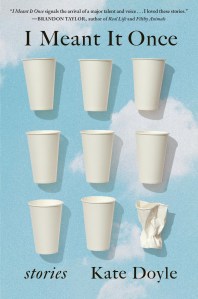
With this sharp and witty debut collection, author Kate Doyle captures precisely that time of life when so many young women are caught in between, pre-occupied by nostalgia for past relationships—with friends, roommates, siblings—while trying to move forward into an uncertain future. In “That Is Shocking,” a college student relates a darkly funny story of romantic humiliation, one that skirts the parallel story of a friend she betrayed. In others, young women long for friends who have moved away, or moved on. In “Cinnamon Baseball Coyote” and other linked stories about siblings Helen, Evan, and Grace, their years of inside jokes and brutal tensions simmer over as the three spend a holiday season in an amusing whirl of rivalry and mutual attachment, and a generational gulf widens between them and their parents. Throughout, in stories both lyrical and haunting, young women search for ways to break free from the expectations of others and find a way to be in the world.
Written with crystalline prose and sly humor, the stories in I Meant It Once build to complete a profoundly recognizable portrait of early adulthood and the ways in which seemingly incidental moments can come to define the stories we tell ourselves. For fans of Elif Batuman, Ottessa Moshfegh, Patricia Lockwood, and Melissa Bank, these stories about being young and adrift in today’s world go down easy and pack a big punch.
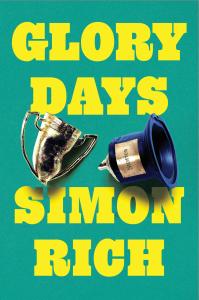
Simon Rich returns with a batch of can’t-miss stories in which Super Mario turns forty and is forced to “take-a stock” of his life and how “messed up it’s-a become.” Goliath struggles to control the media narrative in the lead-up to his death match against David, a small, beloved child. And a long-discarded participation trophy reminisces about the glorious field day in 1993, when he wound up in the arms of a jubilant, asthmatic Simon Rich.
High-stakes and heartfelt, Glory Days mourns the death of youthful innocence and hails the beginning of something approximating wisdom.