Out of This World Reads:4 Books to Explore Outer Space

Explore physics, the cosmos, and more in these four books that dig into the fundamental forces that shape our universe. From particle physics to the way music links into the structure of our universe, these books are sure to fascinate any reader interested in science and outer space.

From a star theoretical physicist, “a love letter to the wonderous universe we call home, and an urge to think critically about how we explore its depths” (Smithsonian Magazine)
In The Disordered Cosmos, Dr. Chanda Prescod-Weinstein shares her love for physics, from the Standard Model of Particle Physics and what lies beyond it, to the physics of melanin in skin, to the latest theories of dark matter—all with a new spin informed by history, politics, and the wisdom of Star Trek.
One of the leading physicists of her generation, Prescod-Weinstein is also one of the first one hundred Black American women to earn a PhD from a department of physics. Her vision of the cosmos is vibrant, buoyantly nontraditional, and grounded in Black feminist traditions.
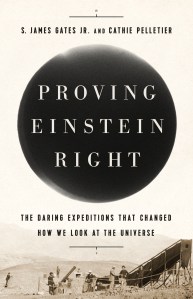
In 1911, a relatively unknown physicist named Albert Einstein published his preliminary theory of gravity. But it hadn't been tested. To do that, he needed a photograph of starlight as it passed the sun during a total solar eclipse. So began a nearly decade-long quest by seven determined astronomers from observatories in four countries, who traveled the world during five eclipses to capture the elusive sight. Over the years, they faced thunderstorms, the ravages of a world war, lost equipment, and local superstitions. Finally, in May of 1919, British expeditions to northern Brazil and the island of Príncipe managed to photograph the stars, confirming Einstein's theory.
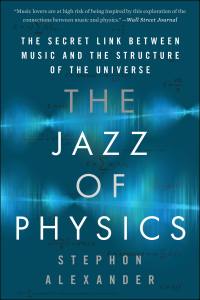
“I’ll forever be grateful to musician/physicist Stephon Alexander… He’ll help you see how our awe-inspiring universe is on a never-ending, cosmological riff.”
―Felix Contreras, NPR
More than fifty years ago, John Coltrane drew the twelve musical notes in a circle and connected them by straight lines, forming a five-pointed star. Inspired by Einstein, Coltrane put physics and geometry at the core of his music.
Physicist and jazz musician Stephon Alexander follows suit, using jazz to answer physics’ most vexing questions about the past and future of the universe. Following the great minds that first drew the links between music and physics – a list including Pythagoras, Kepler, Newton, Einstein, and Rakim – The Jazz of Physics reveals that the ancient poetic idea of the Music of the Spheres, taken seriously, clarifies confounding issues in physics.
The Jazz of Physics will fascinate and inspire anyone interested in the mysteries of our universe, music, and life itself.
Years ago, cosmologist Stephon Alexander received life-changing advice: to discover real physics, he needed to stop memorizing and start taking risks. In Fear of a Black Universe, Alexander shows that great physics requires us to think outside the mainstream—to improvise and rely on intuition. His approach leads him to three principles that shape all theories of the universe: the principle of invariance, the quantum principle, and the principle of emergence.
Alexander uses these principles to explore some of physics' greatest mysteries, from what happened before the Big Bang to how the universe makes consciousness possible. Drawing on his experience as a Black physicist, he makes a powerful case for diversifying our scientific communities.
Compelling and empowering, Fear of a Black Universe offers remarkable insight into the art of physics.
"The rabbit hole gets wrestled here. An old school saying applies: the more you know, the more you don’t know. Dance along this read into the unknown and find out that this book may be the best ever answer to ‘What is soul?'" —Chuck D, rapper and co-founder of Public Enemy
★ Starred reviews from Kirkus and Publishers Weekly!
Named a Best Book of 2021 by Library Journal, Kirkus Reviews, and Symmetry Magazine