
Celebrating America 250: 4th of July Reads
In honor of America’s 250th, this list brings together novels that capture the sweep, struggle, humor, and heart of the American experience. From classic voices to contemporary storytellers, these books explore the people, places, and experiences of our country.
A New York Times bestseller from the world’s #1 bestselling author: They’re ex-Special Forces. They’re on American soil. Their code name is “Rocket’s Red Glare.”
“A military thriller that captures the best of American heroism. There’s courage and nonstop action on every page. Nat Phillips is the hero we need.” —Bret Baier
“Rocket’s Red Glare brings the heat! James Patterson and Matt Eversmann combine forces to create unforgettable characters and plot, with breakneck pacing that will keep you riveted through the night! This one is a banger!” —Jack Carr, #1 New York Times bestselling author of The Fourth Option
Nat Phillips leads an elite roster of special operators. They are ex-Special Forces, communications specialists, and intelligence officers. Phillips is a brilliant strategist and battle-tested leader who inspires total loyalty in his team. Now these decorated veterans of international warfare are at home and on stand-by—until a presidential campaign is interrupted by murder.
Suddenly, the plan is no longer the stuff of Mission: Impossible. Emergency operations happening not overseas but in the centers of American power, from Nantucket to Washington, DC. This national crisis is real.
A National Book Award winner
The New York Times bestselling history of how racist ideas were created, spread, and deeply rooted in American society.
“An engrossing and relentless intellectual history of prejudice in America.” –Washington Post
Some Americans insist that we’re living in a post-racial society. But racist thought is not just alive and well in America—it is more sophisticated and more insidious than ever. In this deeply researched and fast-moving narrative, Kendi chronicles the entire story of anti-Black racist ideas and their staggering power over the course of American history. As Kendi shows, racist ideas did not arise from ignorance or hatred. They were created to justify and rationalize deeply entrenched racist policies and the nation’s racial inequities.
In shedding light on this history, Stamped from the Beginning offers us the tools we need to expose racist thinking and, in the process, gives us reason to hope.
On June 4, 1984, Columbia Records issued what would become one of the best-selling and most impactful rock albums of all time. An instant classic, Bruce Springsteen’s Born in the U.S.A. would prove itself to be a landmark not only for the man who made it, but rock music in general and even the larger American culture over the next 40 years.
In There Was Nothing You Could Do, veteran rock critic Steven Hyden shows exactly how this record became such a pivotal part of the American tapestry. Alternating between insightful criticism, meticulous journalism, and personal anecdotes, Hyden delves into the songs that made—and didn’t make—the final cut, including the tracks that wound up on its sister album, 1982’s Nebraska. He also investigates the myriad reasons why Springsteen ran from and then embraced the success of his most popular (and most misunderstood) LP, as he carefully toed the line between balancing his commercial ambitions and being co-opted by the machine.
But the book doesn’t stop there. Beyond Springsteen’s own career, Hyden explores the role the album played in a greater historical context, documenting not just where the country was in the tumultuous aftermath of Vietnam and Watergate, but offering a dream of what it might become—and a perceptive forecast of what it turned into decades later. As Springsteen himself reluctantly conceded, many of the working-class middle American progressives Springsteen wrote about in 1984 had turned into resentful and scorned Trump voters by the 2010s. And though it wasn’t the future he dreamed of, the cautionary warnings tucked within Springsteen’s heartfelt lyrics prove that the chaotic turmoil of our current moment has been a long time coming.
How did we lose Springsteen’s heartland? And what can listening to this prescient album teach us about the decline of our country? In There Was Nothing You Could Do, Hyden takes readers on a journey to find out.

Few symbols hold the gravity and inspiration of the American flag. It has encouraged heroics in trying times, soothed the nation after tremendous trauma, brightened the eyes of citizens, and offers comfort and hope.
Beginning with the flag’s earliest incarnation, a banner of alternating red and white stripes that hung on Boston’s Liberty Tree years before there was a United States, Old Glory tells an intertwined story of fifty flags and fifty milestone moments that, woven together, create a unique portrait of the nation’s history and the flag that represents it.
There’s the Betsy Ross flag, of course. The country’s first official ensign, its arrangement of stars and stripes became the template for flags to follow, though the story of how it came about may be more legend than fact. There’s the massive garrison flag that flew over Fort McHenry during the War of 1812 and inspired what would soon be known as “The Star- Spangled Banner.” How massive? Each star was two feet in diameter.
Again and again, we explore the symbiosis of the flag and history: The flag that cradled the dying Lincoln. A suffragette flag with just four stars, representing the first four states that gave women the power to vote. The flag that the crew of Apollo 11 planted on the moon. The flag raised at Ground Zero. And flags in pop culture, from Wonder Woman’s costume to Jasper Johns’s breakthrough paintings to the flag’s use as a motif throughout Easy Rider.
For over 250 years the flag has stood as a symbol of democracy and freedom, a way to express America’s ideals, an image to rally around. These fifty profiles of flags through history are one more way to understand and celebrate the grand and complicated experiment that is the United States.
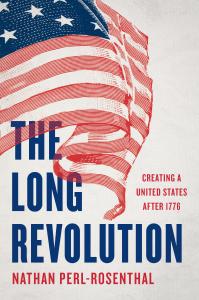
For America 250, a provocative argument that a “Long Revolution” formed the violently beating heart of American politics for decades after 1776.
“Nathan Perl-Rosenthal’s delightful The Long Revolution shows how much the story of America remains unsettled—and ours to make anew.” —Garrett M. Graff, bestselling author of The Only Plane in the Sky
In the century after Independence, many Americans believed that their Revolution was still in progress. Far from a unifying national myth, the Revolution was for generations of Americans a source of radically conflicting political ideas. Nowhere was this clearer than on the Fourth of July, when Americans gathered for speeches that, as one orator put it in 1834, aimed to “examine the present, and to look forward to the future.”
In The Long Revolution, historian Nathan Perl-Rosenthal mines thousands of Independence Day orations to offer a stirring and revelatory new history of this long American Revolution. In the words of local notables and national celebrities, men and women, white and Black, he identifies the contrasting visions, intense anxieties, and radical power evoked by the Revolution deep into the nineteenth century. This is a history of the American founding for today’s fragmented and anxious political moment, helping us find a usable past to guide us toward our own uncertain future.
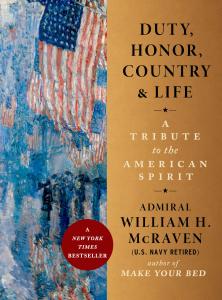
A New York Times Bestseller
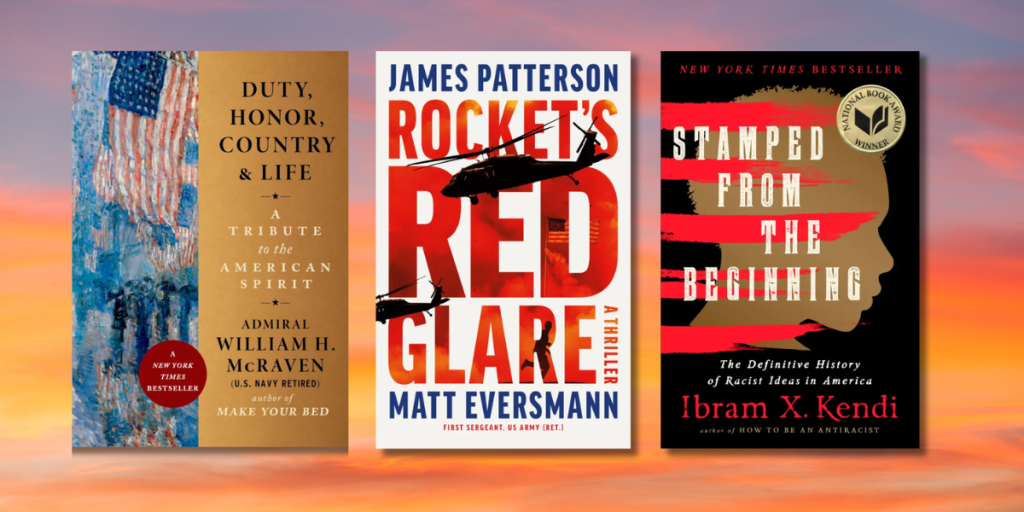
From the author of Make Your Bed, The Hero Code and The Wisdom of the Bullfrog, comes an uplifting selection of the Admiral’s speeches, letters, toasts and poems that capture the essence of who we are as Americans.
Admiral McRaven’s famous 2014 “Make Your Bed” speech at the University of Texas went viral with over 150 million views. Now, for the first time ever, comes a collection of his other speeches and writings that will inspire and motivate young and old readers alike. With his unique writing style, each speech is a story recalling acts of heroism, courage, sacrifice, and a sense of duty, honor, and country. These speeches include tributes to soldiers, Navy SEALs, law enforcement officers, doctors, public servants, Boy Scouts, graduating students, that game of football, and “Irishmen.”
Full of inspiration and wisdom, Duty, Honor, Country, and Life is a reminder to us all of our time-honored American values of civility and decency—and a reflection on what these values mean for the future of our country.
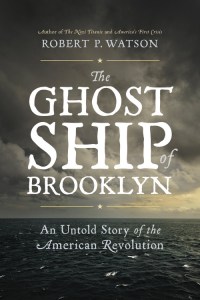
Moored off the coast of Brooklyn until the end of the war, the derelict ship, the HMS Jersey, was a living hell for thousands of Americans either captured by the British or accused of disloyalty. Crammed below deck — a shocking one thousand at a time — without light or fresh air, the prisoners were scarcely fed food and water. Disease ran rampant and human waste fouled the air as prisoners suffered mightily at the hands of brutal British and Hessian guards. Throughout the colonies, the mere mention of the ship sparked fear and loathing of British troops. It also sparked a backlash of outrage as newspapers everywhere described the horrors onboard the ghostly ship. This shocking event, much like the better-known Boston Massacre before it, ended up rallying public support for the war.
Revealing for the first time hundreds of accounts culled from old newspapers, diaries, and military reports, award-winning historian Robert P. Watson follows the lives and ordeals of the ship’s few survivors to tell the astonishing story of the cursed ship that killed thousands of Americans and yet helped secure victory in the fight for independence.