
7 Books You May Have Missed
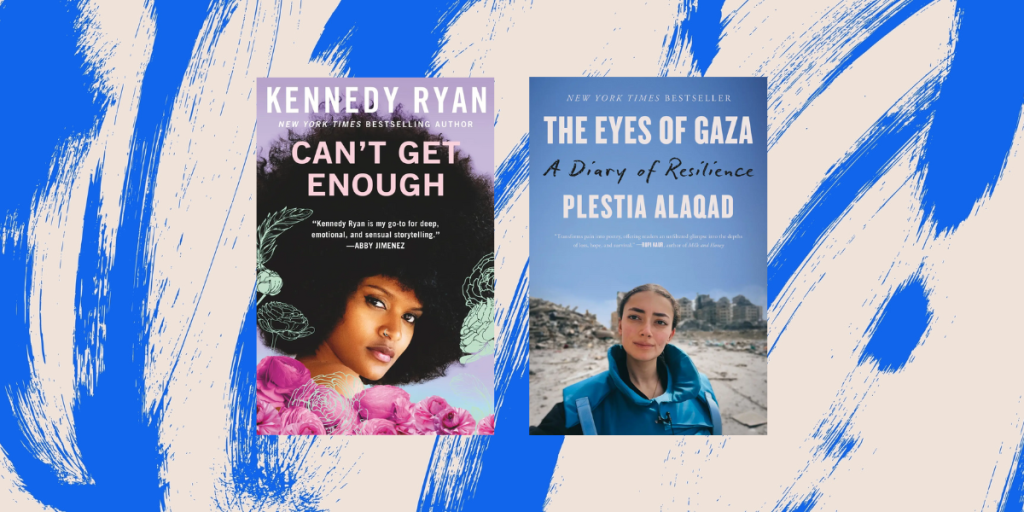
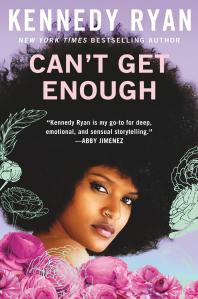
She’s a woman with goals, dreams, ambitions—always striving upward. And in the midst of everything, she’s facing her toughest challenge yet: caring for an aging parent. Who has time for romance? From her experience, there’s a low ROI on relationships. Anyway, she hasn’t met the man who can keep up with her. Until…him.
Tech mogul Maverick Bell is a dilemma wrapped in an exquisitely tailored suit and knee-melting charm. From their first charged glance at the summer’s hottest party, Hendrix feels like she’s met her match. Only he can’t be. Mav may be the first to make her feel this seen and desired, but he’s the last one she can have. Forbidden fruit is the juiciest, and this man is off limits if she plans to stay the course she’s set for herself.
But when Maverick gives chase—pursuing her, spoiling her, understanding her—is it time to let herself have something more?

In early October 2023, Palestinian Plestia Alaqad was a recent university graduate dreaming of a career as a journalist. But by the end of November, her homeland was unrecognizable—and she was broadcasting videos of violence and destruction to millions online, known across the world as “The Eyes of Gaza.”
A series of diary extracts from the weeks following October 7, The Eyes of Gaza is a gutting, on-the-ground record of the turmoil and destruction endured by the men, women, and children of Palestine. As Alaqad flees from neighborhood to neighborhood, from hospital to hospital, she documents all she sees—the destruction of beloved homes, the waves of bombs, and most of all, the boundless bravery and generosity of her people—all the while trying to memorize the faces of those around her “so somebody will have known them before the end,” wondering if, one day, her own journal will be discovered amidst the rubble.
A document of the indomitable Palestinian spirit, told through the voice of one ordinary young woman, The Eyes of Gaza is a tribute to Alaqad’s beloved Gaza, a paean to the courage and endurance of Palestine, and a manifesto of hope for its future.
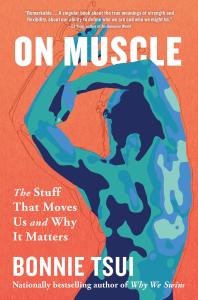
Tsui introduces us to the first female weightlifter to pick up the famed Scottish Dinnie Stones, then takes us on a 50-mile run through the Nevada desert that follows the path of escape from a Native boarding school—and gives the concept of endurance new meaning. She travels to Oslo, where cutting-edge research reveals how muscles help us bounce back after injury and illness, an important aspect of longevity. She jumps into the action with a historic Double Dutch club in Washington, D.C., to explain anew what Charles Darwin meant by the brain-body connection. Woven throughout are stories of Tsui’s childhood with her Chinese immigrant artist dad—a black belt in karate—who schools her from a young age in a kind of quirky, in-house Muscle Academy.
On Muscle shows us the poetry in the physical, and the surprising ways muscle can reveal what we’re capable of.

New Orleans, 1866. The Civil War might be over, but formerly enslaved Coleman and June have yet to find the freedom they’ve been promised. Two years ago, the siblings were separated when their old master, Mr. Harper, took June away to Mexico, where he hoped to escape the new reality of the postbellum South. Coleman stayed behind in Louisiana to serve the Harper family, clinging to the hope that one day June would return.
When an unexpected letter from Mr. Harper arrives, summoning Coleman to Mexico, Coleman thinks that finally his prayers have been answered. What Coleman cannot know is the tangled truth of June’s tribulations under Mr. Harper out on the frontier. And when disaster strikes Coleman’s journey, he is forced on the run with Mr. Harper’s daughter, Florence. Together, they venture into the Mexican desert to find June, all the while evading two crooked brothers who’ll stop at nothing to capture Coleman and Florence and collect the money they’re owed. As Coleman and June separately navigate a perilous, parched landscape, the siblings learn quickly that freedom isn’t always given—sometimes, it must be taken by force.
As in his New York Times bestselling debut The Sweetness of Water, Nathan Harris delves into the critical years of the Civil War’s aftermath to deliver an intimate and epic tale of what freedom means in a society still determined to return its Black citizens to bondage. Populated with unforgettable characters, Amity is a vital addition to the literature of emancipation.

The acclaimed Korean horror and sci-fi writer’s goosebump-inducing new book follows an employee on the night shift at the Institute. They soon learn why some employees don’t last long at the center. The handkerchief in Room 302 once belonged to the late mother of two sons, whose rivalry imbues the handkerchief with undue power and unravels the lives of those who seek to possess it. Meanwhile a live-streaming, ghost-chasing employee steals a cursed sneaker down the hall, but later finds he can’t escape its tread. The cat in Room 206 begins to reveal the crimes of its former family, wanting to understand its own path to the Institute’s dimly lit halls.
But Chung’s haunted institute isn’t just a chilling place to play. As in her astounding collections Cursed Bunny and Your Utopia, these violent allegories subtly excavate the horrors of animal cosmetic testing, “conversion therapy,” domestic abuse, and late-stage capitalism. Equal parts bone-chilling, wryly funny, and deeply political, Midnight Timetable is a masterful work of literary horror from one of our time’s greatest imaginations.

It’s 1996, and Jeremy Atherton Lin has met the boy of his dreams — a mumbling, starry-eyed Brit — just as, amid a media frenzy, US Congress prepares the Defense of Marriage Act, denying same-sex couples federal rights including immigration. The pair steals away to remote forests and vast deserts, London fashion shows and Berlin sex clubs, dinner parties, back alleys, East Village hotel rooms, and San Francisco dives. Finding no other way to stay together, they shack up illicitly among unlikely allies in a “city of refuge.”
With Atherton Lin’s inimitable blend of tenderness and wicked humor, Deep House moves through the couple’s string of rented apartments while unlocking doors to a lineage of gay men who have come before — smuggling a foreign partner through national checkpoints or going public to stand up for the right to get down in the privacy of their own homes. They include hapless criminals, sexpot bartenders, friars, pirates, government workers who subverted the system, activists who went all the way to the Supreme Court, and the celebrated artist Felix Gonzalez-Torres.
Following Gay Bar — called “a rich tapestry” by Vanity Fair and “an absolute tour de force” by Maggie Nelson — Deep House juxtaposes whispered disclosures of undocumented domesticity with courtroom drama and political stunts to explore myriad forms of intimacy while questioning the mechanisms that legitimize love. Deep House is at once a historical kaleidoscope and the innermost tale of two boyfriends who made a home in the shadows of a turbulent civil rights battle.
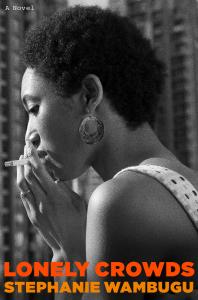
Ruth, an only child of recent immigrants to New England, lives in an emotionally cold home and attends the local Catholic girl’s school on a scholarship. Maria, a beautiful orphan whose Panamanian mother dies by suicide and is taken care of by an ill, unloving aunt, is one of the only other students attending the school on a scholarship. Ruth is drawn forcefully into Maria’s orbit, and they fall into an easy, yet intense, friendship. Her devotion to her charming and bright new friend opens up her previously sheltered world.
While Maria, charismatic and aware of her ability to influence others, eases into her full self, embracing her sexuality and her desire to be an artist, Ruth is mostly content to follow her around: to college and then into the early-nineties art world of New York City. There, ambition and competition threaten to rupture their friendship, while strong and unspoken forces pull them together over the years. Whereas Maria finds early success in New York City as an artist, Ruth stumbles along the fringes of the art world, pulled toward a quieter life of work and marriage. As their lives converge and diverge, they meet in one final and fateful confrontation.
Ruth and Maria’s decades-long friendship interrogates the nature of intimacy, desire, class and time. What does it mean to be an artist and to be true to oneself? What does it mean to give up on an obsession? Marking the arrival of a sensational new literary talent, Lonely Crowds challenges us to reckon honestly with our own ambitions and the lives we hope to lead.