
Da Capo Gifts for Audiophiles
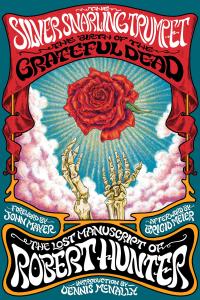
“Strange to think back on those days when it was perfectly natural that we all slept on the floor in one small room … These were the days before practical considerations, matters of ‘importance,’ began to eat our minds. We were all poets and philosophers then, until we began to wonder why we had so few concrete worries and went out to look for some.”
So wrote Robert Hunter in The Silver Snarling Trumpet, both a novelistic singular work of art and the missing piece of the Grateful Dead origin story. In these pages, readers are privy to the early days of Hunter, Garcia, and their cohorts, who sit at coffee shops passing around a single cup of bottomless coffee because they lacked the funds for more than one.
Follow these truth-seeking souls into the stacks at Kepler’s Books, renting instruments at Swain’s House of Music, and through the countryside on mind-expanding road trips. Witness impromptu jams, inspired intellectual pranks, and a dialogue that is, by turns, amusing and brilliant and outrageous. Hunter shares his impressions of his first gig with Garcia for a college audience, along with descriptions of his most intense dreams and psychedelic explorations. All of it, enlivened by Hunter’s visionary spirit and profound ideas about creativity and collaboration.
The lost manuscript is augmented with a Foreword by John Mayer, an Introduction by Dennis McNally, and an Afterword by Brigid Meier, who was part of their scene in the San Francisco Bay Area that served as a bridge from the beatniks to the hippies. Also included is Hunter’s own 1982 assessment of his work—about how he shared it with close confidants but then decided to leave it unpublished. Five years after Hunter’s death, the text has been found, so readers and fans of Hunter’s indelible poetry and song can explore the origin of his genius and his craft.
“An essential document in the Deadhead library.” —Kirkus
“Deadheads will drink this in.” —Publishers Weekly

“The best rock book of the year.” — The Telegraph (five stars)
From the authors of the critically acclaimed oral history of Eddie Van Halen, Eruption, a revealing narrative biography of legendary British guitarist Jeff Beck featuring brand new interviews with the icon himself as well as his famous colleagues, collaborators, and loved ones
With his shag haircut and white Stratocaster guitar, Jeff Beck was an icon known and loved by millions. Yet somehow, he maintained the ineffable low profile cool of a cult hero as he glided through six decades of musical trends with nary a lapse in taste. Not to say he ever played it safe. What other guitarist can lay claim to performing with opera star Luciano Pavarotti, mainstream television personality Kelly Clarkson, and professional degenerates like Guns N’ Roses with equal grace and wit? Or as Beck himself once quipped, “I’m an awkward son of a bitch when it comes to doing the expected.”
In Blow by Blow: The Jeff Beck Story, Brad Tolinski and Chris Gill return to chart the unexplored life of rock’s greatest and perhaps most enigmatic instrumentalist. Culled from approximately 30 hours of interviews with the late guitarist himself, numerous conversations with those closest to him, and extensive research, the book sheds new light on the genius that Jimmy Page once said, “shifted the whole sound and face of electric guitar music.”

Best Music Biography of 2026 in The Nashville Scene
“A superb biography of a singular life.”–Kirkus Reviews (starred review)
A Rolling Stone journalist presents the story of the late singer-songwriter Justin Townes Earle.
When Justin Townes Earle died of an overdose alone in his Nashville apartment, his death sent waves of grief through the country-Americana music community. The son of alt-country hellraiser Steve Earle had long struggled with mental illness and various addictions. There had been encouraging periods of long-term sobriety and active recovery in his adult life, including the years that led up to his career peak when he released the 2010 masterpiece Harlem River Blues, a career-making album of rambling folk blues set to Southern Gospel.
He sang of cramped Brooklyn apartments and crippling hangovers, about emotional displacement, economic anxiety, and the wandering that characterized his feral, formative years as a rootless kid rambling around Nashville, developing his own unique guitar style and absorbing the musical influences that surrounded him. He was anointed by critics as the next coming of the authentic troubadour. By the time of his death, he’d recorded and released eight albums, creating a striking and original body of work.
Jonathan Bernstein, with the full cooperation of the Justin Townes Earle estate, unravels in these pages a short but incredibly creative life, and reveals the backstories behind Justin’s greatest songs (“Mama’s Eyes,” “White Gardenias”) and what happened when it all fell apart while also capturing a shadow world of the neglected children of Nashville legends who wrestle with the legacies of their hard-living, road-weary, often absent parents.
Justin’s journey to near-stardom is a harrowing story shot through with moments of clarity and promise, including his marriage to his wife Jenn Marie Earle and the birth of their daughter. But what Earle called “the myth”—the idea that one must suffer for one’s art—proved to be too powerful.
This heartbreaking, deeply researched tale is an exemplary music biography.

By age twenty-five, Vijay Gupta had lived several lifetimes: he played Carnegie Hall at eight, studied at Juilliard and Yale before most had finished high school, joined the Los Angeles Philharmonic at nineteen, gave a celebrated TED Talk seen by millions, and launched a nonprofit. But behind the accolades was estrangement, addiction, and a private unraveling.
Restrung is Gupta’s unflinching memoir of breaking apart and remaking a self. It begins with a boy raised between the strict devotion of Bengali immigrant parents and the ruthless demands of the conservatory. It follows him through the shimmering world of elite orchestras, into the depths of burnout, and ultimately toward an unexpected reawakening—where he discovered that the music he’d spent his life studying was seen not as a curio of high culture or mere entertainment, but a lifeline of connection—most vividly in Skid Row, where people living through addiction, homelessness, and incarceration heard it as survival itself.
There, audiences spoke to how they saw their own lives reflected in the stories of composers too often frozen into marble busts: the rage of Beethoven, the fragility of Schumann’s mind, the alienation of Bartók, the plight of Handel—who wrote Messiah bankrupt, ill, and broken, yet transformed despair into an enduring Hallelujah.
Restrung unsettles assumptions about success while illuminating how art restores not just audiences, but artists themselves.