London’s Tea Culture
It is odd how some stereotypes never really ring true to form, and yet others are spot on. Certainly the stereotype of the British loving tea is very apt. Nearly everyone here drinks black tea, and for some it can be an important ritual requiring the teapot to be preheated and putting the milk in first (never the other way around). In times of crisis or sorrow, the British often seek some solace in a cup of tea. The comforting rituals of filling the kettle and finding the mugs, as well as the resulting warm mugs to grasp, somehow help to calm frayed nerves and console both the maker and the recipient.
What I find fascinating about the British affinity with a cup of tea is that it is so pervasive: You immediately offer it to visiting friends if it’s during the day (a glass of something stronger may be more appropriate in the evening). Tea isn’t just for social visits—even contractors that have come to do some building work are offered a cup of tea (they usually take “builder’s tea,” a strong tea with several sugars). As you’d expect there are numerous nicknames for a mug of tea, with a “cuppa” (which sounds like “cupper”) probably the most common, though it is also referred to as a “brew” or “brew up.” The London slang for tea is “Rosie” or “Rosie Lee,” so you have a “nice cup of Rosie.”
Wherever you are, be it shopping or at a gallery, even at work or a university, come 3pm-3:30pm people may well disappear to get a quick cup of tea and snack before returning to their tasks. These days they may well be drinking a latte or herbal tea rather than black tea, but they will still take a short afternoon break with a warm drink for refreshment. This is most evident when you are out shopping, for example, and suddenly see the lines at coffee shops dramatically increase.
You should also be aware that the word “tea” can also imply a meal. In particular, people from the north of England use the term “tea” or “teatime” to refer to their main evening meal. My ignorance about “tea” being used to refer to an early evening meal caused me no end of confusion when my children were young and visiting friends. They would be invited around for a play-date and “tea,” which I assumed meant I’d be offered a cup of tea when I arrived to pick them up. In fact, my children had been given their dinner as part of the visit, making the one I had planned at home redundant. The best advice is to listen closely to see if the invitation is for “a cup of tea” or “tea,” and just ask if you are confused (after all, you are a foreigner).
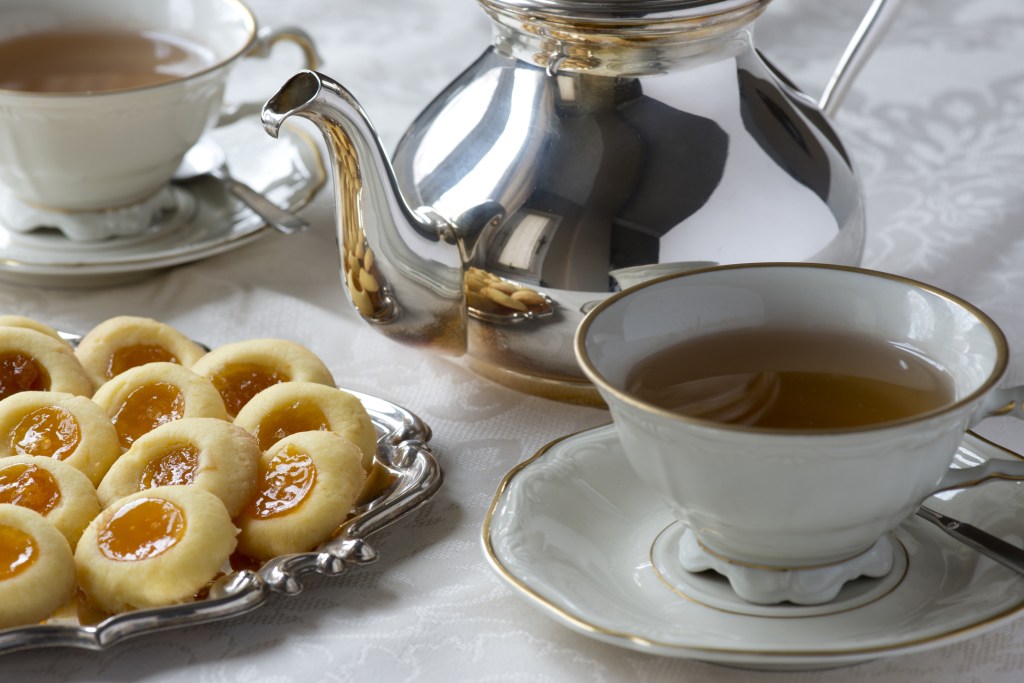
Adding to the confusion of “tea” as a meal are the numerous cream teas (with jam, clotted cream, and scones) and afternoon teas (with cakes and light sandwiches) that are offered at hotels, cafés, and restaurants all around Britain. Going for afternoon tea has gained in popularity in recent years as both business meetings and social get-togethers are sometimes held over a pot of tea and some cake.
Related Travel Guide

Pin It for Later