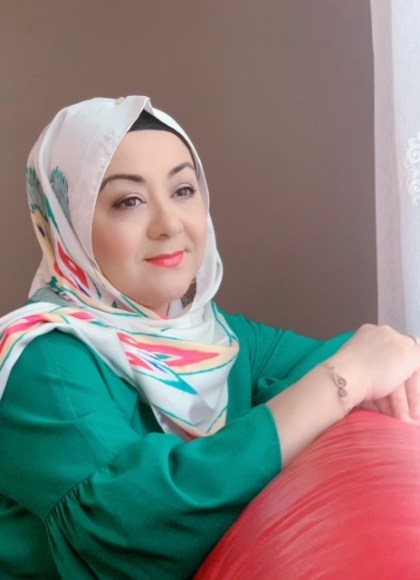
A STONE IS MOST PRECIOUS – Excerpt
A STONE IS MOST PRECIOUS WHERE IT BELONGS – Chapter Excerpt
Late in the evening on February 1, 2018, twenty-four members of my extended family were arrested in the course of a single night. Among them were my elderly father and mother, along with aunts, uncles, cousins and their spouses. Although my younger brother wasn’t arrested with them, that wasn’t because of any kind of luck. The previous year, he had already been detained without cause and had been disappeared into an internment camp.
On that terrible night, two police officers, one Uyghur and one Han Chinese, barged through my mother’s front door under cover of darkness. With my brother interned and my father in the ICU after suffering a stroke, she was alone in the house. They slapped handcuffs on her and threw a hood over her head. Because of her high blood pressure (among other serious health issues), the thick black cloth over her face left her fighting for breath. She begged the police officers to take it off.
The Uyghur policeman leaned down close to her. “I’m sorry. We have to take you like this. Those are our orders.” But as he spoke, he lifted the bottom of the hood slightly so her mouth was exposed.
The other policeman noticed what he was doing and said harshly, “What, is she your mother or something?” He pulled the hood back down tightly over my mother’s face and led her to a waiting police car.
She was taken first to the local jail, where she met my elderly aunt, who had also just been detained. By this point my mother’s blood pressure was dangerously high. Jail officials examined her, but because the jail didn’t have any medical facilities, they wouldn’t accept her. So my mother was separated once more from her sister and taken to the Ürümchi No. 1 Prison, a notorious facility for hardened criminals. Although this prison did have medical facilities, my mother never received any care. When she asked for her blood pressure medication, she was given cough drops. As a professor of pharmacology, she knew the difference.
At the prison, they made her strip off her clothes and change into a dirty uniform, still stinking of the sweat and fear of the last prisoner to wear it. She was thrown into a small room with thirty other women and kept chained to a pipe for days on end. It was just one of many humiliations visited upon her. And she is very far from the only person to undergo such degradations. In the twenty-first century, my beautiful homeland has become the site of terror. The wholesale destruction of the ancient Uyghur culture and way of life has proceeded at an unimaginable pace. My story, and the story of my family, is very much part of that cultural genocide.
The city of Ürümchi where I grew up is flanked to the west by the breathtaking mountains of the Tengri Tagh and surrounded by vast desert landscapes punctuated with startling green oases filled with grape and melon vines. It is an ancient city situated much closer to Kazakhstan than to Beijing. Long a major trading center on the Silk Road, Ürümchi is now the bustling capital of an area that has been known to its indigenous inhabitants as East Turkestan since the nineteenth century. The Uyghur people and our ancestors have thrived for thousands of years amid this harsh and spectacular natural beauty, and along the way developed a complex and rich culture of music, dance, architecture, visual arts, language, and a unique form of Islam. Many elements of the culture can be traced back to ancient Turkic and Central Asian influences from which descended our Sufi-inflected musical tradition, the muqam, and many of our local foods—from the fragrant flatbreads known as nan to the cumin-spiced skewered kebabs cooked over an open flame.
To the south of Ürümchi is the great Taklamakan Desert, the second largest shifting sand desert in the world, in whose oases for more than a millennium the Uyghur people have grown millet, wheat, cotton, figs, persimmons, and other small-scale crops using clever underground systems of irrigation known as kariz. Along the edges of that enormous expanse of sand, the Uyghur people and our ancestors have mainly ruled ourselves under various Turkic, primarily Muslim, potentates. Around 1755, the Manchu-led Qing Dynasty invaded the Uyghur area—which is about the size of the state of Alaska and which today comprises one- sixth of what is now known as the People’s Republic of China—and brought it under the umbrella of imperial China. Local rebellions proliferated and the area increasingly became subject to Chinese military control. It was not named Xinjiang (meaning New Territory) by the Chinese until 1884, while my great-grandparents were alive.
Our cultural memories are long. My father still remembers marching in a parade celebrating East Turkestan when he was seven years old, while his older brother rode on horseback in the local Uyghur cavalry, flying our blue flag with its distinctive star and crescent moon.
Up until 1949, East Turkestan proudly waved its own flag, and came as much within the cultural sphere of the Soviet Union as of the Chinese state. Although it was a majority Uyghur area, with Uyghurs constituting 75 percent of the population until the mid-twentieth century, there was also a sizable population of Kazakhs, Tajiks, Uzbeks, Tatars, and Kirgiz, most of whom follow some form of Islam. It was a delicate balance, one that in the mid-1900s the Chinese government began to systematically destroy.
With the official founding of the People’s Republic of China in 1949 and the establishment of the Communist Party of China as the government, a new policy with respect to East Turkestan came into effect. Instead of nominally ruling from afar, the young CCP decided that a full-scale occupation was necessary to control the Uyghur area and, just as importantly, the Uyghur people. The 1950s saw a massive movement of Han citizens—the Han being the dominant ethnic group in China, and what people may generally picture when they think of a “Chinese person”—mostly former soldiers, into the northern part of East Turkestan. The government sent them there to farm wild lands as well as to provide an enormous paramilitary presence in the region. These people constituted the Xinjiang Production and Construction Corps, or the bingtuan, and they were there to exploit the land and natural resources as much as possible. Simply put, the situation became one of a colonized people and a colonial overlord, with all the shots called by the communist powers in Beijing. Within a few decades, the ethnically Uyghur population in the region dropped to below 50 percent. A vast and terrifyingly accelerating program of colonization and cultural annihilation had begun.
The CCP designated East Turkestan the “Xinjiang Uyghur Autonomous Region” in the 1950s, but just like the “Tibet Autonomous Region,” almost no political or cultural autonomy followed from the name. The Uyghurs, like the Tibetans, were considered by the Han authorities to be a backward people, and few Han Chinese knew anything about our traditions or way of life. Travel was made difficult for Uyghurs—many hotels outside the region even refused to give rooms to Uyghurs—and many Han increasingly considered the Uyghur region to be the “wild west,” full of violence, lawlessness, and primitive conditions. Prejudice against Uyghurs, largely stemming from longstanding CCP propaganda about the necessity of “opening up” the Uyghur region and teaching Uyghurs how to be modern and “civilized,” ran rampant.
In 2017, this campaign was ramped up in horrifying ways when the Chinese government began to incarcerate large numbers of Uyghurs in detention facilities built in the middle of the desert, far from the eyes of both the international community and the local population. With the level of secrecy surrounding these camps, it’s impossible to know how many people have been disappeared into these facilities. But according to the best available information obtained through leaked official documents and eyewitness accounts, somewhere between one million and three million people have been forced into these camps, where they’re subjected to dehumanizing treatment, such as torture, rape, forced labor, and routine humiliation. A Uyghur person can be arrested and put into these camps for any expression of our unique culture. Hundreds of thousands of people have been held for years without any due process or explanation.
Things are bad outside the camps as well. When I was a child in the 1970s and 1980s, televisions were still rare in the Uyghur homeland. Today, however, a vast system of surveillance has been installed throughout the region. In the cities, like Ürümchi, high-tech cameras hang on every telephone pole and can identify Uyghur individuals using sophisticated facial recognition software developed specifically for the purpose of keeping the population intimidated and in line. On corners where watermelon vendors used to park their donkey carts or trucks, military police now stand with machine guns at the ready. Policemen march in formation everywhere, and even going to buy vegetables at a bazaar requires an invasive search. A Uyghur needs an ID even to buy gas at a gas station. Of course, the Han living in the region are not subject to these same oppressive measures; they have separate lines to get into the marketplaces and train stations without any checks at all.
Much of this surveillance and intimidation is done under the pretense of fighting so-called terrorism, but the real purpose is to methodically destroy the Uyghur community. Offered the fig leaf of the Global War on Terror after the terrible events of September 11, 2001, the Chinese government took the opportunity to label regular Uyghur citizens “terrorists” for engaging in behaviors as ordinary as praying in a mosque, growing a beard, or wearing a hijab. Innocent Uyghurs have even found themselves in Guantanamo Bay. Any sign of resistance from the Uyghur community against these oppressive measures is met with overwhelming brutality and an increase in “preventative measures” such as invasive surveillance, intimidation, and incarceration. The noose of total control has been slipped around the region and tightens with every passing day.
Some scholars view the actions of the Chinese government in East Turkestan as straightforward colonialism: East Turkestan is rich in minerals, gas, coal, and other natural resources, and it covers a huge geographical area, offering potential relief for China’s enormous population density. The Chinese have simply come and taken what they want, and they have suppressed any resistance to their presence or their greed. Many scholars emphasize China’s tenuous historical claims on the area and the government’s desire not to seem weak by ceding stolen lands back to their rightful inhabitants. Others see evidence of the state’s fear that the people in other non-Han areas like Tibet and Inner Mongolia might also rebel and seek independence again, while Hong Kong and Taiwan resist being absorbed into greater China. In the end, there are no definitive answers for why genocide in any form happens. Nevertheless, that is exactly what is happening now in my homeland.
All of this explains how my family ended up behind bars on that horrible night in 2018. But it’s not the full story. The hard truth I had to face that night, feeling completely helpless from thousands of miles away, is that the Chinese government took my family away for one reason: me.