
Excerpt: THE THIEF AND THE TRAITOR BRIDE by V.L. Bovalino
Thanks for participating in the ARC Drop for The Thief and the Traitor Bride and supporting local indies!
Please check out the first four chapters below.
Want to read more? Check out the book on NetGalley and request!
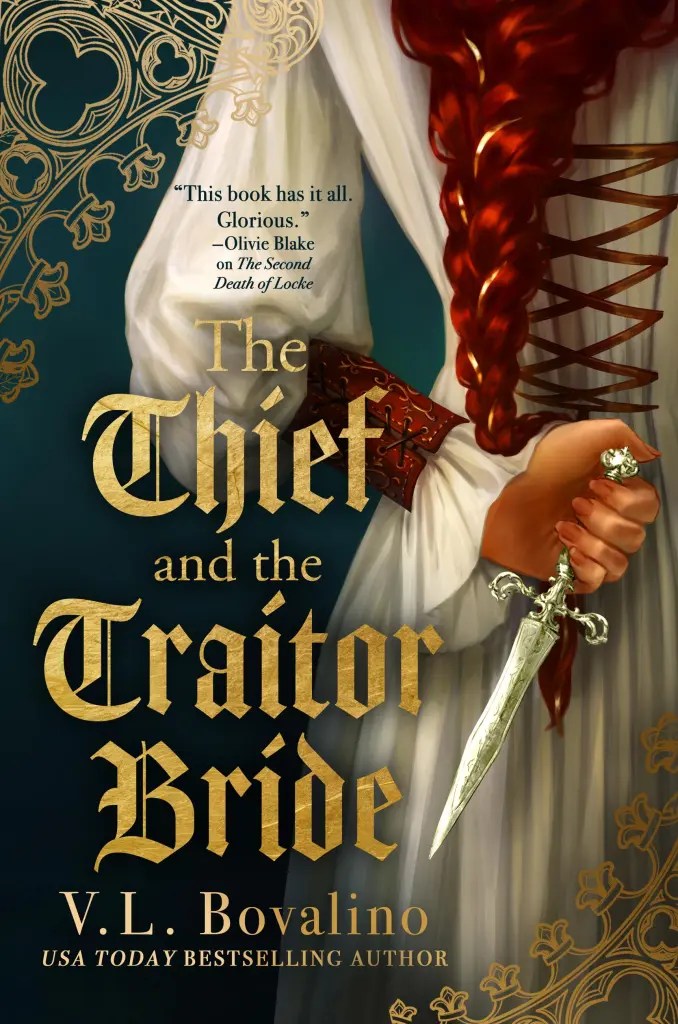
On sale September 29, 2026
PART ONE: THE THIEF
Sword and shield and show of might,
May true be battle won.
But the oldest, fiercest war is waged
Long ere by pen and tongue.
-Lindle saying
CHAPTER 1
The city was alight with a familiar coldness as Nore slipped through the streets towards the harbor. Dawn was tipping over the horizon, casting the streets in an ethereal gray fog. It was one of the few times when Nettlepool didn’t look like a cesspit.
She moved easily, avoiding the notice of the patrolling guards—perhaps they would stop her if she was a lone woman in her expensive cloak, maybe even offer an escort home; but with the ragged elbows of her coat and her hair tucked up into a cap, they didn’t spare her a second glance.
She was nearly done with her work for the night: she had passed a message to a sailor drinking in one of the inland pubs; then retrieved a notebook from a nook on Carver Street, to be secreted away in her office the next morning; and, dressed as a storehouse runner, flirted with a cook in the kitchens of a house belonging to a textile merchant who was supposedly having a rather secretive dinner party this evening. She had one task left, and though she was thinking of her bed and the hours she was not spending in it, this had to be resolved.
In the harbor, there was the usual clamor of morning so early it could barely be labeled as such: the first of the shipping vessels were coming in, clearing the port guard and declaring wares to the overnight clerks—with captains cutting whatever deals they needed to to avoid the worst of the Lindle import taxes. The air was thick with the scent of fish and brine, the harbor overloud with the clapping of waves against docks and the early cry of gulls, all the machinations of a new day. Nore kept her head down to avoid detection and tucked her hands in her pockets until she reached The Gleaming Swine, one of the quayside pubs. It served strong, dark coffee alongside ale in the hours when night bled into morning. She made her way across the worn boards, keeping her head ducked as she swerved against the knots of laughing sailors and brawling merchants, moving around the long bar—there, on the other side, there was a door that opened to a deck that hovered perilously over the water. Someday, Nore was certain, the wood would finally fail and it would splinter away into the sea.
She looked up, scanning the tables in the gap between the high rise of her scarf and the low brim of her hat. In the furthest table from the door, she found an old man in a worn oilskin coat. His left eye was milky and sightless and his fingers curved with arthritis, possibly beyond the point of feeling the cold.
“I have a job for you,” she said, dropping into the chair across from him without a greeting.
The old man looked up at her, nose wrinkled, then spit over the banister of the deck. His saliva landed, filmy and white, on the dirty water below. “Bah.”
“I’ll pay.”
“I know,” the man said. His fingertips were dark with lead as he sketched—to Nore’s upside-down perspective, it looked like a caricaturised impression of one of the meaner port guards. It was, Nore had to admit, an illustration that captured the sense of the man, if not his exact likeness. “You always do. And I say bah.”
“So you’ll do it?”
He raised his gaze to her face. Nore didn’t know the man’s real name, just as he did not know hers. She’d heard him called many things, both names and random nouns: Alba, Owen, Jager, Kitten, Anchor. None of them seemed to fit. Some other regulars simply called him Hands, which almost made sense—the man’s lead-lined hands were the most distinctive thing about him, his palms burned from some long-ago fire on a ship that no longer visited Lindan’s waters.
What she did know was that he was reliable enough, and she had used him for more than one task in the past. Over the years, he had become something of a trusted supplier for her.
“How much?”
“Fifty silvers, if you find what I need, for your time. Plus market rate for your findings.”
His mouth was already poised to protest, but he stopped to consider this. It was more than double what she usually paid—because it was her money this time, and her own reputation on the line. “No matter the outcome?”
“I trust you’ll find me what I need.”
The man sighed, leaned back in his chair, and sighed again. He idly tapped his pencil against the paper, looking out at sea. She had thought, more than once, to ask him why he didn’t sail anymore when he so clearly loved the sea—but not every secret was her business. He left her alone to do her bidding, didn’t care about her name or background or purposes. He only cared about her coin. She respected him enough to do the same.
“Tell me what you’re looking for, then.”
Nore chewed her lip. She was fully aware of the stickiness in what she was about to say. “I need something that will disable magic.”
Hands studied her with his good eye. “Use a protection spell,” he said.
“It’s not enough.”
“What about that repellent paste I found for you last autumn? That should be enough to protect you from—”
“That only works,” Nore said through gritted teeth, “on spellwork produced by an instructive system. And there are no shields I know of, spells or physical, that disable magic from allsystems.”
The man looked at her shrewdly. “If you narrow the magic, it’ll be a much easier fix—and cheaper.”
But she couldn’t narrow the system. What Nore needed was breadth. She’d already tried the repellent paste, which worked for instructive systems—systems where magic could be learned by anyone in the system, like in Lindan, without natural, born ability—and it had done nothing. She’d also tried a shielding spell, which usually worked on magic made in an alchemic system, where artifacts were constructed and imbued with power, like spell-stones; that hadn’t worked either. Nore had nothing that would work on consumptive magic—in which the magical potion was consumed; nor could she protect herself from an inherent mage, gifted power through one’s blood.
She had tried everything she could think of to solve her current problem, and clearly, the mage she was dealing with was not using Lindle magic. Or maybe worse: they weren’t only using Lindle magic.
She needed something strong. Something that worked for everything.
“I don’t care how much it costs,” Nore said. She was not often reckless with her money, but she would spare as much as was needed to rid herself of this nuisance.
Hands raised an eyebrow. “For that to work, it’ll need to be—”
“Amalgamate made or carried,” Nore said, holding her ground. Nore, who was terrible even within her native system of magic, always found herself a little jealous of (and awed by) amalgamates, who had control over more than one system of magic. “Safely transported to a new system.”
Hands regarded her. She needed to prove her knowledge so she wouldn’t get scammed—even though Hands was someone she worked with regularly, she was well aware of how easily that relationship could sour. If he thought she would be an easy mark to pull a game on, to con her out of her money… well. Could she blame him for taking that opportunity?
“You want something that dispels all magic,” Hands said again, as if waiting for her to tell him it was a joke. “So if someone walks in with spell stones—”
“They would crack,” Nore said.
“Or potions?”
“Wear off, or rendered unusable.”
“I won’t find one,” Hands said, but Nore already knew he was cataloguing in his brain, thinking of every possibility. She had not yet posed Hands a challenge he couldn’t best. “If it exists, it would have to be old. Old enough to pre-date most of the systems we have now, and to somehow still be intact and functional…”
Nore shrugged. Magical artifacts were not her trade, just like magic was not her calling, but she had made the study of them a pet project over the years—possibly out of spite. “It’s possible,” she said.
Hands looked out to sea, grumbling under his breath. “If such an artifact existed, everyone would have one.”
Nore doubted that. Most people didn’t care enough about systems outside their own to protect against them, or engage with magic they hadn’t grown up with—and amalgamates were rare enough that it barely mattered.
She knocked twice on the table. “I have faith in you,” she said. She slipped the man a purse of coins. “A deposit for your time. Leave word with Joana at the bar when you find it.”
“Go home,” the man said gruffly. “And get yourself a better job, for gods’ sake.”
Nore smiled and inclined her head. Once, on one of her earlier meetings with Hands, he had told her that this wasn’t a place for nice girls like her. She hadn’t corrected him—but after the third or fourth time doing her bidding, he had mostly stopped with such platitudes.
Nettlepool was back to its filthy worst by the time Nore was at her front door. It was always worse in the first glimmer of dawn, she thought, when the lavender glow of a new day illuminated the filth on the streets and the cloudy skies churned gray and malicious above. It could rain at any moment on any day from any direction, turning the filth into sludge, making the streets iridescent with oil and grime. She checked over her shoulder twice before opening the door and immediately secured the trio of locks behind her the second she was inside. There had been too many close calls over the years to forego this process.
It was only when she reached her rooms on the fifth floor (three more locks, opened and re-bolted) that she allowed herself to relax. Her cat, Grimsby, wound through her legs, meowing with familiar annoyance. She gathered him up in her arms as she crossed the room—he didn’t mind her filth if it meant he received scritches behind his ears and she ignored the way he bit her hand—and kicked off her boots. It was long-past time for sleeping, long-past time when her work should’ve been done, but a consistent schedule was not something Nore’s work allowed for. She made her way through the room in the dark, finding a book of matches where she’d left it on the sideboard. She struck one, careful not to ignite Grimsby’s fur, and lit a candle.
The candle flared to life, revealing a person sitting in her armchair next to the bookcase, waiting.
It was only due to her careful training that Nore didn’t even startle, didn’t suck a quick breath, didn’t change expression. In half a second, her knife was in her hand, a reflex she always practiced but never had to use—but she aborted the motion halfway through, recognizing the figure in the chair. Their broad, expressive feature were now schooled into placid disinterest.
“Well met, Finch.”
“Sparrow,” she said, setting Grimsby down and sheathing her knife, trying to urge her heart to stop racing. She looked over the crown’s messenger—they looked as tired as she felt. It was likely Sparrow had been waiting here a while. “To what do I owe the pleasure?”
“Dove requests you tomorrow,” Sparrow said. “Leave your office at seventeen past eleven. There will be a coach waiting.”
Nore did not look at the clock; she knew it was only just past five in the morning, and she’d need to be clean and appropriately attired at ten to get in and go through her papers without looking suspicious before taking a meeting.
“Thank you for the update,” Nore said.
Sparrow nodded, stood, and slipped past Nore, out the door and into the hallway. Nore locked the door behind them.
Alone in earnest, Nore let herself sag against the sideboard. She pressed a hand to her eyes. She was so tired—she couldn’t remember a time in which she hadn’t been tired. At thirty-one, no longer a girl, barely even a young woman, she felt every hour of her sleeplessness settling into her bones. Her adoptive aunt had always warned her that it would get worse as she grew older but Nore, fool that she was at twenty, thought exhaustion was something that happened to other people.
She pushed away from the sideboard and shuffled into her bathing room. She would have to wash before going to her office, and her hair could dry while she slept.
*
Too few hours later, Nore was applying rouge to her cheeks and kohl to her eyes and pinning her two red braids up around her head. Usually she put more effort in when her employer requested a meeting, but the duchess had to know how late Nore had come home that morning, and she was far more valuable for her talent than for her beauty. She dressed quickly in a black day gown, cut low, with long flowing sleeves and buttoned embroidered cuffs at the wrist. Once she was appropriate, she fed Grimsby and scratched him under the chin, secured her heavy black cloak, triple-locked her door, and went on a long and roundabout walk to the harbor’s front.
Nettlepool had never grown on her. She crossed one of the markets, lifting her skirts to avoid the worst of the puddles, keeping her eyes straight to avoid the calls of the wares. The whole city smelled of rancid fish and waste, the docks were dirty, and the nearby smithing quarter spit black, greasy smoke that seemed to cling to everything. The only place she truly liked in Nettlepool was her own tiny apartment. It was safe. It made her feel safe.
And it felt better when she didn’t examine all the possible reasons that was the case.
Safety was a rarity that Nore valued as much as she feared it: to feel safe was to get complacent, and she could not allow that to happen. But she also needed to sleep, and at least, in her apartment, she could. She kept a second set of rooms in a far nicer area of town, and had once even tried to stay there… but sleep had been impossible, and Grimsby spent the entire two-week period hissing at her from under the bed. Now, Nore used that apartment for hosting guests, a decoy from her true safe place, and little else.
She only diverted twice in her path: once to drop a rolled piece of parchment inside a small gap in the mortar of a wall near the flower district; a second time to change the flag color on one of the postboxes in the garment district from black to red. She did not check to see if these communications were seen and interpreted; that was what made a good spy into a caught spy.
By the time she reached the merchant district that fronted the harbor, it was nearing ten. Nore nodded to the guards at the door of her building and took the six flights of stairs to her office slowly, her knees aching.
When she exited onto her floor, she found Kota, her chief clerk, already waiting with a stack of orders. She perked up as soon as Nore entered. “Good morning, Ms. Gordon,” Kota said.
Nore nodded in greeting. There was a tizzy of activity, as always, as her clerks handled correspondence and orders and settled accounts. Some of her clerks had spellbooks out, making notes as they calculated magic into spells. She could taste the fizz of magic in the air, the clean, tidy accounting spells that wound around her.
“Your appointments have been confirmed for this afternoon,” Kota said, hurrying to follow Nore across the room, past the six desks of the lower clerks, and through the double doors that led to Nore’s office. “Two Nish distributors, that Ortissian shipping representative, and the captain you requested from Arkun. And the Millens wrote—they’d like to have you for dinner this week, if you’re free. They sent through requests.”
“What do they want, then?” Nore asked stiffly, doing her daily scan of the room. Her office was not as safe as her home, but it was familiar enough that she could tell instantly if anything was out of place. Besides, she had traps set, tells that would reveal if anyone had been in here or gone through her things. She let her eyes sweep the bookshelves, the dark carpet, the desk, the racks of wine against the far wall; all was as it should be.
“They’d like to taste some of the Maroushan vintage you spoke to them about last time,” Kota said.
Nore sighed, rubbing her eyes. It was technically good news—it was a trap she had laid, bait taken. Kota thought the Millen family, a third cousin to a well-favored duke, was only appealing to Nore because of the depth of their pockets. But the duke had land that was valuable to the crown, and had agreed to sell it on to their chosen buyer. The problem was he had called off the sale mere days before the land was set to change hands—and only hours after hosting Audrick Millen for dinner. That sale had taken Nore’s colleagues nearly seven months to negotiate, all gone in an instant.
If she could just get to the bottom of what Audrick had said to the duke, if he suspected the value of the land, where their loyalties were falling, and who they were trying to support instead… She held the web of the Lindle nobility there in her brain, and she was eager to fill in this bit of information, to expand the edges of that map.
Kota did not know that Nore was investigating their loyalty to the crown as thoroughly as she was investigating their preferences for wine.
“Put it in my diary,” she said, already dreading the hours she’d need to spend complimenting Audrick Millen’s aggressively flashy tableware. He always tried to get her to drink too much and stay the night, which she had no interest in. Her brain was racing ahead of her work, trying to plan: few knew enough about other systems of magic to suspect them when things when awry. That Maroushan vintage she’d been selling them on, a deep red and syrupy port, would easily hide any traces of a mild Pzyetan serum she used sparingly to loosen the tongue. She’d need to run down to the market district to get more, but that was a problem for later.
She took the stack of orders from the girl and flipped through them, annoyed with her own tired brain. She couldn’t remember why she’d requested the captain, and it wasn’t safe to take notes when they related to her side ventures.
While Nore settled behind her desk, relaxing into the leather chair so old it practically molded to her body, Kota opened the window shades to let in the cold daylight. Nore winced, feeling every single hour she hadn’t slept.
“Good. That’s all, then.” She wanted time to go through her list of upcoming imports before her meeting with the duchess, and she couldn’t focus with Kota looking at her like… that.
Kota hesitated by the door. Nore looked up to see her clerk there, waiting for her attention. Instinctively, she narrowed her eyes, sensing Kota was about to tell her something she wasn’t going to like. “What is it?” she asked.
“It’s only, the delivery from Markesh. It was five cases short.”
Nore put down her papers. Five cases out of five hundred was not significant, but it was noticeable. Enough to catch her attention.
Enough to catch Kota’s attention.
Nore fought the magnificent surge of profanity that threatened to slip. She ran a calculation in her head, summoning an easy spell to deaden the sound within her office—this time, at least, it worked; she felt the lull creep over them as the sounds from the main room were dimmed. Whatever Kota was about to tell her, Nore didn’t want her other clerks hearing it.
“Did you check the delivery records from loading? Was the supplier short?”
“No…”
“And the sailors? Did they drop any bringing them down? Did the captain say if they were prone to drink?”
Kota winced. “It appears, Ms. Gordon, that the cases were accounted for both when the ship left the port, and also when it through the harbor checks. The… disappearance happened between arrival and unloading, somehow.”
“I see,” Nore said, working to contain her annoyance. Nore sat back in her chair and looked out the window. Her office looked out to the harbor below. There was a great ship docking now, eager dockworkers ready and waiting to unload it. “And the workers, who unloaded…?”
“All our people, miss.” Now, she sensed the edge of tears on Kota’s voice.
Nore’s frown darkened. “I’m sensing you have more bad news.”
Kota shifted her weight. She was only a few years younger than Nore—even though Nore felt ancient, she had to remind herself, often, that she truthfully was not—and had been one of the best in her class at the university when Nore snapped her up right after graduation. She was a talented actuarial magician, able to commit numbers to memory with barely a glance, able to solve complex figures without hesitation. A mind like hers would’ve been irreplaceable if Kota had chosen to work in the Lindle treasury office, or for another merchant. It was only luck that Nore had found her before anyone else had.
Nore should’ve known better: She would not have simply missed the discrepancy. The only problem was Kota’s too-soft heart, but at least that, Nore could use to her advantage.
Unless Kota was involved and was stealing the cases herself. Nore had investigated her when she was hired, and again when the thefts had begun, but she’d found no trace of double-crossing on Kota’s part. But Nore had been wrong about such betrayals before.
“It’s only… this is the fourth shipment this month that has been short in such a way,” Kota said. Her tone was apologetic, if anything. “Most of the cases were samples, marked for you, so I thought—“
“Why was I not told?” Nore asked, looking at the other woman shrewdly as the anger curled in her stomach. She was unsurprised that Kota had picked up the latest shipment, but for her to see all four and not say a word of it to Nore?
“The first two were missed, at first,” Kota said, avoiding Nore’s gaze. “But when the third theft occurred, Marek—your new sixth clerk—flagged it, and we discovered the previous thefts.”
Nore pinched the bridge of her nose between her thumb and forefinger. It was already a quarter past ten; she didn’t have time for this.
“And you didn’t tell me,” she said, forcing herself to breathe through the anger, “because you were protecting the sixth clerk, because he should nothave missed the previous discrepancies. Unless you were involved?”
“Ms. Gordon, I swear to you I had nothing to do with it. I was trying to get to the bottom of it.”
She wished Kota had come straight to her instead of hiding it. Nore took one breath, then let it out and counted to five, then took another. “And now you’re going to tell me why I shouldn’t fire him,” she said once she was certain she wouldn’t say anything ridiculous.
“It’s only, the bandits in the harbor—“
“I don’t care about the bandits in the harbor,” Nore said, anxiety rising up familiar in her chest. She stood from her chair and stalked toward the bookshelf, turned, doubled back. She paced with her hands tightly clasped behind her back. The bandits in the harbor didn’t matter, because in most cases, they weren’t bandits at all: half of them were spies or in the duchess’s pay, and the other half knew better than to steal from her. Even if no one knew Nore’s official position, they knew that theft within Miller & Sons Trading was quickly found and harshly punished. That was what happened when one had a finger in everything: they tended to know, immediately, when they’d been burned.
“What did I tell you on the day I promoted you?” Nore said, turning to face Kota.
Her chief clerk had gone a pale shade of green. “That you have no patience for thieves or lies.”
“Precisely,” Nore said. “I cannot tolerate dishonesty from you, and that includes deception and withholding.”
“Ms. Gordon, I didn’t mean—“
“Let this be,” Nore said through her teeth, cursing her own too-soft heart, “the only time I need to repeat myself.”
“Yes, Ms. Gordon.” A pause. “I am sorry.”
“I’m sure you are,” Nore said, forcing herself to sit back down. She still had so much to do before the coach was meant to arrive. Nore brought a paperweight closer under her grasp, a heavy arrangement of marble in the shape of grapes, and ran her fingers over the smooth, rounded surface. “And you will spend the afternoon cross-checking the purchase orders to determine exactly what was stolen.” It would not actually give Nore the answers she was looking for, but it would buy her time—and she could not have Kota sniffing any closer to this. The girl was too smart for her own good. And if samples for Nore were missing…
Kota nodded.
Nore took another measured breath and rubbed her brow. She couldn’t afford to lose Kota. Even though she was too kind, Nore saw the value she added—and having Kota here allowed Nore to travel more extensively, to expand her reach, to hear more whispers and pour them back into Lindle intelligence. Nore needed Kota here if the duchess’s demands on her time would continue to increase.
“Right. The next time a theft occurs, I am to hear immediately. Is that understood?”
Kota barely winced, her eyes on the floor. “Yes, ma’am,” she said. Another pause. Nore looked down at her own hands—she had the sense that Kota was going to cry, and it was her fault.
“The samples,” Kota said, regaining her composure. “From the last shipment, the ones marked for you. They’re under your desk.”
“Good,” Nore said. “Thank you.” Nore went back to rubbing her face, as if that would chase the headache away. “Now, please leave me. I wish to remain undisturbed. And I will be meeting a vendor at half-past eleven, if you could update my diary.”
“Yes, Ms. Gordon,” Kota said, even quieter. She shut the door behind her. Nore got up and locked it—she was not strong enough with her own magic, to use it flippantly.
Alone and protected, she swallowed down the lump of anxiety in her throat, the exhaustion, and glanced at the clock. Thirty-seven minutes, and they would pass far too quickly.
Nore pushed her chair back and lowered herself to the floor. The cases she’d requested were there, under her desk, subtly marked to denote they were to be set aside for her, to come straight to Miller & Sons and its proprietor. She pulled a pry bar from her lower drawer and went to work on the nails.
Inside the cases were, unsurprisingly, bottles of wine. Nore pulled one and felt along the bottom, her finger catching on the latch—the middle slid out, revealing rolled documents and a soft cover notebook, wrapped in waterproof covering, just in case the inner glass wall of the bottle shattered. Nore took one notebook from the case and slipped it into her bag to take to the duchess later. She turned and pulled one of the wine bottles in the display case behind her desk, which shifted the entire section to reveal a square space for storage below. Nore put the rest of the documents here for Sparrow to collect at some later point.
Sometimes, it was actually wine that waited for Nore in the red-marked cases. Mostly, it was this: reports from other spies from abroad, documents stolen from other nations’ spies, or armies, or politicians. Any manner of information was collected and returned to Lindan like this, ushered in inconspicuously on one of Nore’s ships.
Once she was finished sorting, she sat back on her heels. It wasn’t just the theft, or the unknowing. She could not be certain what exactly what was taken from her shipments: whispers, or wine. And unlike the city’s other merchants, Miller & Sons’ bestselling ware was not wine. It was secrets.
She’d noticed the first theft weeks ago: only two crates missing, but both of them samples marked for her. At first, it had raised only a dull thrum of panic—these things could be misplaced, and sometimes an overzealous dockhand wanted to deliver the crates to her personally. But when the full day passed without sign of them, even though the crates were listed on the manifest, she went straight to her employer.
Nore’s instructions from there were easy: set traps. See if the thief struck again. And then, easy as anything, catch them and bring them for questioning.
Except. For the first time in years, not a single one of Nore’s traps worked.
It was as if someone invisible was boarding her ship and making away with her cargo. There was no other explanation—and though Nore did not know of any Lindle spells for invisibility, other magics made the possibility impossible to rule out entirely.
And if someone was robbing her… if someone was targeting the samples specifically… it appeared that Nore’s hand had been revealed.
Tern to Sparrow, 1631 United Common Era (UCE)
Focus on your work. Finch is not your concern.
Sparrow to Tern, 1631 UCE
CHAPTER 2
At exactly seventeen past the hour, the carriage rolled up in front of the offices on Mead Street. Nore stepped out from the shadowed overhang, crossed the walk in the rain, and slipped inside. It was plush, dark velvet inside, tasteful and black, with the windows darkened and the shades drawn. The carriage was otherwise empty.
Nore leaned back and closed her eyes, letting the rocking of the carriage soothe her thoughts, which kept returning to the missing cases. Removed from Kota’s influence (and her beseeching, guilty gaze) Nore was again considering firing the sixth clerk, but that would do nothing to solve her problems.
Someone knew there was more than just wine coming in Nore’s shipments. At first, it had been nothing more than a gut feeling—but in her experience, a gut feeling was merely an understanding that had not yet been quantified.
Why else would they be targeting only her samples?
Nore had few enemies—there was professional jealousy among the other merchants in Nettlepool, perhaps, but she did her best to keep her business unimpeachable and out of public scrutiny. She maintained her relationships with her suppliers and clients with perfect grace—she needed them for information just as much as she wanted their money.
Finch, on the other hand, had quite a few enemies—or, at least, Nore suspected she did. She realized she had been rubbing the boning of her bodice on the left side, absentmindedly tracing over the scar that lurked under her dress.
She grimaced, lacing her fingers together in her lap. Forced herself to behave.
Nore had her ways of keep her identities separate, even though one relied on the other in a delicate balance. And now someone was stealing from her, and the information she gathered for the duchess was at risk. Nore pressed the heel of her palm to one throbbing eye.
It was more likely that it was not an enemy of Nore, or of Miller & Sons. Tensions were always sparking and fizzling with Marous, and they were always looking for allies against Lindan—the latest attempt was to interrupt an ongoing trade agreement with Isbeta. And, there were the negotiations with the tariffs between Lindan and the northern territories; and she had recently returned from a trip to Arkun to try to find out what was happening with the South Central Partnership.
In short: there were a thousand times she could’ve been caught. Hundreds of people who wanted her information. Perhaps just as many who, if they knew who she was and what she did, would find peace in her death. And Nore felt herself spread so thin over all of it, her time in demand and her presence required, that she had somehow allowed herself a vulnerability.
Feeling the familiar edge of panic, Nore forced herself to stop thinking. It was always better when she was as calm as possible when meeting with the duchess.
When the carriage stopped, it was on one of the unremarkable streets out of the city’s center. Nore drew her hood and pulled her cloak tight. She stepped from the carriage and entered house number 43 without knocking.
Inside, it was just as nondescript as outside. The walls were papered in patterns almost a decade out of date, the furnishings worn but comfortable. Pale non-magical light glowed through the room, distracting from the fact that all the curtains were drawn. The only thing remarkable about the place was the woman who perched on the sofa, drinking tea, surrounded by the skirts of her silk gown.
“Ah, darling. You look exhausted,” Celestine said, her voice high and sweet, her accent rounded and noble. She waved a hand, heavy with rings, at the armchair to her left. “Come, sit.”
Nore removed her cloak and hung it next to the door. She took the seat requested and remained still as the duchess leaned close to grip her chin, examining her more closely.
Celestine de Roullier, the Duchess of Arlowe, master of Her Majesty’s spies, was a woman in her late forties. She sat on the chaise lounge in a fashionable day suit of stiff brocade over starched satin. Celestine’s strawberry blonde hair—no sign of gray, never for Celestine—was coiffed to perfection. Her milk-pale skin was perfect, blemish-free, cheeks rosy and lips showing no sign of cracking in Nettlepool’s cold.
To those who didn’t know the truth of her—which, to be fair, was most of the country of Lindan, and the continent beyond—she was an icon of fashion, a shining gem in Lindan’s court, the epitome of grace and high society. A favored cousin of the queen, she’d been married off to a Maroushan noble, then was widowed soon after. In the years since she’d begun to understand things, Nore had realized that it was a convenient marriage for the crown—and an even more convenient widowhood. It only came out later that Celestine’s husband had been responsible for arming Lindle rebels against the crown, but it was very tidy, how everything had turned out in the end.
Though, it wasn’t any of Nore’s business what other people did in their marriages.
Gently, Nore pulled back, out of the duchess’s grasp. “It’s good to see you, your highness,” Nore said, trying to speak like she wasn’t exhausted to the bone. She didn’t like to show weakness to Celestine, who she’d spent so many years trying to impress—and the duchess had already seen too much in her close scrutiny of Nore’s face.
“You look tired, Elinore,” Celestine said. When they were alone, she always defaulted to Nore’s full name. Late at night, alone in her bed, Nore wondered bitterly if she did the same with other spies, or if it was something she reserved for Nore.
“I was out late,” Nore said.
Celestine leaned back, folding her hands in her lap. Nore did not feel the scrutiny lessen, and she wondered if the duchess caught the lingering scent of clove on her skirts.
She probably did. It was always safer to assume her employer knew everything. Nore’s thoughts turned to the stolen cases, and her stomach twisted.
“Would you like a drink, dear? Water? Tea? Anything to make you more comfortable?”
“No, thank you,” Nore said, forcing a placid smile. She was always polite to Celestine, even as her heart tripped in her chest. It was that old emotion, as if she was a girl again. Choose me, she wanted to beg, falling to her knees at the duchess’s feet. Make use of me, and see that I am true.
How many years, she wondered, would she feel she needed to make up for her own mistakes?
Until your scars fade, that dark, inner voice whispered. Until you forget.
Celestine settled back in her seat, ankles crossed, hands placed delicately in her lap. Her suit was pale violet, her gloves white as milk and frothy with lace. Nore was impressed that the duchess had managed to wear that ensemble in Nettlepool without getting it dirty, though she supposed they were far enough from the industrial quarters. Nore glanced down at her own hem to see that the dark fabric was damp and speckled with mud.
“Tell me, darling,” Celestine said. “The traps you laid—how are they faring?”
Nore winced, looking away. She hated admitting to Celestine when she had been outmaneuvered.
“The thief returned, and they did not trip the enchantment to strip Lindle magic, nor did they seem affected by the paste spread on the boxes, which should disable other instructive magic. They remained similarly unaffected by any shielding attempted—so if they’re using something alchemic, it’s impervious to such means.
“The thief dismantled the tracking spells I placed on one of the stolen crates, and removed all other ensorcelled objects from the next shipment. Physical barriers, magical barriers, increased guard presence… nothing works. There has to be some way they’re detecting the magic or dismantling it, yet not tripping any of the protections that would interfere with whatever magic they’re using to avoid detection. They’re getting bold—increasing frequency. I believe we’ll only have one or two chances left to catch them before they disappear.”
Also, Nore did not say, not yet: I think this thief may outsmart me, and my clerk has caught on, and I am exhausted.
Celestine nodded, taking this in. It was a disappointing report. Nore searched for anything that would reinforce her competence. “I have also done a… more thorough investigation into my staff,” Nore said, a note quieter. “I don’t believe my chief clerk is involved, though I have my suspicions on the sixth clerk.”
Celestine waved a hand. “I’ll set one of my lower spies on them—don’t waste your time. What is your next move?”
“I’ve spoken to a contact about an artifact that may be of use, to try to strip enchantments more effectively.” Nore laced her fingers together more tightly in her lap. She hoped that Hands would come through for her, as he often did—because she really was running out of ideas here, and disappointing Celestine was not an option.
But what was she to do? Put herself in a crate and… what? Spring out at them?
Perhaps, she thought, that may not be the worst plan. As if in protest—or reminder—the scar over her ribs throbbed.
Besides, she’d tried planting watching guards in her ships: the thief avoided robbing her any night there was surveillance, so they’d probably be aware of her hiding in a godsforsaken crate, too.
“It sounds like it’s all in hand, then,” Celestine said.
A pause. A beat. A moment for Nore to confess her frustration, to say that it was too much. But she liked a challenge, didn’t she? That was what Celestine expected of her.
Except, this didn’t feel like a challenge. It felt vexing and familiar in a way that got her hackles up.
“It is,” Nore said. She smiled, close-lipped.
“Good,” Celestine said. She shifted in her chair, unfolding gracefully and then repositioning, all fluid motions that made Nore wonder if Celestine had any training herself. In the years of working for her employer, Celestine had never gotten her hands dirty—but that didn’t mean there weren’t risks, in their line of work. “I’ve traced some threads on what has been stolen. All correspondence lifted specifically pertains to Idistra.”
Nore looked up, her thoughts screeching to a halt. “Idistra?” she repeated, her lips barely forming the word.
Of course she knew the duchess kept a careful eye on the northern collection of nation-states—after all, everyone kept an eye on them, and they were uneasily close to Lindan’s northern reaches. Idistra was comprised of five—no, Nore corrected herself, six, don’t forget the sixth—nations with one shared system of magic. It was an inherent system, relying on two people to operate: wells, who generated and held power, and mages, who tethered to wells to perform magic. They were fractious, only a few years removed from a brutal war, and, to Nore’s limited understanding, deeply complicated.
“Yes,” Celestine said, her gaze on Nore far too canny. “In case that narrows things down.”
Nore paid particular attention to what her mouth was doing, and her hands. She knew her tells (middle finger rubbing upper knuckle of index; mouth flinching down at the corners), and Celestine could read her better than anyone. Sometimes Nore wondered if their shared blood had anything to do with it, if there was a layer to familial similarity in their stressors; if Celestine ever looked at Nore and saw an echo of Nore’s father, with his red hair and freckles and charming charisma.
“I don’t work on Idistra,” Nore said, careful her tone showed no change. “But if it’s necessary, I can look into anyone who would be targeting that information.” She saw the spark flare in Celestine’s eye. “But I personally don’t have a handle on their allegiances, and I have no connections. I don’t know the high families for each nation, nor do I know their tension points, so I’m not sure how much I would glean from the context.”
“I’ll send Sparrow with details,” Celestine said. “You still speak the language, don’t you?”
“Rarely,” Nore said. Language came easily to her, the way magic did for other people. It was good for her profession, to be able to speak to customers in their own tongue. She had not done much business in Idistra—there wasn’t much need for a foreign wine merchant in a place where, until recently, the associated nation-states were entangled in a war—but she’d had more than enough exposure to the language, in her early adulthood, to speak it with near fluency.
But she could not let herself distracted, not now. “I’m still at work on getting to the bottom of Audrick Millen’s plight, so it may take time.”
“The thief is your priority,” Celestine said. “All other assignments should be set aside.”
Nore pressed her lips together. She’d spent a lot of time getting everything in order for this dinner—she couldn’t just set it aside. She couldn’t set any of her work aside, because the second she did, it suddenly became relevant and urgent.
The duchess required so much of her that Nore barely slept anymore, even though she spent hours walking the streets, leaving and receiving messages; even though it had been years since Nore had had a fulfilling relationship of any variety since she was too busy with her work.
By the gods, she knew the risks too well.
“Of course,” Nore said. “I’ll adjust my priorities accordingly.” Which meant, simply, she would do more of everything and sleep even less. If she didn’t have Kota, she wasn’t sure how she’d keep her actual business running alongside the duchess’s growing demands.
“Very good,” Celestine said. She looked Nore over as if she could read her mind. “One last thing: Are you happy, Ms. Gordon?” Celestine said, addressing her formally in the identity Celestine herself had created for Nore—she did it so rarely that Nore flinched as if she’d been struck.
“I am content,” she said quickly, “as I ever have been. As I ever hope to be.”
“Yes, but are you happy?”
Nore looked up, meeting the duchess’s shrewd gaze. In moments like these, she wondered how anyone could ever think her vacuous.
And oh, now Nore treasured the intelligence in that gaze, the cold honesty—even as she feared it, when turned back on her. It was the same gaze they shared in interrogation rooms, dripping with damp, with the iron tang of blood in the air. It was a gaze that she caught on her own face in the mirror sometimes, unaware until she recognized the duchess’s features laid over hers, and each time it filled her with an odd discomfort she could not decipher.
It had been over a decade since Nore had first entered the duchess’s service, and in that time, Nore had learned all manner of things—and the duchess had come to represent all manner of things to her. Nore had sworn allegiance to the Lindle crown, yes, but she had done it on her knees at the duchess’s feet. She’d been barely more than a girl then, and had known nothing of the world. But now, Celestine was more than her handler: she had become something almost like a mother, when Nore had no ability to go back to her own; a confidante and a mentor; and sometimes, even, a friend.
But above all, Nore knew the duchess was her employer.
She knew, too, what the duchess was asking: happiness left room for mistakes. Joy made one careless. Nore would not make that mistake again.
“No,” she said.
“Good,” the duchess said. She nodded to Nore, dismissing her. These meetings never lasted long. “Focus on catching the thief, Finch.”
The words nearly rose, bubbling from her stomach: I’m begging you. You have dozens of spies who focus on Idistra, so leave me out of it—but Nore squashed them. Swallowed them down.
“Yes, your highness,” Nore said. “Thank you.”
Before she could second-guess herself, Nore gathered her cape and secured it around her shoulders, pulling the hood up before she exited onto the street. A carriage pulled up right as her foot hit the pavement. When she pulled herself into the carriage and gripped the velvet under her fingers, she felt as if her whole body deflated.
She closed her eyes. You are a tool, she reminded herself. You are the first and last defense of the crown. If there is peril pertaining to Idistra which may impact Lindan, you must go look into Idistra. It is for the greater good.
This time, no matter how many languages she tried, how many times she rephrased, not even Nore could believe her own lies.
*
Nore woke in the dead of night to Grimsby’s hot, heavy weight on her chest and Sparrow’s eyes glimmering from the depth of the shadows. They must’ve made some sound to rouse her, or perhaps her body just knew better now.
“Well, hello there,” Nore said, rubbing her eyes. She didn’t bother with the light. Sparrow didn’t like it when she disrupted her routine for them in any fashion. “I wasn’t expecting you.”
They reached into their coat, withdrawing a leather portfolio wrapped in cord. “Dove sent additional information on Idistra.” They dropped it at the foot of her bed; Grimsby hissed at the intrusion and skittered away, slinking under the bed.
Nore sat up, tucking her knees to her chest. She didn’t care if Sparrow saw through her thin chemise, or if they judged the cat hair on her nightgown or sheets. She’d given up her modesty and privacy with everything else when she’d joined Celestine in earnest. She reached for the papers.
“I don’t need to remind you of protocol, I suspect,” Sparrow said.
Nore snorted. She didn’t need reminded: everything in this folder was to be burned as soon as she committed the information to memory, and she was to do her studying quickly.
She flipped through the pages. They were written in a mix of ciphers, and her head ached at the thought of decoding at all, digesting it, making her own notes in a new and innocuous code. She closed the folder. “Thank you,” Nore said.
Sparrow nodded and slipped back through the window. Nore waited, upright, until she was certain they were gone. Then she got up and went to her tiny kitchen to make a cup of tea.
Grimsby emerged from under the bed to follow her, blinking sleepily from the corner where his bowl sat, knowing that if she was up this early, he could at least get a treat out of it. It was just past four in the morning.
Nore slipped a bit of boiled chicken in Grimsby’s bowl. He bit her ankle in gratitude.
She drank her tea. She leaned her hip against the stove and watched the horizon lighten in the distance. She did not think of the Idistran accent in all its nuances, nor how much she once wanted to visit Luthar, on Idistra’s southeastern coast. She did not think of the way its magic had been relayed to her, the explanation a murmur against her skin. She did not move to start unraveling the coded papers—the familiarity was too close for that, and she needed to think straight.
She could not keep dismissing the feeling in her gut.
When her chest was warm and she felt slightly more alive, she went back into her room. There, the file waited.
Nore carried it to the desk in her room, wedged into the corner by the window. She did not bother with the fire, but wrapped an extra blanket around herself and lit a taper.
Celestine had provided nothing more than an overview: the six countries and their nobility, presumed alliances, trade partnerships, some potential motives for the thief. It was easy enough to find the page she was looking for, the web of Luthrite noble families. Easy enough to trace her fingers over the names, encoded—even in a jumble of meaningless letters and symbols, she knew exactly where to find him.
She traced the name with the tip of her finger. It was crossed out—but she knew better. He was many things, but he was certainly not dead.
She let her eyes slip shut. Let the memories slide over her. Then she tore the page from the dossier and held the corner to the flame, watching the paper blacken and the names disappear as it burned.
She is doing as well as you predicted. Her focus is far better than any apprentice I’ve yet seen, and her heart is as close-guarded as can be.
Bittern to Dove, 1621 UCE
CHAPTER 3
Two days later, Nore received a message from Joana, the barmaid at The Gleaming Swine. Nore stayed at her office long after Kota and the rest of her clerks left—Kota still looked like a wounded dog every time Nore glanced her way, and presented theories on the thief whenever possible, as if to further prove her innocence—and worked until the streets were cold and dark and rowdy. In the late evening, she slipped into a back storeroom and changed into a set of clothes she kept above a ceiling beam. Dressed and disguised, Nore kept her head down as she departed through the building’s hidden access that Sparrow used.
The pub was more raucous now, the off-shift sailors and dock workers and port guard taking advantage of the free hours that sparkled with possibility. It was easy to fade into the background in her weathered sailing clothes with her hair bound and hidden. Nore lingered by the bar, sipping her ale. She’d make her way to the deck soon enough. She came here a couple of nights a week to sit, drink watered-down ale, and listen.
It wasn’t as if she was trying to learn anything about her own shipments—though it would’ve been nice, Nore thought bitterly—but more that she was trying to get the general pulse of the harbor. Who was coming? Who was going? Who owed money and refused to pay up? Where were the tension points, the breaking points?
She was half listening to a heated discussion about port fees rising in Idistra, probably due to the tyrant queen’s new policies—anything she could glean about Idistra was, annoyingly, useful to her now—when a hand landed on her shoulder. “Well met, Finch,” the voice said quietly.
She turned. The captain she knew only as Tern waited behind her. He had ink-black hair and eyes nearly as dark; his face was pocked with the remnants of a disease he’d survived nearly a decade before, sailing around Arkun. Tern was from Hontoro, though he’d lived on a ship nearly as long as he’d been alive.
“Well met, Captain. Are you back for long?” The last time she’d seen Tern, they were on a ship for a three-week voyage to Minho. That must’ve been nearly half a year ago now.
“Not very,” he said. Tern nodded to a curtain that led through to one of the smoking rooms. She followed, taking her ale, slipping with him through the curtain. The room was cloudy, smoky and sweet; she made out the indeterminable haze of people and the murmur of conversation. Tern led the way to a table tucked into a back corner. There was a screen, but neither of them moved to pull it. Though that lessened their privacy, it allowed them to watch the crowd that moved around them.
She watched Tern’s deft, clever fingers as he rolled a cigarette. He often smoked sweet-smelling herbs from Sina, which he always kept in a pouch on his hip. Sometimes, she caught the smell of it on the street and turned, expecting to catch the shadow of him lurking in a corner.
He offered her one; she declined. She wondered at his real name; when they sailed together, his crew called him only “the Captain.” He knew hers, but he didn’t use it—and since he’d used her code, he had a reason for this.
“It’s been a while,” Tern said, lighting his cigarette and taking a long drag. “You alright?”
“I am,” she said so she didn’t say, actually, I’m being robbed. Though the spies rarely spoke to one another and were not really friends, there were ones, like Tern, who liked to check in on one another. When she was younger, she’d hated it, thinking that they saw her as young and lonely and weak. Now that she was older, she understood the solidarity better. It was nice to know that if she died on assignment, someone might remember her.
If nothing else, if she was poisoned in her apartment, she suspected he would send someone to find her body before Grimsby totally consumed her.
And if Tern’s gaze lingered on her, went searching for something she was not willing to offer—well, he was smart enough to keep those thoughts to himself. The closest they had come to crossing lines had been on his ship during a long voyage in which she’d neglected to draw the screen before bathing, thinking she would be alone for a while. Then, for the barest moment, when he’d burst in, his gaze had not lingered. It had burned.
Invite me, his eyes had said. And for a moment, she had considered it. But Nore knew the risks—she did not dare chance a romantic entanglement with anyone she knew.
“And you?” Nore asked, possibly a beat too late.
“As fine as ever,” Tern said. He looked behind her, then cleared his throat. “I hear you’ve gotten into some trouble.”
Nore stiffened. If Tern knew about her thief, it was probably he’d heard from Celestine—which meant she was losing faith in Nore to solve her own problems.
“What have you heard?” Nore asked.
Tern shrugged. “She asked me to keep an eye on the harbor. On your ships. Not on you, Finch; you needn’t worry.”
Nore hadn’t worried at all that Celestine had any suspicions about her until this very moment. “Right,” she said. “Thanks for that.”
“Have you considered an amalgamate?”
It took all her (very tired, frayed) restraint not to roll her eyes. Nore could do magic in Lindan and sometimes in other related systems, but it required a lot of effort, and it was always far more difficult (or impossible) away from home. Outside of those places, she had no magic or power to speak of.
But an amalgamate could perform well in two, or sometimes three, different systems, and even transport magical artifacts between places without losing their efficacy—but they were valuable, useful, and the good ones were rare.
“Yes, Tern,” Nore said, focusing on enunciating so her frustration did not boil over. It wasn’t Tern’s fault—though, it was Tern’s fault he was underestimating her. “Whoever it is, they are definitely using more than one type of magic.” Begrudgingly, she admitted, “Potentially combining them, in a way I would otherwise find fascinating.”
“Well,” Tern said, “at least that’s positive. When you catch them, we can at least learn something from them.” He offered her a smile, probably to comfort her. Nore didn’t return it.
Tern took a long draw of his ale, his eyes skirting over her face. She wasn’t much to look at, roughed up as she was, but she still felt the heat pooling in her cheeks. It had been a long time since she’d taken anyone to her bed—but she didn’t mix with the other spies. Too many complications.
Still, she remembered the rough catch of Tern’s voice as he’d asked, Should I stay or go?
“Are you home for long?” Nore asked, trying to steer the conversation back into territory that wouldn’t rile her up. She didn’t dislike Tern. She was just annoyed, frustrated, exhausted, and probably hungry. Her own needs were so far down her list of priorities that they were better off forgotten.
“No,” Tern said. “I’m off for the Straits, then north.”
A dangerous place to be going for anyone, but Tern was good, and solid, and strong—and she really needed him to stop looking at her like that. Maybe she should break her own rules and asked Tern to help her with some of this frustration. Or better yet, some anonymous body at the pier, someone who was only a shadow and hands and mouth and teeth, someone who could take Nore out of her body and her worries, even if only temporary.
She was sane enough to recognize what a terrible idea it was.
Nore drained her ale and set her glass down, a clear sign of parting. “May the seas be on your side, captain,” she said, standing to go.
“And yours,” he said. “I suppose I’ll see you when I’m back.”
Nore managed a thin smile. “I suppose you will.”
She didn’t speak to anyone else, didn’t pause, until she was back out into the cold on the pub’s decking. Nore leaned against the wall for a moment, scanning the sailors in their coats, the merchants, and harbor workers and sex workers chattering and laughing in the night air, and then she saw the point of stillness near the balcony.
She lowered herself into the chair in front of the old man. “You sent word for me.”
“I wasn’t expecting you so soon,” he said, not looking up from his book.
“Yes, you were,” Nore said.
He only sighed. Hands shut his book and set it aside.
“Do you have anything for me?”
The old man pulled his bag up from under the table. He rifled through it, muttering under his breath about Nore’s character. She didn’t care. She’d suffered worse.
He finally found what he was looking for: something small, wrapped with leathery cloth. He set it on the table between them and pushed it towards Nore.
“Karathak,” he said. “From the ancient city of Tarakis.”
There was no point in saying that Tarakis had never existed out of myth—she did not think the old man would appreciate that—but she brought the cloth to her and unfolded it. If it was old as the myths of Tarakis, it was older than most functional systems. A small stone rested in the middle, carved with runes running in a spiral along its edges, all the way to the center. Just running her fingers over it, she felt the power warming from within, and some odd, sick feeling curled in her stomach. There was a hole in the middle of the stone.
“What does it do?” Nore asks.
“Just what you asked. Feed the runes with blood and nail it to a door and it’ll strip all magic and workings from any system from within a room. Feed it and wear it, it acts as a protection for you, but it goes both ways: you won’t be able to do magic either, just as you’ll be impervious to it. Works for at least a day, by my test.”
“Hmm.” Nore ran her finger along one of the runes. It would be difficult to nail it to the cargo hold, but it was worth a try. “That will suit.” She pulled out the small bag of silver from her pocket and handed it over.
The old man spat over the railing, but he took the silver—it was an eye-watering sum, and still probably less than this old thing was worth, if it did what it was meant to. “Nasty business you’re always getting yourself into, lady.”
“That it is,” Nore agreed grimly.
Letter to Nore Gordon from Golda Barber, her mother, 1630 UCE
CHAPTER 4
Nore stood on the dock, two of the port guard flanking her, as they watched the cutter before them secure the lines and set up the ramp to unload her wares. The guards waited impatiently, their swords clinking against their land-sea modified armor; Nore had the sense that, after a full week of this process, they were growing tired of her. She was certain they thought her paranoid and foolish. She was certain she didn’t care.
They had fallen into a routine: every one of Nore’s ships that docked was to be searched by her personally; then, the unloading was to be overseen by at least two members of the guard to ensure no one was getting on her ship who was not in Celestine’s pocket. After unloading, Nore counted the cases herself, searched the hold, and signed off on the delivery.
Of course, they did not know she was securing a talisman to the hold on her first search, nor that she was recovering it again on her final checks. But no magic had been uncovered. If anyone was using spellcraft to steal from her, she had not yet found it. No more cases had been stolen, so either they hadn’t tried, or Nore had been successful in warding off attacks.
And now that the doubt had sprouted within her, now that she knew of the connection between her thief and Idistra, she was growing more certain that it would be better for everyone if she didn’t catch the thief after all.
But Celestine had given her a job, and unfortunately, that meant she had to fulfil her duty to the crown.
Once the ship was secure, Nore greeted the captain and made her way to the hold. The port guard followed her, chattering on about a fight in the harbor the night before between one of the their own and an Isbetan laborer. Nore half-listened, but she was more focused on drawing the knife she wore in her sleeve, sliding it down, and nicking her skin. Her thumb ached, bruised from a week of drawing her own blood, but she needed only a drop.
The Karathak stone sizzled with heat as the blood took, as Nore whispered the words the old man had taught her. She’d tried the stone herself, at home, and had been relieved to find that it worked—then annoyed when she was unable to call on even weak magic for nearly a day after.
But if someone was using spellcraft to rob her, Lindle or otherwise, this would certainly put an end to it.
You cannot ward every ship forever, that small, sensible voice whispered in the back of her mind—but that didn’t matter. She didn’t need forever.
The port guard waited at the top of the ladder as Nore descended into the ship’s hold. She secured the stone in place with a nail, then dragged the cases marked for her just a little closer, hoping to tempt the thief.
When Nore emerged from the hold, the two guards looked bored as ever. Nore nodded to the one on the left, who had been on more than one watch this week.
“You know what to do?”
“Yes, ma’am,” he said.
“Good.” Nore gathered her skirts and went back through the bowels of the ship, up to the surface. She shifted her bag to her other shoulder. It was weighted with account books—she needed something to do while she sat in the small office in one of the quayside buildings, usually reserved for merchants waiting for appointments or shipments. Nore had booked this particular one for the entire week: it had windows that looked out clearly onto the berths Celestine’s ships used most frequently. She settled in next to the window, waiting for the all-clear signal from the guard—and the frustration that would accompany it.
Nore split her time between looking through the figures and squinting out to the cutter, looking for any sign of something amiss. She hoped the thief was cocky, and would not care about Nore’s intrusion: after all, if they had not yet been caught and had otherwise thwarted her traps, they had no reason to fear her.
But the Karathak stone was powerful, stripped all magic, and was otherwise undetectable—and Nore had not heard of anything like it before. If it worked, she had no doubt that even the most confident of thieves would be caught unawares.
And thank the gods, it was not long before her suspicions were proven correct. The horn sounded, the signal of the port guard calling in reinforcements.
Nore looked up. There was a knot of guards moving down from the harbor post, calling out, drawing swords.
Before Nore could stop herself, she was moving, heart in her throat. She left her account books behind, lurching out of the office and onto the balcony that overlooked the quay.
One of the guards emerged on the deck. Nore leaned on the railing, hands gripping the iron, as the little figure pulled a lone man across the deck, then down the gangplank to the gathering group of armed guards. She could not see exact details from here, but she could see his dark, curly hair whipping in the wind—and she didn’t need light nor proximity to see the rest.
To know it by heart.
Nore felt the acid in her stomach as every fear she had had over the last week was confirmed with brutal agony. But perhaps it was a foregone conclusion—perhaps she had known, since the very first theft, exactly where this would lead.
Her ribs ached. “Shit,” she muttered. “Shit, shit, shit.” This was not something that she had prepared for. Not something she could save herself from.
Nore watched, heart in her throat, as they dragged the thief away.
*
She somehow made it through dinner with the Millens, smiling through Audrick’s fanciful and deeply unnecessary seven courses—and discovered that he had persuaded his cousin to sell a parcel of land to an Ortissian musician who he was dear friends with, for reasons she did not get to the bottom of. Nore forced herself to focus, to keep every single thought from turning to her thief, but by the time she finally escaped Audrick’s grasp, she had only one destination in mind.
She did not bother changing before visiting the prison. She supposed she would be expected, so it did not matter if she looked like a serving boy or a queen. As it happened, her green gown and heavy gray cloak were comfortable and allowed her the room to move. The spell-stripping medallion hung heavy around her neck—she refused to go into his cell unprotected.
Nore drew her hood as she approached the prison. She opened her hand as she approached the guard, revealing the coin in her palm: the official seal of the crown. She was here on their business.
Or, at least, she could make it seem that way.
The guard stepped aside without a word. It was long past dark, the shadows long and deep, as she made her way along the stones. She wore her soft-soled boots, which made no sound as she walked past the shadowed corridors. She showed her coin again to the guards at the end of the hall. They were accustomed to her coming here, questioning prisoners with her face covered.
Nore took the stairs slowly, careful not to trip as she made her descent down and down and down. She’d found out where the prisoner was being kept earlier that day, using her own contacts, breaking one of her rules.
In the lower floors, it smelled dank, like mold and piss and blood. She shivered despite her cloak, walking slowly to keep quiet, careful to avoid the puddles. When she reached the second-to-last cell, she carefully hung her cloak on an empty sconce: here, they preferred to keep the prisoners in the dark, lit only by the cold moonlight through the barred windows, without even the flickering warm promise of torchlight.
She slid the key inside and turned it, flinching at the click of the lock—with the medallion on, she was unable to do the appropriate enchantment to soften the noise. The prisoner laid on a narrow bed, sleeping; he had his hands bound at the wrists and his feet chained to the bottom.
It was too dark to see the details of him, but that didn’t matter: they were burned into Nore’s memory. She knew his black hair, curling over his forehead and pasted to his neck; she knew his dark eyes and his warm brown skin and full lips and the fine, straight line of his nose. She knew the sound of his voice in Lindle or Idistran or any other language they laughed together in, the lilt of his Luthrite accent softening the consonants of her language. She knew the taste of his skin, the texture of him under her teeth. She knew, too, that her heart was thudding faster in her chest out of something worse than anticipation—and she would never forgive herself, because the first emotion that rushed over her when she saw him there, whole and mostly unharmed after five long years, was not hatred, but heartache.
Fortunately, the hatred did not take long to follow.
Nore crept across the room, holding her breath. She’d already drawn her knife, glittering in the dim.
His hands were crossed over his stomach like a body prepared for the tomb. He had a streak of something dark on his right arm, staining his shirt, but Nore could not tell if it was blood or dirt. His right hand was wrapped, left laid protectively over it, spots of blood marring the white of the gauze. She closed her eyes against the briefest flare of memories—a blade falling, a sharp gasp, a wet thump of disconnected flesh hitting the floor—and pushed it down. Nore forced herself back into the present.
Nore was ready this time—she had spent years, after their last encounter, going through the motions. Asking Sparrow to spar with her, hand-to-hand, then Tern. She was not good at it, but she was no longer defenseless.
She waited, searching for any sign of consciousness. Seeing none, she struck.
Nore leveraged herself over him, her knees holding his body still as she put her blade to his throat, gripping his hair with her other hand. He was lithe, a former dancer with the muscle memory of grace imprinted on him.
He startled, eyes flying open; then, too soon, the prisoner relaxed. An easy, achingly familiar smile spread across his face.
He shouldn’t have looked at her like that. Not when he was here, in prison, bound and sentenced to death. Not when she held a knife to his throat.
Maybe she was not the only one who had the wrong first reaction, a knee-jerk holdover from a different time.
“Little finch,” he said, his voice soft and warm as he took her in. “Haven’t been in this position in a while, have we?”
Nore felt the flush crawling up her chest, across her cheeks. “Shut up,” she hissed, pressing the knife further, drawing blood. It ran in a lone rivulet, pooling in the hollow of his throat.
If anything, that seemed to relax him more. Caspian’s smile widened—she forced herself to use his full name, his formal name; she forced herself not to give into the familiarity. “Is that any way to greet your husband?”
Want to read more? Check out the book on NetGalley and request!

Set in the world of The Second Death of Locke, a devastatingly romantic epic fantasy between a spy and thief who were married and are now estranged enemies forced to work together, perfect for fans of The Knight and the Moth and The Six Deaths of the Saint.
A ruthless spy. A deadly mission. A thief who could ruin it all.
Nore Gordon is a woman of many talents: she can speak a variety of languages, disguise herself in plain sight, and has made a name for herself as a successful wine merchant. But unbeknownst to those closest to her, it is all a front for Nore’s true role as the favoured spy of the Lindle crown.
Tasked with infiltrating enemy lands in search of a powerful relic, Nore is forced to engage the services of a great thief. Unfortunately, the only person for the job is her estranged husband Caspian.
Both Nore and Caspian bear the scars of the disastrous end of their marriage, but if they are to survive their deadly new assignment, they must pose as a happily married couple to avoid detection. As danger closes in, Nore finds herself tangled in a web of lies and deceit-and though Caspian is at the centre of it all, she may not hate him as much as she once did. But Caspian has betrayed her before, and trust can be far more deadly than deception.