
Da Capo Gifts for Culture Fanatics

NATIONAL BESTSELLER
INTERNATIONAL BESTSELLER
A remarkably open-hearted, clear-eyed memoir of the ’90s Alternative era by the bassist of Hole and The Smashing Pumpkins.
Even the Good Girls Will Cry begins with Melissa Auf der Maur’s bohemian upbringing in Montreal, where her early, deep connection to art and music gave her entry to the colorful and thriving local creative scene. Working as a cassette DJ and ticket girl, she would see (and sometimes meet) the luminaries who’d pass through town—Nirvana, Jane’s Addiction, Pavement, Sonic Youth. Thanks to a thrown beer bottle and a long-shot fan letter to a PO Box, her band Tinker scored a life-changing opening slot for The Smashing Pumpkins and, sensing her natural talent on bass, Billy Corgan recommended her to Courtney Love, just one of the many uncanny threads that weaves destiny throughout this riveting memoir.
Whisked from her local scene and thrust into the eye of a hurricane of grief on a global stage, Melissa joined Hole for the band’s 1994 Live Through This world tour just after the deaths of Kurt Cobain and Hole’s prior bassist, Kristen Pfaff, with Courtney Love at the center of it all. It was a tour of passionate intensity, as a chaotic yet stunningly powerful band constantly threatened to spin out of control. Melissa brings the reader with raging intimacy into the action, offering a heroic portrait of the unforgettable Courtney Love as she howled into the darkness as if to keep grief at bay.
That was only the beginning of Melissa’s journey through alternative rock. Part rock memoir, part travel diary, part psychedelic scrapbook, Even the Good Girls Will Cry is a behind-the-scenes rock ’n’ roll memoir with a soulful intimacy and mystic undertone that sets it apart from memoirs by her peers. It is a vivid dispatch from the last analog decade, artistically capturing that bygone era in all its messy, angsty glory.

Kaleidoscopic culture critic Chuck Klosterman rewrites the history of reality in an “ingenious” (Kirkus Reviews) work of speculative fiction based on a question that has never been considered or (in all likelihood) even asked: What if The Beatles had only developed a cult following while the Velvet Underground emerged as the most popular band in the world?
“This twisted, ironic tribute will delight, surprise, and provoke rock fans.” (Publishers Weekly starred review)
The Velvet Underground & Nico was released in the spring of 1967. For decades, the cliche has been that it initially only sold 10,000 copies, though everyone who bought it supposedly started a band. It is the definition of a record whose influence outstrips its mass popularity. But what if the opposite had transpired? What if instead of selling 10,000 copies, it had sold…10 million copies? What if it had sold 100 million copies? What would have happened if the Velvet Underground had inexplicably become the biggest group in the history of popular music, and everything about the rest of the 20th century was merely a footnote to that phenomenon?
Whatever answer you imagine is an infinitesimal splinter, at least when compared to Rock*. Chuck Klosterman has generated a fictitious universe where almost everything is different, except for the songs. The songs remain the same—the difference is how they are heard and what they now mean. Lou Reed is a messiah, reversing the monoculture and dictating the outcome of presidential elections. The Beatles disappear, though they never break up. The Rolling Stones collapse while Led Zeppelin goes bankrupt. Punk rock fills stadiums, undermined only by insouciant radicals like Boston and Van Halen. Disco is destroyed. Hip-hop becomes country. The 1980s are defined by disposable pop icons (like G.G. Allin) and Christian revivalists (like Madonna). Lenny Kravitz lets love rule, Oasis collides with a wonderwall, and the terrorist attacks of 9/11 are somehow blamed on the Strokes.
Presented like The Rolling Stone History of Rock & Roll if written by Philip K. Dick, Jorge Luis Borges, and Patrick Bateman, Rock* intermixes satiric contrarianism and Spinal Tap-ish absurdity with darker theories about what makes art popular, how success delineates perception, and the inescapable consensus of subjective history. It is not, nor does it claim to be, the greatest book ever written about rock and roll. But it’s probably the last one that ever needs to be written.
“Can the book-as-friend be saved? Maybe. Reading Is This It, I found myself hoping so.” — New York Times
“A graceful eulogy for rock bands, centered on rock’s last best hope.” — Kirkus Reviews
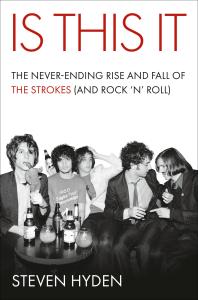
From an acclaimed music critic and author, an in-depth analysis of the rise and fall of rock n’ roll through the lens of one of the best albums of the 21st century—The Strokes’ Is This It.
In 2001, The Strokes broke into the indie alt-rock scene with their debut album Is This It, a work that was supposed to “save” rock music from the evils of nü-metal and teen pop.
It did not.
Despite the album’s countless accolades and acclaim from critics and fans alike, it failed to break into the mainstream like Nevermind did a decade before, and the band never reached as wide an audience as they’d hoped. But then why is it that no other rock band from the 21st century has captured the mystique of The Strokes? And how did a band defined by their repeated failure gain such a transcendent and enduring allure?
In Is This It: The Never Ending Rise And Fall Of The Strokes (And Rock ‘n’ Roll), music critic and author Steven Hyden provides keen insight into The Strokes’ tumultuous longevity by turning a socio-cultural and critical lens on their entire career, as well as the careers of their contemporaries: The Killers (more successful but less cool), Kings Of Leon (the southern Strokes), The White Stripes (their friendly rival), The National (the tortoise to The Strokes’s hare), and more. Hyden uses The Strokes’ classic album Is This It as a vehicle for examining rock’s radically changing role in pop culture over the last twenty-five years, and explores how while rock music may rise and fall, it—much like The Strokes—will never die.

An intimate, behind-the-scenes glimpse into life as the rhythm guitarist, songwriter, and co-founder of the all-female, multi-platinum-selling band the Go-Go’s—both onstage and off.
The Go-Go’s were the first all-woman rock group to hit number one on the Billboard charts while playing their own instruments and performing original songs. As guitarist and lyricist, Jane Wiedlin helped define that revolution. In her memoir, she shares the raw, unvarnished journey of an artist who overcame it all.
From the early L.A. punk scene, Jane’s song “Our Lips Are Sealed” catapulted the band to fame. The Go-Go’s hit dizzying heights, only to splinter apart in a whirlwind of touring, tension, and chaos rivaling any band of the era. Yet Jane’s story goes far beyond the stage.
TMI is a vivid account of rock excess and Hollywood drama. Jane opens up about childhood tragedy, mental health struggles, shattered relationships, and her own relentless reinvention. She tells how she taught herself music from scratch, worked as a “slave” in a world-famous BDSM dungeon, and became the world’s first atheist minister. Through it all, Jane Wiedlin’s story is as candid, defiant, and unforgettable as the music that defined a generation.