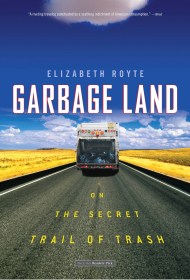
I was never really obsessed...
I was never really obsessed with garbage, which makes it hard to explain why I spent three years researching, pawing through, and writing about trash. Like most movie-goers of the mid-Nineties, I was amused by Andie McDowell's musings, in Sex, Lies and Videotape, on the fate of the nation's landfills. But I was more worried about species decline and disappearing habitat than filling up discreet holes in the ground with banana peels and old socks. Then one day I met a Columbia University professor who was studying what she called New York's coffee footprint. The city had a footprint?
It turned out that we drink so much coffee here that our bean-buying decisions impact hundreds of thousands of faraway acres. An ecological footprint, I soon learned, totals the flow of material and energy required to support any economy - or subset of an economy, like latte sipping - and then converts those flows into the total land and water surface area that it takes to both provide those resources and assimilate their waste products.
Do we have a garbage footprint? Indeed, we do. We are eight million people, and we send all our detritus - metal cans, junk mail, potato skins, rags, double A batteries, and empty shampoo bottles - away.
(Other cities do the same, and they are doing it more and more: the rate at which we throw stuff into our trash bins has nearly tripled since 1960.) Where does all this stuff go? And what happens to it once it gets there?
It was easy to get answers, of a sort. "Oh, we recycle them," sanitation workers said when I asked about my tuna cans. Well, what are they turned into? And where does this happen? The san men, as they're called, didn't know. And so I started to follow my trash, which I divided into four separate streams: recyclables, stuff I could compost, so-called household hazardous materials, and the rest, which went under the charming nineteenth-century name of "putrescible waste."
But there was another great waste stream that began in my house: the one connected to my bathroom pipes.
The question of whether to put a used tissue in the trash can or in the toilet had long gnawed at me (perhaps a gnawing on par with that experienced by the Andie McDowell character). Which would be more environmentally benign, to flush my Kleenex or to toss? To find out, I had to learn what happened to paper if it went in with putrescible waste, in with recyclables, into the compost pile, or down the pipe. In what was arguably the least glamorous branch of my research, I visited my wastewater treatment plant and followed its dregs upriver to a plant that cooked and dried sludge into tiny pellets used to fertilize much of the produce I regularly consume.
Where should you put a used tissue? Read my book and find out.
Copyright © Elizabeth Royte