Since the early 1990s, I've...
Since the early 1990s, I've spent lots of time digging around the manuscript files of various libraries, visiting old friend from the past. Too much time. There they are again: Abraham Lincoln, Ulysses Grant, Jefferson Davis, Stonewall Jackson. It's an eerie, almost electric feeling, holding their musty letters in your hands and reverently walking them up to a photocopier to gently lay them down and make an impression to take home. In nearly every case, with the thousands of letters, of military orders, of hastily-scrawled battlefield notes, the pattern of what you know - of what you ve seen before - from reading about the subject holds true. You know Lincoln and Grant, Davis and Jackson, and pretty much everything they did holds true to character.
After sifting through mountains of this stuff, however, a rather surprising number of records about the Confederacy began to stick out. An amazing number of documents from government officials - Congressmen, military bureau chiefs, state governors, and the like - revealed a stubborn inability to cooperate with the Jefferson Davis government. On all sorts of levels. About almost anything. It became increasingly clear that the much-vilified Jefferson Davis was fighting two wars, one against the Union and another against many of the people who were supposed to be helping him. The senior officials of the Confederate States of America, it seems, had been trained so purely in "state rights" that they not only failed to support the old Union government in Washington, they also failed to support the national government of Davis in their own creation, the Confederacy.
The irony here was amazing. Surely there have been arguments and dissension in every war, and on the Union side of the Civil War too. But the striking thing here was that, while Lincoln and his associates constantly tinkered with the formula to get things right, Davis and the conservative thinkers who ran the Confederacy seemed unable to experiment, to adapt, to get the formula right. They were mired in a sea of petty disagreements and an inability to "all get along." This was a story that exists in the primary documents scattered throughout library collections and one that has been hinted at and even debated from time to time in the academic literature; no popular book has yet told the story. Being a Yankee boy who previously wrote about the battles on the fields, this was a story I would not necessarily have chosen of my own accord. But the story was so compelling, and amazing, that it had to be told.
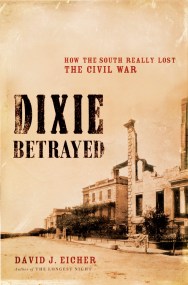
So for the last several years I found myself scurrying into more document collections and digging into the congressional record of the Confederacy's House and Senate actions. This exercise led to Dixie Betrayed: How the South Really Lost the Civil War. In it, for the first time, is the stark record of a hundred arguments over supporting the Confederacy at large versus one's own home state; central powers versus state rights; the power to commission military officers; the civil freedoms of individuals during wartime; conscripting troops; military appointments; peace proposals; and what was until the end unthinkable for most Southerners - arming slaves to fight for the South. It's a story so full of irony and sad failure that it exposes critical weaknesses the Confederacy caarried all along; it also underscores the strength of the dream of a Confederacy, a remarkable achievement in itself: the idea of a Southern Nation burned so brightly in the hearts of Southerners that it made the dysfunctional system between Davis and his associates move along for four long years before succumbing to the Yankees.
Copyright © Dave Eicher