On influences: I would have...
On influences: I would have to say that among the writers I most admire, there is none I admire more than Joseph Conrad.
I'm afraid I read very little contemporary fiction and prefer instead things written by writers long since dead. This, as you may imagine, presents certain difficulties when it comes to reading things I have written myself.
I don't know if its important for a writer to stay current with film or music, or any of the other arts. I tend to doubt it, but that may be because I have serious reservations about the current state of the arts altogether.
On his early work: Do I look upon my 'early unpublished work with affection?' Yes, in the same sense that some people love their children, no matter how stupid and ugly they might be. It took me some time to learn the difference between writing the sort of non-fiction things which I had had published and fiction. In part, it's the difference between telling someone that something happened and showing how it happened. In a non-fiction piece, for example, you can write that a lawyer who lost at trial was very depressed about the outcome. In a work of fiction, you need to describe the way in which it changed the way he looked, the way he felt, the way he talked, to say nothing of the things he did and the things he thought.
On violence: Violence can often be handled off-stage, as it were. In writing about a murder trial, for example, the murder has already taken place. Both violence and sexuality have largely lost their power to shock, which was never a very good reason for writing about them in any event. It seems to me that you ought to leave something to the reader's imagination, because if you don't, you're not likely to engage the reader in the first place.
On working methods and inspiration: Every morning, for several hours, I write long hand with a fountain pen on long lined legal pads. I have never been able to write anything, except an occasional letter, on either a typewriter or, now, a word processor. As distinguished from a word processor, where everything you write stares back at you from the screen, the movement of the pen from left to right helps the mind to concentrate on the next thing you need to say. Because my handwriting is illegible, I then transcribe it onto the word processor, and make changes as I do it.
I think you have to write every day, or nearly every day. Inspiration, if it comes at all, comes only at the point of a pen. In my case at least, nothing is ever quite the same as I think it is going to be once I start to put it down on paper. That does not mean that everything you put down on paper is worth keeping. The two most important possessions for a writer are a pen and a good book of matches.
On the appeal of his work: I would like to think it is because the characters seem both real and interesting; and because at least some of them carry on the kind of conversation we would all like to be part of.
On his work itself: Character is more important than plot, simply because if you don't care about the characters you're not going to care very much about what happens to them.
The Defense, The Prosecution, and my third novel, The Judgment, are all set in Portland, Oregon. The fourth novel, The Legacy, which will be published next year, is set in San Francisco.
On his audience: I'm not sure I do either one. I learned a long time ago not to write what I thought someone else might want to read. In that sense, I suppose I write for myself. But what I'm really trying to do is write as if I were explaining something to someone who was very serious about wanting to know it.
On the importance of reading: Precisely because there are so many other things thrown at us from so many different directions, reading is, if not more important, than certainly as important as it ever was. Reading requires, and teaches, a discipline that the more passive mediums of television and movies do not.
On monastic solitariness: Let me answer this in what may appear a rather oblique fashion. A writer should be someone of whom it could be said that he was never less alone than when he was alone. Someone else - someone famous - said that, but I can't right now remember who it was.
I would think that a religious sense, or at least some sense of the mystery of things, can only help a writer. For a certain kind of writer it is essential.
On Writers as commodities: It is terribly unfair and absolutely unavoidable. Someone has to sell what we write; that does not mean you have to write what you think might sell.
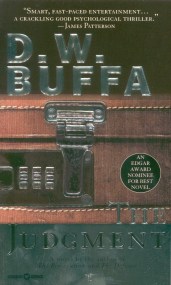
On The Judgement: The Judgment tells the story of someone sent to an insane asylum supposedly so he can avoid going to prison for a crime he may not have committed, and what happens when he realizes that he may never get out. As you probably have already guessed, it is entirely autobiographical.
Copyright © D. W. Buffa