
Excerpt: THE TRICKY BUSINESS OF FAERIE BARGAINS by Reena McCarty
A former changeling must return to the land of the Fae to right a bargain that’s gone terribly wrong in this delightful cozy fantasy debut packed full of charm, adventure, romance and heart.
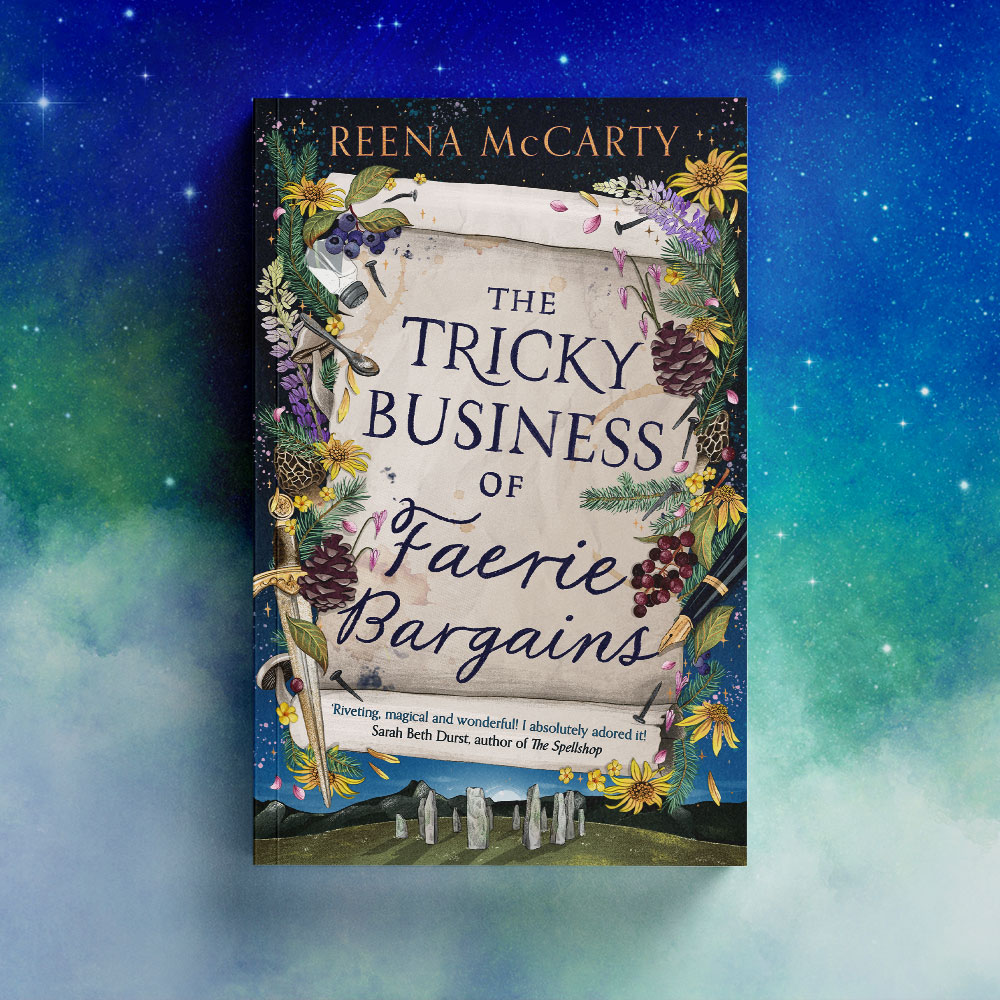
Read an excerpt from The Tricky Business of Faerie Bargains (US | UK), on-sale April 7th, below!
Chapter One

The client was too focused on Gloria to even look at me as I settled into my spot in the small conference room. I couldn’t blame her. Gloria was tall and eye-catching and wore a suit that cost more than my yearly stipend, and I’d spent basically my entire life trying to be as invisible as possible. Still, in my experience, not paying attention to your surroundings often led to sudden, painful death. Our clients were usually at least a little self-centered, but I was always amazed at their lack of survival instinct.
My chair was comfortable enough to sleep in—the whole room was designed to look safe and homey, all overstuffed furniture and big plants in the corners, with light streaming in through plate-glass windows and illuminating the mass-produced watercolors on the walls. Carter Lane had artists on staff who’d spent literal centuries perfecting their craft, but the conference rooms were decorated with prints so generic they might as well not be there at all.
“I just don’t see why this is necessary,” the client said. “I’m not asking for much—a basic policy. I know you have a faerie ready for me, just sign the thing and let me get on with it!”
Gloria looked at me, her dark eyes heavy with a blend of exhaustion and grim amusement. The two of them had been going in circles for nearly three hours before I joined the meeting and she was clearly starting to lose her patience.
“Ms. Cowl,” she said, “you are legally required to insure your bargain before you make it. In order for Carter Lane to sell you that insurance, your terms must pass muster with both me and my associate here. Furthermore, a loophole in your deal is an opportunity for whichever othersider”—she emphasized the term just enough to make the client frown slightly—“you bargain with to exploit you.”
The client rolled her eyes. “I just want an Oscar. Fix it so I get one.”
Right. Felicity Cowl, actor. I should have remembered—actors always had too much hair and too many teeth. I’d read her first attempt at a contract—it was so poorly worded Gloria had sent it back without even a meeting. Asking for an Oscar—not specifying that meant an Academy Award or that the desire was to win one on merit—had the potential to end with a confused and angry man named Oscar dumped into your lap. More likely the othersider would just snatch a statue from someone’s trophy case, hand it over, and call it a day. The newest version wasn’t much better.
“Poppy? Will you walk her through it?” Gloria sounded so fed up I half expected her to crack a tooth from grinding them too hard. “I need to take a call.”
The lie was so obvious even the client must have seen it, but I grinned and waved her away. “Sure thing.”
Gloria was one of the best Otherside lawyers in the country, but she had almost no patience for client bullshit. In her defense, she had to put up with more than most—all those people raised on old-timey Hollywood pap about faeries and Indians living in harmony tended to get way too excited when they realized the lawyer assigned to their case was Blackfeet.
Not this one, though. “I want my own lawyer,” Felicity said. “Seriously. He was doing fine.”
“He was an idiot. I read that contract, and you would have been in six different binds if we’d let you sign it.”
Felicity eyed me, suddenly paying me all the attention she hadn’t bothered with before. “You’re one of them, aren’t you? A changeling? They said I’d get a changeling on my case.”
“A changeling is an othersider or construct left in place of a human child. They weren’t ever in common use in America. When they stole babies here they just took them.”
She leaned forward, a new gleam in her eyes. “But you did live there? Otherside?”
“I did. So when I tell you this contract’s trash, you need to listen. Got it?”
The actress frowned again, but she sat back, arms folded across her chest. Not eager, but not arguing at least.
“OK. Let’s take a look at what needs fixing. There’re two main problems—this is still too loosely worded, and you don’t got a firm enough grasp on what it is Othersiders can actually do. Asking to win an Academy Award for acting—that’s fine. Good, specific—no problem there. But you also have here that you want them to give you the talent you need to win.” I sighed and set the paper down. “That’s just foolishness. Creative gifts can’t be given. They can give you technical skill—learned behavior can be swapped from person to person easily enough. They can also give you glamor or charisma, or something else that’s just perception; but creativity is something that separates us from them. They don’t have it, they don’t understand it, and they certainly can’t give it to you. If your lawyer was worth his feed he’d have told you that.”
Felicity’s eyes were shimmering by the time I finished, and I suppressed the urge to roll mine. It wasn’t my fault she hadn’t bothered with research.
“Look. Talent’s irrelevant. You probably have plenty.” A lie, but one she wanted to hear. “What you need is to get noticed. Remembered. We change ‘talent’ to ‘charisma’ and it works just fine. That’s not your biggest problem.”
“What is?” She leaned forward, all that glossy hair nearly brushing the table top. I wondered if all of it was hers, or if some of those blonde waves started out on someone else’s head.
“No time constraints.” I tapped the paper with the end of my pen, frowning down at the tiny print. Gloria should have seen that one on her own. “There’s nothing here saying you have to win this award in the next year, or the next five, or ten, or fifty. Technically, there’s nothing here that says you have to win while you’re alive—you could be paying your whole life and be honored posthumously.”
“Oh God.” Felicity shook her head, and the tear level in her eyes rose high enough that I was outright concerned. “No. That’s not—the whole point is—”
“It’s an easy fix. Depending on how you’re planning to pay them you either set a period of time—seven years is the most common length for this type of bargain—where you work for them, or you just make a direct trade and get it faster. Do you want to keep the charisma after you get your award?”
“I…” Felicity looked dazed. She had no control over her face, and I couldn’t help but think that might be one of the reasons her career wasn’t what she wanted it to be.
“I’ll add that. Permanent charisma. Which brings me to the payment.” I leafed through the contract, as if I didn’t know exactly what I was looking for. “A script from every film you work on from now until you win. You can’t pay for this sort of thing with someone else’s work. Unless you’re writing them, scripts won’t cut it.”
The tears spilled over exactly on cue. I pushed a box of tissues across the table. They were standard in every conference room. Almost every client got teary at some point.
Felicity was a pretty crier, not blotchy or snotty. Her mascara must have been waterproof, since it didn’t budge. It was too bad she’d never be willing to trade her beauty. She’d be able to get plenty for that.
“I don’t have anything else,” she said, her voice muffled by the tissue in her hands. “If I had anything—if I was talented—” She took a loud, gasping breath. “This is all I’ve ever wanted.”
I shot a glance at the door, trying to force my eyes to see through the dark wood. The one downside of Gloria being good at her job was that sometimes she was a little too sharp. Twice before she’d noticed when I tried to nudge a deal one particular way, and both times she’d renegotiated before it could be completed. I didn’t think she suspected it was on purpose—I worked hard to make sure I didn’t come off as too smart—but if I did it too often, she’d start getting suspicious. It was a risk, but considering how fed up she was with Felicity, I thought she’d let it slide.
“You can have it,” I said. “You’ve got plenty to trade.”
“What, money?” Felicity eyed me. “My lawyer said they don’t care about that.”
“Not money.” It was nice to hear her lawyer hadn’t been completely stupid. “Time. Labor. Yourself.”
“My—” Her face went white. “You mean prostitution?”
I sighed. I wanted to grab her by the shoulders and shake her, but I actually knew how to keep my emotions in check. “Not unless that’s what you choose to do. I mean your labor. Your talents, really. Otherside is always looking for actors. Artists. Talented people who are willing to share their gifts outside of the human world. Creativity, remember? They crave it.” I was laying it on thick, but she took the flattery as her due. “It’s the quickest way. If you do your seven years Otherside—”
“What? Go there?” She shook her head, utterly rejecting the idea. “I can’t—seven years away—I won’t win an Oscar, I’ll be forgotten! I’ll be old!”
“I was born in 1875,” I said. She stared at me like I was gibbering. “I went Otherside in 1880 and came out three years ago. Best the doctors can tell, I’m in my late twenties. Time works differently on that side of reality. Aging is relative.”
Felicity blinked at me. “What are you saying?”
“Seven years of service Otherside—seven years to hone your craft away from human eyes—in return for overwhelming charisma, and you’ll be returned to the human world no more than a week after you left. You won’t be old. You’ll probably age less there than you would in a week here. We’ll put the Return time in the contract.”
“I don’t know.” She’d perked up when I’d tossed in the “hone your craft” bit, which was good. It had been a gamble, but a small one—generally the ones who fancy themselves serious artistes don’t try to cheat, but even the hacks like to think they’re in it for something more than just money and fame.
“We can always look for something else to trade,” I said, keeping my tone casual. “Can you play an instrument? Sing? Dance?”
“No, I’m totally tone deaf. I took some dance classes, but I’m not good at it.”
“What about art? Can you paint? Draw? Sculpt?”
She shook her head, her eyes filling again.
“I suppose you could trade your beauty.” I barely even tried to hide my smile as she shook her head at that one. I knew she’d never consider it.
“Can I think about it? The seven years?”
I let the smile out. “Take all the time you need.”
I slipped out of the conference room, leaving Felicity to ponder her choices. Gloria was sitting in my office, clutching a mug of coffee like she thought it might escape if she set it down. She looked up as I stepped inside, her eyebrows raised. She was pretty, with a heart-shaped face and a high forehead. Most of the people at Carter Lane were pretty. Clients, like othersiders, preferred it that way. Right then, though, Gloria mostly just looked tired.
“Were you able to get through to her?”
I shrugged and sat down at my desk. I pulled a bag of cookies I’d baked the night before from the top drawer and handed it to Gloria. “Maybe. She don’t got a lot to work with.” I leaned back in my chair. My office—technically only half mine, since every other week I was in how-to-be-a-modern-human class and the desk was occupied by a Northern Court Returned called Hester—was barely more personal than the conference room, though at least our decor wasn’t bought wholesale. It was a tiny room, with nothing more than a desk, bookshelf and visitor’s chair that kept the door from opening all the way if you pulled it out enough to sit in. Still, the art on the walls was real—two paintings done by my hallmates, and a framed photograph of the view from the summit of Roger’s Peak. The Reality version. No castle in sight. That one was behind my desk, so I didn’t have to look at it.
“They never do. What kind are these?”
“Chocolate—chocolate chip with dried cherries.”
Gloria took a bite and closed her eyes for a moment, smiling even as she chewed. “Absolutely perfect. I don’t know how you do it.”
I let her see me smile, but only for a second. The last few months we’d been teetering on the edge of actual friendship—she’d talked me into a weekly yoga class, and I cooked us dinner every other Friday—but there was still an invisible line separating us. I lied to her too much for anything real, even if she didn’t know it.
“She won’t trade her looks and she’s got no other talents,” I said. I broke a piece of cookie off in my hand, feeling the bend. Not quite enough. It was good, but perfect? No. “I don’t see much choice other than time.”
“I hate doing that.” Gloria reached for the bag and I pushed it toward her. “It always feels wrong.”
“If she wants this, she has to have something to give. You saw her offer. Scripts?” I shook my head, trying to look regretful. “Time’s all she has. I know it’s not preferred—”
“The risks are just so high there. I know you know.”
“It’s different for them that bargain their way in.” My voice was stone-steady, even warm. Sloan would be proud of me. “Even in the old days it was different. Bargainers get safeguards. But if you can think of something better…” Another gamble. Gloria’d gone back and forth with Felicity for long enough that if she had a better idea she would have used it, but there was always the risk of a last-minute brainwave.
She took a third cookie. “I still don’t like it.”
“Neither do I.” I met her eyes, sincere as could be. “But what else can we do?”
Gloria sighed. “You’re right. If she agrees, I’ll sign off on it.”
I nodded. “Give me that bag. You’ll spoil your lunch.”
“Pretty sure this is my lunch.” She took a final cookie, then handed me the bag. “Are we still on for dinner?”
“If this gets wrapped up in time for me to cook.”
“That’s one way to motivate me, I guess. I’ll get back in there and see what she’s decided.”
By early afternoon I had the formal draft of the contract on my desk, and it was finally time to do my actual job, the thing—on top of the lucrative government contracts that kept us fed—that made it worth it for Carter Lane to take on the task of reintegrating Returned. Housing us, educating us, and helping us get all the documents we needed in order to live normal, productive, twenty-first-century lives was a small price to pay for our decades of lived experience. They made sure we knew how to ride an elevator and we made sure every single one of their contracts was clear as crystal and safe as stone. No problem phrases or gray areas that could be turned around and used against the clients, no forgotten clauses or accidental double meanings that gave the othersiders a chance to take advantage. Carter Lane had only paid damages on three contracts in its ninety-year history, and they planned to keep it that way. There were plenty of firms that traded with Otherside for material goods—copper was copper, no matter what world it came from, and no one cared about things crossing Reality so long as they were paid for with something tangible—but magical bargains were different. Highly regulated. Still dangerous. Carter Lane was the only company in America with dozens to hundreds of Returnees on staff, and there was no way to be even close to safe without our expertise.
I loved being the one to sift through the words and find the secret traitors, the little bits of phrasing that a normal human wouldn’t even consider as having more than one meaning and changing them so the othersider doing the bargain couldn’t twist them into a trap. It was stressful, and on those contracts where I knew I’d nudged the person over to a slightly worse stance than necessary I sometimes felt a little bad. Still, it wasn’t my fault they decided to try and cheat their way to success, and it was still my job to make sure they didn’t get tripped up by accident. It was one thing to trade yourself over for a few years of labor, and another thing entirely to be stolen away for good because some office drone misplaced a comma. No matter how skilled Gloria or any of the other lawyers were, they would never be as careful as one of us who’d lived there. There was nothing like the bone-deep knowledge that the wrong words could worse than kill you to make you determined to find the right ones.
Carter Lane might not like sending their clients Otherside, but even without my nudging it happened often enough to have standard language already in place, and it only took a couple of hours to make sure Felicity’s contract was perfect. I sent it back to Gloria, who did a final legal check, and by the end of the day it made it to the money men, who set the payout price of Felicity Cowl’s bargain at five hundred thousand dollars—if something went wrong, if the Othersider found a way to twist the contract and cheat their way out of the bargain, Carter Lane would have to pay Felicity—or her designated beneficiary—for the error.
I looked once, after my first semester of Economics, Credit and Finance, to see what it cost to buy deal insurance. I’d been sure I misunderstood—no one used money Otherside, and it took me a good while to really get a feel for it—but Gloria confirmed I had it right. It was one of the reasons I didn’t ever feel too bad about sometimes sending people over on purpose. No one who came to Carter Lane was being kicked around by life. Sure, they might not have won the awards they thought they should, or the girl they’d set their eye on might not know their name, but most people didn’t come with real problems. They wanted fame, or beauty, or fabulous wealth—but no one who could afford what Carter Lane was selling actually needed help. The only exceptions were the ones looking for healing, and I always left them alone.
I got word from Gloria just before four—the contract had been accepted, and the bargain was to be made first thing in the morning. A quick turnaround—most of the time it took weeks for all the various departments to come to an agreement—but Felicity Cowl must have thought she was too good to wait, since she’d paid extra for expedited processing, even if it meant we all had to work on a Saturday.
It didn’t matter. There was plenty of time for me to do what I needed to, and until three years ago I’d never had a weekend in my life.
Chapter Two
I left the office at four thirty exactly. It was hot for June, and the back lawn was already starting to yellow. The Carter Lane bigwigs were all hung up on maintaining a natural environment, landscaping with native plants, and not forcing grass to be green. The campus sat right in the middle of the prairie, thirty miles from the Rockies with a sea of rolling hills and stark buttes all around, and they didn’t want it to stick out more than necessary. It was a mile long and a mile wide, with a big, lazy loop of the Sun River cutting right through the middle. The front edge, just off Highway 200, was offices, a gas station and a whole lot of parking. Building One held the business side of things: insurance offices, finance, legal, and the client meeting spaces, along with the offices used by Returned consultants like me. Building Two was administration, and Returnee services—the classrooms, library, and a whole floor of health services, both physical and mental. Carter Lane was too aware of its reputation to allow any of its oh-so-precious Returned-from-Faerie charges leave without a clean bill of health and a lot of mandatory therapy.
All the other buildings—employee dorms, a small movie theater, and a cafe-slash-grocery store—were tucked farther back on the property. There was a walled ritual space right behind the offices, but otherwise the grounds were open. If I had to be honest, I’d admit they were nice—lots of green space and wildflowers, trees and water and plenty of pretty places to walk and sit and think. The river was slow and mostly no more than waist deep, lined with cottonwoods that kept the water cool, even on the hottest days. The whole place was carefully designed to promote healing and calm, since most of the people who lived here were monumentally screwed up.
It’s a traumatic thing, to fall asleep Otherside and wake up alone in a stone circle, back in Reality with no warning. It’s worse for the ones who were older when they first left the human world—I could barely remember my parents or my life before Otherside—but for those who were taken older, it could be difficult to come back to find a different world with everyone they ever loved dead and gone. Especially once they realized that in order to build back any sort of life they had to move to the middle of nowhere and take classes on technology and pop culture and all the history they missed. Not to mention the part where, in return for this education, they were required to spend three years helping other people—rich, successful people who had the option never to go near an Othersider—make deals for the most trivial shit imaginable.
Who could really blame any of us for just wanting to wander around in the grass and stare blankly into the middle distance for a month before we oh-so-gratefully started to get on with our lives?
The river was sparkling blue—a trick and a lie, I’d never once set foot in the water without coming out muddy—and the banks were white with tree cotton. It filled the air, too, swirling up on breezes too faint to feel.
I sneezed. I wasn’t even allergic to the stuff, but just looking at it made my eyes water.
I pulled off my shoes and socks and stuffed them into my bag, then, after a quick look around to make sure I really was alone, shimmied out of my khakis and draped them around my neck. If anyone saw me, I hoped they’d be too distracted by my legs to figure out what I was really doing. I wouldn’t normally risk this right after work, but if I waited until dark it might be too late.
I sloshed along the riverbed, my feet sinking into the mud with every step, until I got to the spot where the cottonwoods gave way to a single enormous ponderosa pine, a mountain tree, meant to grow in high, dry areas that had no business on the riverbank. Every day I thought someone would question it, but no one ever had. The tree’s roots arched up over the water, an impossible tangle that held permanent shade. The bank rose up to my shoulders, carved out and totally private, unless someone stood directly across from the tree. Up close, the smell of woody, dusty vanilla was so strong it seemed like it would seep into my skin and hair and stay like smoke. The roots were wet and dark, forbidding in a way I had to grit my teeth to get past. The magic was subtle enough that most folks would just stay away, but obvious to anyone who’d felt it before. There was no way I was the only one to notice, but I never saw anyone else at the tree, so I figured no one in authority cared enough to do anything about it.
I took a deep breath and reached up under the tangle of roots into the hollow hidden inside. I groped around for a few seconds, getting mud on my arm and shoulder, before my fingers closed on something cool and heavy. A bronze pinecone the size of my fist, its scales flat and closed. I pulled it out and glanced around again, just in case someone had come up behind me, then shoved the pad of my thumb against the tiny needle at the pinecone’s tip. I had to look away when I did it. Blood didn’t make me faint like it used to, but if I thought too hard about it, I still got a little dizzy.
The pinecone’s scales opened one by one as my blood reached them. Once they’d all unlocked I twisted the thing apart, the two halves separating to reveal a small empty space inside. I pulled a folded note from my bag and tucked it in, then rejoined the two halves and dunked the cone into the river to rinse the blood away and make it close back up before I returned it to its spot in the roots. Job done. Message sent. When Felicity went into the circle tomorrow, Sloan would be there to take her away.
I knew it was wrong, both morally questionable and flat-out against the rules. Official Carter Lane policy said no employee was to have casual contact with othersiders. We were supposed to focus on the here and now, on learning how to live in the world and make human connections. We were supposed to forget everyone we ever cared about Otherside, pretend we didn’t have friends there, imagine there was no one left behind when our time was up and we got sent back “home”.
Over a hundred years there, plenty of them happy, and Carter Lane—not to mention the US government—wanted me to just forget. Move on. Focus on learning, catch up on my history, study how humans blew across this continent, torturing and killing each other, poisoning the land, breaking promises and treaties and telling lies and banding the ground with iron to keep the evil faeries away, and then smile and be happy that I’m finally here and not back in the uncivilized Otherside.
Otherside had its share of horrors, but at least no one there tried to lie about it. They never tried to make me forget my friends.
I waded until the bank lowered enough for me to climb out. I was wet, but it was late June, and hot enough that I could scrape off the worst of the mud and get dressed again in only a few minutes. Barely even a delay before walking the last quarter mile home.
The residential area was at the very back edge of campus, almost a full mile from the highway. I’d only been in my apartment for a few months. For the first three years at Carter Lane it was all roommates and communal dining and learning what a computer was in the newbie dorm. I’d finally managed to get my GED and pass the licensing test to start working with clients, which came with the freedom to move to an actual apartment. Alone.
There were four residential buildings—the dorm, two identical apartment blocks with weathered beige siding and a smaller, more hotel-like building that housed out-of-state clients and the occasional day staffer who didn’t want to drive home.
The lobby of my building was cool and dark, and, thankfully, empty. I didn’t bother checking my mail—everyone I knew in the human world lived here, and none of them would send me letters—and hurried up the stairs and down the hall, past the rows of closed doors to the very end. A handful of the doors in my hall had decorations—wreaths of flowers, fancy knockers, bright door mats set on the scuffed wood floor—but mine just had a metal number and my name typed on a paper card and set into a plastic nameplate. 4D. Poppy Hill. It wasn’t the name I had Otherside, or, probably, the name I was born with, but “Hill” was the default for anyone Returned without an official identity. Thanks to Carter Lane I had papers, but it meant I was stuck with a name that sounded more like a picnic spot than a person.
The apartment was nice enough on the inside. Being at the end of the hall meant it had lots of windows. They looked out onto the gardens from the living room, and the mountains from my bedroom. My kitchen was small, but at least I had one. The living room came with an overstuffed couch and a big TV, and my bedroom had a separate study nook with a desk and bookshelf. Finishing my GED just meant moving on to part two of the Carter Lane reentry program: Life Skills. I’d always believed I’d been lucky to grow up in the Wild. In Summer they weren’t allowed to have personal relationships, the Eastern Court was just a megacity full of sadness and factory labor, and in the Northern Court it never stopped raining. And yet, the queen of Summer loved movies and TV, and had some sort of magic setup for showing them to her people. No Media Studies needed there. Those Returned from the East knew all about public transportation and rental apartments, so they got to skip Urban Life Basics. The Northern Court was so devoted to education that almost a third of the Carter Lane clients were scholars trying to get into their universities. Every one of their Returned came out with what I was assured was a world-class education, including a solid understanding of Politics, History and Law.
I might have had freedom and love and sunny outdoor days, but now I was enrolled in every single stupid class. They couldn’t possibly let me out into the world without a solid grasp of pop culture. How would I live?
I left my bag on the couch and made my way to my bedroom to change out of my work clothes. I was tempted to call Gloria and tell her I was just going to go to bed, but if I could tell my therapist that Glo had come for dinner, she might get off my back for a week or so about the need to “make human connections”.
The one thing about the human world I could fully endorse was the kitchens. Steel knives had been an absolute revelation—even the cheap ones that came with my apartment were so much easier to use than the bronze ones I grew up cooking with. Steel knives, and cast-iron pans—absolutely forbidden Otherside—and being able to salt everything without worrying that the wrong person would eat it and damage their magic were all almost worth it.
Cooking, as always, helped settle me down. In this, if nothing else, I had complete control. I shredded chicken and set cumin and chipotle and onion sizzling in butter on the stove. I seasoned black beans and diced tomatoes, reveling in the smells, in the simple actions that I knew would result in something delicious.
I’d laughed the first time I heard someone earnestly say that eating faerie food would trap you Otherside. Somehow the joke had made it across Reality, but not the punchline—faerie food is like hen’s teeth. Othersiders can’t cook any more than they can paint, or dream, or design a new type of water pump. Everything made is made by humans. A human looking at eggs and butter and flour can see the potential for a half-dozen things, cookies or cake or brioche, soufflé or pancakes or a shiny pie crust. An othersider could only ever see eggs and butter and flour. I tried to teach Sloan a dozen times when I was a kid, and the most she ever managed was scrambled eggs, and even then it was only with me telling her the next step every time she had to take one.
There was a knock on my door and I opened it. Gloria smiled at me, and held up a pint of ice cream. “That smells amazing.” She kicked off her sandals and went to put the ice cream in my freezer. “What is it?”
I grabbed a sheet tray out of the cupboard and covered it with tortilla chips. Store bought, but not everything could be perfect. “Nachos.” Cheese. Toppings. Oven. “I was feeling lazy.”
“We have different definitions of lazy.”
I smiled, my hands moving almost automatically to open an avocado for guacamole. “I used store-bought chips. And cheese. I don’t have the right sort of setup here for serious cheesemaking.”
“I take it back. You’re lazy after all. Can I help with anything?”
I shook my head. “It’s faster if I just do it. But if you want to pick a movie?” Even after three years, with tech instruction starting almost immediately, I still hated having to set up the TV. I was competent enough with my work computer—I might never be the world’s fastest typist, but I could manage, and I even used the internet sometimes—but the television made me nervous. It was so large and black, like a spelled window with who knew what lurking on the other side. The remote had too many buttons. Half the time I forgot how to make the sound come on.
Gloria turned it on like it was nothing and pulled up the Media Studies streaming menu. “Is there something specific you’re supposed to watch?”
I squeezed a lime into the mashed avocado. “We’re on eighties teen comedies, but I hate them.”
“Blasphemy.”
“They’re awful. It’s all ‘Derek finds out he was conceived due to a faerie bargain and if he don’t lose his virginity by the stroke of midnight on his eighteenth birthday he’ll be taken away to Summer’ or, ‘Erica turns sixteen and realizes she was a changeling all along’, but it’s all about her glamor failing in front of her crush and having to win the cheerleading competition even though she’s suddenly nine feet tall and nothing at all about how she would immediately be sent back to her home Court when she was outed.”
“The first time I realized Erica was going to switch to basketball I literally stood up and cheered.” Gloria sounded like she was trying not to laugh. “These movies are classics.”
“They’re stupid. And offensive. And no othersider would ever agree to attend human high school.”
Gloria shook her head. “It’s really sad that you have no taste.”
I rolled my eyes. “You come to my home, I feed you, you insult me—what exactly am I getting out of this relationship?”
“My undying support. If you don’t open a restaurant when you’re done with your contract it will be the biggest waste of talent since…” She waved her hand. “I don’t even know.”
My smile must have looked more genuine than it felt, because Gloria didn’t seem to register anything wrong. The idea of finishing my contract and making my way out into the human world, away from Carter Lane and any contact with Otherside—I couldn’t think about it.
All the other Returned were happy here. Grateful. Everyone else in that awful first year of group therapy talked about Otherside like it was a prison and they couldn’t believe they were finally free. They seemed so glad to be here, even if they’d only ever lived there. The only broken one was me.
“Nearly two years to go yet,” I said. “Maybe I’ll find a new passion. Elevator repair. Computer programming. Who knows? I might even take the extension. Genealogy and college prep? It’s a good deal.”
“I guess I can see why you wouldn’t want to rush. You spent a hundred years cooking for a living in a way more literal way than just running a restaurant.” Gloria shivered. “Sorry. And hey, the extension would be three more years hanging out with me. An obvious win.”
“For sure.” I’d made sour cream three days ago, and I knew it was somewhere in my fridge.
“What do you think they’ll do to her?”
“Huh?”
Gloria tossed the remote onto the couch and settled on one of the kitchen chairs, legs crossed at the knee. Her toenails were purple and shimmered in the light with iridescence that reminded me of fish scales. I never expected Gloria to be so whimsical.
“Felicity Cowl. Seven years Otherside. What do you think she’ll have to do?”
“Oh.” I shrugged and peeked into the oven. Almost. The cheese was melted, but I wanted the edges to be crisp. “I don’t know. Depends where she ends up.”
“We’ve already gotten a request for her. Wild Court.” I could feel Gloria watching me, hoping for a reaction. I just smiled. Calm. Easy. Sloan got my message.
“The Wild’s a big place. She could do a lot of things.”
“I just thought she’d go to Summer. She’s an actor.”
“Just because the bargainer is coming from the Wild don’t mean she’ll end up there long term. You know there’s a lot of internal politics about who gets to actually do the deals.”
“I just worry. Always. I hate sending people over.”
I grabbed a kitchen towel and pulled the tray out of the oven.
“Sometimes we got no choice. Grab me some plates?”
Sour cream, salsa, guacamole. I hadn’t missed anything. The food was good. Perfect, except for the chips. I could have made them, but I’d been too lazy. Weak. Human failings, as always.
“Poppy?”
I shook my head. “Sorry. Today was a lot.”
“Tell me about it.” Gloria reached for a chip. “These look incredible.”
I shook my head. “They’ll do. Next time they’ll be better.” I grabbed a spatula and scooped chips from the tray to the plates. “Help yourself to the toppings.”
“If you insist.” She loaded her plate, then moved from the chair to the couch, once again grabbing the remote. “Now, let’s watch one of these movies, and I will explain to you why it’s amazing.”
I took a bite. It tasted like nothing, even with the salt. I smiled anyway, and moved to sit next to Gloria, who hit play.
Happy. Of course I was happy.
There was no other choice.

★ “Cozy, heartfelt, and deeply satisfying” —Publishers Weekly (Starred)
What if cottagecore and goblincore fell in love?
When a halfling, Pansy, and a goblin, Ren, each think they’ve inherited the same cottage, they make a bargain: they’ll live in the house together and whoever is driven out first forfeits their ownership.
Amidst forced proximity and cultural misunderstandings, the two begin to fall in love.
But when the cottage – and their communities – are threatened by a common enemy, the duo must learn to trust each other, and convince goblins and halflings to band together to oust the tall intruder.
“An adorable delight!” ―Sarah Beth Durst, NYT bestselling author of The Spellshop
“An adorable story that will fulfill your cottagecore dreams.” ―M. Stevenson, author of Behooved
“Cozy fantasy lovers will tuck into this lovely story and want to savor every last morsel.” ―J. Penner, author of A Fellowship of Bakers & Magic
