Excerpt: THE THIRD RULE OF TIME TRAVEL by Philip Fracassi
In this electrifying science fiction thriller from acclaimed author Philip Fracassi, a scientist has unlocked the mysteries of time travel. This is not the story you think you know. And the rules are only the beginning.
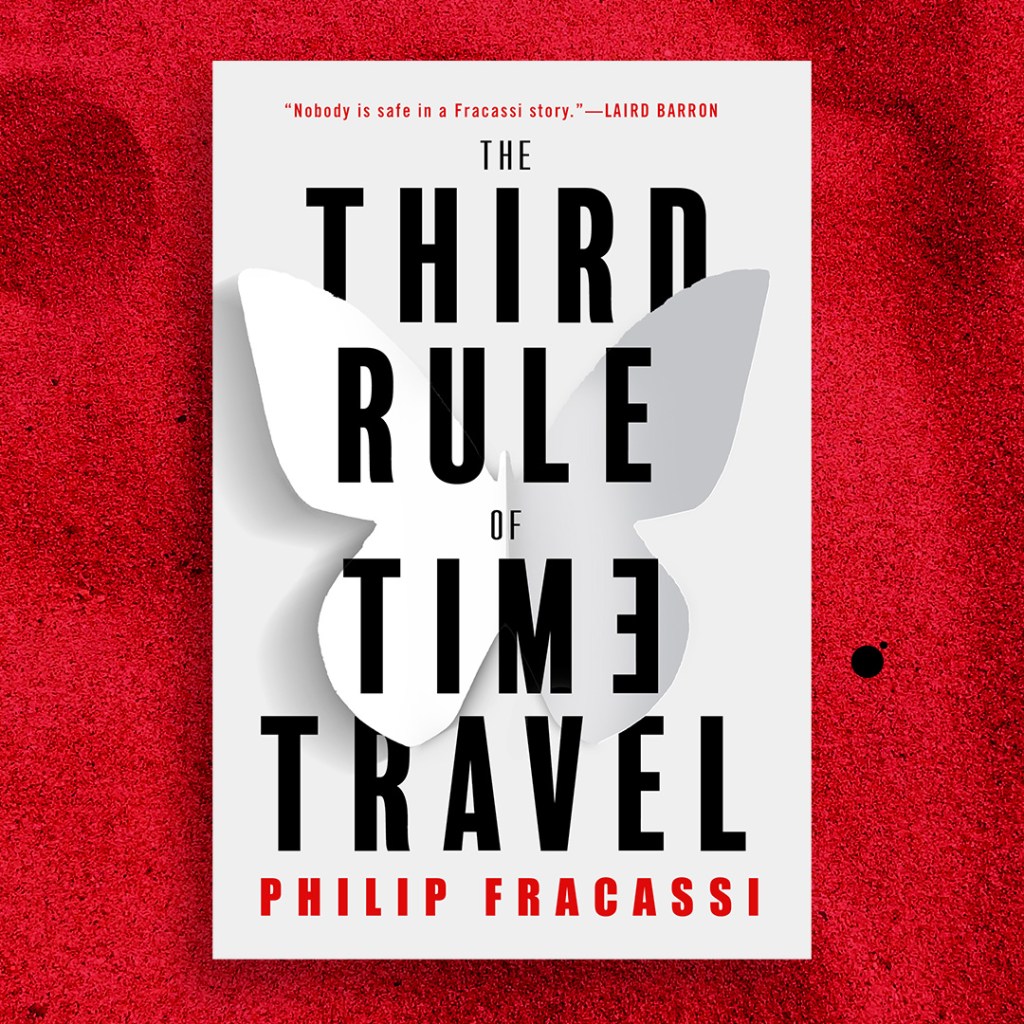
Read an excerpt from The Third Rule of Time Travel (US | UK), on sale March 18, below!
Of course, there are rules…
I’m in an airplane.
A small propeller plane. I look to my left and see my sister, Mary, seated next to me. A large headset covers her ears, but I make out her profile easily. Her mouth, her cheekbones, her eyes. Chestnut-brown hair falls to her shoulders. She wears jeans and a black down jacket.
My vision turns toward the front of the plane.
I have no choice but to follow.
A windshield filled with blue sky. A man seated to the left. I can only see the back of his head, but I know it’s my father. Seated on the right is my mother. Between them, the plane’s console is a smattering of buttons, levers, and lights.
Even through my noise-dampening headset, I can hear the whine of the propellers. The sound is like a swarm of hornets.
I continue looking forward.
My feet, flat against the metal floor of the narrow cabin, vibrate unpleasantly.
As a young girl, I’d flown in this little plane dozens of times. Dad’s Cessna. The last time any of us flew in the Cessna I was twelve years old. My sister, Mary, was fifteen. I think…
No… it can’t be.
I feel a concussion to my right—as if someone punched a hole in the sky—and my vision jumps toward the sound. Out the window, a thick stream of black smoke flows past. I lean forward and glance far below, where an earthen carpet of dense, endless forest rolls past. The plane shakes with a sudden violence. It dips and sways, battered by currents of air.
My father’s voice erupts in the headset.
“Hold on!”
The windshield tilts sickeningly and Mary’s hand clutches my arm. My head turns toward her and I see my own terror reflected in her wide eyes and oh God, no… please, no…
No!
Why have you brought me here?
RULE NUMBER ONE:
Travel can occur only at destination points during the previous lifetime of the traveler. These destination points are random.
The plane shakes with such violence that I’m forced to clench my jaw to keep my teeth from rattling. My vision is vibrating, turning everything around me into a blur of trembling colors. I can barely understand what I’m seeing. Everything is distorted. Focus is impossible.
I turn to look at Mary, and then the plane drops. The engine shrieks like a demon and my stomach leaps into my throat. My hips and chest strain painfully against the locked seat harness, fighting gravity. I watch in shock and wonder as Mary’s hair rises into the air, naked fear on her bloodless face.
My dad is screaming into the headset, but all I can make out amid the savage fury engulfing our plane are the words “Hold on!” and “I’m sorry, I’m so sorry!”
Mom is yelling into a hand mic attached to the plane’s radio. I don’t know what she’s saying—I can’t hear her—but I assume it’s a distress call.
Her lips form the words: Mayday! Mayday!
I think I’m screaming but can’t be sure. It’s too chaotic. There’s too much stimulation.
The windshield is no longer blue; it’s green.
We’re plummeting; we’re going to crash.
Again.
RULE NUMBER TWO:
The traveler has only enough energy to maintain contact with the arrival world for approximately ninety seconds.
The ground rushes toward us as smoke and fire billow past the plane’s windows. A piece of the engine snaps free, slams against the door next to me. The window splinters, and if I wasn’t already screaming, I’m screaming now.
My sister claws at my arm; her fingers and nails dig painfully into my flesh, but I don’t bother turning toward her. My eyes are fixed ahead. Even in the maelstrom of the plane’s descent I can make out individual trees growing closer as my dad yanks helplessly on the controls, desperate to somehow slow our downward plunge.
We hit the top of the first tree just as my mom whips her head around, twisting back for one final look at her children. In that split second her face wears a mask of unimaginable sorrow I’ll never forget. Then the windshield implodes and thick branches rip into their bodies, shredding them like tissue, and I’m sprayed with a burst of glass and blood; the plane lurches sideways as it’s torn apart.
Something sharp and hard smacks into my face, shatters my arm.
I no longer feel Mary’s grip. It’s vanished.
The cabin rolls as we slash and tear through endless branches. I’m turned upside down as dark earth flies toward us through the ragged hole that was, only seconds ago, a cockpit. My parents.
My legs drop upward and I’m suddenly hovering in midair like an astronaut in zero g, and then we crash into the ground like the blow of a hammer.
RULE NUMBER THREE:
The traveler has no ability to interact with the world they have traveled to…
What’s left of the plane settles to a stop.
I’m hanging. My arms and legs dangle, lifeless.
My vision blurs everything a swampy gray.
I turn to my left to find my sister. I see nothing but torn metal and ruptured dirt.
Her empty headset.
I try to twist my head to look behind me, to find her, but the harness strap is cutting into my neck and my chest blossoms with a pain so deep it steals my breath.
In the end I suffered broken ribs, a broken arm. A concussion. Internal bleeding.
I steel myself against the pain, force my head to turn toward what remains of the rear cabin. Spattered against metal walls I see broad sprays of dark blood and parts of my sister’s body. I’m not sure which parts they are.
I vomit into the dirt a few feet below, my body limp, suspended in the wretched belly of the shattered Cessna like a broken marionette.
When this happened—the first time—I remember what I was thinking:
I’m in a tomb.
I’m alive, somehow alive.
I’m alone.
…the traveler can only observe.
ONE
Beth wakes to her tablet’s alarm. A chorus of birds.
Five AM.
Time to run.
She groans, taps the screen to still the alarm, and throws her legs out from beneath the covers. The early morning air is brittle cold, chilling her skin, causing her bare arms to break out in goose bumps. Gray light seeps in through the window. The room hums with the shimmering sound of rainfall.
“Perfect,” she says with a tired sigh, not thrilled to be starting her day with ten miles in the rain, but she pushes herself off the bed and heads for the bathroom to brush her teeth.
Minutes later she’s sitting on a bench in the mudroom, her breathing measured and steady through her nose as she prepares her body, her mind. Wearing a rainproof windbreaker and workout leggings, she slips on her well-worn Asics, ties them tight.
Breathe in. Hold it. Breathe out.
She taps the face of her watch and a steady beat of music plays through her earbuds. She opens the front door of their home (the spacious, classic Craftsman being their lone big splurge when moving to the Pacific Northwest), steps onto the porch, and stretches her hamstrings, her calves. A few yards away, rain shatters the quiet street, slicks the crooked pavement of the sidewalk that waits down the steps and past a small wooden gate, aged white, like the rest of the picket fence lining her modest yard.
She lifts a wrist toward her mouth. “Start morning run,” she says. A timer lights up on the watch face. She nods, jogs quickly down the steps, through the gate. She makes a right on the sidewalk, not wanting to brave the street in the early dark, nor the streams of ankle-deep water already flowing down its sides. The heavy rain drenches her almost immediately.
Beth focuses on her breathing as the Asics slap the wet pavement. After a few moments, she picks up speed.
While she runs, her focus is on her breath, the steady beating of her heart, the pulse of the music pumping into her ears. She pushes away any thoughts of being cold, of being wet or tired. She does everything in her power not to think about the day ahead, or that brief visit to her past the day before, when she was forced to relive the most horrible ninety seconds of her life.
When she returns to the house, the rain has lightened to a drizzle; the emerging sun has brightened the dark gray sky to a less oppressive shade of pewter. She taps the face of her watch, pleased she managed to clock her run in at a reasonable time, despite the slick surfaces.
Marie Elena waits on the porch, standing beside the door, wearing a blue raincoat. A waterproof babushka, patterned with pink flowers, is pulled tight over her head. She clutches an oversize bag in her hands, smiles warmly at Beth as she climbs, sweating and winded, up the steps.
“You’re early,” Beth says, smiling through panted breaths.
“Robert had to be downtown this morning, so I dropped him off and came straight here. Besides, I knew you’d be up,” she says with a wink.
Beth nods and opens the door. “Yeah, you know… Well, come in out of the cold.”
Marie Elena—a spunky woman in her early seventies with three grown children of her own—has been their nanny, for all practical purposes, since the day of Isabella’s birth. Beth doubts she could have ever made it this far without the woman’s help, her strength. She was a stable force in Beth’s tumultuous life, had been so even prior to Colson’s death, when the pair of them worked insanely long hours at the lab, making full-time parenting an impossibility.
And then, when Beth found herself shockingly, tragically widowed a year ago, she knew there would be no way she could continue working at the pace she needed—the pace she required of herself—while also being a responsible, dependable parent, especially given the grief and depression that engulfed her world like an unforeseen eclipse in the months following her husband’s fatal accident.
“She’s still asleep,” Beth says, kicking off her shoes, “and I obviously need to shower, but there’s fresh coffee in the kitchen, and I picked up some muffins from Lenzi’s yesterday. Help yourself.”
Marie Elena nods and shoos Beth toward the bedroom. “Yes, Beth. I’m okay. You go. Go get ready for work.”
When Beth reenters the kitchen twenty minutes later, refreshed after the hot shower and the change into dry clothes, she feels a pang of disappointment at seeing her daughter already seated at the kitchen table, eagerly eating a bowl of oatmeal. Waking her daughter is one of her favorite parts of the day, and now it’s just another moment she’s missed, another memory snatched away by time, never to be returned.
Marie Elena, setting a glass of juice in front of the little girl, seems to read Beth’s mind. She shrugs. “Yes, look who’s up. She must have heard us talking. Came out of her room saying she was hungry.” Marie Elena smiles and strokes the girl’s hair.
Isabella, still in pink pajamas, her hair wild from sleep, twists around and sees her mother hovering at the kitchen entryway. “Mommy!” she yells brightly, holding out one hand, flapping her fingers open and shut in a come! come! gesture.
Beth dismisses her ill thoughts and goes to her daughter, takes her hand in both of her own, kisses each tiny finger. Her heart swells with a surge of love so strong she doesn’t know how she can possibly contain it. Releasing her daughter’s warm hand, she settles herself at the table to watch the little girl eat breakfast.
She ponders how Isabella is nestled in that wonderful age between four and five years, the time in a life when the soft baby parts are being stretched and honed—her cherubic face taking on more defined angles at the cheeks and chin, her limbs lengthening as she begins the unstoppable metamorphosis that will transform her from a lovely child into the beautiful young woman she would become.
Marie Elena sets a cup of coffee in front of Beth and joins them at the table, her own cup steaming. “You should eat as well,” she says earnestly. “Stay for a minute.”
Beth nods and sips her coffee before completing the rote back-and-forth the two women seem to have multiple times a week, if not daily. “I don’t have time. I’ll get something at work.”
Marie Elena tuts, shakes her head. “There’s always time, Beth,” she says. “It’s what you do with it that matters.”
Beth starts to reply when her daughter interrupts.
“Mom! We’re making butterflies at school today,” Isabella announces, her mussed, silky black hair cresting with a casual elegance down the side of her face, brushing her narrow shoulder, enhancing her wide, bright brown eyes. “I’ll bring one home for you.”
Beth stands, kisses her daughter on the head. “Please do, baby. Now, be good for Marie Elena. I’ll be home tonight for dinner and bath, okay?”
Isabella puts down her spoon. She slides her arms around her mother’s neck, kisses her loudly on the cheek, then whispers into her ear. Like a secret.
“I love you, Mommy.”
TWO
To the average passerby, the headquarters of Langan Corporation appears more like a Cold War–era military complex than a cutting-edge tech company with a market value over fifty billion dollars.
Atop a broad hill, reached only by helicopter or via a single winding road, nestled within a high-fenced perimeter monitored 24/7 by a military-grade security team (the parent company of which regularly competes for wartime mercenary duties), Langan Corp. is a single-story Brutalist-style concrete and glass structure. A square city block of impenetrable intelligence and hidden secrets.
Only those permitted inside—a group that includes some of the greatest scientific minds on the planet—realize that the building is not the single-story structure it appears to be, but a massive sunken compound traveling five stories down, each sublevel entrenched deeper and deeper into the earth.
As Beth guides her car to the top of the hill, she sighs heavily at the grim sight of her place of employment these last four years, the slate-gray sky a sodden backdrop to the dark concrete fortress, a utilitarian monument to knowledge that is brazenly ominous, colorless, cheerless.
And yet.
Inside that building, nearly a hundred feet belowground, resides her greatest achievement. Hers and Colson’s. And not just theirs alone…
What sits far beneath the surface has the potential to be one of the greatest achievements in human history.
A machine that could change everything.
And so, despite the drizzly day, the heavy gray atmosphere, and the grim setting, she never fails to feel a tingle of excitement as she drives nearer the security checkpoint and pulls her badge from her pocket, already thinking about the day to come: The data she’ll check and recheck after yesterday’s travel, the scrutinous unraveling of mysteries that lie within the complex configuration of algorithms, electricity, and steel. The quest to control a power not meant for human control—a power that lies beyond the science, beyond the machine and the screens of scrolling equations.
Something undefinable.
But she will define it. She will harness it. And then…
And then she’ll change the world.
Stepping through the glass front doors and into the dim lobby—diamond-polished concrete walls, floor, and sunken lighting giving it the feel of a white-collar prison—Beth shows her ID once again, this time to the burly no-nonsense guard positioned next to a full-body scanner, noting for the thousandth time the bulk of the sidearm the security personnel keep clipped to their waists beneath ubiquitous black sport coats.
Just past the security station is a thick smoked-glass wall with three entry points, and when the guard nods and buzzes her through, Beth walks to the entry at the far right, toward a door-size tinted panel that slides open to reveal a long hallway. Passing through the opening, Beth feels as if she’s entering a different building altogether. The walls are deep cherrywood from floor to ceiling, the carpeting plush, the color of dark chocolate. Ornately framed mid-twentieth-century paintings—primarily abstracts in hues of mustard yellow, crimson, burnt orange, and sea blues—hang along the walls, giving the place a vintage feel, a callback to a world she’s never known. Beth once heard the offices described as an old-school law firm by some of her older peers, but she doesn’t have a clue what that means. Regardless, she has no problem understanding the underlying ideology being presented:
Stodgy. Plain. Archaic.
Langan Corp., she knows, is anything but.
It’s still early, quiet. The doors lining the hallway are closed as she passes them by, making her way toward the lone elevator waiting at the far end of the corridor, an elevator that can be reached only from the ground floor, is wholly exclusive to her lab, and only goes down.
“Don’t fucking touch me!”
Beth spins, breath catching in her throat. Behind her a door bursts open and a man—a man she knows well—is pushed roughly from the office’s interior and into the hallway. Papers flutter from his hands, spill onto the floor. He wields a briefcase as if it were a weapon. A pair of armed security guards—their uniform black suits straining against the muscular, predatory frames all the guards here seem to have—follow him out, their faces stone, their eyes steel.
One of the guards casually pushes aside the hem of his sport coat, rests his hand on the butt of a deadly-looking firearm.
Beth takes a step toward the commotion, moving closer to the hostile trio of men less than ten feet away. “Jerry?”
The older man spins to look at her, his face ghastly pale, his white hair mussed, his suit frumpy and wrinkled. He stares at her with wild eyes. “Beth,” he says, his tone unreadable. “Can you believe this shit? They’re getting rid of me.”
Beth shakes her head, begins to take another step closer but stops when one of the guards—the one with the hand settled conspicuously upon his sidearm—gives her a warning glare. She halts mid-step. “I don’t understand. Jerry, what’s going on?”
The other guard, a tall older man who looks almost bored with the encounter, clamps a hand onto Jerry’s shoulder. Jerry jerks away, backs toward the lobby as the guards watch passively. “I said don’t fucking touch me!” Jerry snarls. Then his eyes look past the guards.
At Beth.
“This is because of you,” he says, pointing at her with a long, crooked finger. “Your ridiculous machine is sucking the rest of us dry. But don’t worry, Beth, you’ll be next! Just wait and see…”
Beth starts to reply when Jerry turns on his heel and walks briskly toward the lobby, briefcase clutched to his chest, loose papers floating to the carpet—almost comically—in his wake. The two guards follow closely, neither sparing a glance back.
She watches until the three men exit through the sliding glass door and disappear into the lobby. Jerry’s office stands open, pale light bleeding into the warm tones of the hallway, illuminating the forgotten scatter of papers left on the floor like dead leaves. She eyes the doorway for a moment, wondering how many others have lost their jobs, were told to not bother coming into work that morning.
Shaken, Beth turns and walks to the elevator.
When the elevator arrives, the doors slide silently open and she steps inside, glances toward the camera—a penny-size eye to the left of the doors—then waves her ID card in front of a black sensor. There’s a soft beep as a glaring red light next to the sensor turns green. The doors slide shut.
There are buttons for five floors on the elevator’s panel, all of them set vertically below the sensor and the ever-watching eye of the camera.
She presses the one at the very bottom, and the car descends.
Moments later the doors open into a cavernous space two stories in height. Every architectural surface—walls, floors, ceiling—is formed from glass, concrete, or steel. In the middle of the room, set into a recess and surrounded by a series of computer consoles, is a machine.
Made primarily of polished steel components, the machine appears, in many ways, similar to an ultramodernized hospital X-ray machine. At the center of the machine is a flat metal surface, or bed. Hovering above the bed is a bubble shape with a red-eyed proboscis—the laser—that points downward, aiming directly toward the head of the bed. A clear flow tube, banded along its length with steel rings, extends from the bubble-headed laser to a massive power generator the size of a small bus. Two steel half spheres, each three feet in diameter and set vertically, sit on either side of the steel bed, the protuberant sides facing the same area as the pointed laser, presumably where a person’s head might rest.
Across the room from the machine are a series of glass-walled rooms, two of which are offices, currently dark. The third is a break room, which contains a full kitchen, sofa, and dining table. Above the offices, running the entire length of one wall, is an observation balcony. Massive viewing screens, nearly invisible unless activated, hover from the ceiling on extended arms between the balcony and the main laboratory.
Seated at one of the consoles that surround the machine, wearing a pristine white lab coat over black slacks, button-down shirt, and tie, is a young man, eyes intent on the screen before him. As Beth approaches, he glances up, simultaneously concerned and mildly frustrated. “I thought you were taking the day off.”
“Good morning, Tariq. No. I have the debrief.”
Beth stops at one of the consoles, types in a command.
Tariq stands, folds his arms. “There’s still time. You could do it tomorrow.”
Beth raises her eyebrows, but her eyes stay on the screen in front of her as her fingers fly across the keys. “And come into work on a Saturday?”
Tariq scoffs. “Right, because that would be shocking. If memory serves, you and Colson were never great adherents to days of the week when it came to work.”
Beth ignores the reference to her late husband, studies the screen before her intently. “I see you’re already running diagnostics,” she says, moving on. “Anything abnormal?”
Tariq shakes his head and sits back down, knowing rebuke is a lost cause. “No. Nothing so far. Whatever you experienced yesterday was within the parameters of what we’ve seen before.” He pauses a moment, as if debating, then says, “There was one thing.”
Beth feels an acute thrill climb up her spine, the rush of adrenaline that comes when one scientist tells another, after years of experimentation: There is one thing that seemed different this time.
She lives for it.
“Go on.”
“You’ll see it yourself when you look at the data. It’s hard to miss. But there were a couple of seconds, right before the machine kicked in, where you had a significant spike.”
“Spike? Like adrenaline…?”
Tariq shakes his head, taps his temple. “No… this was cognitive. Your amygdala threw a little shit fit right before takeoff. I’ve seen similar stuff when doing dream research as an undergrad. The type of brain wave activity we’d see when someone was having, for example, a particularly bad nightmare.”
Beth thinks about it but doesn’t recall thinking anything particularly impactful prior to her travel the day before. In fact, she remembers being even more relaxed than usual. “Nothing comes to mind that could have caused it,” she says. “So if it happened, it certainly wasn’t conscious.”
Tariq shrugs, his slim shoulders barely lifting the stiff fabric of his pristine lab coat. “Still, it seems strange, doesn’t it?”
Beth starts toward the small kitchen. “I don’t think so. Why do you?”
Tariq stands once more, follows her toward the break room, where Beth opens the cabinet above the sink, grabs her favorite mug—the one screaming ALOHA! across the ceramic surface in bold, happy letters, a faded rainbow riding beneath it, the colors aged from use. The mug was her lone souvenir from a trip to Hawaii when she was a young girl. The last vacation she’d ever have with her family.
Tariq leans against the doorway. “You know what I mean, Beth. Where it dropped you. The arrival point. Come on, that had to be…” He shakes his head, searching for the right word.
“Traumatic.”
Beth fills her mug with coffee, notes the digital clock on the microwave. “I’m fine. It was just bad luck. We both know that.” She sighs, dumps a spoonful of sweetener into the mug. “Look, I don’t need you to worry about me. I need you to focus on the data and the travel diagnostics. We need to find what drives these targeted arrival points, Tariq. It’s vital—”
Tariq holds up his hands. “I know, I know. I work here, too, remember?”
Beth nods. “Well, that’s what I need from you. I already have a shrink. Speaking of which, I gotta get settled. My debrief is at nine sharp. Will you have a report before I’m back?”
“Should be done soon, yeah. I’ll send the whole file over to you once I’ve added my notes.” Tariq takes a step closer, so they’re both enclosed within the walls of the break room. He lowers his voice. “Did you hear about Neural Prosthetics?”
Beth takes a sip of the hot coffee, relishes the rush of caffeine to her weary body, then shakes her head. “No, I hadn’t. But I just saw Jerry Wilson escorted out of the building by security. I figured it couldn’t be good. What’d he do? A little corporate espionage?”
“No, Beth. It’s not just Jerry is what I’m saying. It’s the whole damn division. They dissolved it.”
Beth lowers her cup, stunned. “What? The entire group? That’s, like… sixty people. They’re a huge part of Langan’s med line.”
Tariq shrugs, a sardonic smirk on his lips. “Gone, baby.”
“Why? That makes no sense.”
“Above my pay grade. That’s a Jim question. Still, makes one wonder—”
“Don’t worry, they’re not cutting our funding. Look, I gotta get going…” Beth turns back toward the counter to add more coffee to her mug, inadvertently hits the edge. The mug is knocked from her fingers and falls to the concrete floor, smashing into ceramic pieces, the spill of coffee a dark snowflake.
“Shit!”
Tariq drops to his knees, begins gathering pieces. “Hey, I got this. You go do what you need to do.”
Beth puts her hands over her face, tries to stem a sudden rush of emotion, her eyes burning—shockingly—with tears.
Get a grip, Beth.
“Goddamn it. I loved that stupid mug.”
Tariq looks up, worried. “Hey, you okay?”
Beth is momentarily confused by the concern in his eyes, then feels the wetness on her cheeks and realizes, despite her best efforts, that she is crying. She swipes angrily at her face. “I’m fine. Fuck.”
She storms out of the room, leaving her bemused assistant staring after her.
Beth enters her office; the cube lighting, triggered by her motion, brightens the space from within, revealing the only warm area of the entire lab. Oriental-style rugs cover the concrete floor. The oversize desk is dark oak, an antique. Standing floor lamps, shaded with beige fabrics, replace the cold white lighting that permeates the rest of the laboratory. She settles down into her leather desk chair, puts her face in her hands.
“Stupid stupid stupid,” she murmurs, knowing that any signs of emotion in front of her assistant will only deepen the ever-widening cracks in her authority.
Crying over a fucking coffee mug? That’s gonna go over just great, Beth. Would Colson have ever cried at work? Over a cup? It’s just one more reason for Tariq to doubt you.
For all of them to doubt you.
THREE
Beth gets out of the elevator on the second floor. Like the rest of Langan Corp., the floor is seemingly vacant, the hallway eerily devoid of activity.
The few well-spaced doors along each side, she knows, are entryways to labs as big as her own, if not bigger. Neural Prosthetics took up half of the entire ground floor on their wing, a space filled with equipment and testing areas, offices and independent data centers. But to a visitor it might have appeared to be nothing more than a broom closet.
When Beth and Colson first sold their technology to Jim Langan, agreeing to come on board as project managers (in perpetuity), they were happy to have the security of benefits and high salaries, and thrilled to have the funding to continue the development of the machine, but they’d both noticed right away how strange the atmosphere was at the immense tech company.
“So much happens behind closed doors, it’s impossible to know how it truly functions,” Colson said after their first week of employment, both of them still riding a wave of joy and enthusiasm after being given their incredible laboratory space. “I feel like we’re moving into the Pentagon.”
On their first day of orientation, Jim Langan himself gave them a tour of the entire facility, and Beth quickly lost count of how many times she and Colson exchanged glances behind the old man’s back while he continually gestured toward closed doors or sealed-off areas, saying only the name of the department, a rote one-liner about their general function or project, then followed it up with some variation of “Of course, that’s off-limits.”
Still, Beth couldn’t complain. The last thing she or her husband wanted was a bunch of other scientists and tech geniuses coming down the elevator to their lab, sipping coffees and making idle chat while their eyes inspected the machine, the occasional open file, or a random data dump on a console monitor.
But that didn’t make it less eerie moving through the seemingly empty hallways. The outburst with Jerry that morning was one of the few times she could remember seeing another employee someplace other than the semiannual corporate debriefs, which were typically held in a rotunda that could comfortably seat hundreds, or the corporate cafeteria (a space that was hardly used, since most employees took their meals in their respective workspaces).
Truth be told, Beth didn’t know just how large Langan Corporation was, either in number of employees or in physical dimensions. The main lobby split three ways, and she had clearance to access only two of those routes: one that went to the wood-paneled hallways of her own section, which she only later discovered was referred to as the “developmental tech” wing, and the other to a central division that strangely had only three levels (seemingly); the cafeteria and auditorium were on the first, or ground, floor, while CEO Jim Langan’s office, along with the other corporate officers’, was on the second. She’d never been to the third.
The other branch of the subterranean structure—like many things that happened at Langan Corp.—was a mystery. Beth had heard rumors it was pharmaceutical, but Colson had always insisted (only partially joking) that it was alien spaceships, a theory expressed with such earnestness and excitement that it had always brought a smile to Beth’s face.
One more memory for her broken heart to hold on to.
Beth reaches the end of the hallway, stopping beside a set of double doors on her right. A subtle copper placard above the polished wooden doors reads simply: FORUM.
She takes a moment to close her eyes, take a deep breath, and let it out.
Then she pushes through the doors.
Inside, the circular room is dimly lit by sconces placed along glossy wood-paneled walls. The thick, dark carpet acts as a silencer for any sound of movement or life. Beth knows the room is completely soundproofed, something she’s reminded of every time the door suctions closed behind her after she enters.
At the near end of the room is a podium centered beneath a hazy spotlight. Behind the podium is a sectioned-off area of empty leather chairs that Beth always thinks of as a jury box. At the far end of the room is a dais, on which sit three people, their lower halves hidden behind a low wall like a judge’s bench, already awaiting her arrival. As always. She moves to stand behind the podium, grips the edges. A small black mic extends toward her from the top of the podium. She adjusts it slightly and waits.
“Good morning, Beth,” the man to the far right says.
“Good morning,” she replies. She takes a moment to steady her breath, force herself to relax. The man who spoke, a youngish, roguishly handsome psychologist named Jonathan Greer, is the only one of the three she knows well, but she’s had direct experience with each of them over the years, to varying degrees.
Jonathan is a clinical psychologist (a fancy way of saying therapist), one she’s forced to speak with weekly, at a prescribed time and for a predetermined duration. At first, both she and Colson found the arrangement disarming, uncomfortable. For Beth, it was almost… confrontational. After all, Greer has all the power. If he decides to indicate that the mental health of a Langan employee is not, as he likes to put it, “fit for service,” then said employee is immediately suspended until further notice. Likewise, Terry Adams, an ancient-looking man sitting in the middle of the three, is Langan Corp.’s private in-house MD. Health checkups for all employees are monthly (instead of weekly, thank God), and over time Beth has found it harder to be annoyed by them, especially during her pregnancy, when she almost welcomed the reassurance of a second opinion that her baby was doing fine. Besides, it’s free medical care, and if she were to ever show signs of a long-term sickness or disease, one of the monthly checkups would catch it early on.
Of course, Adams also has the power to shut down a project, or an employee, if he determines they aren’t physically fit or able to perform. Still, she likes the old man. He’s never been anything but kind in the years since she arrived.
The woman to the far left is Abigail Lee, the program director. Lee is technically—at least according to some corporate flowchart somewhere—Beth’s direct supervisor. Of course, Abigail has only been in the lab itself a handful of times and, as far as Beth knows, has absolutely no idea how the technology (or any technology, for that matter) works. She’s certainly never shown an interest in their work, at least not to Beth, or to Colson when he was alive. Beth thinks they are fairly close in age but cannot imagine two more disparate personalities. Still, Lee is always there for an annual review, and her signature miraculously appears on all finance requests for the day-to-day operational needs of the lab. Beth sees her more as a babysitter than a boss, one who doesn’t say a peep unless called upon, for which Beth is grateful.
It’s Abigail who leans forward, cautiously addressing the microphone before her, as if it were a cup of tea she was worried might be too hot. When she speaks, however, her normally reedy voice is loud and clear. Perfect for recording. “Dr. Darlow, are you ready to begin the redundant question session, matching to date of travel March 17, 2044?”
Beth nods. “I am.”
There’s a beat of silence, then the program director taps a few keys on a console hidden from Beth’s view. The room fills with the soft sound of static—the chamber’s surrounding speakers, hidden in the dark-paneled walls, coming alive. A man’s sonorous voice fills the room, as if coming from everywhere and nowhere.
Please state your name and today’s date.
Beth clears her throat, makes a point to enunciate clearly. “Beth Darlow. March 18, 2044.”
Who is the president of the United States?
“James Whitmore.”
Describe your marital status.
Beth’s words hitch in her throat for a fraction of a second, then she sighs softly and answers. She does not lower her eyes. “Widowed.”
In one word, describe your childhood.
For Beth, this question has been— from the first time she heard it— a complicated one. Going through this process early on, she made the mistake of overthinking the questions, as if it were an exam, or a study of her life, rather than scientific variables. She could literally give any answer she wanted, as long as those answers were consistent. During the questions, consistency is everything.
Still, easier to stick with the truth.
“Happy.”
Name two members of your immediate family.
Another puzzler. She’s never fully understood why they created a question that offered so many variables, and it was Colson who came up with the idea that, in addition to consistency for comparison’s sake, they must also be using the answers, in some respects, as evaluators of some kind. A psychological test weaved in with scientific variables. Beth had asked Jonathan about it in one of their sessions and he’d refused to answer. Which was an answer in itself, she supposed.
In the beginning, Beth had answered the question using her husband’s name, and then her uncle, Brett, since both of her parents and her only sibling were long dead. Further, when she first traveled, Isabella hadn’t even been born.
And now, death had changed things once more.
“My uncle, Brett Hawkins. My daughter, Isabella Darlow.”
If you could change one moment in your life, what would it be?
This is the question that always hurts the most, no matter how many times she’s heard it. Still, it’s an easy one. There is only one moment in her timeline, were fate allowing do-overs, she’d want to change. That she’d have the power to change.
“I would stop my husband from leaving on the day he was killed.”
The speakers continue their live-wire humming, the hair-raising sound of electricity filling the air. But the questions, she knows, are over.
There are only six. And they never change.
The program director clears her throat, tilts her head toward the mic. “End of questions recorded for transmission.” Everyone remains silent until a soft, low- pitched tone emanates from the speakers, followed by a click as the speakers turn off. The room is plunged into a deep, heavy silence. “Thank you, Beth. Do you need a moment before playback?”
Beth shakes her head. “I’m fine.”
“Very well,” Abigail says, leaning once more toward the mic. “Begin playback of original travel questions, dated March 17, 2044, Dr. Beth Darlow.”
Again the speakers click on, and the same emotionless, mechanical voice fills the room.
This time, Beth doesn’t speak, but only listens to the questions, along with her prerecorded answers, the ones she gave yesterday morning prior to traveling.
Please state your name and today’s date.
Beth Darlow. March 17, 2044.
Who is the president of the United States?
James Whitmore.
Describe your marital status.
Widowed.
In one word, describe your childhood.
Happy.
Name two members of your immediate family.
My uncle, Brett Hawkins. My daughter, Isabella Darlow.
If you could change one moment in your life, what would it be?
I would stop my husband from leaving on the day he was killed.
No one speaks until the recording terminates, the invisible speakers once more going silent with a click.
After a moment, the program director looks to the other two members of the panel, who both nod in confirmation. She leans in, voice softer now that she’s only addressing Beth, versus posterity. “Let the record show there are no discrepancies. We will now continue with the debrief.” She turns toward Jonathan. “Mr. Greer, do you want to begin?”
Jonathan nods. “Director, could we put video for the travel session of Beth Darlow, dated March 17, 2044, on the screen, please? Hold playback.”
The program director nods, types another command into her keypad. A large, clear-tech screen lowers to Beth’s right. A still-frame image appears on the screen, bathing Beth in a dull white glow.
She turns her head to stare at a lightly distorted full-color image of the Cessna interior. The view is from her perspective, the image slightly skewed by mild tunnel vision. Seen clearly, however, is the swath of blue sky through the windshield, and her soon-to-be-dead parents sitting side by side in the tight cockpit.
Beth unconsciously rests the fingers of her right hand across her left forearm. The same place Mary’s fingers nervously clutched her before their plane went down and her sister’s teenage body was torn to pieces.
Seeing it like this, shown as a video broadcast instead of her private memory, does nothing to lessen the sense of association her feelings have toward the event. Rather, the image throws open a locked door inside her head, and she steels herself against the fresh flood of pain that comes surging through at the sight of this moment of time snatched from her life.
The arrival point of her travel.
Rule One: You can only travel to a point within your lifetime.
Rule Two: You can only travel for ninety seconds.
Rule Three: You can only observe.
The rules cannot be broken.
In this electrifying science fiction thriller from acclaimed author Philip Fracassi, a scientist has unlocked the mysteries of time travel. This is not the story you think you know. And the rules are only the beginning.
“Tense, fast-moving, surprsing, and above all else, entertaining.” – Owen King, New York Times bestselling author
“A clever premise digs its heels into a sci-fi thriller that breaks into a fast gallop from the first page – exciting, haunting, compelling stuff.” – Chuck Wendig, author of The Book of Accidents
“Fracassi weaves a tightly plotted story… a solid new entry into the time travel genre.” — Kirkus
Scientist Beth Darlow has discovered the unimaginable. She’s built a machine that allows human consciousness to travel through time—to any point in the traveler’s lifetime—and relive moments of their life. An impossible breakthrough, but it’s not perfect: the traveler has no way to interact with the past. They can only observe.
After Beth’s husband, Colson, the co-creator of the machine, dies in a tragic car accident, Beth is left to raise Isabella—their only daughter—and continue the work they started. Mired in grief and threatened by her ruthless CEO, Beth pushes herself to the limit to prove the value of her technology.
Then the impossible happens. Simply viewing personal history should not alter the present, but with each new observation she makes, her own timeline begins to warp.
As her reality constantly shifts, Beth must solve the puzzles of her past, even if it means forsaking her future.
“Part Crichton, part Bradbury, and all Fracassi, The Third Rule of Time Travel further demonstrates why Fracassi is one of the best writers working today, regardless of genre.” – Tyler Jones, author of Midas
“Probes the endurance of grief, the importance of memory and the ultimate malleability of reality and perception.” — The Wall Street Journal