Excerpt: THE RADIANT KING by David Dalglish
The first installment of USA Today bestseller David Dalglish’s latest epic fantasy trilogy about immortal demigods, civil wars, and ancient evil will be irresistible to classic fantasy fans and will appeal to readers of James Islington and Anthony Ryan.
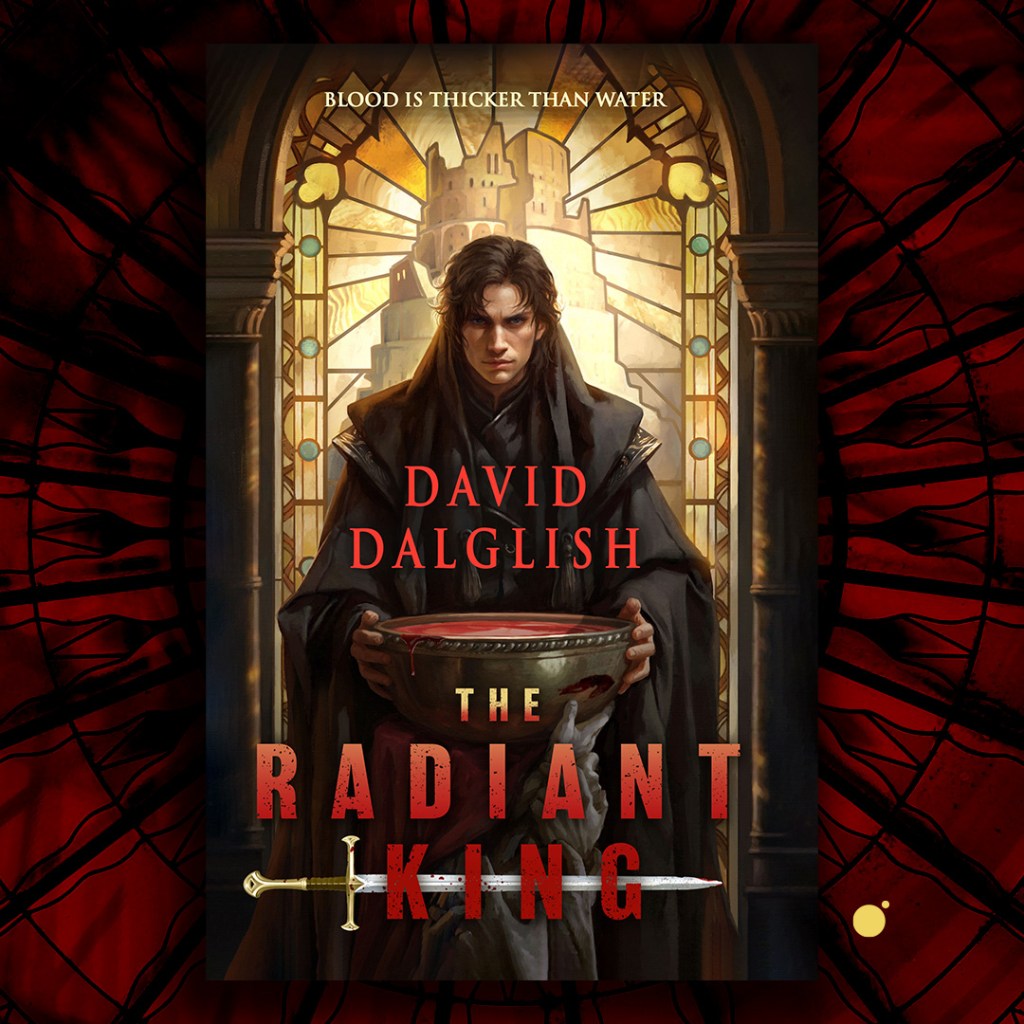
Read the prologue and first three chapters from The Radiant King (US), on sale March 4, below!
Prologue
SARIEL
Deep within a forgotten cave, Sariel’s brother knelt in the heart of an unlit pyre. Sariel stood before him, an oil-skin in hand.
“Are you certain of this?” he asked.
“I am,” Faron said. Though he was a kind soul, his voice was firm, and it reverberated throughout the cave.
So pure, thought Sariel. So foolish. So broken.
Sariel poured the oil across Faron’s brow. It flowed through his brother’s short black hair. Rivulets continued along the sides of Faron’s handsome face and then splashed across his muscled chest and back. The drops continued down to the eulmore logs, stacked in preparation for the coming fire.
“You’ll forget things,” said their sister Calluna. She sat some distance away, her back pressed to the cave wall. She wrapped her pale arms around her legs and pressed her knees to her chest. Her long black hair formed a blanket around her. Protecting her. Hiding her. “It’s been getting worse.”
“It’s what Faron wants,” Sariel said, his voice soft and nothing like his brother’s. He dropped the empty oil-skin on the logs. “To forget.”
“Will you judge me for it?” Faron asked.
“No judgments, not for my kin.” Sariel lifted his hand, summoning the innate power of radiance he and his five siblings all possessed. A blue flame burst to life in his open palm.
“Eder will be angry,” Calluna said, referring to their absent brother. The flame’s blue light flickered off the faint tears in her eyes, adding depth to the cold starlight that forever shone within her irises. Eyes they all shared. The mark of radiance.
“Let him be angry,” Faron said.
“I’ll miss you,” she insisted.
Faron smiled, so warmly, so miserably.
“I know. Be well, Calluna. I’ll see you soon.”
Sariel almost extinguished the fire in his hand. He didn’t have to do this. He need not participate in his brother’s attempts to forget those he’d loved and lost. The idea faded as instantly as it had come. No, he would be here for his family, whatever the cost. He looked down at Faron and saw his brother’s head tilted away from Calluna so she could not see his own tears.
“You’re too soft for this world,” Sariel said as the fire grew stronger in his palm.
“Then do it,” Faron commanded with a tone that had rallied armies and frightened kings.
Not yet. Not until he checked with Calluna, who looked ready to shrivel into herself. His sister sensed his unspoken question.
“I’m here to the end,” she said, her will strong despite the timidity of her voice.
Then let the damned deed be done, thought Sariel.
He tilted his hand. The fire flowed like liquid from his palm and fell to the stacked logs below. The oil caught. The fire spread. Smoke filled the cave as flesh began to blacken and peel.
“Until we meet again,” Sariel said as, for the third time in his agonizingly long life, he burned his brother alive.
Part One
AWAKENED
Chapter 1
FARON
When Faron awoke, he was blind, and he could feel worms crawling through his flesh and organs. An overwhelming sense of loss and sorrow pierced his mind like a spear, receding as his senses returned. Whatever the cause, he could not remember it. Let memory fade as he focused on the now. Where was he? What had happened?
The pyre.
Yes, the pyre. Its ashes were beneath him as he lay on his back. The worms, the carrion bugs, they shouldn’t…
The cave. Sariel and Calluna must not have properly sealed the cave. That, or humans had broken their way in… but no, they would not. They feared the qiyan too much for such a risk.
I do not know how long you have feasted, but it comes to an end. Leave me.
The thought echoed through him, projected by his radiance. He instantly felt the change. The carrion insects cut, bored, and ate their way to the surface of his skin. Faron clenched his jaw against the pain. Worms slithered like snakes from his wrist and belly. A beetle retreated out his nostril. He breathed softly and shallowly, not wanting to disturb whatever creatures occupied his lungs.
Blood, his blood, mixed with the ancient ash. The pain receded, and he slept again.
The next time Faron awoke and opened his eyes, he saw the barest hints of light. It seemed his sight had recovered. The stone was cold, and it felt pleasant against his bare skin. He pushed himself to a sitting position, crossed his legs, and bowed his head.
Warning was given, he told the smallest and simplest of creatures occupying his body. Maggots, squirming in his stomach. Unhatched eggs, laid upon his skin. He clenched his fists and let radiance shine through his body. It burned the invading creatures like fire, shriveling their bodies and popping their eggs.
He gasped when the effort was finished. The pain of it slowly ebbed away. Faron stood, stretched, and then tested his limbs. His balance was wobbly at first, but improved as he shifted his weight from foot to foot. Next he ran a hand through his hair, found it slimy with moisture and dirt. He desperately needed a river or lake to cleanse himself.
The cave was pitch-black, but that did not bother the eyes of those touched with radiance. Faron looked about and found a tightly wrapped leather bundle, poorly hidden underneath a pile of stones. Beside it was a plain but finely sharpened sword. Faron smiled. Little Calluna, always watching out for him.
Within the bundle, he found a fresh set of clothes, remarkably clean after an unknown amount of time spent waiting. He dressed himself in the dark, the measurements correct as expected, and then took in the new style.
A white shirt, lacking the ruffles along the neck and top buttons that had been popular when last he visited the markets of Araketh. Long stockings, and atop them, a pair of leather trousers dyed black with the bark of eulmore trees. Most impressive was the brown leather coat. It had a high collar, thick copper buttons, and six pockets, three to either side. A belt was sewn directly into the sides of the waist, allowing him to buckle it shut should he be marching or riding.
A jingle alerted him to a heavy coin purse in a pocket. Faron pulled it out and undid the drawstring. Within were dozens of silver coins, and he examined one of them. There was a tower on one side and five stars on the other, the designs unfamiliar to him. A new currency, then, minted during his recovery. He put it back, pocketed the purse, and then continued dressing.
The boots Calluna had chosen for him were plain enough, brown leather with adequate padding, the color matching his coat. He slipped them on and adjusted the laces across the back to tighten them. That done, he grabbed the sword and headed for the cave’s entrance.
It seemed he was wrong to doubt his siblings’ diligence. The cave was sealed with a heavy stone, and what cracks remained must have been filled with mud. Time, though, was merciless, and wind and rain had worked away the mud until it was mostly gone. Little streaks of daylight peeked through, as did a hint of wind.
Faron placed his shoulder against the stone, braced his legs, and pushed. Leaves crunched and twigs snapped as the boulder rolled several feet before stopping against a thin eulmore tree. Its branches shook from the impact, its many violet leaves shivering in protest. Faron breathed in the clean air and felt his lungs heal away the last of the damage.
“How many years has it been?” he wondered aloud. His brother Eder could calculate that with a glance at the night sky. Tracking the movements of the moon and stars had always come easy to him. For Faron, there would be no answering that question until he reached civilization. The idea excited him as it always did when he reawakened. With the passage of time, language would be shifted, clothing would be changed, and homes would have adopted new styles or improvements. Even the meals might be different, should new spices become favored or the wandering feet of merchants build new paths between various portions of the grand island.
The reminder of food set his already ravenous stomach to grumbling. Of the several reasons he’d chosen this cave, one had been a field of raspberries to the north. He started that way, the violet canopy above him thinning, then stopping entirely as he exited the forest.
What fruit grew on the bushes was not ripe enough to eat. Not summer. Early spring, then, he guessed, as he skirted the outer edge of the bushes. If it were close to fall, the leaves of the eulmore trees would have been drained of their lovely color, shifting from violet to an ashen white. It seemed he’d have to make do with a bloodier meal.
Faron returned to the forest and gathered the occasional fallen branch or twig. Once they were piled together, he placed his hand in their center, summoned his radiance, and set them alight. For such simple tricks, he felt nothing, but this next one would put a strain on him and leave him winded. Still, it would be better than spending hours hunting.
Faron sat beside the fire, closed his eyes, and let his mind drift. His consciousness slipped through his boots into the dirt below and then spiraled outward. The world around him grew more vivid, more real. He heard the faintest clatter of red squirrel claws clutching black bark and birds whistling their songs as they flitted about the canopy. Blue-breasted robins, building fresh nests to impress mates now the winter was over. Purple-and-gold woodpeckers, thudding their beaks in search of grubs and worms.
Should have checked my body first. You’d have found a much easier meal.
No bird or squirrel would be enough, not for his hunger of untold years. Farther and farther he searched, until he sensed it: a wild hog, foraging among the underbrush.
Come to me, he said, pushing his will into the beast. He saw it in his mind’s eye like little silver threads arcing between his body and the hog’s. Like a spider, Calluna had described them once, and as much as Faron disliked the comparison, he could not deny the similarity.
Minutes later, the hog arrived, docile and quiet. Dirt caked its hooves. Two flies zipped about its deep red hide. Faron lifted his sword, turned its edge, and pressed it to the hog’s throat.
“A victim of circumstance,” he told the beast. “Know that I appreciate you for it, nonetheless.”
A single cut, and the blood flowed.
Come nightfall, and with a full belly, Faron cast his will once more into the forest. This time he meditated for an hour, the focus of his mind spiraling beyond his immediate surroundings. As he took stock of the wildlife, he debated. In his last lifetime, he had befriended a hawk, and before that, a raven. Birds tended to be his favorite companions, but when his mind skirted across a nearby coyote, her loneliness struck him.
Come to me, he told her, and minutes later, she arrived, having crossed half a mile of forest to do so. Her fur was a tawny brown intermixed with white. The gangly state of her limbs and chest provoked a frown. She was not eating well, but why? He beckoned her closer so he could put his hands upon her. Contact allowed him a better understanding. Radiance flowed, silver threads connecting, and he peered into the coyote’s mind.
A mother. Six pups. Four pups. Then three. Then none. Poor food. A poor hunter, abandoned by her pack. She was a failure. A failure. A failure.
Faron withdrew his mind, but his hands remained, and he looked deep into her yellow eyes.
“You do not understand me yet, but you will,” he said, bracing for the strain. This would be harder than lighting a fire or sensing for nearby hogs and squirrels. Little wisps of silvery light floated like smoke from his hands and into her body, shaping her, changing her. What mind she possessed sharpened. The speech of humans would no longer be gibberish. Her eyes widened, and he sensed fear and excitement overwhelm her in equal measure.
“You will not remain this way,” he told her. “It is a change too drastic, and a strain too great, but I would receive your answer amid true understanding. You will visit lands beyond this meager forest. You will walk the cities of man and see their nations and people. Sometimes I will feed you, and sometimes you will hunt for me. The way will be dangerous, and mankind’s trust of you fickle and wary.”
Those round eyes of hers stared into his. Her entire body locked stiff. The concepts he spoke of were grand and foreign to her, and yet she understood them now. It was cruel, in a way, but Faron was no stranger to cruelty.
“Will you join me, and see the wonders beyond this forest?” Faron asked, releasing her. “Stay, if you accept. Run and be free, if you refuse. I will harbor you no ill will should you reject me. The choice is yours, little coyote.”
The connection between them faded, but he sensed faint echoes of her emotions. Her loneliness warring against her pride. The loss of her pups. Her vicious anger at a pack willing to leave her and her offspring to starve.
She turned away, just once, and then sat beside his fire. Her head tilted slightly. He could almost hear her voice in his mind.
What now?
“The intelligence I granted you will ease away,” he told her. “But rest assured, you’ll still be wiser than all other dogs, coyotes, and wolves. I suppose I should have your name. I would not demean you by calling you ‘little coyote’ forever.”
His new companion glanced at the fire and the butchered hog beside it. Faron grinned.
“Go ahead,” he said. “I’ve eaten my fill.”
She tore into it with glee. Faron sat down, crossed his legs, and rested his chin on his hand. All animals had names, or concepts close enough to be usable as names. He closed his eyes and focused upon her.
What are you called? he asked.
She did not answer, not knowingly. Instead, a scent came to him, for that was how all coyotes knew themselves, and others.
Leaves, half covered in mud, wet with rain, bitter with a splash of blood, and yet, hovering about it, the final note of a wild iris bloom.
Faron chuckled at her.
“Quite a mouthful,” he said. “Might I call you Iris, if only to save us time?”
The coyote cracked a rib free, chewed it twice, and then nodded.
“All right, then,” he said. “Iris it is.”
Chapter 2
FARON
Faron traveled east, deeper into the forest, aiming to visit the village of Clovelly on the other side. Once there, he could learn how much time had passed, use the coin Calluna left him to buy a room for a month or two, and then feel out what new life he wished to create for himself. Perhaps he might search for his siblings, perhaps not. It was much too early to make such decisions. The day passed uneventfully, which was fine with him. It gave him a chance to assess his new traveling companion.
She was a guarded sort, rarely keeping to his side. After several hours of traversing the brush-strewn forest grounds, she started limping. Upon noticing, he sat down and called her over. Once she agreed, he took her paw in his hand. A moment’s thought, and he sensed the swollen tendons within, and a shape of bone not quite right.
“This will hurt,” he told her before he squeezed, hard. To reshape, things must first be broken. She yelped and bared her teeth, but to her credit, she did not bite. Afterward, he massaged the paw and let a bit of radiance seep into her to soothe the tendons and reduce the swelling. After a few minutes of that, she laid her head on his lap, closed her eyes, and went to sleep.
He finished the mending not long after, but kept on massaging her paw.
An hour later, they resumed their travel, and this time, she did not stray quite so far. There was also more of a bounce to her step. She seemed old for a coyote, possibly in her sixth or seventh year, but there was no way to ask. Coyotes did not track the number of revolutions of the moon, only the shape of it, and how it affected the hunt.
“Eat up,” he said when they stopped at a stream crossing. He’d packed what meat he could, wrapping it in the leather Calluna had used to store his new clothes. Two packages, one full of meat he’d cooked, the other, raw bits specifically for Iris. They ate and drank their fill from the stream, Faron using his hand to sloppily bring the water to his mouth.
“Next time, if there is a next time, remind Calluna to pack you a canteen,” he muttered to himself as they continued their journey. After a few more miles, Iris’s energy waned, her head sagging and her tongue hanging out one side of her mouth. He stopped again, and while she rested, he scanned his surroundings.
Near his cave, the forest had been nothing but eulmore trees, but here was not quite so uniform. Intermixed about half and half among the violet-leafed eulmores were shorter red oaks, their bark dripping with a sticky brown sap. It kept insects at bay, though some bears had developed tongues thick and dull enough to endure its foul taste to eat the vermin that got stuck. Their leaves were a fiery red, hence their name, and they mixed with the violets of the eulmores so that the sunlight painted the forest below in their wondrous color.
Against such a backdrop, mixed with the golden light of the setting sun, the smoke of a human campfire was all too easy to spot.
“Do you see it?” he asked Iris, and pointed. She looked up, sniffing as she did. A soft growl rumbled from her throat, and she bared her teeth.
“I doubt you’ve had many pleasant encounters with humans,” he told her. “But you’ll be around them during your travels with me. A few might even give you a comfortable scratch behind the ears, if you’re polite enough.”
Iris gave him a most impressive glare.
“Fine, then, don’t be polite. Just don’t bite anyone, either, since I will be the one they blame.” Her ears flattened. “And yes, you should care about that, too. At least, you will, once you learn the comforts of a well-provisioned inn.”
Faron led the way, surprised by how closely Iris trod at his hip. Perhaps she’d had a particularly bad encounter with hunters sometime in her life. It might even explain the lingering issue with her paw, though that was only a guess. Life was not easy as a coyote. Faron adjusted the sword sheathed at his hip, gave Iris a gentle pat atop her back, and then entered the stranger’s camp.
“Greetings,” he said to the lone man at the fire, who startled to his feet. One hand dropped to the knife at his buckle, the other reaching for a wooden staff resting beside him. His meal fell to the dirt.
“I have nothing to interest thieves,” the man said, pointing the knife. His face was round, and his neck covered in a faint gray beard. He had a broad forehead and sharp cheeks; combined, they made his blue eyes seem beady.
“And I come not as a thief, but as a friend,” Faron said. He gestured to Iris. “Might my companion and I enjoy your fire?”
The stranger lowered his knife after a moment’s hesitation.
“Friendly company is always welcome,” he said. “Join me.”
Faron sat beside the stranger atop an overturned eulmore tree. Iris kept on the opposite side of the fire, and there was no disguising her distrust.
“Have you a name?” the stranger asked, settling down.
“Faron. You?”
The stranger’s cheek twitched.
“Preacher Russell, at your service.”
Preacher? Faron wondered. Of what faith?
Worship of the goddess, Leliel, was the dominant faith across the great island of Kaus, yet Faron saw no idols or amulets carved in her likeness. Russell appeared on the heavier side, and Faron suspected much of it was muscle. His hands were callused, as were his bare feet. Nearby were his boots, well-worn and most certainly not cheap. His outfit was peculiar. Though his trousers were plain, his shirt was a mixture of yellow and black, the differently colored threads neatly formed into rows.
Even more peculiar was his staff. Hooked to the top by thick wire thread was a closed glass jar. A collection of insects swarmed inside it, all kinds of beetles, centipedes, mosquitoes, and dragonflies. Most numerous of all were some dozen black horseflies.
“Strange to find a preacher out so far in the wilds,” Faron said.
“Clovelly isn’t too far away,” Russell insisted. His voice rumbled. Given his size, he could be intimidating if he wished to be. The big man ate strips of salted pork, and he tore a little segment free and held it between his thick fingers. A flick of his thumb opened the lid of the jar tied to his staff, just enough to press the piece of meat inside. It hit the bottom of the jar, and the insects immediately swarmed over it.
“Even we holy men need time alone from the people we tend. Besides, if Father orders me out here, then out I go, without complaint or question.”
Faron watched the meat disappear in moments. Not a single bug attacked another. Iris growled from the opposite side of the fire and then lay still.
“Might you answer me a question?” Faron asked, careful to keep his voice light.
“I am a preacher,” said Russell. “I aim to give answers, so please, ask.”
“What year is it?”
The preacher lifted an eyebrow. His cheek twitched yet again.
“My, you must truly love your solitude. We are in the eighty-sixth year of Father.”
A new measurement of tracking time? That complicated things.
“I am not familiar with such years,” he said.
Russell grunted and bit a piece of pork.
“A few of these far western kingdoms stubbornly refuse to adopt the proper calendar, so I suppose I should not be surprised. I believe it’s somewhere around 380, or maybe 381 Years After. I could not tell you for certain.”
Years After marked the time since the Anaon Kingdom united the entirety of the island. Its shattering had led to the rise of what were known as the little kingdoms, dozens of petty human realms eagerly dividing up the island and slaughtering one another in never-ending squabbles.
Faron kept his face calm as stone upon hearing the date. Almost seventy years had passed between his burning on the pyre and his eventual return.
“It seems I must spend our evening confessing my ignorance,” Faron said. “Who is the Father, that kingdoms would change their years to honor him?”
Russell set his plate on the log beside him and wiped grease onto his trousers. There was no hiding his suspicion.
“Do you tease me, traveler, or have you spent so long in these woods you know nothing of the outside world?”
Faron flashed him a smile. “Think what you wish, my friend. I seek only to learn.”
Russell grabbed his staff and shook it, agitating the bugs.
“Father is the mender of our sins. Father is the forgiveness that can soothe, and it is by his power that my prayers heal the sick and wounded. Here, let me show you. Look into my jar, traveler. Gaze upon the creatures trapped within. Do you see them?”
Faron did. They were angry and scurrying.
“Keep looking upon them,” Russell continued. He held the staff closer, the jar swinging from the wire. “But this time, focus not on the creatures, but the empty center. Concentrate on that space. Do you see the light there? Do you see it, growing? Do you feel it, warming?”
His words were true. A light did shine within the glass, and Faron felt warmth in his breast. That warmth, though, was not the result of the spell the preacher attempted to weave. It was rage seething to be unleashed. Closer, closer, the jar. Closer, the preacher’s hand and staff.
“Gaze into the light,” Russell said. “Let it comfort you. Wash away your thoughts. Feel the life leave your limbs. You are silent. You are still.”
The light emanated from the jarred creatures, an unseen force sucking golden, sickly swirls from their bodies. The flying bugs hovered in steady revolutions. Those who crawled ran in circles beneath it. Faron felt it trying to ease away his thoughts and relax his muscles.
This was radiance, the power controlled solely by Faron and his siblings. Somehow, a human, a preacher, was manipulating radiance for his own use.
“That’s right,” Russell said, drawing the knife from his belt. “It will all be over soon. Feel nothing. Await the dark.”
Iris leaped over the fire, her teeth latching on to the preacher’s wrist. Blood flowed across her tongue. Russell cursed and tried to kick her, but Faron had seen enough of the man’s ill nature. He batted the jar and staff aside, and as it fell, he positioned himself so his leg absorbed the kick meant for Iris.
Faron’s hand closed around Russell’s throat and he lifted him off the ground. Russell thrashed wildly, his face turning red. The knife fell from his bleeding hand. Only then did Iris release her grip.
“It is a foul man who would murder visitors to his campfire,” Faron said, slamming the man to the ground and pinning him to the earth. Silver radiance flared in the starlight of his eyes as vines erupted from the dirt to trap Russell’s wrists and ankles.
“But do not worry, Preacher. I shall still have my answers.”
Faron let go of the man’s neck to grab the hastily discarded staff. The bugs within swarmed angrily, as if incensed by their new master. Russell’s eyes followed him, wide and terrified. He said nothing, silent in his fear.
“Listen to me, and listen well,” Faron said, halting in front of his captive. He lowered the jar so it hovered directly above the preacher’s head. “You will not lie. Your tongue will not form the words. My ears will not believe them. The truth, as you view it. Do you understand, Preacher Russell?”
“My soul is steeled against the coming dawn,” Russell said, shutting his eyes. “My heart is made pure from the past that enslaves.”
A single pull, and Faron tore the jar free from the wires connecting it to the staff. He settled to his knees and held the jar closer, its glass bottom almost touching the tip of Russell’s nose. The flies and beetles squirmed, clicking and biting to be free. Above them, in the center of the jar, the first bit of light began to glow.
“It is strange, to use such a thing as a focus,” Faron said. “Why the insects? Need you their life, as a human, to concentrate the radiance?”
“Forgive my sins of the past, for they are many,” Russell continued, ignoring him. “Guide my feet, Father, so I may not add to them as I walk.”
Iris lay beside the fire, watching the pair. She bared her teeth every time Faron moved the jar. Though he was not privy to her thoughts, he could almost feel them drifting off her. She did not understand why he spoke with this man, nor let him live after his betrayal. The business with the jar, in particular, upset her greatly.
Faron used his free hand to pull the preacher’s eyelids open. He disliked the jar, too, but he would grant Russell the mesmerization of that stolen radiance, and all its power. It was only fair.
The man’s prayer sputtered silent as the gold shone upon him.
“You will not lie,” Faron repeated, and this time the words sank into the preacher. Faron watched his eyes glaze over. “Your tongue will not form the words. My ears will not believe them. The truth, as you view it. Do you understand, Preacher Russell?”
“I do.”
Faron let go of his eyelids and shifted the jar from one hand to the other. Nearby, Iris whimpered unhappily.
“Why did you wish harm upon me?” Faron asked.
“Because I was ordered to do so.”
Orders? Faron’s eyes narrowed.
“Explain these orders.”
Tears ran down the sides of Russell’s face. All the bugs gathered at the bottom of the jar, carefully circling to leave a little gap in the center so the golden light, so yellow it almost resembled pus, still shone through. Wings and carapaces fluttered. A lone praying mantis flicked its front legs along the glass in a steady rhythm.
“I was to travel the farms alongside this forest and watch for a man, pale of skin, dark of hair, and with eyes like… eyes like…”
“Like what?” Faron asked, leaning closer.
“Eyes like starlight.”
Faron shook the jar, stirring the insects. The gold light within flared brighter.
“Hold nothing back, Preacher. Speak your truth.”
Russell pulled against the vines holding him, but the attempt was weak and half-hearted. His eyes never left the jar.
“He would have many names, but Faron would be his favorite. He would be confused about the passage of days. Most of all, he would be dangerous. You, you would be dangerous.”
The spell was already starting to break. Faron could manipulate truth and memory, but it was infinitely easier to do so upon a willing soul. Russell, however, quaked with religious zeal.
Faron hesitated. He didn’t have to ask the overwhelming question in his mind. He could continue in ignorance. This might be a misunderstanding. Much could have changed these past seventy years.
“Who gave you these orders?” he asked, refuting that cowardice. He would not walk these lands afraid of the truth. That way would never be his.
“I was told they came directly from the Luminary.”
Another name that meant nothing to Faron.
“Who is the Luminary?” he asked, again shaking the jar. Iris stood and growled. The insects within writhed like mad. The light pulsed, turning from gold to silver as Faron’s own radiance poured into it, overwhelming the wretched stolen gold.
“He speaks for our Father, guiding us through the wilderness,” Russell said. He bit his tongue, hard, but that did not stop the words. He continued, blood dribbling down his lips. “He is Mitra Gracegiver, the one who united the eastern kingdoms, founded the Church of Stars, and granted us our holy light.”
The name “Mitra” meant nothing. Names could be changed. Holy light? The human’s name for radiance. That they possessed the ability to control the magic filled Faron’s stomach with fire. Just how many wielded a gift never meant to be tainted by their hands and lips?
“What does the Luminary look like?” he asked. When Russell did not answer, Faron leaned closer, his voice hardening. He grabbed the preacher’s throat with his free hand. “What does Mitra look like?”
“Beautiful and wise, his hair, it’s… He looks like…” The glazed look in Russell’s eyes faded. He shook, his fear returning tenfold.
“You,” he said. “He looks like you.”
Faron cast the jar to the dirt and waved his hands. The vines receded. Though he was free, the preacher lay still, afraid to move.
“Begone,” Faron said. “And remember that, though your life was forfeit, you were shown mercy.”
The spell over, the preacher broke completely. He grabbed his staff and jar, scrambled to his feet, and fled into the forest.
Good riddance, thought Faron.
He sat by the fire, his chest constricting and his throat tight. When he looked down, he saw his hands were shaking. It seemed Iris noticed, too, for she trotted over and licked his fingers. She whined, and he sensed the question within.
“I’ll be fine,” he told her, and gave the coyote his best smile.
In return, she snarled, but not at him. Faron spun, his hand reaching for his sword, but he never drew it from its sheath.
His brother Sariel sat on the log by the fire. He looked sharp in a coat matching Faron’s, only black instead of brown. His dark hair was long and loose, hanging halfway down his back. Across his shoulders rested his enormous sword, Redemption, untouched by time. It was crafted entirely from a piece of a dragon’s jawbone. With the aid of radiance, unbreakable dragon bone had been sanded and smoothed so its hilt was soft to the touch, whereas the blade, its length half his height, was sharpened into a deadly weapon.
“Welcome back,” Sariel said. He gave a smile that had seduced many a man and woman, for they did not see the truth behind it, nor the unbearable guilt and sadness that lurked in the stars of his eyes.
“We need to talk about Eder.”
Chapter 3
EDER
Are you watching, Father? thought Eder as he gazed up at the clear night sky. Are you ready for the souls to come?
Eder descended on one of the Tower Majestic’s seventy-five lifts, a square platform hanging from thick ropes tied to metal rungs bolted to all four corners and then given a wooden guardrail. Before him stretched the emptiness at the heart of the tower. Lanterns swayed along the other side of that enormous black abyss, hundreds of them, yellow stars a quarter mile away. A chill wind teased the thin fabric of his black robe and fluttered its silver tassels. A wind always blew through that vacuous center, as if nature itself decried its emptiness. The lift traveled smoothly, the boards beneath him groaning and swaying only a little, inevitable given the great distance they covered.
“There are nine devouts prepared for tonight,” said Madeleine, the only other passenger on the lift. She was a brilliant young woman, her blond hair tied back in a bun to lend a severe look to an otherwise beautiful face. Like all officials of the Mind of the Father, she wore a black vest and trousers. Pinned at her breast was a silver pendant, a mimicry of the tower, with three stars beneath to signify her as a Celebrant, her order’s highest achievable rank. Buckled to her waist was Eder’s knife, sleek and silver.
“I have not the heart for nine,” Eder confessed.
Madeleine crossed her hands behind her back. She stood beside him, the top of her head barely reaching his shoulder. He wondered if she saw the same beauty he did when gazing out across the expanse. The emptiness frightened most people, a quarter mile of nothing between the Tower Majestic’s interior walls of hardstone. Far, far below swirled the ocean, sparkling faintly from the unobstructed starlight.
It was said, if one fell, one’s heart would burst from fear long before one hit the water, and only a corpse would greet the hungry creatures of the sea. Eder suspected the people of the tower preferred that story to the truth, that the churning water would crush a body like a man’s heel upon a cherry.
“If you have not the heart, then let others bear the burden,” Madeleine suggested.
Floor after floor passed to Eder’s right, hardstone jutting out from the tower’s side to allow dozens of buildings to be constructed of wood and sandstone atop them. People moved through their tightly curled streets, human shadows lit by torches and starlight. More lifts moved up and down between the juts, crossing far shorter distances, many of them at an angle to connect the different floors. Those were pulled by liftmasters, strong men who twisted and turned gears connected to pulleys to safely and smoothly wind and unwind the heavy ropes.
Though stairs circled the tower’s sides, it took most people more than an hour to climb them from top to bottom. Much faster, and easier, to take lifts to the many floors built into the hardstone. Most lifts would have multiple stops, but not the one Eder and Madeleine rode. It served a special purpose. Its only entrance was near the top of the Tower Majestic, and permanently guarded. Its only exit, the cold cells far below.
“This burden is mine,” Eder said. “I will not force upon anyone that which I alone must bear.”
He looked to the sky for strength. The Tower Majestic, two thousand vertical feet of hardstone, was built in an era long before humans, by a people forgotten to time known only as the Etemen. No matter how grand it was now, it had once been grander, for the tower rising out of the ocean had cracked in half and then collapsed onto the cliffside. This meant the upper portions ended abruptly at open sky.
A blessing, so far as Eder was concerned, for it granted those living within the sight of the stars glittering above.
Madeleine stepped closer to the lift’s edge and touched the guardrail.
“Then rest for tonight,” she said. “The cells can accommodate the devouts for a bit longer.”
“The moon is full, and the devouts’ souls are ready,” Eder said. “They deserve their freedom, not another month trapped and waiting.” He smiled at her. “Do not worry. I am long accustomed to these burdens. They will not break me.”
“All things may break,” Madeleine said. “Is that not the lesson of the Tower Majestic?”
Eder chuckled at her stubborn wit. He should expect as much from his Celebrant. The hardstone that comprised the tower could not be worked, chipped, or cut by any tool known to man, and yet somehow the tower had split and fallen. Stories of why were more numerous than the stars, and Eder suspected all of them were wrong.
“Fair enough,” he said. “But I know my limits. Hold faith in your Luminary.”
The noises of civilization, even those of the night, such as the bawdy songs of taverns, the ripple of window curtains, fabrics drying on clotheslines, and the flutter of midnight birds nesting on rooftops, all came to silence here at the lowest portions of the Tower Majestic. A new sound replaced them: the roar of the waves below.
The lift slowed to a halt before a ledge. Two guards were there to receive them, standing at attention before a wooden gate sealing off the rest of the hardstone jut. One guard grabbed hold of the handrail to steady the platform, while the other offered his hand to Madeleine. She took it and hopped over the thin gap to the ledge. Eder crossed it himself, not needing or desiring any aid.
Once they were free of the lift, the first guard took a sand hourglass atop a nearby pedestal and flipped it. The largest and longest lifts were all moved by pulleys built on the tower’s second-highest floor, known as the Rafters. With such tremendous distance between floors, and so many different levers to pull, the various destinations used matching hourglasses to know when the lifts would be raised or lowered. Four minutes; that was the rule. No matter the destination, no matter the size of the lift, it would move again in four minutes.
“Greetings, Luminary,” the first guard said. He was an older man with swaths of gray in his beard. Those who protected the cold cells were always the eldest of the kingdom’s soldiers, battle worn and tested. He bowed and put his fist to his forehead. “May Father bless and keep you.”
“And you as well, soldier,” Eder said.
Another guard stood watch atop the gate, and seeing Eder, he quickly opened it. Together, Eder and Madeleine entered the encampment protecting the cells. Most of it was comprised of tents, the poles and fabric far easier to transport than planks of wood or heavy bricks of stone. To their right were bedrolls, and to their left, tables and chairs. Farther toward the edge of the jut were stacked crates of supplies.
Given the late hour, one would expect most soldiers to be asleep, but it was a full moon tonight, and they knew their Luminary would soon arrive. They stood at attention, their heads bowed and their right fists raised to their foreheads. Lantern light flickered off their steel armor. All of them wore the tabards of the Astral Kingdom, black cloth bearing the image of the broken Tower Majestic sewn with silver thread in the center.
“Praise be to the Luminary,” their commander shouted as Eder passed.
“Praise be!” the soldiers echoed.
Eder walked among them, careful to keep his shoulders back and head held high. Among his brothers, he was not as beautiful as Sariel, nor as muscular and handsome as Faron. His dark hair he cut just above his shoulders and allowed much of it to fall across his face. A protective veil. Not handsome, not beautiful, but intense. Focused. Slow to anger, slow to smile. A soft jaw, a sharp nose, and eyes that would imprison if he allowed them to do so. Where he walked, people noticed and bowed low. Before he ever wore a crown, before he ever labeled himself a prophet, people sensed the radiance within him and trembled.
Stairs awaited at the far wall, and unlike most places throughout the tower, these were blocked off with a wooden barricade to prevent any arrivals from above. The only way was down, and waiting there was an elderly man wearing a thick black robe. It was rarely warm far at the bottom of the tower, where the sun was at its thinnest and the shadows their deepest.
“I bid you welcome, Mitra,” said the man, a preacher named Glasga. While most preachers were assigned to the far corners of Kaus, specifically areas lacking a church and shepherd, Glasga was special. The people of the cells, and only those of the cells, were his to nurture and prepare. A difficult task, one that few would choose if given the chance. Glasga, however, had relished the challenge when Eder offered it to him.
“I hear there are nine ready for tonight?” Eder asked as they descended. The hardstone stairs were so wide ten men could walk them abreast, yet the trio kept close to the wall on their left. No railing protected the other side. It was also a good five strides from step to step, which birthed claims that the Etemen were, while not giants, extremely long-legged, portrayed to an almost comical degree when painters and storytellers attempted their imaginings of the Tower Majestic’s original builders.
“Eight, I am afraid,” Glasga said. He touched the balding portion of his head with his fingers. “Poor Desdemona perished this morning. The chill, I suppose. She could not endure the chill.”
“Such a shame,” Madeleine said without a hint of emotion.
“It is, but at least her soul was prepared,” Glasga said. “In many ways, she was blessed, and her fate enviable. Is that not true, Mitra?”
Glasga always used Eder’s currently chosen alias of “Mitra,” unlike the rest of Kaus, which referred to him as Luminary, the title he had adopted when he merged his kingship over the Astral Kingdom with his rule over the Church of Stars. Given the importance, and secrecy, of the preacher’s task, Eder allowed Glasga this minor form of familiarity. There was no hiding Madeleine’s disgust, however, for she viewed it as a sign of disrespect.
“There is nothing enviable about their fates,” Eder said, delivering the gentlest of admonishments. “Only joy in the cleansing of their souls. We can celebrate one while acknowledging the difficulty of the other.”
The stairs did not reach the water far below, nor arrive at another enormous jut of hardstone. They simply ended. Hanging from them were the cold cells.
Given the impenetrable nature of hardstone, nails could not be used to secure ropes to the stairs. Instead enormous blocks of stone were placed near the edge, and it was to them the ropes were tied. At the end of those ropes were thick burlap blankets, secured from multiple holes so that while three sides of the cell curled up securely, a fourth would always remain open, facing the great expanse. Those kept within could see the emptiness, the darkness of the far side, and the waters of the ocean below.
When Eder came to power, the previous lord of the tower had used the cells as a form of punishment. Eder halted that on his very first day. He had far loftier plans in mind.
“Raise the first,” he ordered.
“Of course, of course,” said Glasga, and grabbed a metal hook resting on the floor. The hook was tied to a rope of enormous length, the end of which looped into the final step’s lone structure: a hand-crank crane the size of a man. Glasga set the hook underneath one of the taut ropes holding an occupied cell, then walked to the crank. Slowly, amid a clatter of wood and clicking of gears, Glasga turned the wheel. The hook rose higher and higher with carefully measured speed and strength, bringing the cell up with it.
“Before you begin, I ask that you think of yourself,” Madeleine said as they watched the cell rise. “If this first devout is too much for you, do not continue out of stubbornness or pride. The needs of both church and kingdom are so much more than one soul.”
“Ah, but that’s where you’re wrong,” Eder said. “What we do on these lonely, tiring nights will change the world. We shall shake the foundations of heaven and announce ourselves to Father.” He smiled at her. “But only if I am strong enough. And I am strong enough. How could I not be, when so many hold me in their hearts and prayers?”
Glasga halted the turning of the crank at the arrival of the cell. It swung loosely, an arm’s length from the final stair. Inside was a middle-aged man, fully naked, his head shaved and his body heavily tattooed. Glasga administered those tattoos himself, back in his little hut filled with an exotic array of tools. They were a catalog of the man’s worst sins, accumulated over dozens of past lives.
“What is the devout’s name?” Eder asked as he approached the swaying cell.
“Atik,” Glasga answered.
The man looked up, and upon seeing Eder, he began to weep.
“The moon is full,” Atik said.
“It is,” Eder said, and smiled.
“Am I ready? Tell me, are me and all my lives ready?”
Eder offered the man his hand. “Tonight, you shall be free of your past, but only if you hold faith in me, and in Father.”
The devout accepted his aid, and he awkwardly climbed out of the burlap cell to stand naked before the three members of the church. Wordlessly, and still holding Atik’s hand, Eder guided him to the final stair’s edge, and the circle prepared there.
Eder had used melted silver to draw the lines with his own hands, enduring the burns to ensure each and every loop and curve matched his desires. They represented balance and order, and in its perfect center, a gap for the world of Kaus. Surrounding it were little droplets that were the stars of the sky, as well as a half circle for the moon. Eder had forever been fascinated by the midnight canopy, for he could not shake the feeling that it was wrong.
Oh, the stars moved. The sun rose in the east and set in the west. But though he could track the years, his heart refused to accept it. The math felt simplistic, the movements predictable and dull. Yet over centuries of watching, tracking, and counting, never did they falter or prove themselves false.
The stars granted him power, and yet they also felt like a lie. The contradiction grated on Eder’s mind, even if his siblings professed no such similar sentiments.
“Stand in the circle’s center,” Eder commanded, and a shivering Atik obeyed. Glasga retreated, content to watch the fruition of his efforts from afar. Eder closed his eyes, gathering his strength. Every life, every soul, was precious, and he could not afford to be reckless.
“My knife,” he commanded. Madeleine drew it from her belt and offered it to him. He took it, felt the metal hilt against his palm. His knife’s familiarity granted him no comfort.
Eder drew in a long breath to gather himself, blew it out, and opened his eyes.
Radiance shone from where his irises should be. In their dark light, he saw Atik’s soul. He saw the sins committed against the rules and desires of Father, and not only of this life. Atik’s soul had been reborn, again and again, the sins of past lives stacked atop one another to form an oppressive weight that marred its pristine beauty.
But sins could be atoned for. It took faith. It took sacrifice. All sins, from all lives.
“Close your eyes, Atik,” Eder said, his free hand wrapping around the trembling man’s neck. He was so cold, so starved. He’d endured much over the past months since being declared a devout. Glasga had probed his dreams. He had plundered the memories of his past lives. Carefully, deliberately, the preacher compiled the sins of multiple lifetimes, and then together, preacher and devout, they performed the necessary penance.
At last, in preparation for this holy night, his soul was clean.
“You are free of any burden,” Eder whispered so only Atik could hear. “You are light as a feather. You are pure as newly fallen snow. Beautiful, devout child of Father, you are beautiful.”
The silver circle beneath them began to glow the fierce white of distant stars.
“You will be reborn no more. This sinful land will not reclaim you. It is to a new place you shall go. To a land free of strife and discord. To where no more sins may burden your soul. Beyond the sky, beyond the stars, awaits Father’s paradise.”
Atik’s knees went weak, and he fell. Eder caught the weeping devout in an embrace, the man’s cheek pressed against his breast. Tears wet the black fabric. Below them, the runic circle began to rotate, the silver flowing as if freshly melted yet refusing to break from its shape and order.
“Your journey is at its end, but only if you can be strong. Do you feel the power flowing through you? Do you feel the holy light ready to carry you?”
“I do,” Atik said, his voice muffled by the robe.
Gently, lovingly, Eder separated them. He wiped away Atik’s tears.
“You must do one thing,” he said. “When the stars claim you, you must shout to them, do you understand? Shout with all your heart. Scream it. Howl it. That is all I ask, in payment for all I have done. Can you do that for me, Atik? Can you bear this burden?”
“I can. I can.”
“Four words. Just four words. Promise me, Atik, or this will all be for naught.”
Atik stared into Eder’s eyes. He showed no fear of the swirling darkness and light within them.
“I promise.”
“Then say them. ‘Father, I am here.’”
Despite Atik’s weakness, despite his nakedness, Eder saw him as the most noble of humans. This was their pinnacle, not titles and wealth and inherited lands. Not material gains. This strength. This belief.
“Father, I am here!”
Atik’s lungs were weak, and his voice hoarse, but it felt like his words echoed louder than the roar of the distant waves below.
“Again,” Eder said. “With a power to wake the heavens. Pierce the firmament!”
“Father, I am here!”
“Again!”
“Father, I am here!”
“Again!”
“Father—”
Eder sliced Atik’s throat. Blood poured across his hands and wet the silver hilt of his knife. He grabbed Atik by the back of the neck, holding him still, as shock widened the man’s eyes and his entire body trembled.
“Do not stop,” Eder ordered. “Even without words. Even after death. Scream it to the heavens with your very soul. Father, I am here. We are here.”
One push, and Atik toppled to the dark ocean below. The swirling of the silver circle halted in place, every moon and star as they once were. Eder stood within their celestial lines, gathering himself. His heart pounded against his ribs. When he looked up, the light of the heavens felt so very far away.
Celebrant Madeleine offered him a white rag, and he absently accepted it.
“My lord…” she began.
“The next,” Eder said, interrupting her. “Bring me the next.”
She swallowed hard and exchanged a glance with Preacher Glasga.
“As you wish, Luminary,” she said.
Eder did not watch them detach the hook from the crane and set it to the next rope. The twisting of gears was a distant noise, one he could not focus upon. Breathe steady. Wipe the blade clean.
One devout purified. Seven more to follow, before the fall of the moon and the fading of the stars into daylight.

The first installment of USA Today bestseller David Dalglish’s latest epic fantasy trilogy about immortal demigods, civil wars, and ancient evil will be irresistible to classic fantasy fans and will appeal to readers of James Islington and Anthony Ryan.
Six immortal siblings. Five sworn to peace. One demands a throne.
Radiance, the mysterious power of life and creation, is theirs to command. Death cannot claim them. For hundreds of years, the ever-living ruled with ease. Yet when the world is nearly broken beneath their reign, the humbled six swear a vow: They will sit upon no thrones, wear no crowns, and no longer teach humanity the gifts of radiance.
But after centuries of peace, Eder rejects their vow, anoints himself Voice of Father, and spreads a new, cruel faith across the land.
Faron cannot allow such indiscretion. Returning from a self-imposed exile, he swears to crush Eder’s kingdom, and he will not do so alone—Sariel, their cold and calculating brother, knows all too well that an ever-living’s dominion is bound for brutality and destruction. But to overthrow a nation, they will need more than each other. They will need an army and a ruler who can take the throne their own vow forbids. And so, they pledge themselves to the fanatical Bastard Princess, a woman with incredible powers she insists were given to her by the goddess Leliel.
But Eder’s conquest is not what it seems, and it will take more than a holy war to stop an immortal who has heard the desperate plea of a god.