Excerpt: THE DANCER AND THE DREAM THIEF by Rowenna Miller
Dreams are hard to come by in the city of Hebron Falls, and everyone is looking for an escape. One young woman is about to learn just how much power dreams can hold.
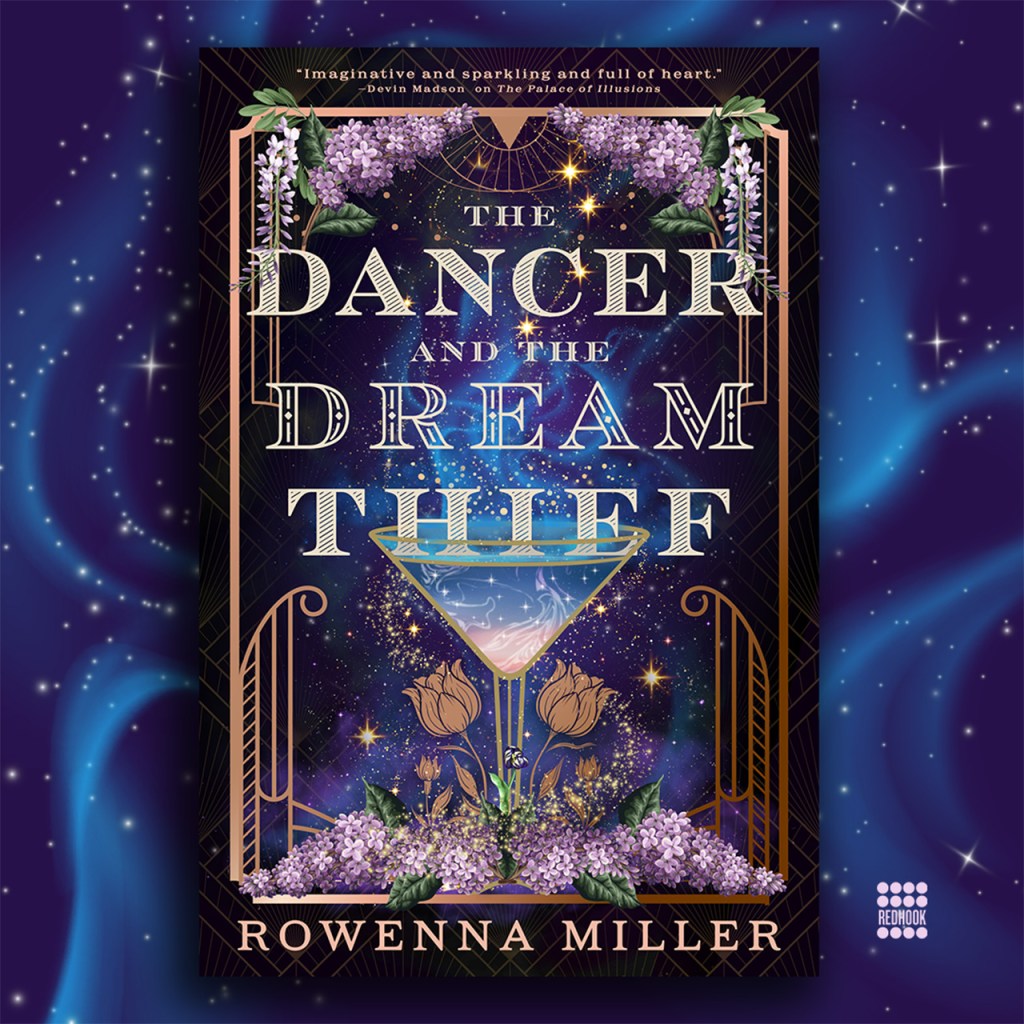
Read an excerpt from The Dancer and the Dream Thief (US), on-sale October 13th, below!
PART ONE
CHAPTER ONE

Raife
We are fairy tales.
At least, that’s the only way to explain who we are to anyone on your side. I’ve had precious little opportunity to do that kind of explaining, of course, but I’ve thought about it. That’s much of what we occupy ourselves with in the elfinlands—thinking, the shaping and honing and polishing of the currency of ideas. It’s a thought I haven’t smoothed most of the rough edges from, but in the end, I’m almost satisfied with it. We are fairy tales.
We are fairy tales, and we are nightmares. I am the story grandmothers tell to keep kiddies from walking alone at night or playing in the woods when they should be doing their chores. The old stories usually go something like this:
A beautiful young girl from the village scorned the interest of the eager young men and instead preferred wandering alone in the woods. One day she was following the trail she liked best, winding by a flashing brook that sprang from a deep sapphire pond. She heard a sound, more beautiful than any she had ever encountered—a song, you might say, but a song not of a human voice. She followed it until she reached the pond, and found that the music seemed to rise from the water itself. It called her closer, and she saw, in the depth of the pond, a brilliant silver horse. Suddenly, it galloped out of the rippling waters, snatched her, and dove down into depths unknown, and she was never heard from again.
Or perhaps like this:
A gallant young man rode off in search of adventure, much to the dismay of his widowed mother, who had only him in all the world. She begged him to be careful, to not trust in appearances or in his own understanding. He assured her that he was quite capable of taking care of himself, and in fact would return bearing great riches so that she would never want for anything again. He rode far and wide until one day he rested by a silvery lake, shimmering in the last of the evening light, and was startled by a voice from the tree above him. A lovely woman, pale as moonlight, beckoned him. There was something strange and unearthly about her eyes, her melodic voice, but he did not stop to question what it might be, beguiled by her beauty. And perhaps she fell in and he dove in to save her, or perhaps she needed no such ruses and simply held his pathetic gaze in hers as she dragged him into the depths, and he was never heard from again.
Or maybe something like this:
A wild and rushing river tumbled past a village where there lived a young girl who didn’t heed her mother’s warnings about its treacherous banks, for she loved the way the water sang and quivered over the rocks. One day as she splashed her feet in the shallows, she spied a beautiful silver-white swan gliding through the rapids. Entranced, she waded toward the swan, and as she did, a great rush of water rose and swallowed them both. She was never seen again, nor was her body found, but the next day the miller found a silver-white swan floating dead in the mill pond. Being an eccentric sort, he made a harp from the swan’s breastbone and when he strung it, it began to play by itself, a sad sound like rushing water, and the chorus sang itself from the harp strings, The elfin swan has borne me away, borne me away to the land of sorrow.
It’s nonsense, all of it—I always wondered who was telling these stories, if the poor drowned girls and stolen young men were always alone and they were never heard from again, but no matter. I figured those stories came from the thick fog of the long ago, the time before the nix were separated from your world and resigned to a life in the elfinlands. We have our own old stories, too, you see. Myth cocooned around history, fable and reality entwined together, and only the Nixerain, the most ancient of us, the ones who were there way back when, know the truth—though maybe even they don’t remember it.
But I can’t get ahead of myself.
We’d just arrived in Hebron Falls. It was another midsize city on our tour of the American Midwest, one of the places where there was still decent work at the factories and mills, so the dance halls and movie theaters were doing brisk business in the escapism trade. It was the same everywhere—Liae rented us a hotel room, we scoped out the local establishments, she swooped in on the ones where she thought she could make a sale. Elfinshine, which with Prohibition on, was no more suspect than bathtub gin and tasted better, too.
Nix had always traded with humans, though rarely as openly and brazenly as Liae did. We had usually kept to the shadows, communing only with fanatics at the fringes, the ones willing to trade with the otherworldly for a glimpse of the sublime. Mystery cults burrowed into the underbelly of ancient Rome, self-styled witches in the thick of ancient forests, eccentric medieval monks—that sort of thing. For the price of a few dreams that have no value in your world, elfinshine gave them visions, and visions gave them all kinds of things humans care about, like power and direction and certainty and belief. And, of course, they kept us percolating through the fairy tales of every pocket of humanity, nix lurking near clear water, nix hiding in dark forests, nix who could give you visions of beauty and wonder, nix who could steal you away to the elfinlands forever.
But now you’re more likely to meet a nix in back rooms and shabby offices and even the occasional booth by the kitchen in a diner. Some of the wonder has rubbed off, even if the danger still hangs around us like the scent of cigarette smoke that won’t wash out of your best jacket. Funny creatures, humans—you all pretend to dislike your dark corners, but you’re certainly amenable to hiding in them when it suits you. And with Prohibition on, dark corners suited plenty of people.
Of course, humans usually think it’s about the elfinshine, and the money. They didn’t know what Liae’s racket was really about. Sure, elfinshine made the money that paid for hotel rooms and evening gowns and boutonnieres and paying off cops. But what we were really after were dreams. Tether a person’s dream with elfinshine, and you can bottle it and transport it back to the elfinlands. And in the elfinlands, dreams are worth more than you could possibly imagine.
I didn’t ask questions about the big picture—the macroeconomics of the elfinlands or our little contribution to the interplay of supply and demand. I just knew that we ran dreams the way bootleggers ran moonshine, only we plucked dreams from the ether instead of rattling crates of bottles from illegal stills. And, sure, I knew that we were paid for our efforts. The pay was in dreams, and the pay was good.
But I’m telling you up front, before we get too deep into this thing—I didn’t know anyone could get hurt. I never meant for any of it to happen the way it did. I just wanted to exist in the beauty of the world humans created in their dreams.
CHAPTER TWO
Evelyn
Ruth leaned against the metal railing outside the Palace Ballroom and took a long drag on the tail end of a cheap cigarette. “I don’t care what management says.” She flicked ash into oily water pooling next to the curb. “I’m not taking dances from nix anymore.”
Evelyn tapped her fingers on the column, her hands at loose ends without a cigarette. The dancers at the Palace took a break when the band did, and she preferred loitering outside to getting harassed by overeager customers. It wasn’t like Fred Wilkes, who owned and operated the sorry excuse for a dance hall, was going to front money to outfit a break room for the young women he hired as dancers, and their dressing room was an unheated afterthought of an oversize closet. Huddling under the awning with a free view of the back alley was preferable. “You know they’ll make us anyway. If they have a ticket, we have to take it.”
“They can go to hell.” Ruth’s platinum waves shivered in the faint breeze. “I’m not risking it. Four girls last month. Four. Run the math. Those odds are worse than playing the ponies.”
“They’ll say what they always say.” Evelyn watched a thin cloud slice the moon in half, wan shadow on pale brilliance, not so different from the nix themselves. “They’ve got just as much right to be here as anyone.” She rattled off the excuses that kept the nix filtering into the Palace, excuses all covering the truth that they were running shine, supplementing Dottie Wilkes’s homegrown gin. She ticked each one off, one by one on a chipping manicure. “There’s no law against it. No one can prove those girls were elfstolen. The police didn’t determine cause of death. They probably drowned.”
“Officer O’Flaherty said there was no water in their lungs. I’m no doc, but that’s no drowning.” Ruth exhaled white, smoke curling away. “They give me the heebie-jeebies, Evelyn. Those eyes, the way their damn hands are always so cold. Why are they here, anyway?”
“Same reason anyone’s around this joint.” Evelyn wrapped her hands around bare arms, October starting to bite cold. “Booze.” Somehow. She’d never quite figured it out—elfin stills percolating diamond-clear moonshine outside the bounds of earth time, space, and laws, that she could buy. But why the local bootleggers let them cut in on their business, that didn’t make sense. Unless, of course, they couldn’t stop it, or they were working together. Seemed men always found a way to work together when it made them more money. Until it didn’t, and then someone ended up in the river.
“Remember when believing in nixies was a choice? When you could just ignore your nana’s stories and write them off like Santa Claus and leprechauns?” Ruth snorted. “Then all of a sudden they start showing up everywhere.”
“Ruth, you’ve met my ma. Believing in nix was never not an option.” Nix, the evil eye, vampires and werewolves—wieszczy and vrykolak, Mama called them. She was well-versed in all manner of stories that would have been horrifying had they been true, and had ample remedies, typically involving a rosary, a crucifix, and a laundry list of saints to implore for protection. Even Mama had to confess to never meeting a real vampire or vrykolak. The nix, though—the nix were a different story. A real story, not a folktale. “I guess they’ve always been real, we just didn’t see them hanging around here until they saw an opportunity for turning a buck running hooch.”
“Well, they sure as hell aren’t here for the ambience.”
Evelyn laughed. “You know, it could be a decent place. If Wilkes repainted the lobby—maybe a nice blue? Add some gilt and mirrors? Or go really modern with it, black and white? Maybe a mural on the ceiling, like at the Trianon?”
“See, this is what I like about you, Evelyn. You see the best in everything, always a dreamer.” Ruth tossed the spent cigarette into a puddle. A middling-sized rat started out of the shadows, scampering away from the ripples in the water. Ruth didn’t spare it a second glance, but Evelyn watched as its shadow melded with the darkness of the alley, as though slipping into another world.
The Palace was the second floor of a nineteenth-century opera house turned now-failing vaudeville. The dance hall kept the whole operation in business, in no small part because it provided cover for Dottie Wilkes to sell home-brew gin out of the back room. The carpet in the foyer was faded where it wasn’t outright stained, and yellow streaked the wallpaper, but the parquet dance floor was nearly new. As long as they kept the lights low it looked almost respectable.
Ruth waltzed back to the edge of the dance floor and flounced against a table, red lips in a pout. It worked almost instantly—someone with a ticket to burn picked her up. Evelyn rolled her eyes. Ruth copied the droll ingenues from the movies with almost comical perfection, but the fellows at the Palace never seemed to catch that it was all an act. Of course, they never seemed to catch that any of it was an act.
She waited with the others, skirts of their chiffon dresses rustling together into a blur of pastel. The Palace was busy tonight, just like the movie theater and Hap’s Diner for the lower-brow types and the Kingston House and the Trianon Ballroom for the well-heeled—first Friday of the month, payday for plenty of people who had work. Those who didn’t—well, they weren’t coming to the Palace, anyway. Breadlines that kept getting longer and winter coming on, with all its layoffs and heating bills. She hoped there would be enough business at the Palace to keep her employed. How else could she afford the privilege of living in a drafty rented room in the coldest damn city on God’s green earth? She was shit for a stenographer and didn’t like doing laundry or waiting tables.
Myrna and Sylvie passed a drink between the two of them, something that winked with ice. Evelyn looked away—they weren’t supposed to drink and dance, especially the illicit hooch that turned stomachs quicker than a prescription emetic. Yet, round and round that floor, time and again, cheap romance painted over the crude whispers and roving hands—a drink helped.
“Miss?” A tall man in a suit that almost fit him held out a ticket. Evelyn pasted on a smile and took his hand, slipping the ticket into her stocking. He wanted to talk; she let him. He was an insurance salesman from downstate, moved to town for the job, missed his dog, Jiffy, who he’d left at home with his ma on the farm. Figured. The fresh-faced boys tended to like Evelyn. She seemed safe, with her soft brown hair in a neat little bun at the nape of her neck. She didn’t wear much makeup and didn’t show much skin and cornered the market on the nervous types who were still a little afraid of perfume and lipstick and sex.
As the dance finished, she noticed them. Nix at the door. Silvery sheen on the sharp planes of their faces, those infernal ears nudging the brims of their hats up, just slightly. Perfectly tailored suits, always. Always.
Evelyn made a sharp turn away from the door, as though avoiding their eyes meant anything. Maybe it did—her ma talked about the evil eye enough that she’d wondered if the Poles had something on elvish behavior.
Ruth glanced at her and smirked. “What are you going to do, make a dash for the exit? Hide in the coatroom with Ginny?”
“I’d take Ginny’s job in a hot minute,” Evelyn answered. “Damn. They brought a girl.”
There was a flurry of activity while Ben, who took cover charge and sold tickets, protested. No girls allowed at the Palace, not unless they were on the employ. But Wilkes owned the place, and he was across the floor in two shakes. Ruth raised an eyebrow. “Must be big money.”
“Or he’s just afraid of them, like everyone is.”
“Wilkes? Wilkes was in the trenches back in the war. And shot a lion in Kenya. I doubt he’s afraid of a couple of cokey nix.”
“Wilkes says he shot a lion,” Evelyn countered. “Hot damn, they let her in.”
“Brightwhite bitch,” Ruth murmured, impressed.
They clustered around the bar, the single nix woman and her three escorts. Evelyn’s curiosity overcame her. You didn’t see many women nix—well, not around here, anyway. Maybe at the nicer department stores or the clubs along Hawthorn Street. Maybe in the bigger cities, who knew. That ageless pallor washed her face, smoothing any hint of wrinkles or personality, a bob cut sharp into her dark hair, and she didn’t bother with makeup except a thick smudge of black eyeliner. Outdated, like something a silent film star might have had playing Cleopatra. But effective, those bright eyes on full display. Her dress was—Evelyn cocked her head. Ordinary. An ordinary evening dress, impeccable seaming on the bias-cut silk belying expensive work, but ordinary. Human.
Did they wear this stuff at home, too? The thought startled Evelyn—she’d never bothered to think before about what they preferred, if they were wearing suits and gowns because they wanted to or if it was a nod to human custom or if they actually thought it helped them fit in. Joke was on them, she thought. Nothing helped them fit in.
The nix woman and one of the men moved toward the back, the crowd parting in front of them and seaming itself back together after they left. Evelyn remembered to stop staring in time to take a dance with a balding businessman who was all elbows and knees. She left him by the bar after their dance and looked for Ruth.
“Miss?” Evelyn came out of her skin but put on a pleasant smile before turning to greet what was probably her next dance.
One of them. A nix man.
They all looked the same age to Evelyn, but he acted younger. Didn’t quite know what to do with his hands, and leaned forward almost eagerly, instead of maintaining the imperious distance most of them kept from the girls they danced with.
“Yes?” She kept the smile firmly in place even though her heart kicked itself into her throat.
“Dance?” He held out a ticket.
She took it gingerly, avoiding his cold fingers. As though they wouldn’t be on her hand, on her waist soon enough. “Sure thing, sugar.”
It was a waltz. The band seemed to slow the tempo in some kind of cruel joke on her. Ruth caught her eye and shot her a sympathetic look. Evelyn had never wished more fervently that she could trade places with Ginny in the coatroom.
But the nix could dance, that was undeniable. Unlike most of the fellows who came through the Palace, he actually knew how to lead, and Evelyn didn’t have to watch out for collisions and subtly nudge him away from other couples. His stance was athletic, upright, and though the touch of his hand was like ice, it also maneuvered her expertly.
“I’ve never been here before,” he said finally, turning her deftly past a large potted palm.
“Then where did you learn how to dance?” Evelyn asked, in a shy teasing voice she usually used on farm kids. It worked here, too.
“I’ve been to other dance halls,” he said, cracking the faintest laugh. It changed his whole face, and Evelyn almost tripped. “Other cities. Other times. Just not here.”
“Well, where did you learn to dance, then?” She found she was actually curious, just as she had been about the woman’s dress. Did they have dance halls in the elfinlands?
“I learned here and there.” He smiled faintly, the marble mask slipping further. “The waltzes—they haven’t changed much over the years. Some of the grand ballrooms before the Great War—now that was dancing.” He paused. “Not, of course, that this isn’t lovely.”
Evelyn knew they were old, lived far longer than people did, but the ease with which he talked about his age shocked her back into wariness. He could smile and make pleasant conversation, but he wasn’t human. He was dangerous—and forgetting that was danger in and of itself.
The waltz slowed and they separated. His pale mouth twitched into a smile, and she fought to return it with a friendly wave in farewell. She walked back to the others, legs weaker than one of Dottie’s cheap drinks.
“Well?” Ruth caught her arm.
“Well what? He was a dance.” Evelyn swallowed, hard. “Just another ticket.”
“If you say so—here, have a drink. You look like you need it.” Ruth pulled a flask out of her garter, as though they were in some back alley and not the middle of the Palace.
“Damn it, Ruth, you’re going to get us both fired,” Evelyn protested half-heartedly as she unscrewed the lid and tipped back the moldering fire.
CHAPTER THREE
Raife
You can get a hint that someone dreams bright and full from their eyes, the way they take in a scene. They seem to dream a little bit right then and there, like they’re drafting the first sketches of a painting they’re going to fill in later. I’m sure humans have no idea when they’re doing it, and I don’t know if they see it in each other or not. But it was our job to spot it, scouting dreams that were high-value goods.
I was pretty sure that girl had dreams like none I had ever seen.
It wasn’t that she was a particularly striking girl. She was pretty, sure, but in a subdued, soft sort of way. Long dark lashes and wavy brown hair, a bright spot of pink on each cheek when she danced, one of her front teeth a little crooked. She was no Jean Harlow or Greta Garbo when it came to arresting beauty, and even compared with the other girls taking tickets she faded into the background.
But her eyes. Her eyes had something brilliantly alive behind them. Not that I could say something like that to her—even I knew enough to see I frightened her. From the way her eyes darted back to her platinum-blond friend, how her hand seemed to shrink in mine, in the gaudily confident smile she pasted on. It could wait; we were patient and the first pass at a new ballroom or dance hall or vaudeville was only a preliminary expedition. We’d be running elfinshine through this dive soon enough, and then all I had to do was be certain she drank a little of it. I didn’t have to make friends with her, I reminded myself as she took a dance with a teenager who was all limbs and no rhythm. She didn’t have to trust me.
And that realization left me with a strange startled feeling almost like sadness. We were never required to get to know our marks, but I’d never considered before that I might want to. I slunk away from the edges of the dance floor and found Liae, waiting impatiently for a back-room meeting with the dance hall’s proprietor, a balding flea of a man named Wilkes. She didn’t like to be kept waiting and it showed, her silver lamé sandals tapping an irritated rhythm on the marred parquet floor.
“Someday,” she said, “we’ll teach you to tie your own tie properly.” She crooked a finger at me and I acquiesced to her deft fingers and rough redress of my errant neckwear. Liae’s human form was about a hundred pounds soaking wet, and she had the most delicate slender fingers I’d ever seen, but she was as gentle as an angry raccoon. No patience with us lunkheads working under her.
“What’s the plan tonight?”
She laughed as she retied my tie—it was an ugly red-and-blue thing, but silk, like something that aimed for classy and failed. “You need to know plans now?” She finished with the tie and moved on to the boutonniere. All three of us working for Liae were god-awful at making ourselves “presentable, damn it,” as Liae always said. It’s more than a little uncomfortable for a nix, putting on a nice suit and pinning on a boutonniere and making small talk and pretending we can blend in when there’s no way in hell everyone around us doesn’t pick us out right away as a nixie intruder on the real world. Fortunately, with Liae, I never had to talk much. I mostly stood around trying to look serious and vaguely menacing. The advent of movies helped for that—I watched every flick James Cagney made about five times, trying to perfect that air of nonchalant violence.
She gave me a light smack on the cheek when she’d finished with me. “There’s the owner. What’s his name? Wilkes.” She didn’t wait for any of us to answer her. She never did. “All right, Yli is with me.” Yli was the tallest and broadest-shouldered of us. Liae usually had weaselly fellows like Wilkes pretty well handled on her own, but Yli added a certain quality of menace and just in case anything went sideways he carried a Colt Bankers Special. “Faro, watch the exits.” She looked at me with a half-feral, half-maternal smile. “Raife, watch the girls.”
I knew what she meant. She said girls, but she meant dreams. After the dance with the girl with the soft brown hair, I knew two things. One, I’d found the best chance at brilliant dreams in the whole of Hebron Falls already. Two, none of those girls wanted to dance with me. Instead, I scoped out a corner near the bar where I figured I could look slightly less like a creep than I would just ogling them from the sidelines.
Of course, as soon as I sat on a stool next to the bar, cleverly outfitted as a soda stand in case the police decided to raid, the booze all hidden behind paneling, the other patrons sidled away. That’s usually how it goes, and I don’t even take offense anymore. But the barkeep gave me a long look that I didn’t comprehend until he finally spoke up. “Look, pal, I know your boss lady is a special guest here, but don’t be chasing away my tips. Understood?”
I took the hint and hovered half hidden by the bandstand instead. A couple of the dancers passed a flask between them; three of them snuck away to smoke. I wondered at how they needed those vices at all, there among all the flash and light and music and talking and color of the dance hall. I couldn’t comprehend it, how they could be surrounded by such saturated sensation all the time that they got dulled to it.
I watched a girl kick her heels in a buoyant Charleston with her paid partner. They could never understand the desperation nix have for even just a little waft of a dream. That’s because none of you understand nothingness. Not really—the word makes sense, but as a concept your version of “nothing” is “Oh dear, I’ve got nothing in the icebox,” in which that “nothing” still includes air, frost, ice, the box itself, the expectation of filling the icebox with something—you see the trouble. Your understanding of absence or deficit is far from the reality of “nothing.” The nothingness of the elfinlands is true nothingness—a void, empty, hollow and formless.
Two things save a nix from shriveling into a bare husk, losing all of the self, of identity: time in the dreams of humans or slipping into the corporeal world. The latter is dangerous, and takes years of your time in careful training. Not only can we burst and leave ourselves in greasy stains on your pavement if we don’t turn correctly, we can of course die in your world. We can’t in ours. For most of the nix, dreams are the only way to stave off the slow desiccation into nothingness ourselves.
And you can’t bring anything into the elfinlands, except for dreamers and dreams.
We’ve never quite understood why you can transport a dream created in your world into the elfinlands when nothing else will survive the transition. Some of our philosophers pontificate that dreams are actually made of bits of the elfinlands, some remnant of our world left on yours from before creation finished baking and everything in both worlds was all a primordial goo running together. The philosophers don’t use terms like primordial goo, but I’m no philosopher and that’s the clearest I can understand it. It’s also a wholly untestable theory, and when it comes down to it, it doesn’t really matter much.
I escaped the stares and whispers inside the dance hall. The air outside the Palace was cool and there was a thunderstorm’s worth of cold rain hovering in thick clouds overhead. The side streets each offered a unique blend of scents—engine oil and faded roses from a discarded bouquet and stale sandwich crusts and something rotting in a trash can. Lights from the movie theater marquee and the streetlights shimmered in puddles lining the curbs. It was exquisite.
“Hey.” Faro punched me in the shoulder, one of his more typical greetings. “Liae says they’re done. Yli and I are supposed to go do a job. Liae says you need to get inventory. She also said if you decide to wander around, don’t mess up your suit.” Faro’s elocution skills always left a lot to be desired. All of us navigate the corporeal world with some deficiencies. Yli has no sense for time but can actually throw a punch. Faro sounds like a Dick and Jane book, but drop him in a new city and he’s memorized the map of the place within a few hours. And I might be a little on the scrawny side and don’t have a great sense of direction, but I am more socially competent than either of them.
“Fine, Faro, thanks.” He gave me a perfunctory nod in return. I wondered what he and Yli were assigned to do that I wasn’t needed for. We usually followed the threads of dreams and bottled them for transport by ourselves; we usually dealt with speakeasy owners and rumrunners in the safety of our whole pack. But I wasn’t going to question Liae’s orders. I disappeared into the softening night to chase a few dreams.
Dreams are hard to come by in the city of Hebron Falls, and everyone is looking for an escape. One young woman is about to learn just how much power dreams can hold.
“An ingenious combination of noir and fairy tale.”—Mary McMyne, author of The Book of Gothel
Evelyn Pulaski spends her evenings selling dreams working at the Palace Ballroom. For a dime a dance, she plays into a cheap fantasy of romance before returning to the gritty reality of everyday life. When dance hall girls start disappearing, a mysterious group of elfin bootleggers is the prime suspect.
Raife is also in the business of selling dreams. He is part of an operation stealing dreams from humans and peddling them in the elfinlands. Raife takes a shine to Evelyn, telling himself his interest is purely professional, but there is something…entrancing about her.
When Evelyn’s best friend disappears, she is forced into an uneasy alliance with Raife. And together they’ll discover the power of dreams to change, or even remake, the world.