Excerpt: SHROUD by Adrian Tchaikovsky
On a planet shrouded in darkness, a stranded crew must fight for survival. But, the darkness may have plans of its own in this wildly original story from Adrian Tchaikovsky, Hugo and Arthur C. Clarke Award–winning author of Children of Time.
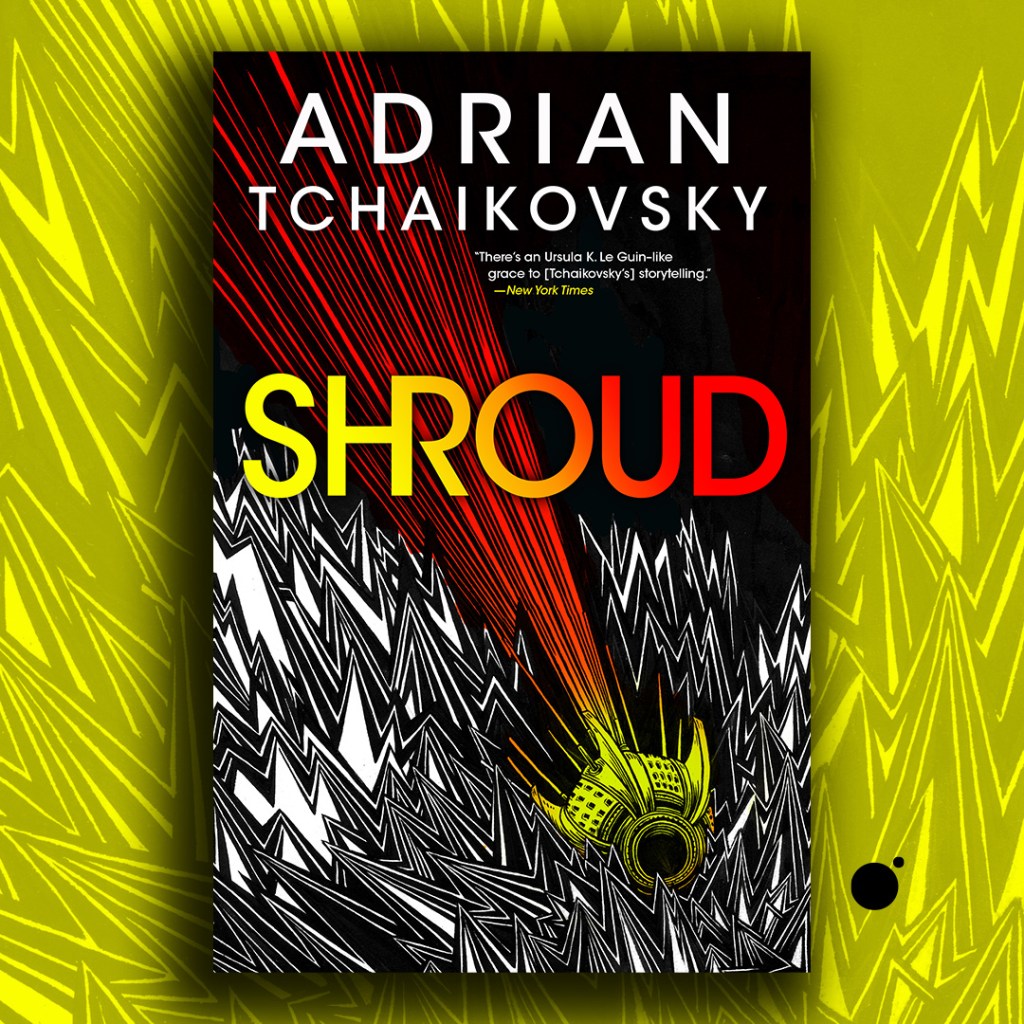
Read an excerpt from Shroud (US), on sale June 3, below!
PROLOGUE
The couch’s design had been cribbed from those on the Garveneer, which had cushioned everyone’s sleeping forms while the ship accelerated through the interstellar void, so it was considerate enough to wake me up after impact. Conscientious as a servant. Or a doctor. Waking me into pain and darkness. The sour residuum of all the terror and panic I’d been caught in the throes of before I blacked out.
Everything hurt. Out of the chorus, specific pains spoke up. I was a mess of discrete bruises, like I’d gone three rounds with a pugilism automatic. But beyond that, everything hurt me. The world pressed on me with such universal force I wondered, Are we travelling? Are we still accelerating? As though I was still in the ship.
Fighting against the gelatinous suction of the couch. Clawing an arm free of it, groping for the controls which should have been beside me on the Garveneer. My fingers met only cold panels. Dead, unseen, existing merely in the contact of my fingers with their smooth surfaces.
I remembered: I wasn’t on the ship. The oppressive weight of my own body, which was half suffocating me, wasn’t just the artefact of man-made motion. And the thrum of directionless sound wasn’t the thunder of distant engines communicated to me through the Garveneer’s superstructure.
I heard the whimpering of my laboured breath, loud in my ears.
No. Please. We didn’t.
But we had. We hadn’t meant to, but events had overtaken us.
Is it just me? Am I alone?
The rush of my panicky, straining lungs would have eclipsed an army.
We fell.
From grace. From orbit.
Dim light rose on all sides. Something lived beside I alone. The feeble motion of my hand had woken it. Faint illumination seeped out into the air, touching across the interior of the spherical space around me, yet some panels remained dark. I wasn’t the only one who’d taken a battering.
“Let me see.” Getting the words out was an effort. A wasted one. It wasn’t an instruction any listening system could have helped with. I mustered some jangled thoughts. Recited the mantra: Juna Ceelander, crew of the Garveneer. Special Projects team. Administrator. Administrator meaning problem-solver and general factotum. Not supposed to be here. Not in this thing. Not down here on…
Shroud.
“External cameras on.” Probably still not the precise wording, but if there were systems capable of listening then they’d interpret what I wanted and give me something. Anything.
I waited, ears full of myself straining to live, and the echoes of my voice.
Panels darkened, converting themselves into screens for my better edification and enlightenment. I stared into them, waiting to see what was out there.
And it was nothing.
The cameras were defective, I assumed. Or else the screens were defective.
But it wasn’t them. It was the world. The lightless, crushing, freezing abyss that was the world of Shroud.
I started to whimper again, then forced myself to stop. It could be worse. There’s still hope. It could be worse.
Distantly, through all the multi-layered and vastly over-engineered hull, there was a dull metal sound. All the many tons of my surrounding structure shifted slightly, as through the idle exertion of an immense strength. I heard a slow, indolent scrape, as if some hard claw was being dragged down the outside of the pod. Out there in the murderous, clenching dark.
I stared at the screens, still seeing nothing at all, and tried not to scream.
PART ONE
ABOVE / BELOW
1.1 LIGHT
The world roared.
It was a moon, in truth. A tidally locked orb, slaved to the gravity of a roiling gas giant, out towards the waist of the star system Prospector413 (annotation: approved for exploitation). This system of cold dead worlds and mineral wealth was about to form part of the Third Stage Commercial Expansion out of Earth. The net that humans were throwing out into the universe, to find somewhere to harvest and build and live. If you could call it living.
We hadn’t even been supposed to end up in orbit here. I remember waking up with the rest of Special Projects, dragged out of the near-freeze hibernation they had us all in. Biologically barely changed and yet somehow feeling incalculably older and more worn out. Each of us sloughed out of our couches like our own cast-off skins. Bartokh, our boss and very specifically my boss, clapped his hands together, striding out naked on his spindly legs, slapping at his gut because he was on enough of a worth-wage to acquire one. He’d been up for an hour already, getting over the cosmic hangover stage of proceedings without ever bothering to throw a scrap of clothing on. Now he was reminding us all of the abrasively cheerful leadership style he practised, which felt like sandpaper on the frontal lobes.
“What?” came the demand from Hari Skien, the geologist. “What, for the love of God? Someone give us some perspective. Is it aliens?”
“Of course it’s not aliens,” said Shemp Rastomaier, the team biologist, who’d basically given up on ever being able to do his job. By now the rest of us were moaning at the pair of them to either shut up or screw, because they’d been at each other’s throats when we went under too. Apparently hibernation had enacted some kind of saved-state on their brains and they were right back at it now we were awake again.
Bartokh, the old, the gleeful, cackled and said, yes, maybe this time it actually was aliens.
Nobody believed him.
But it was. This time, it was.
The Garveneer Composite Mission Vessel had entered the Prospector413 system with a plan to start scouring the patchy asteroid belt and some of the outer planets first off. For this mundane purpose they’d wake the bigwigs, who comprised the select management team known only as Opportunities, and then probably Acquisition Teams One through to Seven or something. Except they hadn’t even started setting up before they caught the signals. From a moon of a gas giant they’d have got around to inspecting eventually, except it was demanding attention right now.
It roared. Howled into space, shrieking its pain far out across the void in a thousand tongues. A constant, all-frequencies storm of radio traffic that blazed bright on every instrument we had.
This was, Opportunities decided, exactly why it needed the boffins of the Special Projects team around. Because something weird was happening, and spectrographic analysis of the moon’s atmosphere made for some interesting reading, so maybe there was some really useful stuff to be harvested over there. They took us off the shelf where we’d been stored, and designated a detachable module as Special Projects territory. They then split us off from the main mission’s planned approach, and spat us out of the Garveneer to visit this screaming prodigy and see what all the fuss was about.
When we arrived, we found only darkness.
A well of night, blazing with electromagnetic activity. So much signal that it became only noise. Of the actual moon itself, we could decipher nothing. Our instrumentation might represent a constant running battle between engineer and entropy, but it was still the best that human ingenuity had designed. It couldn’t hear itself over the tumult, and nobody down there was listening. Every electronic enquiry of ours vanished into the storm without leaving a forwarding address or a scrap of useful data. Our every hello was abraded away into nothing by the ceaseless shouting of the world below. A fleet of drones was able to skim the surface and return with some basic info about the upper atmosphere, but deeper enquiry just vanished into that cloak of noise. The six of us in Special Projects ended up split into at least eight factions, arguing over what could be causing such irregular, constant, chaotic transmissions. All of us dancing about the question of Life, could it be life? A whole civilization with their radios turned up to top volume, down there in the dark?
Eventually, something came back. Eventually meaning weeks of us measuring and experimenting, designing and fabricating, failing, revising. Scrounging for scraps of data around the edges, scavenging the low-hanging fruit of the moon’s high-atmosphere composition. We drifted there, suspended over the roaring world, until even our regular human senses started to feel the moon’s insane, hostile bellowing. Like being in a cell next to a crazed berserker. Bad dreams, ill tempers, the failure of attempt after attempt only worsening matters. Everything we dropped into that void was crushed, destroyed, malfunctioned, crashed, or just vanished into utter silence. We felt like we were battering ourselves against the moon’s intractability like a fly at a window. Until, at last, something came back.
Deep Drone Fourteen, the previous thirteen having been lost to the impenetrable night below.
What returned of the drone was its very heart, torn from its body. Because the body was heavy. Because heading downwards was easy, but the moon was larger and greedier than Earth, so you couldn’t just come back the regular way. The one thing it definitively wasn’t, given the atmospheric composition, was rocket science.
This telltale heart was a heavily shielded datastore, the receptacle for all the instruments that had been left behind with the rest of Drone Fourteen’s casing. Even getting that back up had proved powerfully challenging. We’d all been in the dark, literally, waiting to see if finally, this time, something would escape the screaming oblivion that was down there.
And it had. Which was how I, Juna Ceelander, had a first glimpse of life on Shroud.
Static, mostly, in that first watching, before Jerennian cleaned it up. Static because the constant chorus was far louder down there and, despite our best attempts, had crept into the data. Abrasive as a digital sandstorm, chewing at the edges of everything the drone had tried to preserve. For a moment the six of us sat there and wanted to slit our collective wrists in despair. Opportunities, the Garveneer’s high command, had been riding Bartokh hard for results. Which meant Bartokh had been riding us, and we all knew that if we kept on drawing a blank on usable data, they’d put us back on the shelf in the hibernation bay and maybe never wake us up again. You had to earn your keep in the commercial exploitation fleet of the Concerns, and all we’d been doing was guzzling resources.
Then, a glimpse: a dozen seconds of recorded video that was more than just all-direction snow and a vague suggestion of form. The electronic eyes had been left behind with the rest of the machine on the planet’s surface, but the images they’d seen had come back to us in orbit, through all our improvised measures.
It was dark, but we’d known it would be. The drone had the most powerful lamps we could fit it with, which didn’t cut far into the murk down there, but in those few seconds of imagery it was enough for us.
Not the barren moonscape we’d all been privately expecting, because so many failures, after so long, bred only pessimism. But it wasn’t rocks, it was things.
A knotted tangle of barbed wire. A snarl of briars, save that the drone was twice the size of a human being and the briars still reached high overhead in an arcing tangle. The cameras angled downwards saw more of the same, interlaced like basketwork, riddled with irregular gaps that led beyond the light’s reach. They shifted against one another as though the ground was breathing. The arching, knotting strands above showed a fractured punctuation, which was where the drone had torn through. Their edges were jagged, hollow, honeycombed.
The briars were also segmented, and they bloomed. Dimly glimpsed florets spread and waved, like the fans of tubeworms. With the wind? No, each was in motion separately. Beyond the shattered ceiling, lines extended upwards into the staticky blackness; taut, shifting, like the strings of kites.
Something moved at the edge of the light, intruding straight into it, with no sense of it registering the illumination. We glimpsed a body made of intricate latticework, a shift of motion within, seeming in that moment more like a child’s clockwork toy than a living thing. The way it moved was profoundly unnatural to the human eye, though in those brief moments the reason wasn’t clear. Something about its balance and gait. It was bigger than the drone, and its twisting progress was a slow amble. Its exterior shivered and shimmered, the light gleaming rainbows from a mist of fine hairs surrounding it. Then, as though in response, the tides of static rose and drowned the images. Shroud was keeping its secrets.
There were four hours of recordings locked inside the drone’s retrieved data core. Of the visual records, those twelve seconds were all that were readily interpretable at first glance. But it was enough to let us know that every trial we’d gone through to reach this point had been worth it. Enough for us to show to Opportunities, to justify our continued waking existence.
Beyond the visual data, we retrieved a wealth of physical test results, revealing a great deal about what it was like down on the surface of Shroud. Which was to say pretty damn unpleasant, for a human. Nobody was going for a stroll down there any time soon. Or ever. If you’d asked me right then, I’d have told you that was one thing everyone was certain of.
I mean, you’d have to be mad.
Although I suspect Bartokh was having ideas even then. I think he knew how it was going to go.
Bartokh gave us our marching orders straight away. Jerennian was to get to work trying to salvage more from the drone recordings. Everyone else was to work on developing better drones. Bartokh wanted more: atmosphere samples from ground level, specimens. He wanted something here in orbit that he could see, put under a microscope, then exhibit to Chief Director Advent when the big man came calling. But Shroud was jealous, and we would have to fight it every step of the way.
Three months and fifty-nine drones later, Shroud would win.
1.2 LIGHT
They called it the Second Bottleneck.
The first bottleneck—which for some reason didn’t merit the capital letters in the history books—had been on Earth. This was the great climate and resource crisis that wrecked so much, and came so close to ending everything humanity had built.
But we scraped through it, and those same books tended towards a tinny, slightly strained paean of manifest destiny, and how all that suffering and desperation had obviously been necessary, because otherwise we wouldn’t have ventured out into space and achieved this, and maybe don’t think too hard about it, how about that?
The social structures which survived the first bottleneck and led us into the second—the Second, with capitals—were the products of that desperation. Incorporated Fealty. This was what we learned, in school. How “Megasocial Opportunity-Exploitation Concerns” had been the salvation of our species. What they used to call corporations, except that was back when the presence of other ways of being gave the term some meaning. The rhetoric in the textbooks affirmed that only the big corporations could have done it. Unfettered as they were by the bonds of accountability and reciprocal responsibility, and possessed of foresight and tools which permitted a superhuman prognostication. The whole party line, you know how it goes. Feel free to sing along.
We saw only footnotes about all the other stuff that went on. The Inter-Concern Wars which devastated so many in-system colonization attempts. The way that, even as we were trying to build out from Earth, we were trying to tear ourselves back down too. All the stupid decisions which created the very last narrowing of that first bottleneck. Because despite all that, the fanfare and flag-waving part of the business was true, too.
The people who survived did so with the blessing of the Concerns, and only with that blessing bestowed in return for a pledge of service, as every child out of the habitat tanks can tell you in obedient chorus every morning. This was how we lived. And even if it was crammed together in the great orbital arcologies of the tanks, we did live, so we can all grumble as much as we want, but who are we to say there was another way? The six of us in Special Projects had given our lives to the Garveneer project, sure, but we were only around to do so because our progenitors had given their own lives to other Concerns, and thus been provided for, and bred, and given the universe us.
We were all properly grateful, I assure you.
We were lucky enough to live into the Second Bottleneck as I say, and humanity’s attempts to escape it. This time the Concerns were driven to look outwards at the wider galaxy. Long-term thinking. Expansion. By that point the solar system itself was practically an automated factory. Every part of it that hadn’t been blown up, or ferociously irradiated beyond even industrial use, was being industriously stripped. We could have stuck around, it was true, clinging to our mother system’s apron strings. We’d have lasted a while. But the driving ambition of the Concerns was always expansion and growth. The avoidance of stagnation. The solar system was cramped now, mostly because a lot of the potentially usable parts of it hadn’t really survived the internecine devastation at the end of the first bottleneck. In order to survive the Second Bottleneck, the Concerns needed to look further afield. So rather than a future penned up in a single, vulnerable planetary system, shackled to the dead poison cinder of Earth, we were heading outwards.
The Garveneer was just one of a hundred expeditions sent to every exoplanet-bearing system that looked hopeful. Our mission: to hunt out opportunities. To harvest resources. To create self-sufficient, resource-generating waystations that would serve to resupply the next wave of human exploration. The idea was that, in the future, the galaxy would become a network of stations to everywhere, settlements and extraction operations and shipyards, passing humanity hand over hand from one star to the next, and the next. The Concerns, perpetual economic powerhouses that they were, thought past the death of stars and the exhaustion of planets towards the immortality of their particular model of human society. We were going to spread ourselves across the near-side section of the galaxy like a rash.
Bartokh liked his face-to-face meetings. We could have done everything more efficiently from our workstations, but Bartokh was old. He had been in and out of the hibernation couches more than anyone. Once I realized this, I began to appreciate his insistence that we all actually dragged ourselves into the same room every so often. Because in the rush to hit targets and quotas, it was easy to forget you were human.
Needless to say, I prepared the presentation. Modelling things; that was part of my skillset. Not exactly the most useful thing to take into the field, but then I never thought I’d end up going into the field. I was just Director Bartokh’s administrative assistant.
Despite the generally uninformative nature of Shroud—our unofficial name for the moon, but one that stuck—we knew some things from our initial flyby, and from Drone Fourteen. Its distance from the star (via its planet, Prospector413b, on average 498 million km). Size (thirty per cent larger than Earth); orbit (tidally locked, 112 hours to circle the waist of a giant larger than Jupiter); gravity (1.8 that of Earth, partly from its size, partly what was probably an unusually massive iron core); atmosphere (anoxic, volatile, thick as soup; basically majority nitrogen but with dangerously high levels of free hydrogen, plus a whole lot of ammonia, methane and other more complex stuff); pressure at wherever Fourteen had fetched up (twenty times Earth at sea level); temperature at the same point (minus thirty-five centigrade).
Those were the drawbacks, really. All the reasons you’d never want to go there. The pluses were that minus thirty-five was actually really balmy for a moon of a gas giant this far out, which meant that a combination of planetary radiation, vulcanism and a tiny greenhouse effect were obviously doing their best under trying conditions. There was also a lot of stuff in the atmosphere we couldn’t readily explain, like why the high levels of hydrogen hadn’t all bled off into space, or where the ammonia was coming from, or a variety of other puzzlers which Rastomaier had been scratching his head over. Without that, it wasn’t anywhere we’d have been looking for life, save for the fact that it was literally yelling at us to come look.
Rastomaier was a miserable streak of a man, with a droopy moustache and a combover. Short and skinny, like most of us who’d come out of the orbital arcologies of the habitat tanks, and because nobody on Special Projects had the wage-worth for big dinners, except Bartokh. Before Fourteen’s little lightshow, Rastomaier had only been talking of life you could fit under a microscope slide. Skien, his opposite number on the rocks front, was shorter, balder, and their sourness was of a more adversarial flavour. Denying the whole life hypothesis, they’d been positing some way you could torture the moon’s geology to make it scream like it was doing, and maybe weep ammonia tears too. Nobody had actually expected Big Life, though. Nobody had been looking for a son of a bitch bigger than the actual drone. It wasn’t going to fit in a sampling canister, that was for sure. It was a whole macrobiotic eco-system down there—life on an Earth scale, a dinosaur scale. We’d found Shroud during an age of alien giants.
I’d modelled the planet based on what we knew. Meaning pretty damn little, and we couldn’t even formulate much of an idea of topography because, again, almost everything we sent down there just vanished. Or maybe was eaten, given what Fourteen had seen. I’d tried to model the creature from the clear footage, too, but failed. Too fleeting, too alien. Nothing I could come up with actually fitted the data. So that was just one other part of my role I couldn’t do.
My job description was Bartokh’s assistant. Having an actual human being serving as his assistant was the main privilege of his rank. What my job actually entailed was Bartokh knowing he could reliably unload most of his unwanted chores onto me, and I’d get them done in a close-enough approximation of his working style, so he could then show them to Chief Director Advent in Opportunities and make himself look good. My job was also serving as unofficial liaison between Bartokh and everyone else, as well as between Skien and Rastomaier, and between the two engineers and the rest of the team. Basically, I was perfectly positioned for everyone to blame whenever anything went wrong.
Due to this unspoken arrangement, what my skillset included was an aptitude for being the go-between amongst any two given factions in the team. A major in non-confrontational communications, meaning that whichever combination of the crew were currently pissed off at each other, they could sit down with me, and I would talk them through whatever the current spat was and smooth it all over. Honestly, I don’t like to blow my own trumpet, but when you’re six people stuck in a can and under the hammer of Opportunities to come up with results, I reckon my role was as important as any of the science.
The Garveneer Special Projects module was a configurable feast of a vessel. We hit orbit and the whole show turned itself from a ship with a front and a back, to a station hanging over the dark orb of the moon, which itself was just a jet bauble circling the enormous, purple-red-blue storm of the planet Prospector413b. Garveneer SP in its orbital identity always reminded me of a bug. One of those really fat bugs, whose wings don’t look big enough to keep it in the air. Of course the thing which kept us up was our trajectory around Shroud, fast enough to stop us falling into its hungry gravity, but not fast enough to just send us zipping off into space. Our wings were our solar arrays—multi-layered, hyper-efficient and still struggling to draw much from Prospector413, the system’s star. The bulging belly of GSP, directed towards the moon, was hollowed out to make space for our laboratory-workshop. That was where we diligently gathered information about Shroud, so we could make a profitable use-case scenario to Opportunities and justify our ongoing existence and resource budget. The back of the ship, facing away from the moon and sandwiched between workspace and solar panels, was a patchwork of cramped little bunk rooms, plus our social space—the circular room where almost everyone came together to bitch about whoever wasn’t present at the time. There was no gravity throughout any of it, but we were more than used to this. A growing proportion of the human species lived their entire lives strung between zero-G and the murderous press of heavy acceleration. Everywhere throughout the Garveneer was dotted with grab-handles and attachment points that paired with patches on our suits. And we had magnetic boots for walking around in, if you wanted to go fancy and retro. All this was our lot, facilitated by a ton of invisible, gene-level surgery and nano-implants which they started putting into us in the habitat tanks. Eyes, bone marrow, inner ear and the spatial centres of the brain. Weaning humanity out of the planetary conditions we’d evolved for, so we could gad about in free fall, or muscle through a protracted thruster burn without our bodies either collapsing or attenuating into nothing.
In the wake of Drone Fourteen’s twelve seconds of fame, a special commendation came back from Chief Director Advent over in Opportunities. We, the Special Projects crew, shared a tenuous moment of unity and cheer. You know, right before everyone went back to being frustrated at the planet’s intractability again. Old Man Bartokh let his impenetrable solitude of rank slip enough to show some teeth in his grin. Skien and Rastomaier forgot they hated each other. Mikhail “Big Mike” Jerennian, the data specialist, lost his punchy surliness enough to share a nod, and even bumped knuckles with me. Only Mai Ste Etienne was up and out of her seat straight away. Everyone shouted at her to at least sit down and enjoy the success.
“What?” Like Skien, Rastomaier and me, Ste Etienne was short and resource-starved. One of the many who’d grown up jostling elbows amongst the masses of the Concerns in the tanks, desperately taking aptitude tests until we fit some kind of mission-generated need. Bartokh’s little barrel of a gut was a late addition, worn with pride to show how he’d bartered his natural gifts into the modest success of becoming a middle manager. Jerennian was just big, born that way. Some fluke of genetics that he’d fed with bare-knuckle cage fight winnings. Because when you grew up in the high-density orbital slums of the tanks, you made your own entertainment. Which made it extra weird he’d ended up specializing in fine data manipulation. But you can never tell, right? Anyway, even though Big Mike Jerennian had the mass of two of us put together, when Ste Etienne had her head set on something, he moved well out of her way. She was someone who didn’t take no for an answer when she had a job to do.
Now she hung there, one foot in a strap and at a forty-five-degree angle to everyone else’s consensual “up.” She put her head on one side, rolling her eyes a bit. “I thought you wanted a better drone. Not going to design itself.” I always had the impression Ste Etienne felt the rest of us weren’t a necessary part of the mission process.
We persuaded her to sit down eventually, or at least Bartokh pulled rank. And, like all of us, any resource bonus Ste Etienne might have coming to her was strictly by his nod, just as he had to keep Advent happy to gain his own moiety. So after Bartokh had directed enough eyebrow-waggles and expectant expressions at her, she pulled her leg in and drifted to one of the attachment points. This meant I could take out the bottle I’d had printed at Bartokh’s instructions. Something acceptably stimulating, but which wouldn’t impair anyone’s working judgement. I know most of the others abused their printer privileges to make worse and stronger stuff when they thought nobody was keeping track of usage statistics, but we were doing things on the official level, so it was going to be milkwater, as we called it. Hard to feel properly festive with milkwater, but we all of us raised a tube of it nonetheless.
As moments of success went, I took it. Nice to have a brief pause when I didn’t have to watch everyone else for stress fractures. I hadn’t asked to be the morale officer. I was just supposed to do what Bartokh considered beneath his dignity. Turned out that included actually making sure his team functioned. He wasn’t what you’d call an approachable boss, and so I’d become the human equivalent of a passive-aggressive note left stuck to the wall. Tell Skien that… If Rastomaier thinks… Ste Etienne has taken my… Now seeing everyone actually united by some viable data left me realizing how crunched-up with stress I’d become.
They’d be at each other’s throats again imminently, of course. Either from natural orneriness, or because some new demand would come down from Opportunities. This too shall pass: simultaneously the best and worst commentary on any moment of human experience.
Sure enough, there came a message ping with that special, slightly shrill pitch which told us it was from the top. Chief Director Advent was delighted we’d made such sterling progress. But Terwhin Umbar, from Resource Oversight, was appalled we’d basically just thrown away so much of the rare elements stock into Shroud’s atmosphere, never to be seen again. Advent exhorted us to keep up the good work. Ten more drones, a hundred, a thousand! Whatever it takes! Umbar reined in our budget and expressed Serious Dismay about the waste. Where could we make economies? Did we really need all of six people to study an impenetrable alien moon larger than the Earth? Wasn’t there a corner we could cut, so she could balance her precious books? Both these messages, each exerting its own inexorable gravity, arrived simultaneously in the same packet. It was time to put the bottle away and go back to work. Which, for me, meant trailing Bartokh to the small space he claimed as his sanctum.
Bartokh settled himself against the wall, the seat of his suit handshaking with the relevant point to fix him there for the duration. He had that expression of his, as though he’d just said something very funny which nobody around him was intellectually equipped to appreciate, but he was magnani-mously forgiving us our ignorance. I had to remind myself that he was, in fact, extremely intelligent, and held his position as SP Director through genuine merit. He was not, in fact, just an egomaniacal pain in the ass. A gifted man, a man of vision and, if he was devoid of emotional intelligence, he was at least aware enough of the fact to make sure I was around to do it for him.
“Twelve seconds of usable video,” he mused. “What’s our trajectory?”
Meaning nothing to do with orbital physics, as I knew full well, but the far more difficult piece of navigation which would be threading the needle of competing demands Opportunities was saddling us with. What was going to happen next and how would it impact Umbar’s budgets?
“Mai already has early plans for improved drones. She sent them over to me,” I reported. “Mai” was Ste Etienne, because Bartokh was a First Names Person.
In order to act as the universal go-between of Special Projects I’d had to become everybody’s understudy. I couldn’t have created Ste Etienne’s designs, but I could see what she was doing with them. I walked Bartokh through what she, and everyone, was doing. I was used enough to him calling these one-on-ones at a moment’s notice that I always had the current checklist ready to reel off. Meaning this meeting could have been a memo. But as I said before, he liked his face time. An old man’s understanding of why human contact was necessary. He didn’t actually want much contact with the other humans, though, so I became the carrier wave for his atrophied humanity. Because Just Getting Along is the most important thing on the list, after air, power and food. Contrary to the old maxim, when you’re all in the same tin can with limited elbow room, in space everyone can hear you scream.
I’d perfected a kind of brisk jollity for this task, like spoon-feeding an elderly uncle. Mai Ste Etienne and her drones. Jerennian had declared more sections of Fourteen’s recording as eminently salvageable. Skien and Rastomaier were working on new mission parameters so that Ste Etienne’s improved drones would have something to do. And I, as well as acting as the glue for all the other elements of Special Projects, was working with Technical Oversight to make sure we had everything we needed to make all of this happen.
“Which means…” I ran Bartokh through a long list of choices—where we spent and where we saved, because these missions were always playing dice with entropy. And we were driven by a demand for results. Not just theoretical, oh-isn’t-that-curious science, but a big fat report on Advent’s desk entitled Commercial Exploitation of Shroud that could play into the wider development of this system. Another node in the greater project of human galactic expansion. Flags, trumpets, et cetera.
Big Mike Jerennian was the least congenial member of the crew. Meaning he still fitted within certain acceptable parameters, because nobody wants to be locked up in a spaceship with a psychopath. His particular neuroplot basically read “monomaniac with little headspace for niceties.” Extracting a pleasantry from him was like drawing a useful breath out of Shroud’s atmosphere.
You’re not supposed to ever see your own neuroplot notes, but there’s always a brisk trade in them via those who have access. I knew my own said I had an admirable flexibility, and should therefore be used to liaise between rigid people. Hence, as well as being Bartokh’s emissary to the rest of the crew, and the entire crew’s emissary to Opportunities, I was also the team’s emissary to Jerennian.
I found him in his corner of the ship-belly workspace. He’d already flagged seventeen sections of snow-static that the algorithms reckoned contained retrievable footage. It was a delicate business. Both human user and artificial systems needed to make certain assumptions and predictions, and these affected what the cleaned-up images would resolve into. The human mind was very good at seeing faces where there were only clouds. And if you told the algorithms there were faces there, so were they. Jerennian was exacting, though. I almost felt the subjective human part of him got packed away somewhere in his head when he was working. I brought him a coffee-flavoured stimulant, and the grunt I received in return was parsable as a thank you.
After that, I retreated to the little crunch of space that was mine alone and set to work. Bartokh wanted me to create models of Shroud from the observable data. Not a good use of time, or computational resources, except that it would give Opportunities something to look at beyond the big resource deficit we’d built up making it this far. I constructed my phantom planet. I did it so well I almost felt it. The toxic, brutal conditions below us. The crush of the gravity. The icy bite of a temperature which never came closer than twenty degrees below the melting point of water, even on the… Well, not the equator. That wasn’t how the thermal distribution of Shroud worked. It rotated precisely once per revolution around Prospector413b, the gas giant. Which meant one hemisphere was forever kept facing outwards into space, so that when the moon’s orbit and its parent planet’s were on the same plane, this hemisphere sporadically faced the distant star for a meagre injection of solar energy. Far more significantly for the moon’s energy dynamics, the other face was constantly turned towards the turbulent roil of the gas giant itself, which put out considerable radiation and heat of its own. Light, even. A little almost-star that never quite could.
It wasn’t as if anything would be sunbathing down there, though. No actual light ever reached the surface, and not just because the whole celestial business was way out in the waist of this planetary system. Shroud’s atmosphere, the source of that informal name, was a turbulent yellow-brown fug, with levels of methane and other opaque impurities ensuring that below—that unknown surface Fourteen had fetched up on—was nothing but darkness. Those twelve seconds of life we’d glimpsed existed in an abyss as profound as the bottom of the deepest sea-trench.
By Earth standards, any life there should have been eking out an anoxic, chemosynthetic existence in a thermal vent. Nothing but microbial scum, with perhaps a few colony organisms building high-rise necropoli on one another’s graves. Heavy, cold and dark. And crushed. While the atmosphere was thoroughly unbreathable and—if you tried, and before it killed you—would absolutely stink of urine and flatulence, there was also an awful lot of it. Which explained what had happened to some of the earlier drones, because the first couple hadn’t been rated for that kind of pressure. So many of Shroud’s parameters would gang up like thugs to kill you, but somehow it was the dark that upset me the most.
The dark, and the things living in it. Very unprofessional of me to think about a marvel of alien life like that, but there was something profoundly horrible about the idea of all that colourless, blind life fumbling about down there, groping through the methane-clogged murk.
With their radios broadcasting on all frequencies.
That remained an oddity neither Rastomaier nor anyone else could really explain. But it wasn’t my problem. My models weren’t trying to account for it. The whole Shrouded biome wasn’t meant to feature in my work, save that it kept creeping eyelessly into my head. But all that upsetting ideation did spark a few thoughts. And, like I said, I was everyone’s understudy, so had been forced to get up to speed on a very broad curriculum.
When I’d gone as far as I could with the data we had, I went to see how Ste Etienne was progressing. Her space was next to Jerennian’s, and the pair of them generally just got on with things wordlessly for hours. Then—sometimes of their own notion, and sometimes because I came and bothered them about it—they’d stop, eat, drink, and discuss what they were doing in clipped abbreviations. Not actually asking me, or each other, for suggestions. But just because the act of putting their work into even those few words would shake loose new thoughts. I was their sounding board. Sitting there with them, chewing a nutrient bar, I wasn’t sure whether they actually liked me, or each other for that matter. They had working relationships, for which liking was irrelevant.
That was according to the manual, of course. We had jobs to do, and a greater cause. There was a promotions and rewards structure that Opportunities dangled over us too. You did what you could to secure a hand on the ladder’s next rung. You were a team player, until there was only one post to be filled and then you became pointedly better than everyone else. All the usual. Liking tended to get in the way.
I was very lonely.
Which is trivial, and not something that turned up in my reports. I didn’t ever tell anyone I felt lonely, because that would have made me not a team player. I don’t know if anyone else felt the same way, and if they did they wouldn’t have told me, for the same reasons. Up there in orbit, we were all in our individual little tin cans.
In Ste Etienne’s workspace projected screens overlapped in bewildering profusion. I saw a lot of drone schematics, already advanced beyond those latest she’d sent me. I could identify the sampling apparatus, annotated with a bewildering cascade of weight and thrust calculations, tackling just how to bring the extra weight back out of Shroud’s gravity well. The composition of the atmosphere complicated any kind of regular rocket business. Everything would not burn at all, or burn far too much, depending on how much oxygen you tried introducing into the equation. We’d drawn Fourteen’s lobotomized brain back using a hydrogen balloon warmed with non-combustive chemical heating, some serious fan technology, and compressed gas for that final Newtonian kick to push it high enough for our orbital scoops. All to recover a datastore about the size of my smallest toe.
Amongst the drone plans there was something else. I didn’t understand it at first, because I hadn’t checked the scale of the schematics.
When I dared enquire, Ste Etienne gave me a level stare.
“Your boss asked for it,” she said.
When people were pissed off, Bartokh became my boss rather than everyone’s. I was the insulating layer between management and workforce.
Except this time—as he sometimes did—Bartokh had end-run around me and just sent instructions direct to Ste Etienne. Probably immediately on waking, before they fell out of his head.
“And this is…” I pointed at something, trying to pretend I knew exactly what was going on, and merely wanted some tiny detail clarified. Hoping whatever the detail was would clue me into the whole big picture that had been snuck past my back.
Ste Etienne wasn’t fooled in the least. “This is for the manned mission,” she said.
I should have nodded sagely but the enormity of it got away from me. “The what?”
Ste Etienne shrugged. A roll of the eyes, a spread of the hands. I’m just a poor engineer and all these dumbasses keep asking me to do the impossible. Except there was a bit of a spark there. More enthusiasm than she usually let show. Devilment, basically. Devilment in an engineer is a terrible thing. The idea of sending a poor fragile human body down into that nighted hell actually appealed to her.
I bearded Bartokh about it. I explained at length all the risks this idea was running, with especial reference to all those ghastly, murderous numbers that had gone into informing my model. Bartokh said placatingly that, obviously, it was just a theoretical sideline, that we were still working with the drones and the instruments, and I shouldn’t worry myself about it. Or about any of the other points I’d raised, where we were having to bite into my nice broad safety tolerances, because they made everything more resource- and time-intensive.
Bartokh then gave me that very clever expression of his and, just as I was leaving, said, “You know, Opportunities are really keen. Who knows what might be down there that we could use? If we can only take a good look. Drones and remotes, all very well, but limited, you know. Limited.” As though every other word we’d just shared had been entirely in my imagination.
They looked into the darkness and the darkness looked back . . .
New planets are fair game to asset strippers and interplanetary opportunists – and a commercial mission to a distant star system discovers a moon that is pitch black, but alive with radio activity. Its high-gravity, high-pressure, zero-oxygen environment is anathema to human life, but ripe for exploitation. They named it Shroud.
Under no circumstances should a human end up on Shroud’s inhospitable surface. Except a catastrophic accident sees Juna Ceelander and Mai Ste Etienne doing just that. Forced to stage an emergency landing, in a small, barely adequate vehicle, they are unable to contact their ship and are running out of time. What follows is a gruelling journey across land, sea and air. During this time, Juna and Mai begin to understand Shroud’s dominant species. It also begins to understand them . . .