
Excerpt: QUAINT FOLK by Bitter Karella
Quaint Folk is a sharply satirical queer folk horror novel that peels back the idyllic veneer of a seemingly perfect island town to reveal the rot beneath, from Bram Stoker and Shirley Jackson Award-nominated author Bitter Karella.
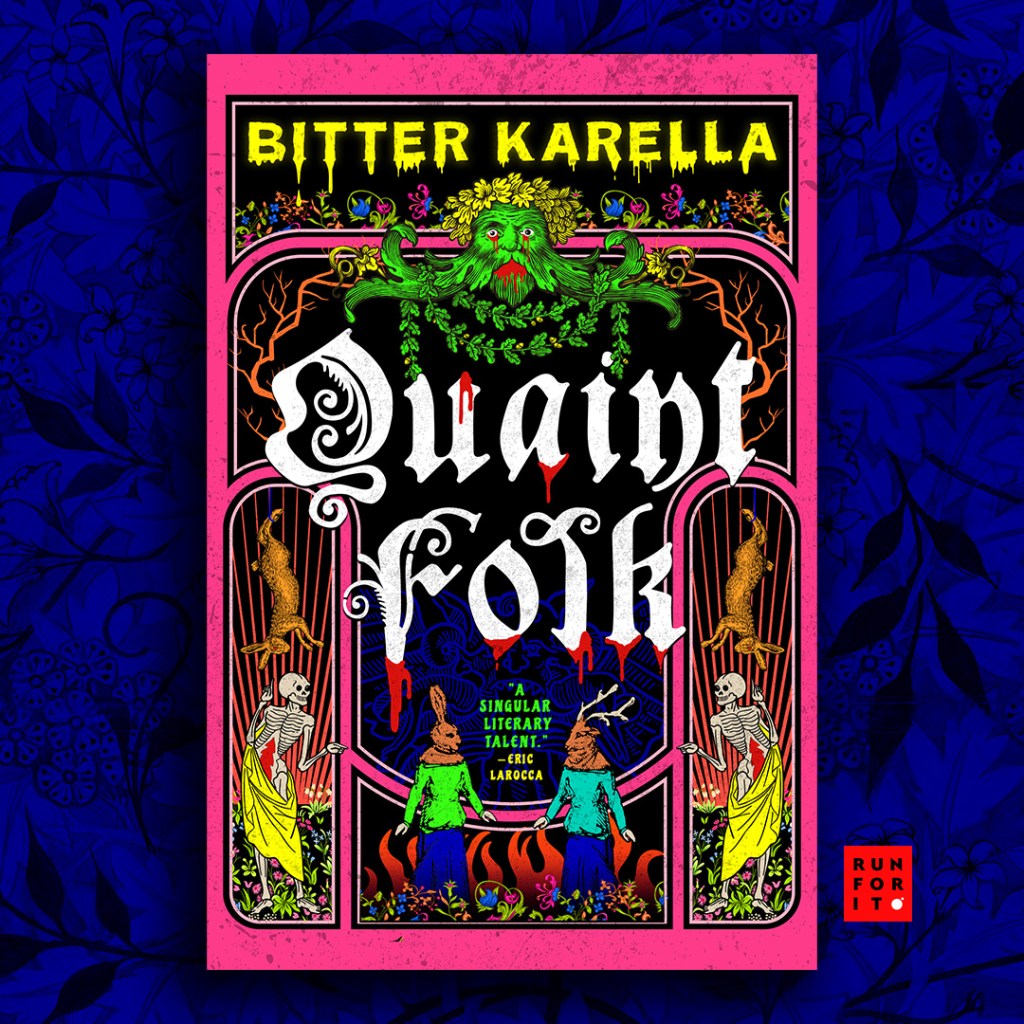
Read an excerpt from Quaint Folk (US | UK), on-sale October 6th, below!
0.
The grounds of Hollyoak House still retained a certain regal dignity in slow decay. The once-spectacular sunken garden was now consumed by overflowing thickets of yarrow and foxglove, hydrangea and catmint. Rabbits ascended from their burrows to feed at dawn and, confident in their solitude, sometimes lingered upon the surface well into the day. Here, there was an antique sundial with a polished brass gnomon. Over there, a fountain with a basin full of lily pads and duckweed, and a pissing cherub statue with long strands of algae dangling from its wings and tiny stone penis like green snot. Always there was the cloying sweetness of flowers in bloom. The fog never lifted entirely and, in the eternal gloaming, fat black slugs like ambulatory turds on their own business oozed languidly across the flagstones of the garden path at all hours of the day.
The exact age of the house was uncertain, and the foundations were even older than that. Even so, the house still held strong against the wind and the damp and all the indignities of this harsh island life that would quickly whittle a lesser dwelling down to its bones. Hollyoak House was comfortable without being ostentatious, stately without being insistent, three good solid stories, twelve bedrooms and three baths of refined luxury living, indoor plumbing, dependable electricity, and a nice proper watchtower that terminated in a steadfast widow’s walk. There were other rooms, whose existence was not advertised and whose purpose was obscure.
A good family would do well here, so it was a shame, the locals said, that such a beautiful house should stand empty—although they all understood, even if they were loath to say it aloud, that the house was not empty. There was something there, lurking within the warren of the home’s long, long corridors and padding silently over threadbare carpets in the wee hours of the night. It was subtle and it rarely showed itself to visitors. When it did, it was nothing more than the merest glimpse of a shape in the corner, so faint and so quick that a rational person could only conclude that their imagination was playing tricks on them. Sometimes there were sounds in the middle of the night, the faint scuttling of something moving in just the next room, always just the next room.
And, sometimes, there were dreams.
1.
The village of Hasenhurst, located upon the island of the same name off the coast of the United Kingdom, is a “folksy getaway” perfect for the “experience-hungry visitor,” that offers “cozy accommodations,” “friendly locals,” and “delicious traditional cooking.” The village is known for “celebrating Tigglestide,” “a unique festival” that “blends religious and secular elements” in “a taste of true down-home Britannia” like “nowhere else.” The villagers of Hasenhurst are “very devoted” to “tradition.”
—Greengarb’s Guide to the Undiscovered Gems of Great Britain (1997 ed.)
Jessica had not received the sacrament of communion in nearly thirty years, nor had she gone to confession, nor prayed the rosary, nor even attended church, all of which her parents had assured her in her youth were unforgivable mortal sins, yet God had not seen fit to punish her for these blasphemies. She still had her health, a comfortable life, a husband to take care of her, a child whom she loved, her youthful beauty, all the earthly delights that God loved to ironically deny his most ardent followers to test their faith. Sometimes Jessica liked to imagine that she had discovered a cheat code to life, that the best way to avoid the wrath of the petulant almighty was simply not to believe in him. A younger Jessica might have worried about the inevitable consequences to her immortal soul, or the immortal souls of her husband and child, the people she ostensibly loved more than anyone else in the world, but an older, wiser Jessica knew, deep in her heart, with a rock-solid certainty far greater than she had ever believed in the faith of her parents, that there was nothing in the sky above except the distant stars—no God, no angels, no demons.
Although Jessica had not set foot in a church in decades, she still retained an unfailing instinct for identifying church people. There were a lot of them. Most people in America, in fact, were church people, although Jessica was grateful that speaking of church was considered gauche in the elite social circles in which she could now travel due to her husband’s employment. The churchies who could operate at this level had learned to speak of church as if it were a quaint hobby, and they would praise it for the great community or important social work, but they would not talk about demonic possession or visions of the virgin. The churchies at this level were mostly protestants and Mormons, the occasional Jew and a few edgy Church of Satan libertarians. Jessica considered any sort of organized religion to be “churchy.” They were all the same to her.
And so she did not like the wife of her husband’s boss, because she was certain, despite never having spoken on the subject of church, that the wife of her husband’s boss was a churchy. And a particularly annoying one at that.
“Aren’t you just so excited to be visiting Hasenhurst?” said Stan’s wife. (Jessica’s husband’s boss was named Stan.) “I’ve heard tell it’s lovely. And so quaint! But I expect that every place in Great Britain is quaint. They’re rather known for it.”
“Sweetie, I am so excited,” said Jessica, smiling her broadest possible smile. It was her main job, as the wife of an Ungo.com™ junior vice president for implementation and implementainment, to be enthusiastic about anything that the company decided. “I’ve always wanted to visit England. There’s just so much history, so much culture.”
Stan’s wife came from an old money Protestant family, so this level of performance came naturally to her. Jessica came from a large family of Italian Catholics, who never once in their lives disguised their true emotions, so she’d had to become a late-in-life master of the art form.
“What I love about them is that they’re so real,” continued Stan’s wife. “You know? Not like people here.”
“Oh absolutely, sweetie. I know exactly what you mean!”
Jessica gathered from Stan’s wife’s gossip that Stan believed Hasenhurst’s location made the town “strategically significant” for “the future sustainability of Ungo.com™,” but since Jessica didn’t actually know or understand what Ungo.com™ did, she couldn’t comment on that even if the input of a junior vice president’s trophy wife was welcome. All she knew was that Stan was sending her family there so her husband, Greg, could complete some sort of arcane business deal with the town fathers of Hasenhurst, and Jessica, as Greg’s trophy wife, was committed to being pleased about the whole affair.
Stan’s wife took a sip from her wineglass. “Stan was talking with their lord mayor—isn’t that delightful? They call their mayor a lord mayor!—to work out the preliminaries, but these people really don’t like communicating on the phone. That’s why Stan was so insistent on sending Greg out there. He’d really like to show them that we’re all just normal folks here at Ungo.com™, nothing to be afraid of. You and Greg would be the perfect face for Ungo.com™.”
Stan’s wife’s husband (Stan) was senior vice president in charge of implementation and implementainment at Ungo.com™. He was younger than Greg, with a glorious full head of wavy blond hair and a perfectly manicured blond goatee, not a single gray hair in evidence, and he received all the promotions that Jessica felt were Greg’s due. Stan was good at playing the game. Greg’s only skill seemed to be a genuine knowledge of computer stuff. It was the one thing that kept him employed at Ungo.com™.
Although maybe, now that Greg was going to secure this Hasenhurst deal, that would change.
Jessica always felt just slightly inadequate when the family was invited to Stan’s McMansion, allowing Stan to sell Greg on whatever exciting new synergistic development needed to happen so Ungo.com™ could finally turn a profit this quarter and Stan’s perfect wife could show off her expert cooking and homemaking skills that she honed in her off time from being a professor of comparative literature at UC Berkeley. There were rumors that Stan was one of the beautiful people, part of the cabal of Ungo.com™ higher-ups who secretly met in a chat room where the real decisions were made. And, of course, Stan and Stan’s wife had raised a pair of perfect, very well-behaved children. Jessica was certain that, eventually, Stan’s wife would reveal that the secret of well-behaved children was, in fact, regular church attendance—and she would innocently inquire Have you ever considered that for Sandy?
Dinner was concluded and the adults had retired to the den. The kids were in the backyard, frolicking in the pool in the gathering twilight, and Jessica could keep a watchful eye on her Sandy through the large picture window even as she endured Stan’s wife’s interrogation. Sandy hoisted themself out of the pool and scampered, dripping, to the diving board, where they plunged back into the water with a splash that delighted the Stans’ kids. Sandy wore a full-body wet suit when they went swimming, and Jessica was bracing herself for the inevitable Why is a boy wearing that question from Stan’s wife and the equally inevitable tension that would result from a churchy asking that question.
Meanwhile, the men were occupied in their own affairs; Stan was showing Greg his new stereo system and bragging about decibels or watts or whatever, and Greg was nodding seriously as if he understood what any of that meant.
“Stan really thinks that your family would be perfect to win over these Hasenhurst people,” said Stan’s wife. Stan’s wife liked to pretend that they had a deep and abiding connection by virtue of their sex, but Jessica was no fool. The world was full of sharks, both men and women. Stan’s wife’s first loyalty was to Stan, and Jessica was certain that anything she said in confidence to Stan’s wife would quickly reach Stan too. Stan’s wife was friendly to Jessica because she thought Jessica was too stupid to understand this reality about the world. She thought that a woman like Jessica—no degree, no career, nothing to get by on except her looks—didn’t have the smarts to play that game. “But he only really knows Greg, doesn’t he?”
Jessica tensed, but she outwardly smiled and ran a finger around the rim of her wineglass. Jessica had a great smile—warm, approachable, sincere. It was her smile that first attracted Greg and it was her smile that cinched the deal of their marriage. But she was beautiful otherwise too, although the effortless appeal of youth now gave way to a more cultivated middle-aged grandeur, the inevitable spread of her hips and thighs speaking to good living rather than sloth, her stomach still flat after only a few little nips and tucks, her long raven-black hair (mostly) free from gray streaks, and her face still smooth and firm. Her arms were ringed with scars, but nothing a tasteful long-sleeved blouse wouldn’t hide, and the scars lacing her thighs were even easier to conceal. Greg, meanwhile, only had scars that didn’t require embarrassing explanations. They came from an appendectomy, wart removals, stuff like that. Greg had otherwise once been her equal in looks, but men were allowed to gracefully settle into middle age, and he had, like most men, taken full advantage of that allowance: His potbelly bulged over his belt and his thinning hair had been retreating from a growing pink bald spot since he hit forty.
“That’s why I really wanted to ask about your Sandy.” Stan’s wife furrowed her brow in mock sympathy. She glanced out the window; Sandy was in the pool up to their neck, laughing and splashing water at one of the Stans’ kids. “I spoke to him earlier tonight; he tells me that he’s a they/them now.”
“They’re a they/them, yes,” said Jessica. “It’s a thing with the kids these days, but that’s fine. I want to make sure that my Sandy always feels loved and supported as they discover who they are. As a mother, I’m sure you can understand. Wouldn’t we all just move heaven and earth for our kids?”
Stan and Stan’s wife had two kids, a boy and a girl, a pair of delightful towheaded moppets who never disappointed their parents. The Stans liked to brag about them. Sandy climbed out of the pool and prepared to take a second leap off the diving board. Their long purple hair hung down past their shoulders, wet and plastered to their back. Jessica didn’t mind the long hair. She thought her little angel was perfect no matter what kind of hairstyle they preferred. She didn’t much care for the color purple, though. It really made Sandy stick out. It really made people ask questions.
“I think it’s just so brave of you,” said Stan’s wife. “I am inspired. But honey, just between you and me, the purple hair? It might put people off in Hasenhurst. I’m just saying this out of concern.”
“Thank you for your concern.”
Stan’s wife laughed. The breezy attitude was back. “But let’s not talk about unpleasant things! Anyway, I’m sure this whole they/them thing has brought you both so much closer together.”
Jessica smiled her most practiced, brittle smile, and her fingers clenched around her wineglass until she was certain that it would shatter. What did that mean? Unpleasant? Jessica’s gaze flicked momentarily over to Stan and Greg in the corner. Greg did not share Jessica’s innate understanding of the world. He was too eager to accept that a smile meant friendship, never bothering to notice whether the teeth behind it were pointed. He was too open, and with a little friendly prodding, he would blab anything. That was why he’d never advanced higher than junior vice president. He didn’t have the hard reptilian hide that true advancement required.
“We’re very close,” said Jessica, and she smiled wider in hopes that Stan’s wife wouldn’t detect the lie. Sandy was a teenager and was deep into that typical teenage phase where they resented their mother for being their mother.
Stan’s wife leaned forward and placed her own wineglass upon the coffee table, stole a glance over at Stan and Greg (still babbling by the stereo), and then spoke in the soft, sad voice that women always reserved for speaking of topics they would rather not speak of: “And how are things between you and Greg? Everything good?”
Jessica felt like her smile was going to split her skull in two. She could not keep smiling like this. She was going to go insane. She was absolutely furious. How did Stan’s wife know? Or was she bluffing? Did Greg tell her? What did Greg tell her?
“Everything is lovely. I wish your Stan wouldn’t keep him so busy, of course, but I understand how that is. Ungo.com™ paid for our house, so who am I to complain?”
“Jessica, a woman knows,” said Stan’s wife soothingly. “I can see the way you two interact. I can see the tension. You think I haven’t been there? You think every woman hasn’t been there, at least once?”
Jessica laughed a breezy laugh and tossed her hair, as if to indicate that this was no big deal and she was not bothered at all and let’s just change the subject and talk about something more pleasant, please. We’re not even friends, thought Jessica. I don’t even remember your name. You have no business knowing anything about my marriage.
They had met, maybe, five times total—at company parties, passing at Greg’s office, or occasionally at obligatory but uncomfortable social dinners like this one. It helped Greg’s career for Jessica to be friendly with Stan’s wife, so Jessica did it. Jessica sometimes felt her only worth was in how friendly she could be with Greg’s obnoxious business relations.
“It’s hardest on the kids when parents are going through a rough patch. Makes them act out.”
Jessica could not keep her smile going, not in the face of that insult. Sandy was Jessica’s perfect little angel, and no one could ever imply in front of this mama bear that anything was wrong with Sandy and not expect a fight.
“Sandy’s doing well. They’re a trooper.”
“Stan said he was getting into fights at school.”
“They’re getting into fights at school.” Jessica was gratified that she was able to correct Stan’s wife. It made her feel like she had the upper hand again. “And it was just one fight. Kids get into fights. It’s no big deal.”
“And you don’t think this whole they/them thing is Sandy acting up because…?”
Jessica swallowed. It suddenly felt like her entire life, the life that she had so carefully built over the last twenty years, was falling apart: Her husband, Greg, was a stranger to her, a stranger who surely would soon tire of his useless trophy wife now that she was forty-six and didn’t turn heads at Ungo.com™ company parties like she once did and couldn’t even raise their son properly to not have purple hair. Sandy was fifteen; that was the age that children didn’t need their mothers anymore, the age that children would understand if their father told them Mommy had to go away and not have lasting trauma.
“Sandy is not acting up, sweetie,” said Jessica. She added a giggle to indicate how little she was worried, but it came out too hoarse. “We’ve been through worse. We’ll get through this.”
“You know,” said Stan’s wife, “a child really needs a moral structure in their life or they’ll keep acting up. We go to Grace Community—”
“Settle an argument for us,” called Stan from across the room. He took the opportunity to peep at Jessica’s cleavage with the subtlety of an experienced peeper. “Greg says that [technical gibberish], but I say [technical gibberish].”
“Of course, Stan, it’s [technical gibberish],” Stan’s wife called back.
Stan punched Greg playfully on the shoulder. “Told ya!”
Jessica did not understand what they were talking about. It was probably something to do with Ungo.com™ business. Stan shared his work affairs with his wife because Stan’s wife was smart and could understand that sort of thing. Or maybe it was because Stan and Stan’s wife truly loved each other in a deep and meaningful way that few couples did. It was hard to tell. Jessica spent every evening together analyzing their movements, their words, the little inflections in their voices, wondering if this was love—was it the real thing or was it a show for their guests? Or had they been playacting for so long that now even they couldn’t tell the difference? It seemed real and Jessica suddenly felt a deep ache, way down in the depths of her gut, wondering why she and Greg couldn’t have that.
Stan’s wife turned back to Jessica and said, “If nothing else, you’ll find this trip wonderful fodder for that book you’re always working on.”
“Greg told you about that old thing?” Jessica was proud of her writing, but she had to play it cool. False modesty was the purview of both the great artist and the desirable trophy wife, and Jessica was skilled at playing both roles. She needed Stan’s wife to draw the details out of her so she wouldn’t look like a blowhard. “Sweetie, it’s nothing, just a fun little project. You know, a woman’s gotta keep busy.”
Jessica waited for Stan’s wife to ask for details about the book, because Jessica had a whole spiel prepared and she was always eager to speak more about it, but Stan’s wife notably did not.
“It’s a fantasy story for young people, about a princess who doesn’t follow the rules,” said Jessica, unprompted. “It started as a bedtime story I made up for Sandy and then I thought, maybe it could be a book?”
That was as much prompting as she dared. Propriety required that Jessica wait for Stan’s wife to express interest before she said any more, but Stan’s wife’s only follow-up question was: “And how does Greg feel about that?”
Jessica understood exactly what Stan’s wife was asking. Everyone was always asking her about Greg’s feelings on her writing, as if Greg had a say. Greg made good money as a junior vice president at Ungo.com™. He could afford to be a patron of the arts. He could afford to indulge his loving wife in this little vanity project. After all the effort Jessica put into this relationship, after years of unfailing devotion as a wife and mother, didn’t she deserve to spread her wings a little? Didn’t she deserve some acclaim of her own?
“He’s supportive.”
“Lovely.” Without skipping a beat, Stan’s wife moved on. “I am sure you are going to just adore Hasenhurst. Sometimes a change in scenery is exactly what you need, something to get you out of your rut.”
Jessica gulped the last of her wine. The problems in this family ran deep, the roots twisted in strange knots that none of them could fathom nor untangle, but there was a lot to be said for a nice, quiet vacation in a nice, quaint village. Everyone knew that Britain was renowned for its exquisite quaintness and the exquisite quaintness of its citizens. Jessica felt like, if anyplace could help her, it would be there.
Read the next chapter at Dread Central!
Quaint Folk is a sharply satirical queer folk horror novel that peels back the idyllic veneer of a seemingly perfect island town to reveal the rot beneath, from Bram Stoker and Shirley Jackson Award-nominated author Bitter Karella.
“The folk horror I always wanted: queer, funny, bloody, and outrageous in the best way.” —Laura Cranehill, author of Wife Shaped Bodies
From the outside, it looks like Jessica has the perfect life. She’s a stay-at-home mom, married to a man with a respectable job, raising a son they adore. Her family is as wholesome as all-American pie. But deep down, Jessica knows there’s something wrong with her; she knows she can’t escape her past.
When her husband’s job has them move abroad, Jessica thinks this is her chance for a fresh start. On the remote island of Hasenhurst, the modern world can’t get in. The people there grow their own herbs, make their own jam, and mind their own business. They believe in folk tales and the power of dreams. They tell visitors, we’re a quaint, quiet people.The right sort of family would do well here.
Jessica is determined to be the right kind of person for a family—and a life—like this. But as she tries to befriend the townsfolk and learn their ways, she soon realizes that beneath the town’s cozy idyll, something sickly-sweet and rotten lays buried …
“To experience Karella’s cheerfully unhinged fiction is to surrender to a spectacularly fierce and uncompromising literary force. Quaint Folk astonished me with its charming, mythical weirdness threaded with genuine moments of pure tenderness. A bold, potent brew of all the best elements of folk and queer horror.” —Eric LaRocca, author of Things Have Gotten Worse Since We Last Spoke
