
Excerpt: FOR HUMAN USE by Sarah G. Pierce
An unforgettable debut, For Human Use is a twisted tale of modern love that bends every genre, sears itself into your brain, and presents a horrific romantic comedy unlike anything you’ve ever read before.
★ “An utterly ingenious horror-romcom, darkly zeitgeisty, and unnervingly plausible—funny as hell, too. You will not forget this book.” ―Heather Aimee O’Neill, author of Read With Jenna book club pick The Irish Goodbye
Modern dating is dead.
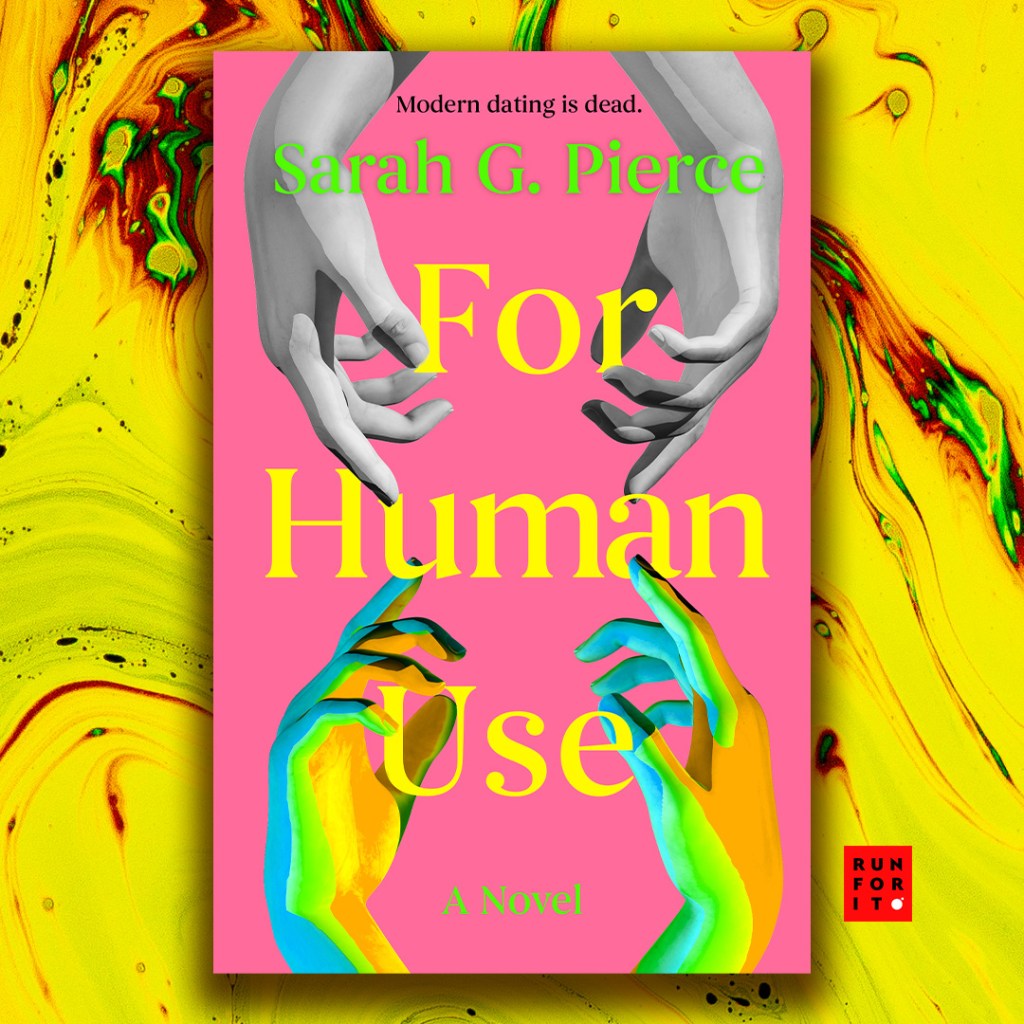
Read the first two chapters of For Human Use by Sarah G. Pierce, on sale February 10th, below!
TOM
On the day his corpse nightmare began, Tom Williamson was at his desk because that’s where he lived.
Lorraine, the firm’s other most senior partner, swung open the door. “Are you coming to this pitch?”
He looked at his watch. “I can’t, I’m already late.”
“To that fake dentist appointment in your calendar?”
“To meet her at my apartment,” he whispered.
“Didn’t you call it off like two weeks ago? Why is she still there?”
“The movers come this morning.”
Lorraine didn’t notice the pile of clothes on the floor. Tom was too cheap for the St. Regis’s laundry service, so he had been dragging his shirts and underwear to a wash- and- fold. The errand offered de minimis savings, unless you included the cost of his time, in which case it was a total loss.
He grabbed his phone and headed out. Lorraine walked alongside him. “Reschedule with her. Trust me, you don’t want to miss this pitch.”
“I can’t.”
“Tom,” she laughed. “You broke off an engagement after the invitations were printed—what additional harm is there to be caused?”
“I can’t— literally— the movers are booked for a month. I had to bribe the guy.” Almost at the elevator bank, he lowered his voice and gestured to the pit where Kane Capital associates and admins tended to the 113 billion in assets under management. “Plus my shrink specifically told me not to let work intrude. I’ll sit with her while the movers pack, be back by lunch.”
Lorraine sighed. Fifty- five and twice divorced, she had the gift of effortless cynicism, a quality Tom yearned for and lacked.
“You’ll wish you’d stayed, but whatever.” She widened her eyes. “Kane picked the deck himself— it’s that bad.”
Tom didn’t doubt it.
Robert Kane was seventy- one, and if he hadn’t founded one of the most successful private equity firms in history, he probably would have coached high school football or sold insurance. Kane spoke with a slow Georgia drawl, but after decades in Manhattan, it was more theatrical than regional.
Tom looked over to the executive suite. Like his own office, the curving glass wall offered no privacy. In this fishbowl over Central Park, his boss was in animated conversation with the author of the deck in question. Sitting in one of the Bauhaus chairs facing Kane’s desk, the entrepreneur wore a black T- shirt and charcoal jeans, the costume of a one- man play. His dark blond hair was long enough to tuck behind the ears, cut bluntly above the neck.
“Text me what the pitch is about,” Tom said.
In a cab on Park Avenue, his phone buzzed:
Lorraine
10:05 AM
it’s a dating app for dead bodiesTom
10:05 AM
What?Lorraine
10:06 AM
It’s a swiping app, like tinderTom
10:06 AM
????Lorraine
10:06 AM
But for dead bodiesTom
10:06 AM
Your autocorrect keeps typing ‘dead bodies’Lorraine
10:07 AM
corpses, cadavers, whatever you want to call themTom
10:07 AM
???? Niche dating for people who work with cadavers? Like funerary workers? Or med students?Lorraine
10:07 AM
LIVING people swipe left/right on pictures of DEAD bodies. If you swipe right, a human corpse gets delivered and you live with itTom
10:07 AM
that’s not realLorraine
10:07 AM
The company is called LIV, it’s legit (as far as any bullshit startup can be legit)Tom
10:07 AM
illegalLorraine
10:07 AM
Apparently not!!! Legal confirmed, bodies are technically property?! The founder Auden White says people are already using it.Tom
10:07 AM
then he’s lying.Lorraine
10:07 AM
Kane is disgusted. And enthralledTom
10:07 AM
Why didn’t you say any of this before I left?Lorraine
10:07 AM
Would you have stayed?
Tom stared at his phone. Eating a dead body made more sense than dating it.
When Elizabeth answered the door, he stood back with a tentative wave.
Her demeanor was hard to read, but her mood wasn’t difficult to guess.
He followed her into his living room. Collapsing on one of the sofas, she burst into tears. He sat down opposite, fearful anything closer might give her the wrong idea.
“This is such a mistake,” she sobbed. “I can’t believe you woke up one day and decided to waste all this.”
She motioned around the room, though Tom had no idea what she thought he was wasting.
I haven’t really thought about you since I left here two weeks ago . . . which is pretty crazy because before that, we were planning on getting married.
On this they could agree: They both hated Tom.
He fell into their relationship to get off the dating app. When she asked to move in, he didn’t argue. Four months ago, he accepted her suggestion they get married, but only so they could go to bed without fighting. Agreeing to spend the rest of his life with her felt like signing a false murder confession in exchange for permission to sleep—he was that tired.
Far from disengaged now, Tom was alert with pressing concerns, but he couldn’t for the life of him work them into the conversation.
For instance, how could anything Lorraine had texted be real? If not illegal, then prohibitively regulated. Did Elizabeth go under the couch to retrieve the four- carat diamond ring, or was throwing it at him the same thing as returning it? That was the night he checked into the hotel.
The movers arrived. Seeing the three men in uniform, he recalled a long- forgotten article in the Economist on cadaver use in car- crash risk assessments— a corpse, dressed in a jumpsuit for its dummy work, seat belt across its chest, hands and face wrapped in white cloth to spare the researchers undue exposure to its humanity. Tom stared as the movers slipped on blue disposable shoe covers.
They worked their way through the thirty- ninth- floor condo, packing up half of every drawer, shelf, and closet. When Elizabeth accompanied them to the bedroom, he checked his phone.
Lorraine had sent Liv’s pitch deck.
With no warning at all, a white male cadaver popped up on his phone screen. Early twenties, he rested on his back with closed eyes, absent the relaxed vulnerability of sleep, impassive expression jammed into place. An autopsy had left two long incisions in his chest cavity. Stitched closed, they formed a burgundy Y on his sternum.
Tom gaped in a paralyzed silence, jaw slack, face bloodless. Hearing Elizabeth leave the bedroom, he hurried to put his phone down. Back at the couch, she took another look at him and sobbed harder. He tucked his knees sideways against the couch as the movers inched by with a painting.
How do they deliver the bodies?
Like crating furniture, the shipping costs must be obscene.
Elizabeth pointed to a box in the kitchen. “What are we going to do with the invitations?”
Tom had reimbursed her for all the expenses but would have paid a premium to avoid discussing it. His phone vibrated across the coffee table. They looked down at it like a barking dog, messages bubbling over the screen:
Lorraine
10:15 AM
their users are nuts . . . . . . “Liv is a rebellion, against the conflicts that are killing us. The Dead have a super unique ability to middle- finger the capitalist equation.”Lorraine
10:15 AM
“corpses have a silent vibe. I can say whatever I want.”
“Tom?” Elizabeth snapped. “The invitations?”
Knowing it was a trap, he pretended to give it careful thought, but the longer he sat there, the more he started to panic.
These days, even taking a meeting with a company like Liv could bring down a firm. If the media got a hold of it, investors would pull their money, and like a run on a bank, Kane Capital would cease to exist. He’d be forced to sell the apartment and downsize. Unable to deny ever being in the same room as the founder would stain Tom in reputational damage for the rest of his career.
“They were so expensive,” she pressed. “We can’t just throw them in the garbage.”
They’re literally not worth the paper they’re printed on.
“Maybe we can recycle them?” he offered.
“Recycle them?”
Tom knew that since the Chinese had stopped buying US recyclables, the invitations would get dumped in with regular landfill, but he doubted Elizabeth could do much with that information.
Idling over the worthless invitations reminded him of the six- figure diamond ring. “Have you reconsidered keeping the ring? Maybe it could— ”
“Are you trying to buy your way out of this?”
If that were possible, Tom would have paid in flesh to help her stop crying. He wanted to tell her she really could do so much better, but Dr. Thornton advised against it.
He kept quiet.
“It’s like everything else— the minute something isn’t perfect, you throw it away and cut your losses.”
“I’m not ready to get married again,” Tom lied.
Thirty minutes later, he was back at Kane Capital next to Auden White, the founder of Liv. They sat in the Wassily club chairs facing Kane’s desk. The chairs had fabric panels stretched over a chrome exoskeleton. Noticing their mirrored posture—ankle at rest over opposite knee—Tom uncrossed his legs.
Behind the desk, a computer chair with elasticized polyester and 360- degree glide smoothed Kane’s geriatric fidgeting into an athletic bounce. “Tommy! Survive that root canal?”
He glanced sideways at Auden. “It was a cleaning.”
“Lorraine’s grabbing lunch— she’ll catch up with you later.” Kane faced Auden. “My guy Tom here is our chief mechanic. He’s gonna be your point man—”
Tom shook his head. “I’ve got some questions.”
“You see his deck?”
“Oh, I’ve seen it.”
“I’ve got a question.” Auden smiled, gripping the Wassily’s tubular steel. “These chairs are killer. Are they real?”
“Yes, sir.” Kane was impressed.
Between the narrow diameter of the chrome piping and the stained tangerine canvas, most guests dismissed these Wassily chairs as haggard knockoffs, but they were designed by Marcel Breuer at the Bauhaus school. While Tom’s and Lorraine’s offices had the ubiquitous black leather models, editioned in the 1990s, Kane’s club chairs were from 1925, the earliest pair outside of a museum collection. Factory objects don’t trade in originals, but Kane’s were fabricated by the original German Austrian manufacturer.
Auden took a moment to admire them. “Breuer was genius. It’s like a bicycle melted itself into a chair. More than a century old, still futuristic.”
Tom thought the chairs were uncomfortable and the wrong height for the desk, but it disturbed him that a guy pitching recreational use of dead people also had a taste for German innovation in the period between the two world wars.
“Not too kind on the lumbar,” Kane said, smiling.
Auden shrugged. “The avant-garde makes people uncomfortable.”
Tom rolled his eyes.
“My wife bought me those chairs,” said Kane. “Barbara don’t give one damn about comfortable.”
“She and I have that in common,” Auden said.
“Son, let me make sure I understand you,” said Kane. “I swipe . . . right. And then the box arrives.”
Auden clapped his hands. “The box arrives!”
“And I pull this thing up my porch steps, except it’s pretty heavy.”
“Very heavy.”
“And I don’t care it’s so heavy?”
“Because it’s the most exciting thing you’ve ever done.”
Kane seemed to give him this point, and unwillingly, Tom felt himself agree. American consumers were rabid for products designed to cause anxiety.
“We recommend users be alone when they accept their first box. You’re not responsible for other people’s feelings about Liv.”
“Then I take it out and we’re just—”
“Sorry,” says Tom, no apology. “The box—”
“Delivered by the goddamn United States Postal Service!” Kane laughed.
“No, I mean, what’s in the box?”
“A person who has died,” said Auden.
Tom corrects him: “A dead body.”
A silence followed as the entrepreneur waited for a question.
“Why?” Tom asked.
“For the experience.”
“Why would anyone want that experience?”
“Spending time alone with a person who’s dead is a profound emotional event.”
Tom shook his head. “Nobody wants that.”
When the founder met his hostility with a full and intimate gaze, Tom knew he was dealing with an unusually gifted liar.
“It’s okay if Liv makes you uncomfortable,” said Auden, gently.
“What do people do with the bodies?”
“It’s none of your business.”
Tremendously gifted.
Auden sat back, giving the assertion room to breathe, hesitating after an extended pause. “I understand why you want to know, but it’s inappropriate to ask what users do with their bodies. Liv is a private experience.”
“That reminds me,” said Kane. “Corpses rot, though HR might scold me for saying so.”
Tom became very warm. Light pounded through the windows.
“‘Organic separation’ is suspended with my breakthrough embalming formula. The only part of Liv that feels like science fiction is our exceptional preservation, even at high temperatures.”
“So with the Liv formula, it’s like a dead doll?” asked Kane.
Auden nodded. “That would depend on your definition of a doll.”
Tom felt his carotid open like a drainpipe emptying itself. “Nobody mistakes an embalmed corpse for a doll.”
Kane laughed at him. “Regular folks might surprise you.”
Stretching his neck, Tom fought off a migraine. He attempted a reset with no trace of emotion. “I’m struggling to comprehend Liv’s product and its value to the user. I need a clear answer. Why would a person download Liv and swipe right, knowing a dead body will be delivered to their house?”
Auden stared all over and inside Tom with a perfect calm, feeding off his disorientation. “People love clarity, I get it. We want to sort everything into tidy little boxes, but not all experiences can be labeled.”
Kane nodded, as if adding to the same thought. “Are these things lyin’ flat or rigid? What’s the deal there? How do I get it around—”
“BOB! WE’RE TALKING ABOUT CORPSES! THEY SHOULDN’T BE GOING ANYWHERE!”
“But let’s just say it’s in the living room, I need it in the kitchen.”
“Why would you need it in the kitchen?”
Auden faced Kane. “The box has wheels that pop out and lock, like a trolley.”
“Oh, nice, you got a patent?”
“Unfortunately not, we buy the boxes from a vendor.”
Brimming with nervous discomfort, Tom laughed. “Is this the part where you tell us it’s losing money?”
“I’m not really incentivized by money.”
Tom scoffed as if this was somehow worse than hauling corpses through the mail. In a childish and incoherent gesture, he grabbed a plastic pen from Kane’s desk and flung it at the carpet. “Well, guys, forgive me! When we get dragged in front of Congress, at least I’d like to be able to say, ‘They had great revenue, I thought the product was a typo.’ ”
Kane threw his head back, laughing. “Auden, son, you’ll have to forgive Tommy here. He can have the touch of a buzzsaw when it comes to intangibles, but believe me, have faith, he is truly the best car mechanic money can buy—the problem is he fucking hates cars.”
Auden looked at Tom as if he was going to address him, then seemed to change his mind before turning back to Kane.
“I don’t think an Excel spreadsheet is going to help him understand Liv.”
For some reason, it was the attack on standard accounting that sent Tom over the edge. Several minutes of discussion followed, during which he leapt out of the objectively uncomfortable Wassily chair and paced around the room, shouting at the top of his lungs. His back was to the soundproof glass wall, beyond which the entire floor was pretending not to stare, desperate to interpret the unusual pantomime being put on by executive management.
“Then we arrange for unlimited exchanges until the user is happy.” Tom paused so silence might voice his disdain for such a useless commercial benchmark. “Happy . . . with a dead person we’ve found for them. And it’s safe to say that’s hard to predict because these unclaimed cadavers are not terribly attractive individuals, they’re probably— ”
Auden cut in: “Disgusting?”
Tom wouldn’t have said it out loud.
“Guys like you always surprise me,” Auden said, looking him over.
Tom waited for an insight, but the entrepreneur seemed pleased to keep it to himself. Instead, he condescended to explain, “If you haven’t noticed, beauty is played out. Liv opens up attraction, unbinds it from conventionality. What you call ‘disgust’ is a feature, not a bug.”
“Now that we’re there,” said Kane, “should I be worried people will use this to screw corpses?”
It was at this moment— not two weeks ago when he broke up with Elizabeth or in the previous months when he thought about ending it— that Tom grasped he couldn’t remember the last time he had sex.
Over the summer?
The thought exited as quickly as it arrived. Tom opened his arms and yelled, “YES, BOB. I WOULD SAY THAT’S A GOOD CONCERN TO HAVE!”
“True necrophilia is exceedingly rare,” Auden explained.
Tom noticed this didn’t answer the question and, worse, inferred connoisseurship.
Kane nodded along, as if he knew it to be true. “Yeah . . . necrophilia, I gotta believe that’s a narrow market.”
With no way to follow up on the nonsense dribbling out his boss’s mouth, Tom simply glared. He needed to pull at his collar, but the gesture would further signal discomfort, so instead of breathing, he feigned disinterest.
Throughout, Auden kept an easy, half- open smile. “Right now, our models indicate sex with a corpse is too out there for most Liv users”— he pointed at Tom— “though all bets are off with the Harvard guys.”
Kane chuckled.
“University of Chicago, actually,” Tom whispered.
“Consent is between the living. The Dead aren’t incapacitated, they’re dead. A door doesn’t give consent to be opened. Violation, hurt, offense— these are feelings the living experience. Users, ages eighteen to twenty- nine, cite ‘relief ’ as the primary motivation for starting a relationship with a corpse—”
“You just said they’re not having sex with them,” Tom snapped.
Auden looked at him with pity. “You’re equating relationships with a very specific definition of sexual gratification—some folks measure a partner’s human worth beyond their value as a sex object.”
If he wasn’t already overwhelmed, Tom reached his maximum depth trying to comprehend the founder’s insinuation.
Auden sensed an opening and addressed Kane in a more natural speaking voice. “You don’t need to believe you would use Liv, only that other people might.”
After some time, Kane shifted his weight, elbows on the armrests as he bounced himself in the chair’s rocker. Turning away from Auden, he faced Tom, holding up his palm. “I know, I know, I know, now just hear me out.” He folded his arms on the desk and sighed. “Barbara is always yelling at that Alexa thing, frustrates her to no end. Now, it might not understand what she’s asking, but that’s not why she hates it.” He paused, starting over. “Folks today, they’re having a hard time making themselves understood . . . I’m beginning to wonder if it’s on purpose.”
Tom collapsed into a biting whisper: “This will bring down the firm. The investors will lose their minds—”
“I hear you, Tommy. Thirty years ago, I would have called the cops on this kid,” said Kane, as if the entrepreneur weren’t sitting there next to them. “I just don’t know anymore. Have you seen his numbers?”
The pitch deck was open on the desk.
As a math major, former quant trader, avid poker player, and distressed debt specialist, Tom recognized Liv’s metrics as an unverifiable Scrabble board of numbers, not to be trusted, much less relied on, but once Kane saw “data” formatted to appear “financial,” it was over.
Like a pouting teenager, Tom made a dramatic show of turning away from them to get out his phone.
Tom
12:15 PM
It’s happening, Kane’s pulling the trigger.Lorraine
12:16 PM
How much?Tom
12:16 PM
150 M.Lorraine
12:17 PM
Yikes. IDK . . . . . . social media, dating. It’s all so transactional these days. Maybe people want thisTom
12:17 PM
Is this a joke? I’m serious, is this a joke on me?Lorraine
12:17 PM
LOL not everything is about YOU. Stop bitching, we’ve got our work cut out for us
“Now, son—”
“You can call me Auden,” said the entrepreneur.
Kane lifted his eyebrows. “Anything else I should know?”
“Can you be more specific?”
“You got some dead girlfriend I should know about?”
“I have someone at home. She held on a long time to get the formula right.”
Tom felt movement in his stomach, heavy and cold.
The soft flesh of Kane’s body—thinning skin, muddy age marks—bounced in the computer chair. The old man dripped with an uneven smile, crooked and sagging. “She must really get you, Auden.” After some silence, Kane went on: “I’m giving you the money. Tom will sit on Liv’s board. You need his help— ”
“Thank you, but that won’t be necessary.”
“Tom is on Liv’s board or you’re not getting a dime—nonnegotiable. He also signs off on the company valuations around here, so go ahead and come to Jesus on that.”
“Fine”—Auden made an abrupt stop—“but I want these chairs.”
Tom’s head snapped up.
Kane answered, far below regular volume. “My wife bought me those chairs, after my first bonus. That was before you were born.”
“She has a good eye. Original Bauhaus, even back then they must have been expensive.”
Kane’s eyes trailed over the Wassily chairs, his constant companions through five decades of business. When he reached for a yellow legal pad, Tom felt so lightheaded, he had to casually walk behind Kane’s desk to the only non- glass wall in the office and lean against it.
The old man wrote with furious concentration, his pen stopping and starting, filling the page with written stipulations. When it was done, he tore off the sheet and signed the bottom, pushing it across the table.
“Now, I’m just a country boy, so this won’t be a gentleman’s handshake. I’m going to ‘perfect the lien’ to ensure against the cross- collateralization of this asset. That means I’ll give ’em to you, but they ain’t yours.”
Kane pointed to the chairs, but he couldn’t look at them. “You sign here. Says these chairs are on loan until Liv shares sell at this price— or above— within the next three years.”
Tom leaned in and saw a number so high it would have been more appropriately attached to a private space program or fossil fuel alternative.
Auden crossed his arms. “You think I can’t hit that mark?”
Kane looked over his shoulder at Tom and smiled. “If he even comes close, make sure they cremate me.”
Auden signed the document, looking at Tom as he capped the pen and put it back on the desk. He lifted himself with a relaxed confidence, gave a saluting wave to Kane, like they’d known each other for years, and walked out.
Tom stared at the door. “Bob, he might actually convince people to do this.”
“Hell of a salesman! No question.” Kane brought his hands together, deep in thought. “It’s my impression we’re dealing with a highly sensitive individual, so I’d like you to keep the heat low around this ice sculpture, if you catch my meaning. You know the drill. He’s vision, you’re business, Lorraine’s the hostage negotiator. Starting today, you and this asshole are on the same team.”
Tom threw off what came dangerously close to an eye roll, but Kane had none of the usual ego challenges of men in his position. He looked Tom over with a gentle smile. “Son, can I give you some advice? Don’t try to make money by judging people.”
AUDEN
This first rehearsal was unformed and awkward, the memory an embarrassment. Months before Auden walked into Kane Capital, the living girl finally agreed to visit him.
Mara was his stepsister, but his father was dead and her mother was gone.
Former stepsister.
They were in the damp backyard of Auden’s hulking brownstone, gutted down to the studs. Mara had taken the train to Penn Station.
“Where are you living?” he asked.
“Some above-garage apartment— they don’t raise the rent.”
This was her way of being funny. She owned the garage, the apartment above it, and the main house to which it was attached. She also knew Auden hated the rental property drowning her in a rip current against forward motion.
They stood together at a garden door to the ground floor. She looked up at the house. “Are you going to live here alone?”
“I’ll have friends visit.” Auden looked over his shoulder at her. “You should come back when it’s done.” He typed numbers on a keypad and pushed open the buzzing door, standing back so she could walk in first. “I’ve never let anyone down here.”
It was a state-of-the-art anatomical lab, but Mara didn’t know that.
“Are you seeing anyone?” Auden asked.
She didn’t respond. He could tell she was trying to make sense of the smell. Raw chicken dipped in septic. Frozen, or in a partial thaw. She didn’t notice the two metal gurneys at the far end or the drains in the floor.
His working spotlights would have startled her, so Auden turned on dimmed halogens.
“What’s this stuff?” Mara asked, walking up to a high metal table. She picked up a rounded suture needle, twisting it between her finger and thumb, setting it back down. “Are you still making sculptures? I kept that glass- blown one you made in high school.”
Mara’s eyes moved to the next table, blinking rapidly in disbelief. She stumbled backward to get away from it. In front of them, a woman’s corpse was laid out to sleep on a metal gurney. Naked and bruised, falling into decomposition.
Before she could react, Auden stepped up to hold her. “Don’t scream. The neighbors— it’ll be a mess to explain.”
Silent, she tried lifting her palm over her mouth, but Auden grabbed her wrist, gently pulling it down to her side. “Shh, it’s okay,” he whispered. From behind, he pulled her in, wrapping his arms around her. “Mara, try to look. It’s okay. I promise you’re safe.”
Don’t be the girl who can’t even look.
“Mara, it won’t hurt you to look.”
“What have you done?” she whispered.
Since they were teenagers, her elusive superiority had always been a quiet shell, but Auden could feel it slipping. He pulled her to a couch against the wall and gave her space, kneeling at her feet.
Mara looked at him sharply. “Why is that here?”
“I do my research with her. This is a lab— it’s all legal.”
“What do you mean, ‘research’?” Mara asked, confused.
Auden didn’t answer.
Outside the basement’s hopper window, a group of drunk revelers shouted over one another, their feet tripping on the sidewalk. New York on a Saturday night.
“Her face . . . Did you hit her?”
His brow wrinkled as he glanced back at the corpse. It was the blood, trapped and pooling in the woman’s eyelid as if it had been freshly beaten. “Of course not,” Auden said, embarrassed she had to ask. “Mara, you know I would never do that. It’s the embalming chemicals— when you get it wrong, it can look like bruising.”
“Auden,” she whispered. “This is insane.”
★ “An utterly ingenious horror-romcom, darkly zeitgeisty, and unnervingly plausible—funny as hell, too. You will not forget this book.” ―Heather Aimee O’Neill, author of Read With Jenna book club pick The Irish Goodbye
Modern dating is dead.
Finding a human connection online has become impossible. Enter Liv: a dating app that matches people with dead bodies. Somehow, it has taken the world by storm. Millions of users are convinced that life with a corpse presents a better alternative to conventional relationships.
Flailing against Liv’s popularity, venture capital superstar Tom Williamson—whose company is funding Liv—isn’t buying it. Mostly because dating an embalmed cadaver, let alone monetizing it, is obscene.
Believing that Liv is the future, Auden White, the insufferable “visionary” behind the app begins demanding more and more funding, quickly making enemies with Tom.
It’s no secret that Tom struggles with people, dead or alive, but when he has a chance meeting with the woman who knows Auden (and his secrets) best, Mara Reed, he realizes everything is about to change for all three of them.
With Liv’s userbase growing by the day, the need for cadavers rapidly increases. Humanity might not want to connect with other living, breathing people anymore, but they do want to connect with something. What could go wrong?
★ “A wildly entertaining debut. Sarah G. Pierce cleverly skewers our modern era of disconnection and corporate overreach. But amid the horror and humor there is a deeply human love story at the heart of this book.” ―E.K Sathue, author of Youthjuice
★ “A razor-sharp satire of venture capitalism, online influence culture, and The Discourse, Pierce holds a mirror to an all-too familiar reality where the unthinkable becomes thinkable if there’s profit to be made and prestige to be gained. A human romance in a world gasping for human connection, this one goes places!” ―Bitter Karella, author of Moonflow