
Excerpt: CROSSROADS OF RAVENS by Andrzej Sapkowski
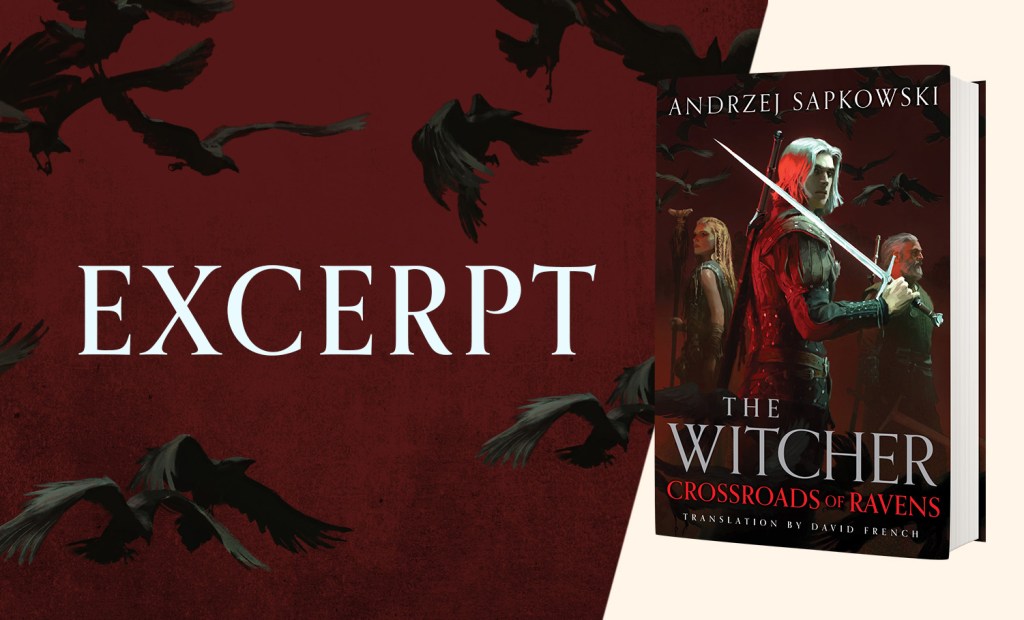
Andrzej Sapkowski’s Witcher series is a global phenomenon with over thirty million copies sold and translated into over forty languages worldwide. Crossroads of Ravens is a new standalone novel following fantasy’s most beloved monster hunter, Geralt of Rivia, on his first steps towards becoming a legend.

Read chapter one from Crossroads of Ravens (US), on-sale September 30th, below!
Kaedwen is a land wedged in between the Dragon Mountains from the north, the Blue Mountains from the east, and the impenetrable wastes from the west. It is reigned over by the hereditary monarchs of the Topp dynasty. The first capital was in ancient Ban Ard, but in the year 1130 post Resurrectionem King Dagread gave that town to the mages for a school, while he moved his capital to Ard Carraigh, which lies in the centre of the country.
Kaedwen’s other notable burghs are Ban Fearg, Daevon, Ban Fillim and Ban Gleann.
Since time immemorial, the arms of the Topps and the land entire has been the unicorn—d’or, licorne effrayée de sable.
Set around the royal lands of Kaedwen are the borderlands, called the marks or marches, which also belong to the monarch. They are governed by the margraves (or counts): either hereditary or nominated by the king. Their name derives from the fact that those lands are, one could say, the advance guard, and move ever onward, driving conquests and wresting new lands from the elves for Kaedwen, shifting the borders and setting their signposts—id est their marks—further and further. The marches consist of the Western, the Upper, the Lakeland and the Lower.
Baldwin Adovardo, Regni Caedvenie Nova Descriptio
In spite of his sincerest intentions—or actually for important reasons—Geralt could not concentrate at all on the alderman’s prattle. All his attention was being taken by the large stuffed crow on the table. The crow, glaring at the witcher with its glass eye, was standing on a plinth of green-painted clay, with both its feet stuck into it. Thus, the crow, despite looking utterly alive, could in no way have been so; there was no doubt about that. Why then, Geralt couldn’t help wondering, had the crow already winked its glass eye at him several times? Magic? Probably not, for his witcher medallion hadn’t twitched or vibrated, not once and not in the slightest. Might it then be a hallucination? Was he seeing things? Perhaps because of being punched in the head several times?
“I shall repeat the question,” Alderman Bulava repeated. “I shall repeat it, though it is not my custom.”
Alderman Bulava had already assured Geralt several times that he wasn’t in the habit of repeating himself. Even so, he kept doing it. He clearly enjoyed it, though it wasn’t his custom.
“I repeat my question: what really happened? What did you have against that deserter that you carved him up so terribly? Some old grievance? You see, I don’t believe at all that you cared for that peasant and his young daughter’s honour. That you were somehow coming to her aid. Like some damn knight errant.”
The crow glared. Geralt moved his arms, which were tied behind his back, trying to get the blood circulating. The twine was digging painfully into his wrists. He heard the heavy breathing of the village enforcer behind him. He was standing very close and Geralt was certain the man was just waiting for an excuse to punch him in the ear again.
Alderman Bulava wheezed, lounged back in his chair and stuck out his belly and velvet kaftan. Geralt stared at it and identified what the alderman had eaten that day, the previous day and the day before that. Concluding that at least one of those dishes had been served in tomato sauce.
“I thought,” the alderman said finally, “I’d never have to look on any of you witchers again. None have been seen for years. It was said that after the year one hundred and ninety-four few survived up there in the mountains. Then word had it that whoever was left had died of hunger or from the plague. But what have we here? One of them shows up right in my village. And the first thing he does is murder somebody. But when caught red-handed, he has the audacity to cite some bloody edicts.”
“On the strength of the titulary edicts of the year one thousand one hundred and fifty,” Geralt cleared his throat and croaked out, “issued by Dagread, King of Kaedwen and the borderland Marches, primo: witchers are permitted freely to practise their profession in the lands of the Kingdom and the Marches and are exempt from the jurisdiction of local powers—”
“First of all, primo,” Bulava interrupted sharply, “it’ll soon be half a century since Dagread turned to dust, and along with him his titulary despotic edicts. Second of all, primo, no king can exempt anyone from anything, for the king is far away in Ard Carraigh, while this place is governed by the local powers. Meaning me. And third of all, primo, you, chum, were not arrested for practising your profession, but for murder. Catching werewolves and killing leshens is your witcher work. No king privileged you to slaughter people.”
“I was acting in the defence—”
“Daryl!”
The enforcer obediently thumped Geralt, this time in the back of the neck.
“Your repetition is annoying,” said the alderman, looking up at the ceiling. “Do you know what happens when you annoy someone? Even a calm fellow like me?”
The crow glared with its glass eye. Geralt said nothing.
“You are not a witcher,” said Bulava finally. “You are a defect. You need to be repaired. You should be sent back to that mountain Fastness of yours folk talk of. I don’t know how things are done up there. It may be that a botch job like you is dismantled to be used to manufacture new and better witchers. After all, that’s what they do there, isn’t it? They assemble witchers from various human parts, sew or stick them together or something. I’ve heard all sorts. Thus, so as not to talk in vain… I will pack you off, you botched-up witcher, back to the mountains, beyond Gwenllech. In one week’s time.”
Geralt said nothing.
“Won’t you even ask, why in a week?” said the alderman, baring his yellow teeth. “You like to quote edicts and laws. Well, I also believe in the law. And the law says that comers-in shall not carry weapons in the borough. And you walked in here with a weapon.”
Geralt wanted to argue that he hadn’t walked, but had been hauled in. He didn’t manage to.
“The penalty is twenty lashes,” announced Bulava. “It will be administered by Daryl here, and he has a heavy hand. You won’t get back on your feet in less than a week. Righto, off with him. Take him to the village green, bind him to the post—”
“Whoa there,” said a man in a dun mantle with a very dirty hem, who was entering the chamber. “What’s this, Bulava, so hasty with the post and the horsewhip? You mean to mar this here witcher? Just hold on, nothing doing. I need him in one piece on the work site.”
“What do you think you’re doing, Blaufall, interrupting me in the execution of my duty?” said the alderman with his arms akimbo. “I already have to put up with you constantly taking men from the village for forced labour on the roads. But don’t interfere with my jurisdiction: it’s no business of yours. Crimes must be punished—”
“It’s a trifle, not a crime,” interrupted Blaufall. “There is no offence, simply self-defence and rescuing folk. Don’t make faces, don’t make faces, for I have a witness. If you please, fellow. Go on, fear not. Say what happened.”
Geralt recognised the peasant. It was the same one he had saved from being robbed the day before, and who had fled into the trees rather than thanking him. The father of the wench whom he recalled stripped down to her undergarments.
“I testify…” the peasant grunted, pointing a finger at Geralt. “I testify in words that this here youth rescued me from brigands… Saved my chattels… Delivered my daughter from being dishonoured… Freed the innocent girl from those murderous hands…”
“And that deserter,” Blaufall prompted, “fell on him with a hatchet. The youth was only defending himself. It was self-defence! Confirm the truth of it, fellow.”
“Aye, so it was… Right enough! M’lord alderman, yonder youth isn’t to blame!” The peasant was pale and speaking unnaturally loudly. “M’lord alderman! Release him, I beg. And here… Please take it, sir… By way of, hmm… Perhaps there were some costs or losses… I’ll gladly recompense…”
Bowing deferentially, the peasant handed the alderman a small pouch. Bulava swiftly secreted it into a pocket in his puffy trousers, so deftly there wasn’t even a clink of coins.
“Self-defence!” he snorted. “He carved the man up into slices with his sword. Innocent youth… I ought to—”
They went out to the village green. The bruisers shoved Geralt without untying his arms.
“Are you so hot-headed, Blaufall, as to even dig up a witness?” said the alderman. “Do you need this witcher so badly?”
“As if you didn’t know. We are building a road, a Highway. It will run from Ard Carraigh through the forests to Hengfors itself. And not just any old thing, not some track, but a road, dry and level, lined with balks and fascines, so that carts and wagons can travel along it. It’s a great thing, a Highway, bearing brisk trade, I mean from our lands with the North. They say the king himself has ordered haste. And there are monsters in the forest and in the bogs, a labourer dies every few days, killed or snatched away by some beast…”
“Since when have you cared about labourers? You always said they matter not; you lose one and another will soon—”
“Fuck the labourers, they’re mostly unpaid peasants. But occasionally a monster kills a foreman, and that disrupts my schedule, the business end of the work goes down the drain. Oh, what am I saying. I tell you; I need a witcher. I won’t meet my deadline, never mind my bonus going to hell, and then they’ll send inspectors. And inspectors—”
“Always find something,” said Bulava, nodding his head in understanding. “If it’s not building materials sold on the quiet, it’s inflated estimates, or—”
“Don’t stray from the subject,” said Blaufall grimacing. “And release the witcher at once, without delay. I’ll take him to the work site right away… Hey… What have we here?”
“Soldiers from the guardhouse,” said the alderman, shielding his eyes with a hand. “Captain Carleton’s men.”
About a dozen horsemen galloped onto the village green, kicking up dust and frightening chickens. Soldiers. Colourful, garish, and rather shabby. Only the two men at the head were dressed more smartly. The commander, a moustachioed man in an elk-hide jerkin with a gilt pendant, wearing a hat with a plume of ostrich feathers. And a long-haired elf with a band around his forehead in the green uniform of a scout.
“Captain Reisz Carleton, said Bulava, stepping forward in greeting. “Welcome, welcome. To what do we owe this honour?”
Captain Reisz Carleton leaned over in the saddle and spat vigorously. Then gave a sign to the scout. The elf rode over to the post with a horizontal timber and dextrously tossed a rope tied into a noose over it.
“Oho,” said Bulava and stood with his arms akimbo, looking back to see if his enforcers were standing behind him. “Well, if m’lord Captain hasn’t come to my village for a hanging? Ah, why, I can even see whose fate is the noose today. I see, I see those two in fetters… Ha, so m’lord Captain caught the rascals who deserted from his fort! The same who’ve been attacking peasants and maids in the woods?”
“I have no mind to hang them,” said Captain Reisz Carleton, twisting his moustache. “They will both run the gauntlet through the streets, being beaten with sticks. To teach them a lesson. And that is all. I have too few men to hang them for any old thing. And for some vagabond to murder them with impunity.”
The captain sat up straight in the saddle and raised his voice, addressing not just the alderman, but all the bruisers, Blaufall, his servants, and the small crowd of peasants that was now gathering.
“Why should I punish my soldiers? For what? For wilful desertion? For wanting to fuck a wench? Why, we sit in that guardhouse as if at the end of the world, like exiles, as if being punished. You can’t partake of ale or women there… Is it any wonder the boys occasionally seize some spoils, grab hold of some…
“Why the bloody hell are women wandering through the forests?” said Reisz Carleton, raising his voice. “And why did this fellow choose that route with his lass? Couldn’t he leave her at home? Is it surprising the lads fancied a bit of… I don’t commend it! I don’t commend it, but I understand! Master Aelvarr? Ready over there?”
“Ready, Captain.”
“Then bring the witcher here, Bulava. He killed one of my soldiers, so he’ll hang. One must give an example of terror. And don’t cut him down, alderman, let him hang for a while as a warning.”
Blaufall stepped forward, giving the impression of wanting to speak, but thought better of it. The enforcers caught hold of Geralt, but stood hesitantly. With reason, as it turned out.
Everything went suddenly quiet. And a chill wind seemed to blow.
A pitch-black horse ambled very slowly onto the village green, from behind the barns. It bore a rider. White-haired, in a black leather jerkin with silver studs on the shoulders. Two swords were sticking up above the rider’s right shoulder.
Very slowly, with some grace even, the black horse passed the peasants and the alderman. Coming to a halt in front of Captain Carleton’s riders.
For a moment there was silence. Then the black horse tossed its head. The rings on its bit jangled.
“Alderman Bulava,” said the white-haired rider in the silence, “will release the young witcher at once. He will return his horse, weapons and belongings. Immediately.”
“Yes…” said the alderman, coughing. “Of course, Master Holt.”
“This moment…”
“Captain Carleton.” The horseman bowed his head faintly. “Good day.”
“Master Witcher Preston Holt.” Reisz Carleton touched the rim of his hat. “Good day.”
“Captain,” said the horseman, raising his voice, “you will kindly deign to remove from here that elf, his rope and the rest of your men. You are no longer needed here. Today’s lynching has been called off.”
“Indeed?” said the captain, stiffening in the saddle and placing a hand on the crossguard of his sword. “Are you so cock-sure, Master Witcher?”
“Aye, that I am. Farewell. Alderman, is the lad at liberty? His effects returned to him?”
“Why, you motherfucker!” yelled one of Carleton’s horsemen, unsheathing his sword and urging his steed forward. “I’ll—”
He didn’t finish his sentence. The rider called Preston Holt raised one hand and made a short gesture. The air howled and whistled; the peasants covered their ears. The horseman screamed, flew from the saddle, and fell heavily and inertly before the hooves of his companions. Their horses shied, neighed, stamped their hooves, shook their heads; one reared up. The now riderless horse darted between the cottages, kicking and bucking.
A deathly silence descended.
“Anyone else?” asked Preston Holt, raising a gauntleted hand. “Anyone inclined to challenge me? Play the hero? No? I thought as much. I bid you farewell, gentlemen. Is the young witcher mounted?”
“I am,” Geralt replied.
“Then let us ride. Follow me.”
Then, read excerpts from Chapter 2!
Need the next chapter already? We’ve got you covered. Start with the exclusive excerpt from Gizmodo, then conclude with the exclusive excerpt on Polygon.
“Geralt had set off from Kaer Morhen the day before the Equinox. That was the custom of witchers.”

★ “A wonderful insight into the beginnings of one of fantasy’s most beloved and iconic characters, Geralt of Rivia. Immersive, exciting, and emotional. Crossroads of Ravens is not to be missed.” – John Gwynne, New York Times bestselling author
Witchers are not born. They are made.
Before he was the White Wolf or the Butcher of Blaviken, Geralt of Rivia was simply a fresh graduate of Kaer Morhen, stepping into a world that neither understands nor welcomes his kind.
And when an act of naïve heroism goes gravely wrong, Geralt is only saved from the noose by Preston Holt, a grizzled witcher with a buried past and an agenda of his own.
Under Holt’s guiding hand, Geralt begins to learn what it truly means to walk the Path – to protect a world that fears him, and to survive in it on his own terms. But as the line between right and wrong begins to blur, Geralt must decide to become the monster everyone expects, or something else entirely.
This is the story of how legends are made – and what they cost.
★ “Geralt is one of the great characters in all of fantasy. Whether you’re coming from the games, TV show, or are simply new to the Witcher universe – these books are absolutely worth the read.” – James Islington, author of The Will of the Many
★ “Sapkowski is a true master of fantasy literature, and Crossroads of Ravens is his latest example of his writing prowess.” – Popverse
Witcher Story Collections
The Last Wish
Sword of Destiny
The Witcher Saga
Blood of Elves
The Time of Contempt
Baptism of Fire
The Tower of Swallows
Lady of the Lake
Standalone Witcher Novels
Season of Storms
Crossroads of Ravens
The Hussite Trilogy
The Tower of Fools
Warriors of God
Light Perpetual
Translated from original Polish by David French
