Excerpt: CHILDREN OF STRIFE by Adrian Tchaikovsky
A new entry in the wildly successful Children of Time series from award-winning master of science fiction Adrian Tchaikovsky.
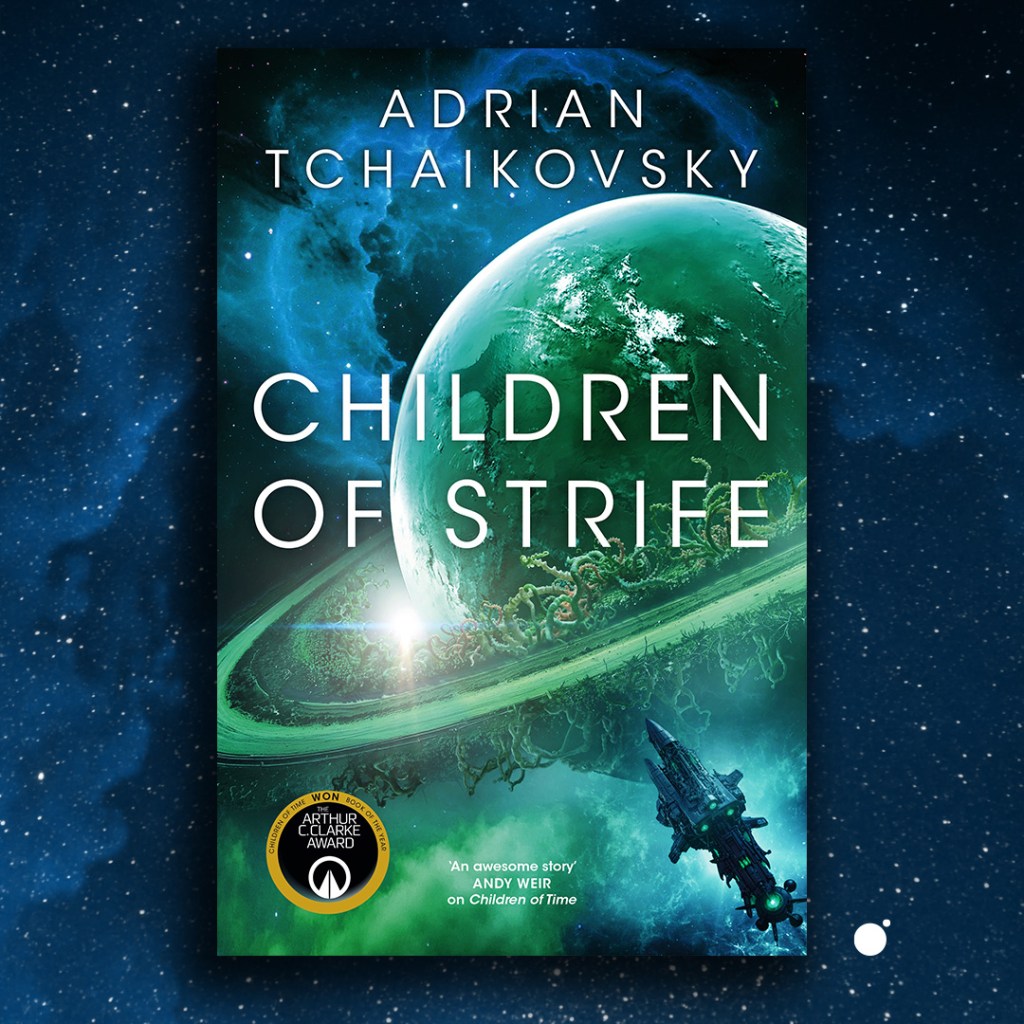
Read an excerpt from Children of Strife (US), on-sale March 17th, below!
PART 1
THE FIRST AGE
Pantheon of Five
1.1
She supposed she should be glad he hadn’t actually killed anyone yet. Given the string of disappointments with the project, the powers Hartmand had reserved for himself, and the fact he had the emotional maturity of a thirteen-year-old, that was probably on the cards any day now, though.
Which made paying a visit to the great man to give him bad news a risky proposition, but Redina Kott was very good at making things other people’s problems. She was taking this particular risk, in fact, because getting in early and telling tales was a good way of dodging the inevitable blame-throwing match.
So here she was at the threshold of Hartmand’s den, as she thought of it. A grown man—a leader of men, a Great Man—who had ordained for himself a suite of rooms on a space station, outfitted with everything his enormous personal fortune and corporate resources could give him. And it was a den. She had no other label for it. A den full of all the cold toys, pleasures and games that artifice could construct for him. Which meant all possible ones, given the reach of Gerey Hartmand.
She supposed she should also be glad he liked his pleasures artificial. There were only five of them floating in this grandiose tin can. Five and the AI underseer system. No crew, because crew would mean lesser mortals who wouldn’t understand their vision, and who’d have tiresome needs of their own. And who might not, after a few years of the project, have been as subservient as all that. Might have developed ideas. Though nobody had actually raised that as a justification for not having human crew, during the long planning stage. The concern that those lesser mortals might have started eyeing up the hierarchy with dissatisfaction; might not have done what they were told purely out of their awe for the superior intellect of industry leaders like Gerey Hartmand.
Pausing at the threshold of his den, she smirked. Redina Kott had a lot of smiles. She was seldom seen without one. She made very sure that the smiles indicating her contempt for her fellows, and those denoting schadenfreude at other people’s woes, were indistinguishable from those indicating her general sunny good nature. She’d practised with the underseer system, challenging it to tell the difference with all of its analytical tools. Had Hartmand appeared then and there to find her lips curling in derision at the shortcomings of his personality he’d have taken it for a pleasant greeting.
God, she found him a bore. She found most of the others bores too, much of the time, but Hartmand was a bore who’d reserved executive privileges over the ship-station’s life-support functions, and somehow this inherent threat didn’t make him any less boring. Just as well she had her own den where she could occupy herself, decompress, and write nasty little stories in which the others died in a fire one by one and she had the chance to save them. Sometimes she tried to and sometimes she didn’t. You had to keep yourself sane somehow, out here orbiting an obstinately dead rock, like five Doctor Frankensteins hovering over a corpse that wouldn’t become a monster.
She smirked at that, too. A specific shade of sour humour. God, she was a riot. She was wasted here.
Of course, if they couldn’t get that monster moving, they were all wasted here. She thought this would probably destroy Hartmand. She’d say that she’d survive, and her fellows on board, Pil and Milner, would probably find some other business to move on to. Except if they failed then she didn’t reckon Hartmand would accept a return journey back to Earth in ignominy. He’d crash the ship into the corpse of their dead planet, the lot of them sacrifices to his childish pride.
Hartmand had made such a noise back on Earth, about the true direction the terraforming initiative should take. He’d gone head-to-head with that woman, as he called her, over who should actually control the projects. And, to his shock, he’d lost. Hartmand wasn’t someone who lost, in his own estimation. He’d been offered the number two position instead. In recognition of his potential contributions. Meaning his resources, Kott reckoned, rather than his intellect (snicker). But Hartmand knew exactly what a number two was and, as far as he was concerned, it was Number One or nothing for him.
Explains why he’s such a miserable streak of piss. That had her actually chuckling. I am such a goddamn riot. They don’t deserve me. And yes, yes, laughing at your own jokes, all that. But it wasn’t as though anyone else was funny around here.
Okay maybe Pil was funny, but he usually didn’t intend to be.
Hartmand had not only refused to kowtow to that woman back on Earth, he’d tried to bring her down. Mobilized all his companies, sycophants and sock puppets to destroy her. But failed utterly. That woman had outmanoeuvred him at every turn with a kind of casual contempt that absolutely pushed every shiny button Hartmand had. He’d ended up having an extremely public meltdown in an interview, which that woman had ensured had been seen without any of the normal edits, and with sufficient certificates of authenticity that people knew it was the real thing. Actual unvarnished truth—rarer than gold in modern media. With the blasé grace of a stage magician, that woman had revealed a variety of grimy financial scams and misdemeanours that had been propping Hartmand’s businesses up, meaning that just remaining on Earth to face the music was unattractive. Leading to the Great Man greatly accelerating his private terraforming project and getting the hell off Earth. At that stage Kott wouldn’t under any circumstances have joined him in exile if her own dealings hadn’t had the Band-Aid ripped off them at the same time. Suddenly, anywhere within Earth jurisdiction was a dicey place to be. So all five of them, the geniuses, the far-seeing innovating giants, had fled from someone who’d turned out to be a cleverer bastard than all of them put together.
She had a little spreadsheet on her private system, in her own den. The names of her co-conspirators, alongside categories with tickboxes. Funny, crazy, Dunning-Kruger overconfident, self-sabotagingly malicious. All the executive functions, as she thought of them. Hartmand hadn’t quite earned the crazy tick yet, but she hovered over that box daily. Next reversal on the project and she reckoned she’d be able to collect the set for him. He’d probably earn the tick by cutting someone’s quarters off from air and power, and that would be the point of no return.
The underseer queried her as she applied to enter their leader’s quarters. Milner, whose baby the AI was, called it Domus, which he claimed was “home” in Classics. It was, she thought, a dumbass name for a thing that talked to you—a surrogate servant. You wouldn’t have given the name to your butler, after all. It was an underseer because overseer had allusions of dominance which Hartmand didn’t like. He was, in fact, exactly that petty. One more box ticked.
“Great Man needs to look at the project progress,” she told Domus. “And he’s greatly turned off his great comms, so I can’t just ping him about it.” Which was another thing about Hartmand. When he was in a snit he sulked, meaning you couldn’t just break in on his solitude with, say, actual essential mission stuff. Instead he made sure you literally had to schlep around the circular ring of the Pancreator with your own actual human feet. Or, admittedly, the little two-wheelie buggies that Milner had put on board, out of his resource allocation pre-launch. They were ridiculous, given that you could walk the circumference of the Pancreator’s rotating section in—at her brisk pace—thirty-three minutes. So the little wheelies were weight that they could have used for something mission-relevant, and therefore one more decision of dubious merit taken by her co-terraformers. That said, she’d absolutely scooted the footling distance down the central corridor from her own rooms, because who wouldn’t?
“Master Hartmand is currently in conference with Doctor Dorcheson,” Domus told her. Domus had a woman’s voice, soft and subservient, and that rankled a bit with Kott. But it wasn’t as if she hadn’t known what her fellows were like before she joined up with them.
“That’s grand. I need to speak to her as well. Two in one. Peak efficiency. Let me in,” she told Domus. It was a complex enough system that it could interpret her words, tone, facial expression and stance, and come up with a ninety-five per cent accurate understanding of what she wanted it to think she meant, and what her tolerances were; when to stand on ceremony and when to bend the rules. Otherwise it could never have worked for Gerey Hartmand without him having fired it into the sun, honestly. Or the star out there, their world’s star, that wasn’t the sun.
The door opened, giving Kott an object lesson in just how good the soundproofing of the Pancreator was, because there was a full-blown row going on inside. In space, no one can hear you bicker. Dorcheson and Hartmand going at it like hammer and tongs over… well, she wasn’t even sure. Dorcheson’s personal projects were being throttled because Hartmand had shunted a chunk of the mobile resource allocation over to Pil. Hartmand was Number One (snigger), so he got to say who received the lion’s share of mass, manufacturing and computing time. On the surface this was what was going on. Dorcheson’s work was on the geological matrix and the woman reckoned that, given how early the days were in their personal Genesis myth here, it meant she should have everything she wanted, and everyone else should just twiddle their thumbs or do wheelie races around the rotating section. Except Dorcheson’s geosciences were of the uninspired flavour, by everyone else’s lights. She wasn’t really an innovator. She wasn’t a disruptor. She’d certainly sold herself as one to secure a seat on the ship—although her own corporate funding contribution had also been a prerequisite, of course. Now they were here and had a planetary canvas to scrawl their names over, she’d turned to plodding in circles. Hence the resources being diverted to Pil, who’d promised some truly mad things. Hence this shouting match.
Honestly, it was amazing Hartmand hadn’t actually just pushed the button on his rebellious Number Two yet. Dorcheson didn’t back down—she was vitriolic, had all that dominance and incipient-violence body language, and she was shrill. God, she was shrill. Kott didn’t like to throw that in the face of the only other woman on board but Dorcheson in full dudgeon was like nails on a chalkboard. Except Hartmand fed on it. That was her surprise revelation about the Big I Am of the Pancreator. He needed someone to go hammer and tongs at him, whom he could just look down on and dismiss. Dorcheson was all bark and zero per cent bite. She was a safe rival, a licensed fool in the court of the king. Because of how Hartmand had swindled them all, in the way he’d set up his personal space-fiefdom out here. She could rant and rant, but it was all words that could never harm him. He’d reserved all the sticks and stones for his personal use.
Dorcheson would only ever be Number Two, and she knew what that meant just as much as Hartmand himself. So it was a pissing contest, in which the current Number One was always going to win.
Kott fought down the laugh, which came just as she’d penetrated far enough through Hartmand’s rooms of displays and games—the couches, whole-body tanks, and the weirdly antiseptic space of an Immersive All-Sensory room, which always made her think of old-fashioned asylums, down to the drain in the floor. A squeak of her amusement escaped anyway, and they stopped shouting at each other to turn their thunderous glowers onto her.
“Don’t mind me,” she told them, beaming her best at them. “You go right ahead. Where did you get to—most recent survey results say what?”
Hartmand’s sanctum, where Dorcheson was bearding him, said a lot. It was, in short, a shrine. Not to any faith, per se, but to the cult of the genius individual. Here they were at a key point in History, and Hartmand was the Great Man come to steer it. He claimed, in that smooth way he had, that it was designed specifically to focus his mind on the important things. The improvement of mankind. The future of the human race amongst the stars. This was not, to Kott’s eyes, what it actually said. It was a hagiography of one Gerey Hartmand. A tableau over which the man’s own features loomed sternly down on their living exemplar, staring off into a notional distance with the stink of manifest destiny. Below that outsized holographic visage was a whole parade of Earthly things which fell into his dominion. Corporate logos, the machinery of industry, the iconography of international commerce. And people, of course. Some generic figures, attired to indicate the various trades they plied in his service, their positions properly subservient, their expressions decently grateful at being given the chance to earn a crumb from his table. And others whom Kott could put names to. The statesmen who had supported him, the former corporate partners he’d outstripped, the demagogues who’d turned their honeyed words to his praise. Some of his wives—the ones he’d parted from on better terms. And, to the lower left of the vista, in the position that might traditionally have been reserved for Hell in religious art, the others. The faces of Hartmand’s detractors and opponents. She suspected that, if he did actually receive any benefit from contemplating this remarkable piece of art, it was from that direction. Hartmand fed on hate, in Kott’s opinion. Part of the reason why the fellow visionaries he’d invited along on this project weren’t actually just toadies and yes-men, as she might have expected. Hartmand’s heaven was empty if it didn’t contain those he could simultaneously see as worthy adversaries, and also dominate without threat of mutiny.
There were unsympathetic media talking heads in that diabolic throng. There were those political types who’d opposed his innovations and rise, either from principle or just because they’d backed a different horse. Most of all there were the major figures in the tech-science sector who hadn’t fallen in line. Especially those who had won out against him—captured the public imagination and its purse with greater acumen. For them, Gerey Hartmand saved his most abiding loathing. One above all, in fact—the greatest devil in Hell’s parliament, chief fiend of this Earthly Pandemonium. A woman with a long, olive face and bony features. Though the artist had plainly been directed to caricature her, the original’s cool disdain came through anyway, as though it was a quality one couldn’t remove without taking the Kern-ness with it. Hartmand’s Earthly nemesis, that woman. Avrana Kern, queen of the terraformers. Which, in a sudden third-act-twist reversal, actually made Hartmand and his fellows the rebel angels, skulking off to some corner of the cosmos unsurveyed by the eye of that dispassionate and probably sociopathic god.
Kott had seen her own projects ruined by Kern’s jealousy, acquisitiveness and refusal to share. Kern was, therefore, Hartmand’s mirror, equally as bad. The only difference between them was that Kern had screwed Kott over during her big dust-up with Hartmand, while Hartmand himself had offered Kott a place on the ark when she was very short of other options. And Hartmand had promised a level of autonomy in the project, their own terraforming, where Kott could play. Nobody on Kern’s crew would be able to lift a finger unless there was a string tied to it that Kern had tugged, Kott was absolutely sure of that.
Kern was not an Earthly nemesis any more. She was out there, working on a string of likely exoplanets, using her own methods of accelerated ecogenesis. She’d bagged all the best prospects, out of every surveyed extrasolar world. Hartmand had worked very hard to sequester this one for his own use, and that disparity of arms showed just how badly he’d lost the war in heaven.
The echoes of Dorcheson’s last exclamation fell away into the busy edges of Hartmand’s domain. They were both staring at her. A pair of ugly customers, Kott thought. If they’d been sexbots she’d have sent them back to the factory. Another snicker broke through her control and stoked their collective anger. They knew she was laughing at them. She was always laughing at them. What else, honestly, did she have to keep her sane? Dorcheson’s life of being offended and vitriolic had left her with a constant downturned mouth and upturned nose, as though everything stank and she was constantly on the point of mentioning it. She was a stocky woman and the Health And Hygiene overalls didn’t do her any favours by Kott’s reckoning. Not that they were overly flattering as garments went—Milner had designed them and he couldn’t do fashion for shit. Hartmand, on the other hand, had one of those faces that looked good in images. The one with him staring commandingly into the distance of destiny was absolutely the best take on him. The problem was, in person, he was stuck like that. The frown, the grimace, the stare. She reckoned it was probably that he’d had surgery to make him more like the man he was supposed to be, and it had set like hard plastic. As though his face had become a mask of his features made by some slightly cheap manufacturing process. She was almost surprised not to see mould lines. Another snigger.
“So, you’d turned your yatter off,” she said languidly, watching the pair of them fidget and fret and damn her to hell for not getting to the point.
“Did that not suggest to you I might want some privacy to work?” Hartmand asked her acidly.
It hadn’t, really. She’d assumed he’d be either topping up on stimulants, indulging in some sort of automated carnality in the body tank, or listening to those self-motivational audioloops she knew he had. Probably one or all of those had been the case before Dorcheson had preceded her in breaching his fortress of solitude.
“Pil,” she said, dragging out the revelation, “has done a thing. That you need to see.”
“Pil’s asked for me?” Hartmand snapped.
“I mean no, not asked, not Pil,” Kott drawled. “He just went ahead and did a thing. And you should come see. Because it may mean he’s fucked the whole show. Again. I mean, you know Pil. Loose cannon.” Her mind, still thinking of the religiosity of the art, and Hartmand’s general assumption of godhood, said loose canon, and that set off another round of self-congratulatory merriment. She was not, she was well aware, as funny as she thought she was, but given the company she was the funniest thing around.
If it was that big a deal, Hartmand decided, they needed a full house. If he was finally going to cast down one of his fellow angels, he wanted it to be an object lesson to all the survivors. So they had to go roust Milner before confronting Pil. This was also, Kott knew, because Milner was Hartmand’s creature, and if there was going to be a showdown between Great Men, Hartmand wanted numerical superiority.
Gerey Hartmand and Sui Dorcheson were industrial innovators. They’d staked their claim to the world’s influence and resources by driving technology. Driving it out of reach of their competitors, and then driving it into a corner where it could be conveniently brought down and nice lucrative slices carved off it.
Kott herself had come out of a very funny place, as far as she was concerned. A very particular place where she had done very funny things for highly amusing corporations and governments, in exchange for positively hilarious sums of money, on the absolute promise she would never explain the joke to anyone else in case it caused offence. Industrial espionage, therefore. Which these days (these days? Those days, surely, given they were fifty years out from Earth as the vacuum-frozen crow flew) generally segued into just general espionage, because you couldn’t really disentangle business from governance. She’d worked for Hartmand. She’d worked for Dorcheson. She had developed a set of proprietary data-handling systems that, whilst intended to handle the data of people who hadn’t consented to the groping, also worked as semi-independent organizers in any informational system. Her work allowed structures of interconnected meaning to arise and evolve autonomously, which was exactly what Hartmand had been looking for to make his terraforming dreams work. She had not, contrariwise to what Dorcheson had repeatedly insinuated, blackmailed herself a place on the Pancreator. She’d earned her spot.
Of the other two, well they’d get to Pil soon enough and see just what lunacy he’d cooked up that was going to crap all over the project planetside. Pil was crazy, but it was a crazy Kott had a handle on. One of those people who didn’t have barriers and boundaries to stop him just doing whatever seemed like a good idea to his raddled mind. Unlike the similarly unconstrained Hartmand, at least Pil wasn’t an asshole with it. He wasn’t going to spontaneously have the robots space one of his fellow crew. Although, if he kept on just doing random things and provoking Hartmand, he was probably more of a danger to the mission through sheer negligence.
Milner, though… Milner was the one who Kott didn’t quite get. He did seem to be a yes-man, whenever he and Hartmand were in the same room. But left to his own devices, Milner could fill all the hours of his day better than any of them—meaning all the hours, given Dorcheson’s sleep-replacement implants. Only, Milner filled the hours with… idiot stuff. Organizational things, paper shuffling with virtual papers. He was cybernetics and logistics and, given they had Domus to actually do the heavy lifting, she’d have thought Milner would be spending his free time on a lounger with a cocktail in one hand. Instead of which he was mostly in meetings.
Meetings, in a ship with four other people, none of whom attended meetings. Being the best part of thirty light years from Earth meant the communications delay would have made every “all in favour” an exercise in dragging out the suspense beyond any sane person’s tolerance. But Milner was very insistent he had to account to the investors, shareholders and partners back on Earth. Without, of course, meaningfully being able to. Hartmand’s project had the resources and as much autonomy from other authority as any rebel angel ever had. There was no need to do all those tedious box-ticking exercises that they’d assured everyone they would. She could only assume Ottis Milner actually enjoyed it.
When they arrived at his quarters, he was sitting at a table, speaking earnestly to all of the board members and investor representatives, fielding their queries and directing that minutes be taken. Ottis Milner, and the holographic facsimiles of a dozen other people. Not just vacant images, even, Kott knew. Each of these phantom faces belonged to a human who’d undergone a surface personality upload into Domus before they set off, so an actual working doppelganger of theirs could raise the concerns they would be liable to raise, out here at the project. It seemed madness, but it was legal. With these semi-possessed dolls around Milner’s table, every decision had the binding moment-to-moment consent of everyone whose resources and intellectual property they’d spirited away. A piece of bureaucratic legerdemain that Hartmand and Milner had persuaded people to accept back on Earth, and which had oiled the wheels of commerce for years, until the practice had become second nature. Kott had assumed Milner would drop the act once they arrived, but apparently it wasn’t an act. Milner just liked playing dollies. She was beginning to think he was madder than old Pil.
“Ottis,” Hartmand called from the doorway. Milner flinched and leapt up—his master’s voice, Kott thought. Around his table—itself no more substantial than his guests—the representatives froze. She could almost sense Domus’s other functions quicken. She didn’t think that, whatever semblance the AI gave to these figments, it was their full uploaded personas. Even Domus had limits, and the masks which Milner spent his time reassuring and mollifying were no more than background algorithms, pre-programmed to be reassured and mollified. An administrative circle jerk with only one dick at the heart of it.
Milner addressed the table, actually making his apologies to the literal non-entities, before telling Domus to save state so he could pick up the nonsensical business later. He had his cringing smile on as he came over to Hartmand. He scuttled, she’d noted before, walking like a crab, where his superior was concerned—sidelong, shoulder up, arm folded as though to cushion a blow. Renfield to an emotional vampire.
“Pil’s up to something.” By now Hartmand had asked the relevant queries of Domus. Had discovered that various failsafes he’d placed around the planetside project had been quietly sidelined by Pil (and Kott, though she’d made damn sure her fingerprints were off them. Sometimes you had to give the pot a stir if you wanted anything to cook properly). He’d found out the most rebellious of his angels was off on a frolic of his own.
They picked up a couple of the robots on the way, which meant Hartmand really was at breaking point. They looked… well, exactly like robots were supposed to look in the human imagination, which wasn’t necessarily an efficient way for robots to be. Humanoid forms, a bit top-heavy, a bit ape-like, smooth brushed steel finishes, heads with just an eye-slot. Scary robots. They were theoretically lifters and movers and general factotums, but nobody looking at them would have been in any doubt that they were security. Milner had designed them, then passed their reins cravenly over to Hartmand. If it had been Kott, she’d have kept a back door open with a code to shut them off, but Milner probably wasn’t that much of a free thinker.
Anyway, they had the robots clumping along behind them now, the solid cla-clock of metal feet magnetizing to the metal beneath the plastic floor, then parting from it again. Hartmand’s face was twisted into rage as much as its surgical tautness would allow. Kott stole a glance at the other two. Milner scurried along in Hartmand’s wake, eyes on everything except his boss. Dorcheson was practically licking her lips, as though seeing a colleague thrown out of the airlock by robots was her very particular kink.
When they arrived in the main mission room, Pil was in his sling, spinning slowly in the centre of the room. He didn’t like chairs, he said. Plus, he said there was a weird way the hanging sling interacted with the false gravity of the Pancreator’s rotating section that was particularly trippy. Meaning, for Pil, conducive to innovation—he wasn’t a man who’d ever done a day’s work with an unaugmented brain.
He revolved to face them. Or, because of the way he was slouched back, his bare feet did: calloused with yellow claw-like nails. The rest of him peered past those hideous toes. “Why Mister Hartmand,” he said. “I’ve been expecting you.”
“What have you done?” Hartmand demanded, and Pil beamed beatifically, flexing his feet as though he was trying to transform them into hands.
“My friends, my colleagues, fellow visionaries,” he said. A spread of his arms set him wobbling gently, rotating so his words were delivered to the circular, display-busy walls of the room. “Rejoice, for I have saved the world.”
1.2
Somewhere out there, on a string of worlds she’d claimed for her own personal use, the abominable Avrana Kern was working her humdrum science. They’d all seen Kern’s method. Being sufficiently far ahead in the game, and having a stranglehold on the major exoplanetary enterprises, she hadn’t cared to keep it secret. It had been the basis for her bragging rights, after all. Worlds for humanity, out across the vastness of space. Worlds unspoiled by human touch, so humans could come touch them. Room, space and paradise enough for everyone. Or that was the snake oil Kern had sold to the leaders and people of Earth. One of the rare beliefs uniting Hartmand’s rebel angels was that Kern didn’t give a pin for anyone who wasn’t Kern. She was writing her name across the stars as a colossal vanity project. It would all come crashing down, they were sure.
And when it did, they would be the proprietors of the one genuine paradise in the universe. A second Earth, ready to be populated by the worthy, no Kern-supporters need apply.
Hartmand had a whole rant concerning Kern’s terraforming processes. Pedestrian, he said. Slow, dull and high-risk. When modelled, they stalled out most of the time: arid wastelands, seething hells of replicating nanobots, toxinriddled death worlds. To reach something like an Earth, even an approximate Earth, required constant intervention by the terraforming crews. Without that oversight, perhaps by Kern herself, how could any of those worlds become anything other than a soup of caustic fallout? That was what Milner’s models claimed, and Hartmand had fought fiercely to try to turn everyone against Kern’s dream. But failed. Like so many other would-be world-bestriding colossi, he’d broken against Kern’s insufferable self-regard.
By then, all five of them had run onto similar rocks, back on Earth. None of them had been Kern’s people; all of them had invested significantly in exoplanetary terraforming as the future of humanity. Not a hard bet to place, given both the environmental and political instability back home. But it was Hartmand who’d stolen a world from Kern, redacted it from her records, bought off the astronomy projects. In one case actually had a couple of prominent scientists murdered and put the blame on eco-activists. He had removed a star from Kern’s firmament for his own personal use. Then, because no man is an island, he had invited four other disgruntled terraformers into his private pantheon.
After which, things had gone downhill.
It was Dorcheson’s fault, roared Hartmand, after the first three failures. She was the geosciences savant, after all. If the biomatrix wasn’t taking hold on the rock then obviously she hadn’t done her job properly. Or—after Dorcheson had stood up to him—it was Milner’s fault, because he was responsible for overall logistics, and plainly some part of their perfect plan wasn’t playing properly with some other part. Or it was Pil’s fault, and the problem was at the biosciences end. Or at last, he turned his accusations on Kott, saying that her data linking wasn’t shaking hands properly, and wasn’t that what they’d all been relying on? Almost a month, during which Hartmand had held court and pointed fingers at everyone but himself. Not good times. The only reason there hadn’t been a general mutiny, four against one, was that literally everything on the Pancreator listened only to Hartmand. The robots, Domus, life support, it was all wired to his word. If he’d just died in his sleep, maybe they could have hacked the system, given Milner’s cooperation and enough time. Otherwise, with Hartmand’s still-living hands on the wheel, the man could literally have had the robots murder the rest of them and nobody could have stopped him. It wasn’t as though distant Earth had a jurisdiction or legal agency out here. Needless to say, the project hadn’t been sold to them on this basis. Kott was amazed she hadn’t seen the trap before blithely stepping into its jaws.
I can’t imagine how we keep screwing the project up. We’re such a well-oiled machine.
She had an uncomfortable feeling that actually it might be her fault. Her vaunted self-growing architecture—which should have let the terraforming process accelerate until you could look out on the planet and see it happening in real time—wasn’t up to the job. It didn’t hold together at a planetary scale. She’d modelled it, and in the models it’d worked. Which only told her that her models weren’t good enough.
Hyper-accelerated terraforming from an iterated soil matrix, that was the title of the paper. That was the big idea—Hartmand’s legacy. Start with an artificial organic soil rich in biological and geochemical elements, and a handful of engineered microbes. Dust your dead world. Wind up and let go. The microbes would take what was there and turn it into what you wanted. Liberate oxygen, pump out heat, free water. They’d mutate, generation to generation, reacting to the new conditions they’d created, so that every single day the mix would adjust to better exploit the altered environment and drive it further towards Earth-standard. Fire-and-forget terraforming, blossoming out across the rock, turning dust into soil, atmosphere into air, and the microbes transforming themselves into increasingly more complex life forms to turn the terraforming crank more and more swiftly. In the models it had become a liveable world within just a few years, ready for trees and bears and whatever you wanted. And people.
Everyone was learning that “in the models” was a pipe dream. This should have been a prime world. Hartmand hadn’t stolen trash. The right size, the right gravity, close enough to its star for liquid water at the equator, and further around it, after sufficient exothermy and atmospheric adjustment. Here they were, gods with a blank planetary canvas for their acts of creation, and what they got was…
Death. Again and again, death. Their downhill go-kart of life with the wheels coming off. Chemical feedback loops meant their little engineered workers were working towards their own annihilation, creating conditions that they couldn’t themselves survive. Infinitesimal mass-suicide on a planetary scale. They’d restarted the process six times now, and watched the seething host of invisibles continually engineer their own destruction. Different each time, and each time the precise pathway of failure was readily identifiable in retrospect. Build-up of toxic metals; premature oxygen release killing off the early-stage anoxic microbia faster than they could adapt; a rogue strain predating its siblings; parasitism; failure of the toxin bin vacuoles; spectacular autolysis where the things just ate themselves. Even a coding error where factions of competing microbes evolved and fought each other to a mutually assured destruction over the same resources, as though they were desperate to replicate the errors of their creators.
Probably for the best it was just the five of them on board. If Hartmand had brought along a pack of adoring followers, he’d be looking pretty stupid about now.
Actually, Kott decided, if he had, then everyone would probably be dead. Because in the face of that public scrutiny, Hartmand would absolutely have ensured someone else took the fall for the failure, to save face. Then someone else. And someone else. If he’d brought along a cadre of little cultists to kiss his boots and tell him how wonderful he was, Kott herself would likely have been first up against the wall.
In truth, she’d been running a private sweepstake, regarding just who it’d be Hartmand would actually murder, once his personal frustrations exceeded his ability to hold himself in check. Dorcheson had been a strong front runner but, by Kott’s reckoning, Pil had just crossed the finish line by a nose. And, because she was more than implicated in whatever debacle was about to unfold between her peers, she’d decided that playing tattletale was the best form of defence.
1.3
Shortly before her fateful visit to Hartmand’s den it had been the pair of them, Redina Kott and Ken Pil, killing time in the mission hub. An odd place for them to be, like kids taking drugs out of the view of the school surveillance system. But since the mission had kept going wrong time after time, none of the others tended to spend much time surrounded by reminders of their collective failure. So the hub of the Pancreator had become a seedy backwater where a pair of reprobates could enjoy a little recreational brain-frying.
Ken Pil was a decade and change older than Hartmand and Dorcheson, almost three decades on Kott and Milner. He’d been the grand old man of a range of biotech ventures back in the day, one of the big inspirations to the up-and-comers the rest of them had been. Kott had done her homework on his glittering career, probably more than the rest of them had. Hartmand thought Pil was evidence that the Genius Innovator was a real and quantifiable archetype, the driving engine of human progress. Kott reckoned the old man was mostly proof of survivorship bias. There’d been plenty of Ken Pil clones about at the time of his ascendancy—not literal, just kindred spirits (his self-cloning venture had gone nowhere)—the rest of whom had crashed and burned the way most such chem-head tycoons did. Only Pil had somehow balanced the auto-chemistry and the genius, and come out the other side with workable, profitable results. Microbial hydro-cleansing, which sounded like an oxymoron but had given ninety per cent of the world drinkable water, and ten per cent of the world a new way to sell them drinkable water. The telomechondrichon was another, which sounded like an alien race out of bad media to Kott, but was at work right now in the cells of everyone who could afford it, repairing DNA and extending lifespans. A handful of such left-field ideas had left Ken Pil with enough resources to stew in his own head for the rest of his extended life. When Hartmand had offered him a place on the Pancreator he’d jumped at the chance. Something Hartmand had doubtless regretted since.
Pil had been in his sling, as usual, and had a bare, calloused foot up on one of the panels. Kott had to keep nervously checking that the touch-surfaces were all off, or God knew what his toes might be doing to the mission parameters. He was using it to push off from occasionally, to keep him swinging. Around them, a hundred holographic displays were explaining just how their current planetside iteration was dying on its ass. It was time to wipe the surface clean and re-seed, but after half a dozen crashes, nobody was sure another reboot was worth the effort. Milner had designed the displays to be immediately clear and informative and, whilst Kott wouldn’t normally have trusted him to design a toothbrush, in this case he’d been absolutely on the money. Meaning every detail of their failure was instantly communicated to the eye.
“You’re brooding, Kitkat,” Pil told her. He had a face that had outgrown its own cosmetic surgery, so that parts of it were wrinkling at different rates, sagging here, taut there. One bony hand offered her a plastic tub, the little amber lozenges within shifting in the slightly greasy way things did, under their centripetal gravity. Unless that was just her imagination.
She’d tried Pil’s concoctions. They were tailored very specifically to his body chemistry. He was a wizard of head-candy with a clientele of one. Another innovation of his, very bespoke. It had been adopted by a variety of otherwise drug-averse jurisdictions back home. The idea had been that one could code for all the desired effects of whatever high you were after, with none of the negatives, and it’d been mostly popular because the price tag guaranteed it was only for very rich people—drug-averse jurisdictions had never really had a problem with rich people stuffing stuff up their noses. What nobody, except Pil, had understood was that the negatives, in drugs, were usually also the desired effects, and so the whole venture had been a dismal failure on the regulatory front. It had meant that Pil’s habit was funded by a lot of municipal cash for a while. Now he had a whole pharmacopeia of elixirs that had exact and calibrated effects on him, and wildly variable results for anyone else. She politely waved the tub away. She had her own little cocktail running through her veins right then, which traditionally didn’t play nicely with newcomers. It made her feisty and bitchy and eager to ruin someone’s day. Which was to say, just more like herself.
“Hmmm,” said Pil, and busied himself with selecting something to dose himself with. He was looking at her out the corner of his eye. He was waiting for something.
Kott felt the knot, inside. The thing that was her. As though all the rest of her, the meat, the neurons, the name, was just a biomech suit that the knot was piloting around. And the knot was trouble. Specifically, trouble labelled for export, to whoever. She’d made it this far through life—fifty years, the youngest of them—by being very smart at being trouble. By inventing new ways of stirring the pot. Ruin someone’s day, discover a secret, spoil a deal, undercut a rival. The knot pulled tight; she felt alive. Leave the world alone, then the knot loosened; she felt like she was losing herself.
She had enough self-awareness to understand how unhealthy all this was, as personality traits went. That she was only herself when the knot tugged in her. Maybe that was why she’d cast her lot in with these megalomaniacs. It put your problems into perspective when Gerey Hartmand and Ken Pil were your neighbours.
Now the knot was telling her something, cinching tighter. There was something up.
“What did you do?” she asked.
Pil kicked off again, swung, gave her a saintly leer. “Oh, ho ho,” he said mildly.
“What did you do?” she repeated. Then, thinking back, “What have you been doing?” He’d been closeted in the mission hub, just him and his drugs, for long enough that the shift of tense seemed appropriate.
“We,” he corrected, somewhat nonsensically.
“We what who now?” she demanded.
“All your code, Kitkat. Your interlinking, handshaking, intelligent data-crawling, reactive-multifunking intergalactic cosmic-weaving fantabulatron.”
For a moment she thought he was having a stroke, but then she realized he was fucking with her, playing up the mind-addled freak to get on her nerves. If there were nerves to be got on, that was her job as far as she was concerned.
She sent a signal to her internal brakes, and they began to flush her system, sharpening her up so she could work out what was going on. The knot tightened further. Someone was in trouble. Possibly her.
The displays were wrong. Stuff was going on. She redoubled her system cleansing, cellular factories pumping out counter-agents to clear out all the shit in her bloodstream. Another Ken Pil special, ironically enough. “What’s…” She looked at the signs of their latest failure, the planetary microecology eating itself. It was still a failure, but it was a… different failure. One an order of magnitude more complex than it should have been. “Holy crap, what did you do to it?”
“I gave it the gift of you,” Pil chortled. She didn’t apply the word “chortled” lightly but that was exactly what the son of a bitch was doing. “It was your idea. I just translated it from your dead old data architecture to our living systems. Look, they’re all talking to each other.” They being the billions of microorganisms currently failing to terraform the planet below them.
“They’re killing each other,” she said.
“But now they’re doing it with purpose!” Pil said, and burst out laughing. “Your face is a picture, Kitkat.”
She hated him calling her that. She hated him for laughing at her, whose role it was to laugh at everyone else. Most of all, she hated him because he’d possibly just implicated her in some enormous fuck-up.
She watched the displays, seeing the proliferation of red and other dangerous colours, Milner’s easy-to-read chronicle of the apocalypse. It was… going places, she saw. The interactions between the engineered microbes were ramping up beyond anything she’d seen before. More common, more complex, more varied. Some sort of mad loop sending it all spiralling into utter chaos. The rapid-evolution function of their little helpers down on the planet was going into overdrive. Mutations sprang up, not in orderly step as they were supposed to but piecemeal around the planet—polities and fiefdoms of genetic variance going to war with each other, then re-mutating in the next generation to outcompete whatever they’d just come into contact with. She felt that if she could look down at the world below with unassisted eyes, she’d actually see the tides of microbial armies sweeping back and forth across the globe.
“Did you just ruin the planet?” she said quietly. “Did you just do something we can’t even roll back?”
Pil giggled, sounding as senile as she’d ever heard him. “Oh, I was just the messenger,” he said. “The message was all yours.”
That was the point when she knew she had to out-race this news to Hartmand before any alarms started going off. Their beloved leader was going to want someone’s head for this, and it sure as hell wasn’t going to be hers.

★ “Cozy, heartfelt, and deeply satisfying” —Publishers Weekly (Starred)
What if cottagecore and goblincore fell in love?
When a halfling, Pansy, and a goblin, Ren, each think they’ve inherited the same cottage, they make a bargain: they’ll live in the house together and whoever is driven out first forfeits their ownership.
Amidst forced proximity and cultural misunderstandings, the two begin to fall in love.
But when the cottage – and their communities – are threatened by a common enemy, the duo must learn to trust each other, and convince goblins and halflings to band together to oust the tall intruder.
“An adorable delight!” ―Sarah Beth Durst, NYT bestselling author of The Spellshop
“An adorable story that will fulfill your cottagecore dreams.” ―M. Stevenson, author of Behooved
“Cozy fantasy lovers will tuck into this lovely story and want to savor every last morsel.” ―J. Penner, author of A Fellowship of Bakers & Magic