
WHO NEEDS FRIENDS by Andrew McCarthy (Excerpt)
I was seated at the kitchen table drinking a cup of weak tea. The dog was asleep in the corner. My twenty-one-year-old son sat cross-legged on the floor, messing with his electric guitar, telling me a funny story about a dating disaster involving one of his good friends.
“Rocco’s a fool,” I said with affection when Sam’s tale was done. “He is,” Sam agreed. “I love him.”
We laughed. Then Sam stopped strumming and looked at me. “You don’t really have any friends, do you, Dad?”
The directness of my son’s comment was typical of him, but Sam didn’t mean it in a hurtful or aggressive way. As far as he knew, it was a fair enough assessment. But as is the case between parents and their children, there’s more to the story of my life than my son is aware. I looked at him.
“I have friends, Sam,” I said. “I just don’t see them, but I know they’re there. And that’s enough.”
Somewhere I must have known that Sam had hit a nerve, because I instantaneously and unconsciously adopted an attitude that spoke from a parental height. My tone was infused with wisdom and understanding, and allowed me to share my insight with my son in a spirit of openness and generosity.
Sam considered me—probably knew I was full of shit (even if I didn’t at the moment)—then graciously accepted my answer with a brief nod. We chatted some more, and he went off to meet his girlfriend.
His comment stayed with me.
What had actually happened to my friendships? Were they still there, as I claimed? Did I even want them? Or need them? What did I get from them, anyway? What did I have to offer them? How did friendship affect my place in the world? What did I value? What mattered?
I sipped my tea—it was cold. My eighteen-year-old daughter, Willow, raced through, late for a dance class. The dog lifted her head at this excitement, stretched, then went back to sleep.
My experience with friendship has not always been straightforward.
Growing up in suburban New Jersey, mine was a typical neighborhood upbringing, now long gone—driveway basketball games and stolen peeks at Playboy magazine in wood-paneled basements. “Be home at six for dinner” was my mother’s after-school mantra. I was the third of four boys. My older brother Peter was my protector. I was a shy kid with a small circle, yet never wanted for friends.
In my early twenties I became successful in the movies. “Overnight,” my position in the world was forever altered. I was a very unprepared public figure. Someone who was content to slip along the edges, desiring to be special yet not craving overt atten- tion, I was thrust into the center of things. People came at me. I wrapped myself tighter around the friends I had before this burst of notoriety. That I began to drink too much spoke to my innate alcoholism and not to my newfound fortune.
I retreated, then withdrew.
By the time this brush with fame had subsided and my drink- ing had been arrested, I was nearly thirty, and a more solitary version of who I was began to emerge. I discovered I liked my own company and often sought out time alone.
When eventually I married, I saw that almost all my friend- ships with women had been based around flirtation and the possibility of our going to bed. That obviously had to change. And with men, I looked up to realize that my several close and long- time friends had moved away. Far away.
On the rare occasion I did form a new connection, the motivation to nurture it was often lacking. Whether a reaction to the hollowness of some insincere friendships made during my early fame, or a fearful nature, or just becoming set in my habits, I found myself uninterested, even unwilling, to reach out to new friends. No matter—I was happy in my own company and with that of my wife and children. And there was always work. Life felt full—at least full enough.
But sitting alone at the kitchen table, dog asleep in the corner, my now-cold tea in hand, I became aware that this was one of those moments that occasionally present themselves and, by the very nature of its almost imperceptible arrival, demand a reckoning.
Excerpted from WHO NEEDS FRIENDS. Copyright © 2026 Andrew McCarthy published by Grand Central Publishing, a Hachette Book Group company. All rights reserved.

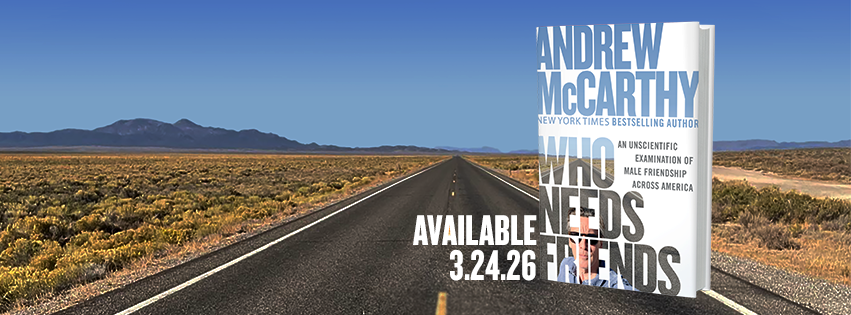
A moving and provocative exploration of male friendship and loneliness, from New York Times bestselling author, filmmaker, and actor Andrew McCarthy as he crisscrosses the country to reconnect with his friends.
“[A] soulful book, filled with the kind of bighearted, amiable characters who one hopes will populate any road trip.” – New York Times
“You don’t really have any friends, do you, Dad?”
A seemingly innocuous, if direct, question from Andrew McCarthy’s son left him reeling. McCarthy did have friends, but like so many other men, the necessities of modern adult life had forced his friendships to the background. At one point his friends had been instrumental in broadening his horizons, bolstering his courage, providing safe harbor. Now, McCarthy found himself questioning what had happened to those friendships, whether he needed them, what he valued, and what he had to offer. A simple question had become a moment that demanded a reckoning.
Who Needs Friends charts McCarthy’s journey over nearly ten thousand miles behind the wheel, following him on often-unexpected travels through Appalachia, the Mississippi Delta, the Chihuahuan Desert, the Rocky Mountains with one driving purpose: to reconnect. Along the way he talks to countless men about their male friendships, from cowboys and blues musicians to preachers and rootless teens. What began as a simple desire to catch up with a few friends turned into a deep exploration of the challenges and rewards that men experience in forming bonds with each other.
In McCarthy’s own words, “It turns out that guys have a difficult time with friendship.” But that’s not the way it needs to be.