
Ready To Live Your Best Life? Time To Make It Interesting.

Introduction
On the cusp of turning forty, i found myself at the top of my game professionally and at the bottom of my game personally. This part of my story is a little clichéd, but sometimes things are clichéd for a reason. I’m one of these people we hear about a lot: married early, threw herself into her career, juggled having babies and working full-time, pushing herself year after year…until it all came falling down and I found myself divorced and alone with two young boys to raise. Only when it all fell apart did I stop, did I pause, did I think: Who am I? What do I want my life to look like?
I found myself yearning for the spirit of my youth, who was all about travel and adventure. I took up sailing again after twenty years. I stopped caring about what others would think, or about how different my life looked than those of my siblings. Soon I fell in love with a man who saw me, probably even more clearly than I did. We bonded together over our shared passions, for skiing, for water, for conversation, for each other. We had fun together. I stopped working so hard and leaned into everyday life just a little more. With him by my side, I learned to notice the little things, to laugh at them, to let things go a little, and to relish the very chaos of life. Life started getting better. Life started to become way more interesting. In fact, life was good.
Poetically, I’d dedicated my career to thinking about the very same problem that plagued my personal life. Namely, what makes life “good”? I was drawn to philosophy in the first place largely because it offered a framework to understand what counts in life, and why. Philosophy offers a way of getting under the hood of what makes living worthwhile. Sure, we can look at the lives other people live and try to see what makes best sense for us—this is an important piece of the puzzle of living well. But philosophers seek something more fundamental: a universal understanding of what it looks like to live our best possible lives.
My first academic book, Eudaimonic Ethics: The Philosophy and Psychology of Living Well, explores how important being virtuous is to living well, a topic that has its roots in Aristotle and continues to be an important theme among philosophers and psychologists. I published this book the year I got divorced, the same year I also got tenure. I then started to think more broadly about living well. Surely, there’s more to living our best possible lives than being good people. I’d argued that developing virtue was essential to our psychological well-being, but I knew there was more to life. I started to ask: What does a Good Life— our best possible life—really look like?
I began to think more about happiness, and I soon started writing a book on the philosophy and psychology of it.1 The more I learned about happiness, though, the more I became sure of one surprising thing: Happiness really isn’t that big of a deal. It’s challenging to pursue and ultimately a feeling that comes and goes. It’s important to our lives, no doubt, but its role is limited—way more limited than people seemed willing to admit. Surely, the Good Life couldn’t be all about happiness, and my own personal experience had taught me it couldn’t be all about purpose or meaning, either.
My personal and philosophical journeys started to come together in 2014, when I got an email from a psychologist, Dr. Shigehiro Oishi, who was beginning a new research project and was interested in having a philosopher join his research team. He’d reached out to a mutual contact who had recommended he get in touch with me.
Oishi suspected that there was more to the Good Life than happiness and meaning, and he was interested in testing his hypothesis that psychological richness was an important aspect of the Good Life. A psychologically rich life is one full of experiences that stimulate and engage the mind, that provoke a wide range of emotions, and that can change your perspective. Oishi thought that this was a form of the Good Life that—amazingly—had not yet been appreciated by philosophers or psychologists.
He’d already begun conducting focus groups, asking students to describe “interesting, rich” experiences, along with “happy” experiences and “personally meaningful” experiences. This preliminary work suggested that the interesting, rich experiences were different from the others, and were correlated with novelty, variety/complexity, and a change in perspective. These markers, we’ve gone on to show, are distinctive to psychologically rich experiences, but not to other kinds of experiences.
With this basis established, the next task was to flesh out the nature of psychological richness, both theoretically and empirically, and together we secured funding from the John Templeton Foundation to pursue this important research. As the philosopher on the team, my task was the theoretical one: How do we understand and locate psychological richness in relation to the dominant theories of the Good Life that philosophers have developed over centuries? While philosophers had discussed elements of psychological richness in other areas, such as aesthetics, there was no developed notion of psychological richness construed more broadly, nor had other philosophers explored the possibility that psychological richness is itself an important part of the Good Life, independent of whether people derive happiness, meaning, or purpose from their experiences.
While I set out to show that psychological richness was separate and different from other philosophical conceptions of the Good Life, Oishi continued to conduct studies showing it is empirically distinct. Our 2020 coauthored paper, “The Psychologically Rich Life,” brings together both lines of research and established the framework for subsequent empirical and theoretical analysis. At this point, I began the independent, daunting philosophical task of showing that psychological richness was good in itself. This research led me to focus more heavily on the interesting—the qualitative feature uniting and underlying psychological richness. My 2023 paper, “The Interesting and the Pleasant,” argues that the interesting is an intrinsic, prudential value.2 It’s the value of the interesting that makes psychological richness good in itself.
Throughout this process, an amazing thing happened. My research on the psychological richness and the interesting brought together my professional and personal journeys and showed me the clear path forward.
Maybe you’ve shared a similar personal journey. Maybe you’ve crashed and burned. Maybe the toils of the pandemic pushed you to confront the status of your life. Maybe you’re not satisfied with happiness, or with meaning. Maybe you are simply ready to live a better life, right now. Maybe you know, deep in your gut, that there has to be more to life. Whatever your reason for picking up this book, seize the momentum now. Because I have good news: There is more to life.
PSYCHOLOGICAL RICHNESS AND THE INTERESTING: AN OVERVIEW
A psychologically rich life is composed of complex, novel, and challenging experiences that stimulate and engage the mind, that evoke different emotions, and that leave you with a different perspective than you started with. At the time Oishi reached out to me, his preliminary empirical research suggested that this kind of life is one that people value, even if they can’t label it. And his research showed that this kind of life couldn’t be explained within the dominant frameworks, which tended to think about the Good Life in terms of happiness and meaning. The experiences that comprise psychological richness just don’t always contribute to happiness or meaning. Sometimes they do, but sometimes they don’t. We still think they are good.
To start to wrap your head around this idea of psychological richness, you might begin by thinking about the kinds of experiences that challenge you, that force you to feel different emotions, that leave a dent in your mind. But—for now—don’t get too caught up in what those experiences are. Focus on what it feels like to have them. Psychological richness is something that we can notice in the mind.
Its definition describes the features of experiences observed to deliver psychological richness, but fundamentally, psychological richness is a psychological state. Notice, though, that observing its existence— while super important—doesn’t actually give us clues as to whether it’s good/helpful/worthwhile. Even though its name suggests something positive, it’s still just a psychological phenomenon we’ve recognized. Implicit bias and anxiety are also patterns psychologists can name, and we know that neither of those is inherently good.
These days, we are used to looking to psychology to explain how we are in this world. We think that if we can understand our minds, emotions, and thoughts, we can diagnose how to be better. And sometimes this diagnosis is very clear. Learning about the sneaky ways in which implicit bias affects us can help us be proactive in safeguarding us from its influence. Learning about our mind’s proneness to anxiety can help us to prevent its arousal. But notice this only works when we know that these are states we want to avoid. Does psychology tell us this? Can psychology tell us this? Well, no. As a science, psychology delivers information about our psychological states and the experiences they are correlated with. It tells us implicit bias is correlated with use of stereotypes; it tells us anxiety is correlated with rapid heartbeats and obsessive thoughts. It doesn’t tell us these are bad. It can’t.
What makes something good or bad is a philosophical question. Philosophers probe beyond the correlations; where science ends, we ask why. And this is my contribution to the research team. The empirical work shows people think psychological richness is good. The philosophical work is to show why people think it is good.
What caught my attention about psychological richness as a potential key to the Good Life was precisely that it wasn’t about meaning, and it wasn’t about happiness. I’d thought about meaning and happiness for years, without ever being tempted to think that they told the full story. Certainly, they didn’t grip me, and no philosophical argument about their value had ever quite satisfied. Seeing the results of the empirical studies, which delineated psychological richness from happiness and meaning, struck a chord with me. I was immediately convinced that psychological richness added value to our lives, and always has. But how could philosophers have missed this? And what were we missing? What kind of value have we overlooked that seems so clearly present in psychological richness?
The philosopher in me took hold— over years of research and thought, it became clear to me that psychological richness can enhance our lives because it makes them more interesting. And being interesting alone makes something valuable. As I write this now, it seems so obvious. Yet often the hardest and most important philosophical work is to make sense of that which seems so intuitive.
WHAT IS THE INTERESTING?
We use the word “interesting” in all kinds of ways. Have you used it today? This week? We think it while scrolling our news feed. “Hmm, that’s interesting.” We get into the habit of saying “Interesting” when no other words seem to suffice. A coworker shows you the website her teenager built about Minecraft? “Interesting.” We use it to set up our stories: “I had the most interesting thing happen to me today.” We use it to praise: “She’s so interesting!” “This is the most interesting book!” And sometimes we use it in lieu of praise, when we find ourselves unable to say anything else good about something: “How was the drive? It was…interesting.” “Wow! Your outfit is so, er, interesting.”
We need to move a little past our ordinary ways of using the word “interesting” to get to the sense of the interesting that adds value to our lives. But not too far. Notice that almost all the ways in which we use the word “interesting” highlight the ways in which interesting things stimulate our minds—even the teeniest bit, such as the first Minecraft fan site we’ve seen, or the first time we’ve seen someone wear a particularly hideous combination of colors and patterns. We don’t often realize it, but “interesting” describes the way we respond to things. No thing is inherently interesting. What’s interesting is all about how we experience the thing.
When we talk about interesting books, or an interesting class, we speak as if the book or class itself is interesting—to all who may read it or take it. Really, though, there’s no one book we all find interesting, just as there’s no one class we all find interesting. This is because experiences are interesting, not things. Reading a book can be interesting, and often is—outside of a classroom, we don’t really find ourselves reading books that don’t stimulate or engage us. The ones that do, though? They are the interesting ones to read, the ones we recommend to like-minded people who we think will find them interesting to read. The interesting isn’t about any one thing, or even a collection of things. It’s about our experiences of things that stimulate and engage us.
The interesting describes a quality of our experiences, and interesting experiences make up a psychologically rich life. That a psychologically rich life is full of interesting experiences explains why we value it. Complexity, novelty, and challenge stimulate our minds and spark engagement with the world around us. While we often shy away from things that push us in this way, we are learning more every day about how much value they offer to our lives. It may be easier not to engage our minds, but, please, trust me: Our lives go better when we do.
There is so much more life has to offer than meaning and happi- ness, and thank goodness. We’re all feeling the disillusion. Whether it’s a general sense of feeling stuck in life, or the anxiety and exhaustion that builds up day by day as we strive for more, all while we’re confused about what we’re aiming for and why it’s not working, these feelings of disillusion hit all of us. We’re yearning for more.
It’s little wonder we are struggling. All we know is to try to cultivate happiness, or to seek meaning, and it’s just not working. We meditate, volunteer, take CBD, change careers, change careers again, go to therapy, try to make friends, become a seeker—and yet none of it has yet delivered on the promise we’ve been chasing: that if we can just find enough pleasure, enough purpose, or maybe both, that we, too, can lead a Good Life.
It’s time to start going for more. Opening this book is your first move. In part 1, we’ll look at why living a life of happiness and/or meaning just isn’t going to cut it, and why including the interesting allows us to live our best possible lives. Then, in part 2, we’ll take a deeper dive into ways that we can cultivate the interesting on a day-to-day basis. Because even though all of our minds hold the capacity for the interesting, there is an art to unlocking its potential.
There’s important work involved here, clearly. What could be more important than learning about what makes our lives go well? But work shouldn’t always feel like work, especially work on the interesting. Thinking about the interesting is interesting in itself, and one of my aims here is to deliver you one interesting experience while you learn the skills you need to enhance your life.
This points to one of the coolest and most distinctive aspects of learning the art of the interesting. To better your life, you don’t have to set aside all the plans and projects that you’ve already got going on. You don’t have to go on a wine-and-gelato-fueled mission to find your true bliss, nor do you have to give up what you already care about in some search for true purpose. You could do these things, and maybe you’ll be inspired to make big changes in your life upon reading this. It’s just as likely, though, that you’ll find value in the little tweaks, which pay off in big ways. The art of the interesting delivers the tools you need to enhance your life without having to change or fix them.
Don’t get me wrong: Change can be a good thing, even when it comes disguised as the worst. Change can resolve our problems, and a life with less problems is always a better one, no matter who tells us otherwise. Problems weigh us down. Living from paycheck to paycheck. Living with chronic illness. Tensions between family members. Long-distance commutes. Long-distance relationships. All these things bear down on us, sucking our energy to no end. Even the little annoying things—finding a parking spot, paying bills on time, calling the plumber, having to reschedule a hair appointment—can clump together and become lead, simply dragging us down every day. If we can fix our problems, we should. Even those that seem most impenetrable, the ones buried so deep we feel we may as well keep them there, are worth fixing, too—even if at the slowest pace, chipping away, block after block, making us lighter with every small step.
But you know what? Sorry to be the bearer of bad news, but life can suck in so many ways that are outside of our reach. Not every problem can be fixed, and sometimes change isn’t possible. Even when change is possible, there’s no guarantee it’ll fix the problem. You can change your job, even your career, but you likely can’t change the demand- ing grind of capitalism. You can shatter ceilings everywhere you go but still struggle against racism, patriarchy, homophobia. We should take charge of our own lives, and we most certainly should take charge of making our lives go better, but changing and fixing is hard. And some things are just out of our control. Here’s the catch: Even when we can’t change and fix, and even when life might be downright miserable on the outside, we can make it more interesting.
A LESSON TO REMEMBER
Few knew this better than Aaron Elster. Born to a Jewish family in Poland in 1933, from the age of six Aaron was running for his life, moving with his family into the hidden corners of his town’s ghetto. When even those hidden corners became less safe, and the rest of the family had to flee, Aaron somehow made it to the Gurski family’s door. In better times, the Gurskis had been regulars at his father’s butcher shop. Mrs. Gurski reluctantly let Aaron in and quickly shuttled him up to their attic.
Aaron spent two years, from age ten to age twelve, hiding alone in the attic. Watching clips of Aaron speak of his time in the attic, it is hard to imagine this tan, bushy-haired man, with a smile so quick to turn to laughter, could be the same boy who lived through such conditions, no doubt ghostly pale from the lack of sunlight, starving for food but much more so for companionship. Mrs. Gurski would deliver him food once a day; any more contact would have jeopardized everyone’s safety. Aaron grew so lonely he’d pull the wings off of flies, so that they couldn’t fly away and would keep him company.
I could not begin to imagine trying to live under these conditions, the strength of will it must have taken to get up, day after day. To have to fight to simply live. How did Aaron make it through the hunger, the fear, the absolute loneliness of his existence?
There is no question in Aaron’s mind what got him through these times, what allowed him to survive, in the dark, on his own, at such a tender age. It was his mind:
I had the ability to daydream. I used to write novels in my head. I was the hero all the time. And we have that ability, to either give in to our misery and our pain and die, or to absorb physical pain but keep your mentality, keep your soul, keep your mind.
Stuck, so alone, scared, and desperate in the attic, never to see his parents again, Aaron somehow made the choice to live. And he found a way to make his life better without changing a damn thing about it. He daydreamed. He wrote novels in his head. He was the hero all the time. Aaron’s capacity to create the interesting saved him and it delivered the only good aspects of his life.
My hope is that this book shows how we can all cultivate this same skill. May none of us ever have to use it in such horrific circumstances as Aaron found himself in, but let’s also not forget that the interesting is always within our reach, because the interesting depends on only one thing: our minds. As long as we’re alive in any meaningful sense of the word, we’ve got the capacity to use our minds, so no matter what else is going on, and no matter how limited our lives may feel from the outside, we hold the power to make them good.
So keep reading. Learn the art of the interesting. Take advantage of the opportunity this offers: to forever change the way we live, to live better lives, maybe even better than we thought was possible. The Good Life really isn’t all about happiness. And it isn’t all about meaning, either. To live truly Good Lives, we need more of the interesting.
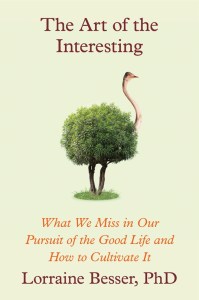
Traditionally, philosophers and psychologists have thought of the Good Life in terms of happiness or meaning, or some combination of both. But, if it’s really that simple, why aren’t more of us achieving that truly “good” life? You’ve hit all the markers, jumped on the happiness train, committed to a gratitude practice, sought purpose in your work, and yet The Good Life you’re seeking is still out of reach.
Emerging research is revealing that there is more to the good life than the current —and even ancient—conversation suggests. This has been identified as psychological richness. Dr. Lorraine Besser shows how psychological richness helps to make our Good Lives more interesting. Interesting experiences captivate our minds, engage our thoughts and emotions, and often change our perspective. In this illuminating book, you’ll take a deeper dive into the ways that you can cultivate the interesting in your everyday life, including:
·How to develop an interesting mindset
·How to harness the power of novelty
·How to turn obstacles into adventures
Whether you feel like something is missing from your life, or you’re yearning for more, Besser’s groundbreaking manifesto will guide you toward a fuller, more satisfying life.
Longlisted for the 2024 Porchlight Business Book Awards