
I WAS TOLD THERE’D BE A VILLAGE by Melissa Wirt (Excerpt)
I’d been duped by the big lie about contemporary motherhood—that the ideal mother will turn all her energy and attention inward to her own family unit, everything else be damned. Nearly every mom I know has bought into this mentality. Increasingly, we all seek out our metaphorical farms—cocoons sheltering the family, free from the ties that bind us to other people— and, as a result, we are pretty damn lonely.
In my defense, putting our own families first makes sense. After all, what is more important than protecting and raising the next generation? The fate of the entire species depends upon it. So with the best of intentions, as modern parents, we turn ourselves into child-optimizing machines. While not everyone goes as far as I did by picking up and moving to a remote farm, we concentrate the laser focus of our attention on our children. We enroll in Baby Einstein classes, puree our veggies into homemade baby food, jockey for a place in the best schools, and hound teachers about our children’s performance. We chauffeur our kids from piano to soccer to cheer squad, reading articles about attachment parenting on our phones as we wait in the car by ourselves. We operate out of a fear of messing up our kids’ childhoods.
In our quiet moments, we know something is amiss. At the end of each activity- filled day, we collapse into bed, bodies limp, minds processing tomorrow’s to-do list. We are told we can “do hard things,” but what is left unsaid is that we’ll do them unsupported and alone. Is the word for what we’re feeling languishing? Is it burnout? Is it mom rage— or maybe dumpster fire? We knew raising kids would be difficult, but was it supposed to be this difficult? Or this lonely? Hadn’t someone, somewhere, said that it takes a village to raise a child?
For millennia, there were villages, large groups of people woven together in communities of around twenty individuals linked by proximity and dependent upon one another. They hunted for food together, protected one another, and shared responsibility for tending to children, a structure called alloparenting. They lived in a web of extended families united by their common need to survive.1 This period of history, when raising kids was a group effort among several generations of a family, with friends, neighbors, and even other children pitching in, lasted tens of thousands of years.
But now, the idea of a village is as foreign to us as the idea of commuting by horseback. If you had set out to design a society that keeps people away from one another, you might have come up with one that looks a lot like the world we live in today. We cram our schedules so full that we rush from activity to activity with no opportunity for serendipitous meetups. Instead of venturing out into markets, we have food delivered to us. We order our Q- tips, clothes, and movies online. We check Yelp instead of reaching out to a friend to ask for a restaurant recommendation. Everything about our society is engineered to keep us apart from anyone outside the nuclear family.
Beginning in the Middle Ages, as society began the process of shifting from intermingled groups to smaller family units living side by side, the social mindset shifted from communal to individualistic. Our current hyper-individualist mindset in the West wouldn’t be so bad if we lived in a society with a strong social support system and robust family- friendly policies and institutions. However, for those of us who have become mothers in twenty-first-century America, the message we get from our government is very much You’re on your own. Good luck!
The US government’s failure to support mothers begins early, with childbirth, an event that is more likely to kill women in the United States than in any other developed country—and the risk is three times higher for Black women.2 After giving birth, we have a quick session at the hospital with a lactation consultant, and then we are sent home, where we are left to google “good latch” and “mastitis” while a Niagara Falls of hormones cascades through our bodies. We try desperately to remember the swaddle the nurse showed us and turn to the internet for advice to help our babies learn to sleep through the night.
Because Americans still (still!) don’t have a good national paid parental leave program, a few weeks later, many moms have to go back to work before they are ready, forcing them to spend a gigantic percentage of their household income on childcare. If a mom decides to breastfeed, she’ll have to finagle a way to pump her breast milk, usually at a workplace that isn’t equipped with a private room. Pumping during the first year of life can take as many as 1,800 hours, an amount of time that is within spitting distance of the 1,960 hours you’d work at a full-time job in that same year. In the years that follow, families in the United States continue to feel this dearth of support in the lack of universal pre-K and subsidized childcare. Simply put, we are left to lone wolf our way through parenting.
If I have learned one thing from watching the Latched Mama community of half a million mothers bravely share their triumphs and heartbreak online, it is that every mom out there is dealing with these challenges.
In an ideal world, there would be a committee of highly trained experts working day and night to nudge our society back to a more natural and beneficial state of connectedness. But the hard truth is that there is no incentive for anyone else to fix our culture of isolation. It’s working for everyone else that moms bear the brunt of child- rearing labor. In no household anywhere is the non-lead parent thinking, Gosh, I really wish I could do more of the scheduling, meal planning, and pesticide- intake monitoring.
Things have gone on this way for so long that we assume “hard” is just the way things are.
But it doesn’t have to be this way
A NETWORK OF SLEEPER CELLS
What if we had the power to make a change? What if there was already a network of support out there? What if it turned out that we moms are our own greatest resource? I believe we are. After all, who runs the world? Moms. We are a group of highly capable, motivated women who know how to tend and befriend—and we are everywhere, hiding in plain sight like sleeper cells just waiting to be activated. What if we could show up for one another and collectively lighten our loads by offering logistical and emotional support? Yes, we can protest and advocate for institutional change, and we should. But protesting doesn’t get my kid to swim practice while I’m at work. Maybe someday there will be an effective, centralized organization creating better maternal support policies. Wouldn’t that be nice? In the meantime, in this book, I want to address how we can cope right now. I’m convinced that one of the best solutions is leaning on one another. We mothers can show up, not just for our kids but also for other moms—and for ourselves.
Consider yourself activated.
This quiet revolution is already brewing. Not just on the margins, where people are co- living and forming mommunes (which are great, but not always a realistic option), but also in our living rooms, where a number of parents are opening their doors to a more porous way of parenting. When moms step up for one another, the result is awesome. I’ve seen that if we let go of the mindset that we must do it all ourselves, we can embrace a village mindset and become what I call village moms.*3
In a world populated by village parents, moms will join forces to help one another thrive. Village moms show up for others with understanding and without judgment. They know that we are all fighting the same battle and feel safe and open enough to host a playdate without thinking twice about the fact that the dog peed on the floor earlier that day. A village mom also takes care of herself by calling on her resources for help—she might drop her kids off at a friend’s house, go grab a cup of coffee and head to Target, or get her nails done, then come back and pick up those fed and happy kids three hours later. And she will return this favor for her fellow moms.
Village parenting is already happening out there. Through my work at Latched Mama, I’ve watched moms create community in ways that are beautiful and inspiring. It’s happening in PTAs, grocery aisles, and boardrooms, where moms have one another’s back, stick up for one another, lend a hand, and appreciate the heck out of how hard it is to be a mom in America today. It’s time for it to happen for you. For all of us.
- David Brooks, “The Nuclear Family Was a Mistake,” The Atlantic,
March 2020. ↩︎
RoosaTikkanenetal.,“MaternalMortalityandMaternityCare intheUnited
States Compared to 10 Other Developed Countries,” Commonwealth
Fund, November 18, 2020, https://www.commonwealthfund.org
/publications/issue-briefs/2020/nov/maternal-mortality-maternity
-care-us-compared-10-countries; “Working Together to Reduce Black
Maternal Mortality,” CDC, April 8, 2024, https://www.cdc.gov/womens
-health/features/maternal-mortality.html. ↩︎- *A quick note: a village mindset is not the exclusive property of moms. Dads, uncles, aunts, friends, and grandparents are welcome recruits to the cause. I’m addressing moms in particular here because the crisis in parenting falls most heavily on our shoulders. ↩︎
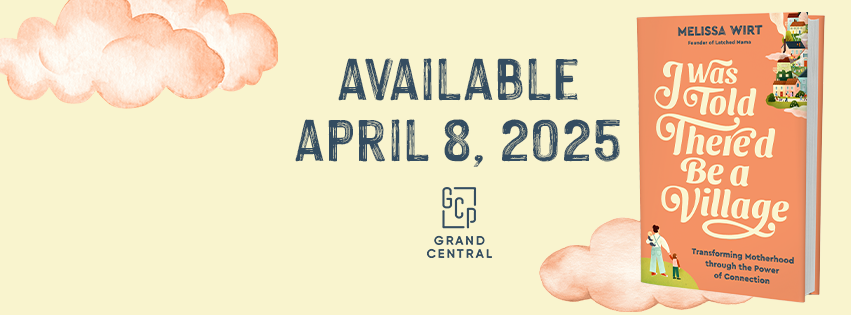
Excerpt from I WAS TOLD THERE’D BE A VILLAGE by Melissa Wirt. On sale April 08, 2025. You can pre-order now.

Melissa Wirt recounts her journey and dozens of others in building a supportive “village” to transform oppressive, solitary motherhood into a connected—even joyful—endeavor.
Melissa Wirt thought she had everything—she'd built her own company and moved to a beautiful farm with her family. Then during a personal crisis, she realized that despite having created an online community reaching thousands of moms, she’d also somehow, become utterly isolated.
In I Was Told There'd Be a Village, Melissa leads us through the small changes she made to seek out connection. She also recounts how she talked to mothers from across the country, and soon saw that the beliefs keeping each of us parenting solo – I don’t have time; my life is too messy – were also keeping us from accessing our most powerful resource: each other. The stories she uncovered, combined with her own, became a foundation for slowly building back community.
That journey starts with an intentional shift from an isolation mindset to a village mindset. It might be as simple as smiling at the mom next to you at story-time or sending a quick text to a friend. But it can be much bigger, eventually growing into a thriving, supportive community. Motherhood shouldn’t be this hard, and it doesn’t have to be. Here, at last, is a roadmap for finding your village.