Excerpt from WHY DO I KEEP DOING THIS? by Kati Morton
INTRODUCTION
Many of us have been told since childhood that we need to keep it together, be less dramatic, or toughen up. Some of us were told not to cry, to stop making a scene, or that our emotions were too much. As we got older, our upsets were dismissed, labeled as overreactions, or even seen as embarrassing. The message was clear: Falling apart is a failure, and if we just tried harder, we could appear unfazed.
These toxic ideas teach us to stuff our feelings down, ignore our instincts, and worry more about how we’re perceived than how we actually feel. We learn that our emotional reactions should be con- trolled. But here’s the paradox: While controlling our emotions is seen as a strength, controlling others is condemned. A controlling friend or partner is toxic. Trying to manage someone indirectly is passive-aggressive. The very thing we are trained to do—keep things under control—becomes the thing that harms our relationships, our well-being, and, ultimately, ourselves.
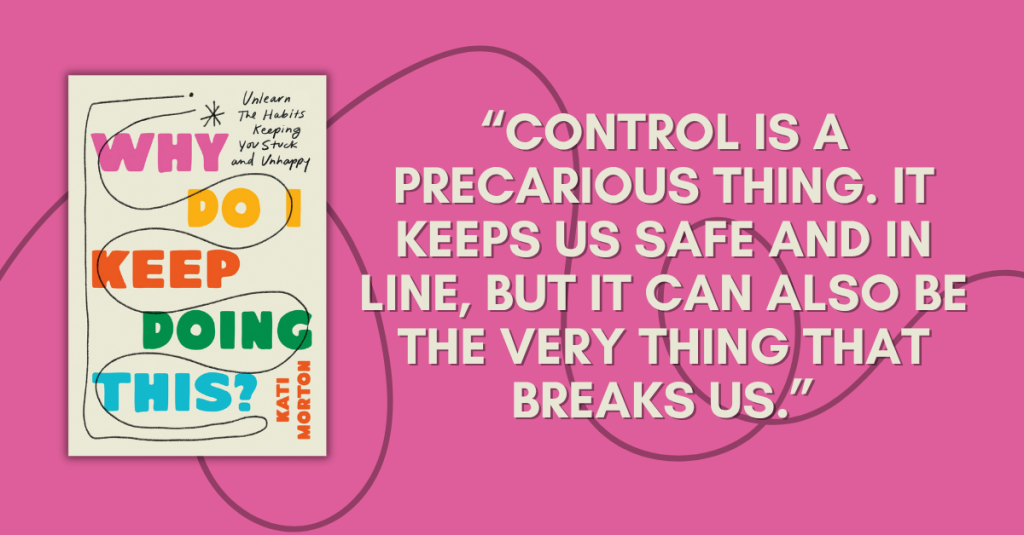
Control is a precarious thing. It keeps us safe and in line, but it can also be the very thing that breaks us.
And I know this firsthand.
I have always needed things to be just right. As a kid, I believed that if I could be perfect—if I could anticipate what people needed, say the right things, and avoid mistakes—then everything would be okay. If I could control my environment, I could prevent problems before they happened. I didn’t see this as control at the time. I thought I was being responsible, prepared, a good friend. But look- ing back, I realize that this constant need to manage everything wasn’t just about doing my best—it was about trying to feel safe.
In 2023, I hit a breaking point. I had spent the year working relentlessly, convinced that if I just did more, I would finally feel accomplished. But no matter how much I did, it never felt like enough. I ignored my exhaustion, dismissed my own needs, and kept pushing forward. Taking a break felt like failure. Slowing down felt unsafe. So I kept going. Until one day, I realized I wasn’t just burned out—I was resenting the very things I had once loved.
I snapped at my husband over something small. I felt irritated that my dog needed a walk. I was exhausted but refused to rest. And worst of all? I was annoyed with myself for feeling this way.
“Get it together, Kati,” I told myself.
I knew I needed a break just to think straight, but I couldn’t let myself take one. Every time I even considered stepping away, guilt kicked in. The fear of falling behind, of failing because of time off, made rest feel counterproductive. So I kept going. And going.
Until I finally sat down and started journaling about it. That’s when I saw the pattern.
It wasn’t just about working too much or struggling to take breaks. It was something deeper—something I had been blind to for years. I wasn’t just exhausted; I was trapped in an endless cycle of trying to control everything around me. My to-do lists, my emotions, my relationships—I was holding on so tightly that I didn’t even realize how much I was suffocating myself.
And I was frustrated to find myself here again. Hadn’t I already worked through all of this? I had been in therapy since I was fifteen, done the self-reflection, put in the work. When would I finally get over this feeling of not being enough? When would I stop running myself into the ground just to prove something—to myself, to others? And yet here I was, stuck in the same exhausting cycle.
Why did I keep doing this?
I had spent years believing that if I could just stay on top of every- thing, anticipate every problem, and work harder than everyone else, I would finally feel at peace. But instead, I felt more anxious, more disconnected, and more on edge than ever before. I was constantly managing, fixing, and adjusting, trying to orchestrate my world in a way that would prevent failure, rejection, or disappointment. And yet despite all of my efforts, those feelings still found me.
It wasn’t just about control—it was about safety. Somewhere along the way, I had learned that control was my shield, my way of keep- ing chaos at bay. If I could manage everything perfectly, I could avoid pain. But the more I tried to control, the more out of control I felt. The harder I gripped, the more everything slipped through my fingers.
This realization wasn’t just a professional one—it was deeply per- sonal. As a therapist, I had spent years helping others untangle their struggles with anxiety, perfectionism, and self-sabotage. I had seen firsthand how control showed up in their lives, just as it had in mine. The need to be the best. The fear of making a mistake. The exhaust- ing cycle of overworking, overapologizing, and overfunctioning, all in the hope that it would somehow make us feel enough.
And now, here I was, caught in the same trap.
That’s why this book exists. Because I know I’m not the only one. I see it in my patients, my friends, and my online community. So many of us push ourselves to the brink, believing that if we just man- age things better, try harder, and never let anything slip, we’ll finally feel okay. But the truth is, control isn’t saving us—it’s breaking us.
That’s what we’re going to unpack in these pages. Why we keep doing this to ourselves, where it comes from, and, most importantly, how to finally let go in a way that doesn’t feel like free-falling. Because there is another way—a way that allows us to feel safe, sup- ported, and whole without needing to control every single detail of our lives.
I’m not here to tell you to simply “let go and trust the process.” I know how terrifying that sounds. I know how impossible it feels when every instinct is telling you to hold on tighter. But I also know that there is freedom in learning to loosen our grip. There is peace in realizing that we don’t have to carry everything alone.
If you’ve ever felt stuck in this cycle, you’re not alone. And the good news? You don’t have to stay here.
Let’s dive in.
Many of us were told to stuff our feelings down when we were younger. We were taught that that our emotional reactions and responses should be controlled so we didn’t embarrass or upset our parents and those around us. However, if that control oozes over into our relationships it’s considered a bad thing. Controlling our friends or romantic partners is seen as toxic. Control is a precarious thing. Some sides of control are meant to keep us safe, while others harm connections. So, what are we supposed to do?
In Why Do I Keep Doing This? licensed family and marriage therapist , Kati Morton, explores this common struggle and contradiction with control. Kati shows how our upbringing and anxiety are often connected to our struggle to take up space. We can feel like we are too much by just existing in the same place as someone else, or that we are less deserving of their time and care. This struggle with asserting ourselves, or taking what we require can harm our development. We sometimes think the only way to feel okay and get what we need is to please everyone else first. Why Do I Keep Doing This? is a vital tool in helping us understand why control can be so attractive, but if left unmonitored can become detrimental to our lives. We all go through tough times and face uncertain futures, and we do what we can to cope, but as we get older and in an attempt to get wiser, we have to notice what behaviors are holding us back and change them.
Why Do I Keep Doing This? will shed light on shared struggles as readers follow Kati through some key points of growth in her own life while incorporating what she has learned as a therapist and content creator who knows how to create lasting healthy change. This book gives readers the ability to not only ask themselves why do I keep doing this? but also have the insight to find a real answer.