

Billie Jean King’s rise…
Excerpt from THE BIG TIME by Michael MacCambridge
There were no antecedents for Billie Jean King.
Despite her habitually bad
knees, she was a kinetic presence both on and off the court, and possessed a kind of grit that was still rare in the country-club sport.
One of the few elite professionals to wear glasses, she moved with a kind of
headstrong purposefulness. She lacked the dainty pirouettes and elegant
flowing forehands of other top women players. King attacked the ball, attacked
the net, attacked her opponent. Even her speech consisted of an aggressive set
of slangy expressions, many of them being Southern California idioms of broken
Spanish—a late choke was an “el foldo,” when she gained too much weight, she would
refer to herself as “el flabbo,” while a parsimonious tipper would be tagged
as “el cheapo.”
She also had a keen sense for the larger narrative. In American sports—
and to a great extent, in American culture—the magic figure was $100,000 a
year. The best baseball players were making six figures, and the round number
had become a yardstick of excellence in individual sports like tennis and golf.
Which is why King conducted a punishing schedule in 1971, playing
nearly all the Virginia Slims events, but also a wide range of other tournaments,
in hope of becoming the #rst woman athlete to reach the $100,000 mark
for yearly earnings. As she plotted her schedule that spring and summer,
she grew increasingly excited about the prospect. Not for the money itself so
much as what the accomplishment would signify.
King finally pushed over the line with a 7–5, 6–1 win over Rosie Casals at
the Thunderbird Tournament in Phoenix on October 3.
That prompted a press conference the next day at the Philip Morris headquarters
in New York, when Richard Nixon called in to offer congratulations
on passing the milestone.
“Hello, Mr. President,” King said.
“Yes, I just wanted to congratulate you for your great successes this year,”
Nixon told her. “I’m glad to see a fellow Californian get over $100,000.”
“Well, it proves that women can earn a respectable living in sports,” she
said. “It’ll open up more avenues for women in other sports.”
“Well, that’s the most important thing,” Nixon said.
While King’s earnings were gaining attention—“You girls are making
some real bread!” exclaimed Reggie Jackson, who met King at a Bay Area
sports awards dinner at the end of the year—she also recognized that the
key to the sport’s long-term success was finding new faces whom the sports
public viewed as compelling.
Earlier that fall, at the U.S. Open, King was sure she’d seen the future of
tennis, in the person of a sixteen-year-old from Florida named Chris Evert,
who arrived on the scene with a preternatural sense of poise.
Evert (even then, everyone called her Chrissie) was one of five children,
raised in a three-bedroom—and, eventually, four-bedroom, and, finally, five bedroom—
ranch-style home in Fort Lauderdale, the daughter of the teaching
pro Jimmy Evert, who presided over the nearby public court Holiday Park,
where Chrissie Evert, from an early age, showed an unshakable capacity for
concentration.
Evert burst onto the national scene at the ’71 U.S. Open, an indomitable
competitor in ribbons and bows. In her #rst- round match at Forest Hills, she
fought off six match points before rallying to win. She advanced to the semi-
finals, playing on center court to ever more enthusiastic crowds fascinated
by the teenager’s maturity and comportment. Her on-court cool became an
instant calling card. “The Ice Princess” or “The Ice Maiden” were early nicknames.
In Evert’s honey-blond good looks King recognized an ambassador
for the sport, the girl next door who could captivate the imagination of both
women and men.
Evert was stoic and shy and, well, sixteen. “I think the older players were
slow to warm to her,” said the pro Judy Dalton. “She was reserved and aloof
and cold.”
At one point during the tournament, King gathered some of the veteran
women on the tour and made an impassioned plea for them to be kinder to
Evert. “Listen, you guys, Chris Evert is the greatest thing that could happen
to us,” King implored. “Look at her— she is it! She’s our next superstar and
you’re going to be passing the baton to her. So, I don’t even care if you like
her. We’ve got to make her feel welcome. It’s not about ‘like.’ It’s about doing
the right thing.”
One of the players mentioned to King that Evert wasn’t particularly
friendly to them, either. “Guys, she’s sixteen!” pleaded King.
King had defended Evert, and now she had to defeat her. Evert had thus far
avoided the full Virginia Slims tour and was playing only the rival USLTAsanctioned
events. King recognized that an Evert victory over her at Forest
Hills might delegitimize the whole Virginia Slims tour.
On their walk to the court before the semifinal at Forest Hills, King counseled
Evert to savor her arrival in the spotlight. Then she disposed of Evert
in straight sets.
Asked in the winter of 1972 if she was growing tired of the focus on her
callow youth, Evert replied, “Well, it would be nice if some writer would get
around to describing me as sexy.”
In the event, she wouldn’t have to wait long. The attention generated
by Evert and the indigenous Australian Evonne Goolagong, twenty-one,
reflected their grace and promise, but at times seemed beyond what their
court accomplishments had to that date merited.
In the summer of 1972, the elfin Goolagong had been the subject of illicit
attention from the Sun, the tawdriest of London’s Fleet Street tabloids, which
published a sketch imagining what she would look like playing in the nude.
It wasn’t the sort of thing Johnny Unitas ever had to deal with.
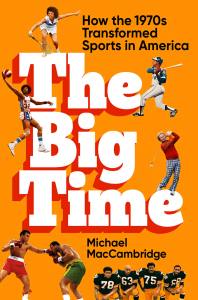
A captivating chronicle of the pivotal decade in American sports, when the games invaded prime time, and sports moved from the margins to the mainstream of American culture.
“Indispensable history.” —Sally Jenkins, bestselling author of The Right Call
Every decade brings change, but as Michael MacCambridge chronicles in The Big Time, no decade in American sports history featured such convulsive cultural shifts as the 1970s. So many things happened during the decade—the move of sports into prime-time television, the beginning of athletes’ gaining a sense of autonomy for their own careers, integration becoming—at least within sports—more of the rule than the exception, and the social revolution that brought females more decisively into sports, as athletes, coaches, executives, and spectators. More than politicians, musicians or actors, the decade in America was defined by its most exemplary athletes.
The sweeping changes in the decade could be seen in the collective experience of Billie Jean King and Muhammad Ali, Henry Aaron and Julius Erving, Kareem Abdul-Jabbar and Joe Greene, Jack Nicklaus and Chris Evert, among others, who redefined the role of athletes and athletics in American culture. The Seventies witnessed the emergence of spectator sports as an ever-expanding mainstream phenomenon, as well as dramatic changes in the way athletes were paid, portrayed, and packaged.
In tracing the epic narrative of how American sports was transformed in the Seventies, a larger story emerges: of how America itself changed, and how spectator sports moved decisively on a trajectory toward what it has become today, the last truly “big tent” in American culture.