By clicking “Accept,” you agree to the use of cookies and similar technologies on your device as set forth in our Cookie Policy
and our Privacy Policy.
Please note that certain cookies are essential for this website to function properly and do not require user consent to be deployed.
The Messy, Memorable Decade…
Excerpt from THE BIG TIME by Michael MacCambridge
The broad societal trends and rise of television had created more leisure time
and more consumers in the ’70s, and presented a horizon full of possibility
as well as the freedom to try anything. Over the next ten years, nearly everything
was tried.
So much about the decade was marked by letting things go—hair, clothing,
styles, morality, social conventions, the color of appliances. Writ large,
this saw the country acting at times like there was no history, no gravity, and
no consequences for the present moment of freedom. Psychically, much of
the decade had the feeling of third-drink revelry descending into something
darker, fourth- drink recklessness bound for a hangover.
In this, the decade in sports closely resembled the American decade as a
whole: unruly, unhinged, unpredictable, and in the end, unsustainable. Some
breakthroughs proved innovative and resonant, others failed to stand up to
time and scrutiny. And they were all mixed together in an indiscriminate
mishmash of innovation, novelty, gimmickry, and genuine social progress.
The decade in sports brought designated hitters and tearaway jerseys, “wildcard” playoff berths and eligible freshmen, two-fisted backhands in tennis and the three-point line in the NBA, the last all-white national champions in college football and the first Black manager in baseball, a no-hitter pitched while on LSD, a golf shot on the Moon, an attempted rocket jump of the Snake River Canyon, epic heavyweight title fights in Jamaica, Zaire, and the Philippines, made-for-TV competitions like the Superstars and the Battle of the Network Stars, a thousand winged doves at the Super Bowl, a butterscotch football, an orange baseball, a blue hockey puck, and a red- white-and-blue basketball.
Even the equipment changed: Tennis rackets went from wood to composite
materials, jerseys went from wool to cotton to mesh to breathable hybrids,
and the decade brought the invention of the aluminum baseball bat, the
multicolored tennis ball, the protective flak jacket modified for football, the
waffle-trainer running shoe, and, not incidentally, the sports bra.
The universe of sports continued to expand, with upstart leagues in football,
basketball, hockey, soccer, and even tennis and volleyball. The era saw
the rise and demise of such teams as basketball’s San Diego Conquistadors,
hockey’s California Golden Seals, volleyball’s El Paso/Juarez Sol, football’s
Shreveport Steamers, tennis’ Boston Lobsters and soccer’s Colorado Caribous,
who actually did play one season in brown-and-tan game jerseys with
a strip of leather fringe across the chest.
No sport was unaffected. The decade that began with the full merger of
the National Football League and American Football League also eventually
saw two leagues condensed into one in basketball and hockey. While Major
League Baseball’s structure held, almost nothing else in the sport did, leading
one historian to observe that the ’70s brought “more changes than the
game had known in the first seven decades of the twentieth century.” Among
the changes that baseball confronted at the beginning—and certainly by the
end—of the decade was that it was no longer the national pastime. Pro football
“Indispensable history.” –Sally Jenkins, bestselling author of The Right Call
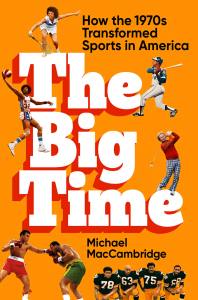
A captivating chronicle of the pivotal decade in American sports, when the games invaded prime time, and sports moved from the margins to the mainstream of American culture.
Every decade brings change, but as Michael MacCambridge chronicles in THE BIG TIME, no decade in American sports history featured such convulsive cultural shifts as the 1970s. So many things happened during the decade—the move of sports into prime-time television, the beginning of athletes’ gaining a sense of autonomy for their own careers, integration becoming—at least within sports—more of the rule than the exception, and the social revolution that brought females more decisively into sports, as athletes, coaches, executives, and spectators. More than politicians, musicians or actors, the decade in America was defined by its most exemplary athletes. The sweeping changes in the decade could be seen in the collective experience of Billie Jean King and Muhammad Ali, Henry Aaron and Julius Erving, Kareem Abdul-Jabbar and Joe Greene, Jack Nicklaus and Chris Evert, among others, who redefined the role of athletes and athletics in American culture. The Seventies witnessed the emergence of spectator sports as an ever-expanding mainstream phenomenon, as well as dramatic changes in the way athletes were paid, portrayed, and packaged. In tracing the epic narrative of how American sports was transformed in the Seventies, a larger story emerges: of how America itself changed, and how spectator sports moved decisively on a trajectory toward what it has become today, the last truly “big tent” in American culture.
This item is a preorder. Your payment method will be charged immediately, and the product is expected to ship on or around October 10, 2023. This date is subject to change due to shipping delays beyond our control.