
America’s Team, the Dallas Cowboys…
Excerpt from THE BIG TIME by Michael MacCambridge
BY THE TIME they made their fourth Super Bowl trip of the decade—at the
end of the 1977 season, for Super Bowl XII, the first that would end in prime
time—the Dallas Cowboys had become as identifiable a national “brand” as
McDonald’s or Coca-Cola. With their sophisticated public relations and their
keen use of image, they were—in the words of Esquire magazine—“football’s
richest and stuffiest team.”
If Oakland’s Raiders were the anti-heroes in black and silver (immortalized
by NFL Films’ Steve Sabol in his adaptation of Mary Jane Carr’s poem
“Pirate Wind”) and the Pittsburgh Steelers the very reflection of hard-hat
resilience of western Pennsylvania, then the Cowboys were an even more
clearly defined entity. The team had become a shiny glass skyscraper, the
consummate expression of sports superiority for the modern age.
Tom Landry, in his suit and fedora on the sidelines, striding the sunbleached
artificial turf at Texas Stadium, exuded corporate detachment. His
quarterback, Roger Staubach, was a daring throwback, known as much for his
All-American rectitude as his unscripted scrambling and late-game heroics.
If Paul Brown had treated football as an academic discipline, injecting it
with intellectual rigor, Landry reimagined it as an engineering project, which
relied on exact specifications (his Flex defense, his modern adaptation of the
shotgun formation, endless analysis of opponents’ tendencies) and personnel
that would carry out the tasks with consistent precision. The Cowboys would
miss the postseason only once between 1966 and 1983, and always seemed to
be playing either on Monday Night Football or in the featured late game on
CBS. Their success created the image, and team president Tex Schramm was
an expert at burnishing it.
“Tex Schramm took care of the media in a way that I don’t think anybody
else ever has,” said the announcer Verne Lundquist. “He understood how
important television and written media could be in promoting his product.”
At a time when other teams relied on local newspapers and TV to convey
their message, the Cowboys had an assured grasp of the media in the Dallas–
Fort Worth area and beyond, and also their own newspaper, The Dallas Cowboys
Weekly.
The image of sophistication was there in the team’s uniforms, designed by
Schramm a decade earlier to evoke the spacesuits of the Apollo astronauts.
It was certainly there in the uniforms of the Dallas Cowboys Cheerleaders,
who’d become a cultural phenomenon of their own, with a poster selling over
a million copies in 1977 and a made-for-TV movie starring Jane Seymour and
Bert Convy.
In previous decades, teams sold tickets; by the late ’70s, they were
selling something more: an image, an experience, a sense of belonging.
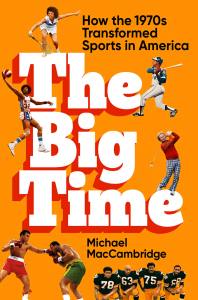
A captivating chronicle of the pivotal decade in American sports, when the games invaded prime time, and sports moved from the margins to the mainstream of American culture.
Every decade brings change, but as Michael MacCambridge chronicles in THE BIG TIME, no decade in American sports history featured such convulsive cultural shifts as the 1970s. So many things happened during the decade—the move of sports into prime-time television, the beginning of athletes’ gaining a sense of autonomy for their own careers, integration becoming—at least within sports—more of the rule than the exception, and the social revolution that brought females more decisively into sports, as athletes, coaches, executives, and spectators. More than politicians, musicians or actors, the decade in America was defined by its most exemplary athletes. The sweeping changes in the decade could be seen in the collective experience of Billie Jean King and Muhammad Ali, Henry Aaron and Julius Erving, Kareem Abdul-Jabbar and Joe Greene, Jack Nicklaus and Chris Evert, among others, who redefined the role of athletes and athletics in American culture. The Seventies witnessed the emergence of spectator sports as an ever-expanding mainstream phenomenon, as well as dramatic changes in the way athletes were paid, portrayed, and packaged. In tracing the epic narrative of how American sports was transformed in the Seventies, a larger story emerges: of how America itself changed, and how spectator sports moved decisively on a trajectory toward what it has become today, the last truly “big tent” in American culture.