Excerpt: THE TRIDENT AND THE PEARL by Sarah K. Wilson
A desperate queen makes a deal with the gods to save her land in this spellbinding romantasy debut from Sarah K. L. Wilson.
“Perfect for readers who love slow-burn romance steeped in lush fantasy!” ―Danielle L. Jensen, #1 New York Times bestselling author of A Fate Inked in Blood
“Intricately wrought and deeply imaginative … the kind of delicious slow-burn fantasy that made me love reading.” ―Hannah Whitten, author of The Foxglove King
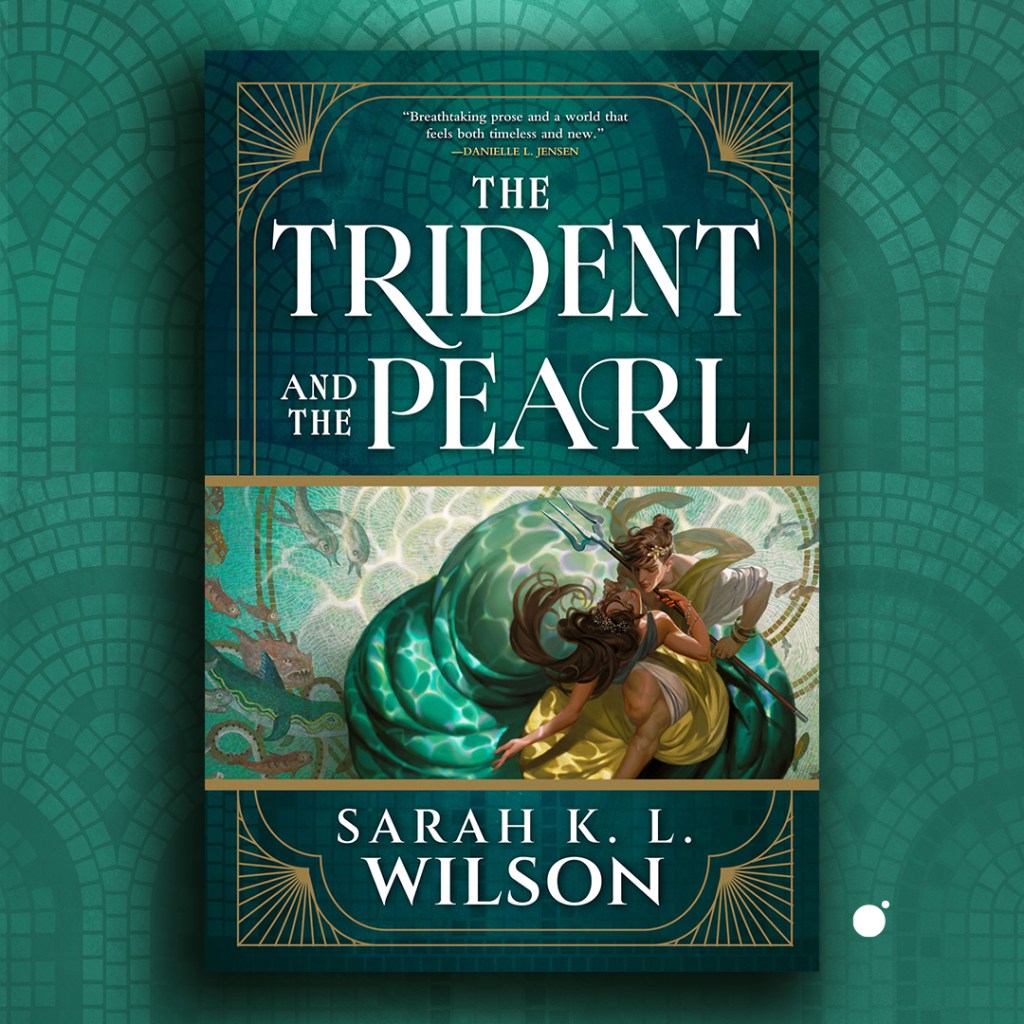
Read the first three chapters of The Trident and the Pearl, on sale February 24th below!
Chapter One
I was born into the embrace of the sea on a moonless night in the month of the Ragged Tides. My mother did not bleed out her life into the sea with my arrival, nor was my father visited by a terrible curse.
In fact, neither one of my parents passed away until the summer of the Year of the Peacock brought yellow fever to our fair shores. By then, I was a woman grown, and when I took up the Pearl Crown and settled the mantle of woven seed pearls over my shoulders, I did not need to have either cinched to accommodate me.
I was not forced into an arranged marriage to a man the age of my father, nor obliged to dance attendance on an emperor who might make demands on my kingdom if he couldn’t make demands on my person. Instead, I married my childhood friend Lieve, a man of smiles and teasing jokes who filled our short marriage with laughter.
One might think I wasn’t to be at the heart of a fairy tale at all. One would be wrong, as I was. And the discovery of how very wrong I was nearly became the end of me.
But I am getting ahead of myself.
This tale starts with the sea and with a storm.
If you’ve spent any time at the sea, you know its smell, but if you’ve spent time traveling many seas, then you know that the smell of the sea is different in every port. Here on the five Crocus Isles, the sea smells of brine and spices and a little of the honey-sweet crocuses that grow on all five islands.
“Coralys.” Lieve’s voice is rough, but it has to be to pierce through the howl of the wind.
My eyes snap to him. He sets the back of his knuckles against my cheek in a moment of public intimacy he’d never normally allow. He is always tightly controlled, my Lieve. Always a ship smartly rigged.
His brown eyes soften for a half a breath, he almost smiles, and then he brushes a kiss across my lips.
“I will be back shortly,” he says, and I think this time that some of the roughness is emotion.
I tangle my fingers in his, unable to find words. If I beg him to be careful, it will only instill the idea that I doubt him. If I make him promise to come back to me, it will put weight on his shoulders that does not need to be there. If I tell him what an honor it has been to be his wife, it will feel like I am already reading his eulogy.
Or mine.
He has no choice but to go. Or rather, he has a choice, but he’s Lieve and he’d never take it. We thought we saw a capsized boat on our way here. It was too far away to divert to when we were racing for the island of Talasa, but there were people clinging to the hull and Lieve must go back for them.
So, I muster a smile—seas and skies, where do I even find it?—and it seems to be enough.
Our fingers tighten. “I will be here,” I say—my normal response when he leaves me, but today it feels like some kind of declaration. Some kind of challenge to the wind and seas that lash our islands with increasing furor.
I will be here, I tell them. I will not be moved. Keep trying all you want, you will not budge me.
“Your Serene Majesty.” Turbote shifts from foot to foot just one step above me. His white beard is so wet it looks like the foam collecting in tufts on the edge of the sea. “Please. We must hurry. You dare not wait!”
Our fingers untangle and Lieve’s strength slips away from me. He tosses a last warm look over his shoulder and then hurries down the steps. I’m memorizing him without meaning to, tracing his muscular shoulders and tight, lean frame. He’s purpose come to life, leaning forward as he jogs back to the boat.
I wrench myself up another stair and away from him.
I try not to look back, but I do. Twice.
We sent away the last of the ships yesterday after the harbormaster brought me a fish with a coin in its mouth—a terrible omen of devastation for my people—and we sent away the last of the seaworthy boats this morning. They’ll have raced to find shelter outside this storm, fleeing to our neighbors in hopes they were hit lighter than we and still have fresh water supplies or piers left to tie a boat. Talasa is our tallest island and even here we’d docked against the temple steps halfway up the holy hill. The pier is deep below the waves.
Now, all we have remaining are boats so unseaworthy that they cannot be trusted to set out into the surf with our precious people for anything other than the shortest of journeys. They’re all that’s left to take Lieve out to search for those we saw stranded.
One more glance over my shoulder. I’ve lost sight of Lieve in a wall of blowing water. I try to tell myself I’ll see him again, but my inner voice is a liar.
The storm has not relented in three days—not only that, it grows more angry as the hours pass, swelling up over our islands, battering every bit of our lives until they crumble and fail or sink beneath the furious waves. The line of dockside fish markets is nothing but matchsticks. The pottery market lost the roofs off every shop. My own palace is knee-deep in brackish water, the imported rugs ruined, the riches buried in the green brine of the sea.
We are already climbing the hundred stone steps faster than I imagined was possible. Turbote’s wet robes slap his legs in an arrhythmic beat. He’s panicked. He’s been panicked since we left the main island on Lieve’s wreck of a boat and came here to the island of Okeanos’s Temple. The boat doesn’t carry many people. A mercy, perhaps. Instead of my entire council of bickering advisors, I am accompanied only by Turbote, my most annoying counselor and the priest of Okeanos.
Our ancestors carved the temple from stone, following the natural ebb and flow of the white rock bones of our islands. The steps swirl up like waves tousled by a benevolent breeze to where the temple rises—enormous in scale in a way that bids the worshipper to wonder if the gods had actually met man here once, and if this place had been carved to suit their size rather than ours.
At the center of the temple is a single statue of Okeanos, carved of white marble. If the god truly lives and if he looks like this, then I am impressed. The image is two men tall and boasts intricately carved tangles of long hair fanned out to one side as if he was caught by the sculptor in the middle of twisting, trident in one hand, a set of five chains in the other. His blank marble eyes house a fury impossible to portray in stone, and yet it is there.
I, who once told Turbote to his face that the gods were nothing but a beautiful dream, am here to plead with him. I, who refused on the first day of this cataclysm to so much as offer a single prayer, have come now on my knees. I know this for what it is. Futile. Desperate. The last thrashing of a dying whale trapped on the shore.
But I can no more stop thrashing than the whale can.
“We’ll plead with any god who will listen when we get to the top,” Turbote gasps. “Let me do the talking—pray by all means, but any bargain should be made by me. I am the priest.”
We spill out into the temple—two tiny figures at the highest point of the Crocus Isles standing under the last sign of our strength and will. Above us stone waves crash. Below us real ones swell ever higher, lashed by rain.
We told the council that I would go and pray, but Turbote and I both know what that means. Nothing comes from nothing. If any of the gods deigns to bargain with me, then I’m going to be asked for something. Yet my riches are already lost to the sea, my people scattered to the winds, my power evaporated with them. So, it’s my life they’ll have or nothing.
Turbote is praying loudly to any god who will hear, but mostly to Okeanos. He presses my head down hard so that my chin hits the white rock and I taste blood in my mouth, half expecting to feel the knife of his blade cut my throat. He’s dousing me with holy ocean water. In his enthusiasm I’m half drowned.
“Pray,” he begs from above me. “Add your words to mine! Please, Your Serene Majesty.”
“Gods of the sea and storm,” I shout out over the blast of the wind, and as if in answer the wind blows twice as hard, whipping my long black hair behind me until it snaps like a banner. “Show yourselves!”
And for a long moment there is no response.
Not that I thought there would be.
Everything is still. Everything waits with me. Water trickles down my neck, down my spine, making me shiver, and there is no god who comes to claim my life. And no god who comes to save us. I draw in a deep breath, about to let out my resignation with a sigh, when I freeze.
A whirl of wind kicks up, spinning so hard around the temple that I hear a crack, and then one of the decorative waves behind me falls and shatters. Turbote screams and falls back, but I do not. Because worse—so much worse than the destruction of the temple or the wrath of the gods—I’ve lost sight of the little dot bobbing on the waves.
I swallow, stand, and take a step forward as if I could fly out like a pelican and swallow up my beloved from the waters and carry him to safety.
But of course, I can’t. I’m mortal still.
WHAT WOULD YOU HAVE OF ME, MORTAL QUEEN?
They aren’t spoken words. They’re the crash of the sea and the beating of the waves. They’re the howl of souls caught up in the shaking power of the storm. And yet they make my heart race. I fight against a chattering jaw—my body’s natural flinching from so great a glory washing against my mind. My will must be greater.
“Spare my people,” I beg succinctly. “Still this storm.”
WHAT BARGAIN WOULD YOU MAKE FOR THIS BOON?
I had thought I was not one to plead. How naive of me.
“What would you take, Lord?” I ask, choked. I dare not withhold anything.
YOUR FUTURE.
I swallow, looking again at the empty patch of ocean where my husband has disappeared. The grief swelling in my throat tells me he asks for too little, for already my future is lost to me. But if I am bargaining for lives, then I am bargaining for Lieve’s life, too, if he is not yet lost. If there’s even a chance he could survive this, then I must fight for it.
“Yes,” I say so quickly that the word blurs into the storm. “All of it.”
I think I hear a laugh, but I am not certain, for the wind shakes us again, ripping at us so hard that a piece of my dress tears away and is a tenth league out over the sea before I notice it has broken free.
I can barely breathe, my air is snatched before I can draw it in, and then suddenly the wind stops. The waves still. I hear water pouring, and it takes a heartbeat for me to realize that it’s running from the stone down the slope of the hill in rivulets.
Out over the still sea—unnaturally bright and peaceful to my eye—my green islands rise up out of the water like a half-drowned child rescued and hauled into a boat. They are torn and ragged, but they gleam like lost gems recovered. My islands. Restored to me. My heart leaps.
Can it… would the gods truly bless me so? It feels like grasping at air. Impossible to hold. I can no longer deny that they exist. I must not deny their blessing, too.
AND NOW THE PRICE.
The storm has passed, and yet the voice in my mind is as howling as a turbulent wind.
“The price,” I agree, but my eyes ache from looking, searching. I don’t dare blink. I’m scanning every bit of water I can see. He only disappeared for a moment. He might be out there in that calm water. He must be.
YOU WILL MARRY THE FIRST PERSON TO SET HIS FOOT UPON THE PIER. YOU WILL BE HIS BRIDE. HIS STATION WILL BE YOUR STATION. HIS CROWN YOUR CROWN. HIS PEOPLE YOUR PEOPLE.
I blink, confused. “I am already married, Lord.”
ARE YOU CERTAIN?
I am certain now. And it guts me like a fish brought to market.
I wail my pain and fury into a still, perfect sky.
Chapter Two
By the time the waters begin to recede, the sun is sinking in the sky, and though the rains have stopped, the clouds are heavy, and I am born all over again on another moonless night.
“We’ll sit here, then, until morning,” Turbote says, shuffling his bones to the floor beside me and kicking his legs out over the edge of the stone steps like a child. He seems smaller than he did an hour ago.
The temple is built into the crown of the mountain so that the land sweeps out from it like a skirt, the frothing ocean its lace. From the temple, all is seen, just as all is seen by the gods. I grit my teeth at that similarity. They might see, but they only care if it benefits them.
There’s a lightness to Turbote’s tone that seems like it’s coming from a faraway land. “A fire would have been nice,” he says, not seeming to care that I have no part in this conversation. “It would have lit the way for any boats, but no matter. Everything is far too wet to burn. Eventually people will make their way back. The fleet from Andalappo will be close and they may be the first to set foot on the dock. Their prince would make a fine choice for you, though that’s likely too much to hope for. We’ll see their lights from here if they make landfall.”
Now that the winds have calmed, there are lights dancing in the distance across the span of many waters. He’s right. There are boats and ships out there. Soon, my people will return from the safe harbors and dry land they hoped to find in Andalappo. The swell was so strong here that three of our islands were completely submerged, and the other two nearly so, but Andalappo is a string of island mountains. When the sons and daughters of the Crocus Isles return, they will be safe.
It’s the birdsong that breaks me.
The Crocus Isles are thick with emerald-fronded plants, broad leafed and bountiful. Below us, in the last scraps of light, I see them waving gently as if all is well, though it is not well at all. And then the birds begin to sing, telling one another that they’ve survived this terrible storm. That it is past. That they are whole. If they hadn’t gone and sung, I could have held the tears in, but the fool things won’t let up with all their cruel joy.
I sink down beside Turbote.
“We can send someone down to demand their captain disembarks first,” he says, sounding happy. “Or any noble they have aboard. That should suit well enough. As long as it isn’t Gheric Rodehands. That miserable traitor.”
“Opposing monarchy doesn’t make a man a traitor. He loves the isles, too.” We are both so tired of this ongoing argument that Turbote doesn’t even bother to answer back.
“I wouldn’t worry if I were you, Your Serene Majesty. The council will take it all in hand right away.”
“Worry about what?” I am long past worry. I can’t even see it on my horizon anymore. What is left to worry about? The worst has happened, and it can’t be taken back.
“Who you’ll be forced to marry, of course.” Turbote sounds put out.
I snort gently. I will marry a gull if I must. I care not at all.
“We’ll make the best of it!” Turbote can’t disguise his satisfaction anymore. It would make me bitter, except I know it’s only relief to have survived. “We’re good at making the best of things.”
“The council will see to the rescue of survivors, the rebuilding of the isles, and the restoration of order,” I say calmly. “My heir is Cousin Delarte. He was on the Merrymaker when it set out two days ago. If all has gone well, they’ll return with the rest. He’ll need a strong council to help him reign.”
“My queen?” Turbote sounds rattled. I regret stealing his temporary joy. “Coralys? You heard the gods speak. You bartered with them. You must marry! If you break your pact with them, they will return with five times the fury. There will be no survivors from such wrath.”
I turn to him and make my voice firm, thankful he won’t see my face in the falling darkness.
“Counselor Turbote, tomorrow we will recover and bury our dead. And I will marry the first man to set his foot on our pier here on Talasa, whoever it is. And I will go away and be his wife and my crown will pass to Delarte. You heard the god. His station will be mine. And his people my own.”
“But, my queen—”
“Enough. The gods have spoken. And so have I.”
And with that I close my eyes, lean against the too-large pillar, and let my sorrows carry me through the long, aching hours of the night. I am certain that Turbote argues against my will, but I cannot tell you what he says, for I am not listening.
In my mind, I hear a sad song singing, one usually sung to children to list out the gods, though why we end it in sorrow, I could never divine.
Take your breath for Aurelius,
Drink your drop for Okeanos,
Plant your seed for Glorian,
Give your kiss for El’Dorian,
Sing your song for Ordanus,
Strike your hammer for Alexandros,
Walk your trail for Pagetto,
Dig your grave for Treseano,
But for me it is Heskatan with her snorting horses,
And Markanos will guide me through battle’s courses,
And your love will fade, my dear, as my death takes me
And in the Nightwaters, all ten gods I’ll see.
Perhaps my Lieve sees the ten gods now, though his war was not with men but against an angry sea. Perhaps he’ll have seen which god bargained with me—Okeanos, most likely, as this is his temple.
When dawn creeps in, my bones ache from sitting on cold stone all night. To my surprise, Turbote is not with me.
I walk through Talasa like one in a dream, a lump in my throat for every scattered line of wood or stone I see where once there had been a dwelling, a rough exhale for walls toppled and wells filled with brackish seawater. In the top of one tree is a dead goat. They’ll have to climb to bring him down again.
I feel as though I am a ghost walking through my own land. My eyes skim over roofless houses and matchstick remains, unable to settle on just one loss under the bulk of so many.
I reach the docks—dry now and accessible—in time to find Turbote weeping.
Washed into shore at his feet are Lieve and Rasale and pieces of the wreckage of their boat. I barely recognize my beloved husband without the gleam of life in his eye. His fists grip a line so tightly that we must leave it in his hands. He did not surrender to the sea; it tore his life from him.
Rasale, Lieve’s crewmate, looks more peaceful. Perhaps he did not mind the last embrace of the waves. I linger over them, tasting bitter dregs in my mouth. Had I been just a few moments faster in my prayers, perhaps they would yet live. There is no sign of Carmante, who sailed with them. He did not make the journey back.
I do not need to look at my husband’s lifeless body to know he is gone. I have felt his absence keenly all night. I do not have to hold his empty corpse. I do not have to look once more into glassy eyes. I do not have to lay him out on the door we find blown off a dockside shed, or arrange his limbs, or tear fronds from those plants that survived to garland him.
I do not have to. But I do.
Which is how I miss seeing the first boat return.
I do see Turbote, though. He is opposite me, where he has been doing for Rasale what I have done to honor Lieve. It’s when he freezes in horror that I know what has happened.
“Your Serene Majesty,” he chokes out.
Anyone can step on a dock. And with every boat and ship we had filled with people fleeing the storm and the floods, is it any wonder that in the distance I see craft upon craft bearing down upon us like migrating butterflies in a swarm?
But fastest among them, quickest to return to the fold, is not the fleet of rescuers promised by Andalappo. It’s not the rest of the council. Not a merchant boat’s ruddy-cheeked sailor or a huddling family clinging to one another.
Instead, a lone sailor in a tiny boat with a single sail—the name scrawled across the prow illegible in the peeling paint—ties his boat to the other end of the long pier.
I have never seen Turbote run. I’m not sure I’ve seen any man of his age run. He tears down the pier screaming, waving his arms. The part of me who is watching all this thinks it’s almost funny. The part of me gently holding my dead husband’s hand thinks nothing will ever be funny.
Turbote makes it almost halfway. It’s a valiant attempt. But he does not succeed.
The survivors close to the pier, surprised to see Turbote sprinting, follow him, but even through the small crowd I see the moment the man—a fisherman, I’d guess, based on the nets hanging along the side of the boat—stumbles onto the pier. He’s either badly beaten or much the worse for drink. He can’t walk a straight line, and he falls into a quickly retreating Turbote as if embracing a long-lost relative.
Turbote shakes him off, and I get one glimpse of the man. His skin is sunburned. His hair an indistinct color slightly bleached by the sun and pulled back into a gnarled knot. He’s bearded. His clothing is ragged and hangs over his body in a way that makes it hard to tell his height or width. But he’s a man. And I suppose that means he’ll be my wedded husband soon enough.
Turbote is speaking loudly and with hands waving—likely explaining the situation to this man. He pays Turbote about as much mind as I usually do.
Our eyes meet from across the distance, and his narrow as they watch me in a distinctly predatory manner.
I do not like that I look away first or that I feel suddenly both hot and cold all at once. I see my future in those twinkling lights as surely as if I’ve read it in the stars.
I have too many duties to speak with him now. Or at least that’s what I tell myself, but I know the truth: I must set my husband to rest before I meet the next man I’ll marry. I owe him that much respect, at least.
Chapter Three
The morning and afternoon pass in a blur of arrivals: relief, hope—for other people—and then the hour of solemn burials at sea for those dead we’ve collected, including Lieve. I know there will be many days like this to come for the Crocus Isles. But the rest will be without me.
By now, the council is all here, the island is flooded with people, the weeping is shot all through with joyful reunions and glad surprises. Under the bright sun and over the azure waves—mocking things when they were so harsh and cruel yesterday—the rescue fleet from Andalappo arrives. They carry supplies for my weary citizens: clean water, fresh food, canvas and rope, promises and well wishes.
The last ship to throw anchor and send in boats is the Merrymaker, which holds Delarte. My cousin is twenty-six summers and favored in looks, but soft from drink and good food, and while he makes his obeisance to me, it’s hesitant because we both know it’s ephemeral and by tomorrow I’ll owe him the bow.
“You’re all here,” I say, looking up at my counselors and Delarte hovering a little away and speaking in hasty whispers. “Which should be more than enough for you to conduct a wedding and wish your monarch well on her new life.”
“You don’t have to do this, cousin,” Delarte says.
It’s performative, but that’s fine because everyone knows it’s his piece in this little drama. He’s delivered it well. It even sounds heartfelt, and maybe it is, but it doesn’t matter because it’s a throwaway line. It’s the ones that come after that matter.
“We do,” I say calmly, gravely.
There’s doubt in Delarte’s eye. I’m sure there’s doubt in mine. But I received my boon, and now I will pay the price.
Turbote is grim. “I heard the voice of the gods. This is the payment they take for their mercy. Our queen is right to offer herself as the price.”
“You should have managed it, Turbote,” one of my counselors says in a tetchy tone. “It’s a simple thing to order a man to stay in his boat. If it had been a member of our nobility, there’d be no talk about a change of rule. We could have said she was staying with her people and that the noble was of her station. Things would go on as they always have. Instead, you’ve let it all fall apart!”
Turbote wrings his hands.
“You don’t have to do this, Your Serene Majesty,” another counselor says. I will not recite my counselors’ names. That they had nothing more valuable than empty objections tells all that is needed to know about them.
“If I do not fulfill my vow, I will have broken trust with the gods,” I tell them quietly. “And if I break trust with them, then they will break trust with me. Do you already forget how many of our own we have lost? How severe the storm was? How very narrow our escape became?”
They’re silent.
“Still…” Delarte lets the word hang in the air. “To step away from the Crown…”
“Is the only option left,” I tell him, and this time I put steel in my voice. “A commoner stepped onto the docks. A commoner’s wife I will be. That means I will no longer be queen. It is the price the gods demand and I will pay it.”
“They ask for too much,” Delarte mutters. As if me giving up my crown and marrying a stranger are the true tragedies here. As if it is not Lieve and the others being sent back into the sea.
It is agreed that the wedding will take place the next morning. Morning is the time of weddings and the tide pool will be warm and ready for the ceremony. For one last night, I will be queen. Delarte is happy, for he looks benevolent as a result of this decision, and the council feels they have done all they can, which sets their hearts at peace.
“I’ll stay here,” I say, looking down the pier to where a pair of guards has been set by the council to watch the fisherman I’m to wed tomorrow. He sits, leaning against the bitts, huddled over himself as if he is still ill or injured. I wonder if he’ll be a problem. “If it’s good enough for him, then it’s good enough for me. I’ll be his wife in the morning.”
Turbote scoffs. “We set the guard so he wouldn’t slip away.”
“You didn’t set a guard on me.”
Turbote looks side to side as if he’s uncomfortable, and then to my utter surprise he steps forward and wraps me in an embrace. I’m so stunned that I freeze, arms straight and stiff.
“What is this?”
“Coralys.” His voice breaks. “Like a daughter you’ve been to me. Willful and brave. Fair and just. No one would think you would run from your duty. Not even now.”
And I know I should feel something. Surprise would be appropriate. Affection would be permissible. But I see an old man touched by the voice of the gods who thinks now that his queen is the center of some great epic tale. I disentangle myself from his arms and say kindly, “You’ve been a good counselor, Turbote. Do not ruin it by softening now.”
He laughs, dashing tears from his eyes. “You’ve saved us all. Who would think the gods themselves would barter with you? You’re honored, Your Serene Majesty.”
“Live a long life, Turbote. Make Delarte as miserable as you’ve made me.”
He laughs again as if that was a joke, but then he’s on his way and I’m grateful to see his back. I look down the pier to where the fisherman sits with his head tipped back. Hardly an auspicious beginning to a marriage—one forced by the hands of guards and man, the other forced by the threat of the gods.
I make my way down the dock, watching him as the distance grows shorter. I have not had a good look at him yet. I do not know if I am wedding a youth tomorrow or a man as old as Turbote.
Even as I draw close, it’s hard to tell. He’s hunched over himself as if in pain, one arm wrapped around his middle, his head bowed. He has a wild beard that hangs in hunks like rushes and spreads out to the sides like the tail of a thrush. It is not an attractive thing, but to be frank I’ve never met a man good at judging what’s attractive in a beard. Mayhap the fisherman thinks he looks very well indeed with a face like a thrush’s tail.
“I don’t think we need guards,” I say mildly when I reach him. He has not bothered to stand at my arrival—or even look up. The guards don’t move, so I fix them with my steady gaze. “Leave me one lantern.”
They look at each other. I don’t know their names, though I know the names of all my own palace guards, so these are part of the regulars. They’re worn and tired, uniforms salt-stained and rumpled.
I’m surprised by how offended is the part inside me that can feel their hesitance. But no one forced to marry a piece of flotsam after a storm can brag that she’s too good to be ignored by the guards. I’m still laughing at myself when I put a hand out to be given a lantern.
“There’s food at the palace, they tell me.”
I’ve hit the right note. They exchange another glance, offer a pair of reticent salutes, and give me one of the lanterns. Their footsteps echo down the pier. Voices drift in muffled tones and the sounds of people preparing for night echo over the water. The waves batter the sides of the various craft tied up along the pier, and the shushing lull of them calms me enough to sink down to the decking and place the lantern between myself and this mysterious heap of beard and cloth.
“Do you believe in fate, lady?” he asks me, and I’m so startled by his voice that I nearly tip over the lantern.
“No,” I say a little sadly.
I wish I could lay all this at the feet of some unknown divine storyteller, cruel and immovable. It would be a comfort.
“Do you believe, then, that your choices shape the course your life sails? That you are arbiter in the place of fate?”
He mocks me. And he does it with such a voice. His appearance may be shabby, but the gods have given him a voice that seems to have the power of the great swells of the sea behind it. I think if he were dressed well, giving orders, there’d be no hesitation in those he commanded. He wouldn’t have to tempt the guards away with food. I smile slightly at the comparison.
“Who should I blame but myself?” I put to him.
He makes a sound that at first I take to be a fit of some kind and I look around helplessly. I am not practiced in healing arts. I make to rise, but his hand snaps out and grabs my wrist, and I freeze.
There’s a lot of power there. Too much to make me feel safe. Not an old man, then. The hairs on his arm are dark. His forearm is well shaped and darkened by the sun. He holds my wrist in a firm grasp, but not so tightly that it hurts. I am surprised at the gentleness of his touch. It takes a breath before I realize that the sound I hear is him laughing.
“You don’t blame the gods, then? For this fate of yours? To marry me, a poor fisherman?” His expression is hidden by the long hair that falls around his face.
“Is that what you are?” I ask curiously. But his words strike a chord in me. I do blame the gods. Not for the marriage. I care not about that. I blame them for the death of my Lieve. For the deaths of the rest. For being able to stop it but toying with me first instead.
The fisherman’s hold on my wrist tightens, and for one terrible moment I have a strange feeling that he is not what he seems at all, but rather some monster of the deep come up to claim my soul.
“A fisherman?” he says, seeming pleased with the title. His words break my reverie and he loosens his hold on me. “Among many things, I am certainly that.”
“And will you take me willingly to wife tomorrow?”
“Isn’t that what they’ve kept me here for?”
I open my mouth and then shut it with a click when he looks up at me for the first time. His eyes are bright and sharp. Those are not the eyes of a fool. They are dangerous eyes.
And they are also beautiful, like the sea just before a storm. They draw me into an intimacy I do not want.
I swallow hard. I know nothing of this man but his dress and conveyance. He could be anyone. Not a ghazul or a kraken, obviously, but perhaps a criminal. Perhaps a man who enjoys the torture of the innocent. Perhaps a pirate or reprobate or drunk.
And I will be his wife.
It will not be like my marriage to Lieve, where I was queen as well as wife, equal—superior, even—by birth and blood. Nor will it be the sweet partnership between us where trust was so strong.
I am about to learn a very different kind of marriage now—the binding of disparate souls, the tying of divergent fates.
“You know that you’ve been held here to marry me,” I say coolly, refusing to break our shared gaze. I will not bend first. “They would have told you.”
“A bargain with the gods.” His eyes flash in the lantern light. Against my will, my breath catches. “As if a mortal can bargain with the immortal for anything and come out the winner.”
“And yet, I did,” I tell him. And I’m not sure if my voice is cold because he is toying with me, or because the idea that the gods were playing with me last night is taking root and growing in my heart. “Tell me, fisherman, why else but because you are to wed me tomorrow are you kept here on my pier unmolested?”
“Your pier?” He finds that amusing.
“Until I marry you,” I say firmly. “Until I marry you and abandon this life of mine, I am Coralys, Her Serene Majesty, queen of the Crocus Isles, seventh of her line. My ancestors built this pier—and the others of the five islands. They carved our palaces and courthouses, shiphouses and temples from this rock. They set in pools and springs, fountains and terraced gardens. We are a haven of bounty and spices and peace between men.”
He smiles as if he is charmed by a tale. “Is this so, Coralys? You are so very favored as all that?”
“Yes.” I am annoyed now.
His voice softens. “Is it true that your husband died in the storm? Or is that one more exaggeration I should lay at this man Turbote’s feet?”
I feel the blood drain from my face, annoyance shattered with the strict reminder that grief is my companion this night.
“It is true.”
I cannot decipher the emotions rippling across his face, but he is very grave when he speaks.
“Your people lived—mostly—but your kingdom is drowned. Where will the terraced gardens be today? Washed away. Your beloved fountains filled with debris and brackish water. Your silks ruined, your rugs trashed, your riches washed out into the greedy mouth of the howling sea. I name you Queen of the Drowned, for that is what you are.”
“What is that to you?” I ask softly.
His answer is so faint that I barely catch it. “What indeed?”
He drops his hand suddenly, as if stung, and I feel cold.
Carefully, I retreat to put a post at my back and close my eyes.
“Are you going to run?” I ask him.
“There’s nowhere to flee.” His words sound bleak and one corner of his mouth hitches in a way that makes me wince in sympathy.
“Is marriage to me so grim as that?”
But he does not answer and I do not care if he runs. It will only mean that I am bound to follow, and I think that maybe chasing him would be preferable to him chasing me, so I close my eyes and I lean back against the pier.
This journey is too important to abandon now. Because I have made a choice as I spoke to him. I have decided I will climb up out of the mortal mirk and find the gods, and I will have my revenge on them for withholding their mercy like it was a game and plucking my husband’s life like fruit from a tree. And the thought of this new purpose swells in my breast in a way that sits very nicely alongside my grief and drives all doubt from my mind.
The fisherman is whistling something tuneless that sounds like the wind in the rocks of the shore more than the song of a man. It suits my mood perfectly. Neither one thing nor the other, just like me tonight. I drift in and out of cold, comfortless sleep, and I clench my fists and wish I could pray for revenge, but with the gods as my enemies I refuse to pray at all. Instead, I simply hope and I cling to the haunting sound of that whistle until dawn.

Forced by the gods to be wed. Forced by their secrets to be enemies. A desperate queen and a lowly fisherman must join together to save her land in this spellbinding fantasy from Sarah K. L. Wilson.
“Intricately wrought and deeply imaginative … the kind of delicious slow-burn fantasy that made me love reading.” ―Hannah Whitten, author of The Foxglove King
Queen Coralys, ruler of the Crocus Isles, kneels to no one. But when her kingdom is besieged by a terrible hurricane, killing her husband and destroying half her nation, she is forced to make a deal with the gods for salvation.
But the gods have a wicked sense of justice, and they demand payment for their help. Coralys must give up her titles and marry the first man to set foot on her pier: a poor, wounded fisherman with broad shoulders and dark power in his eyes.
Coralys keeps her promise and sets out with him in his dinghy, with only the hope of revenge against the gods to keep her from despair. But her new husband hides his own secrets: a link to the gods that may make him her enemy or her ally, and a mysterious list of impossible feats waiting to be crossed off. However, learning to trust each other will be their greatest challenge, because only together can they stop the enemies gathering at her kingdom’s shores.
“Perfect for readers who love slow-burn romance steeped in lush fantasy!” ―Danielle L. Jensen, #1 New York Times bestselling author of A Fate Inked in Blood