Excerpt: The Isle in the Silver Sea by Tasha Suri
From World Fantasy Award-winning author Tasha Suri comes The Isle in the Silver Sea, a heart-shattering standalone romantasy of sapphic longing, medieval folklore and a love that spans the centuries.
★ “Beautifully inevitable and surprising at the same time.” –Kirkus (Starred Review)
★ “A sensuous and haunting story of love beyond time.” –Library Journal (Starred Review)
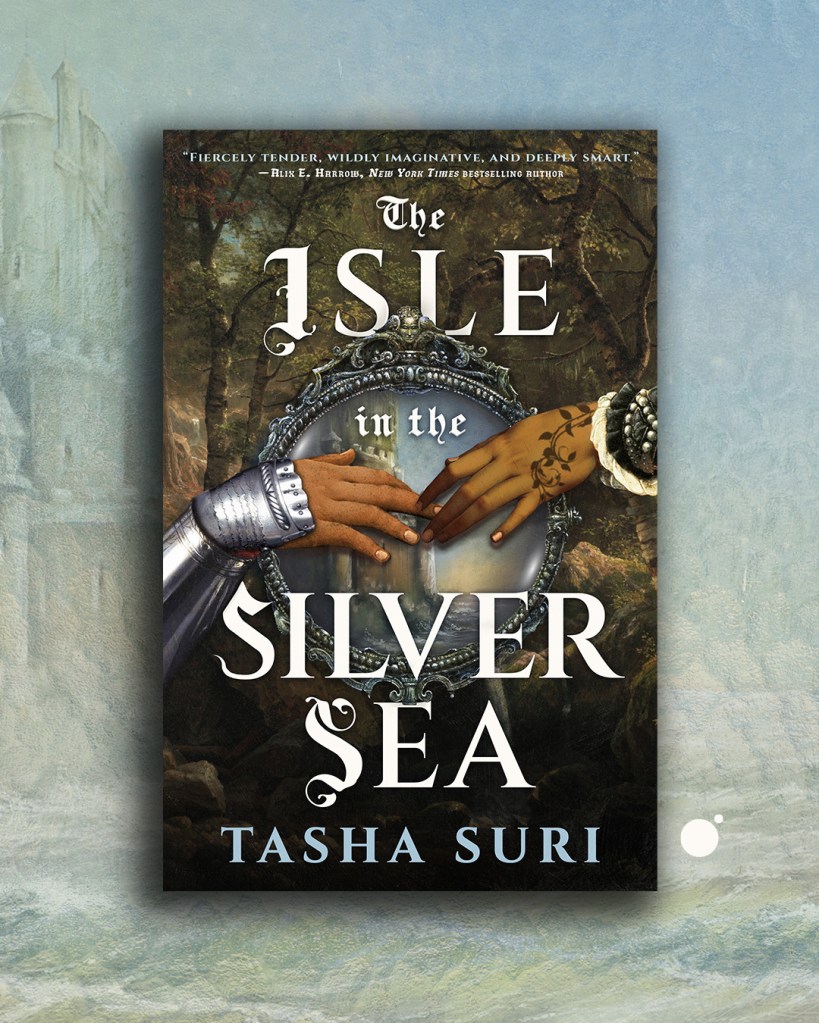
Read the first three chapters of The Isle in the Silver Sea on sale October 21st below!
Part One
[Anonymous, “The Knight and the Witch,” in Laura Beaufort-Morgan (ed.), Incarnate Tales for Children (Chancellor Press, XVIII), pp. 22-23.]
Long ago, there lived a knight who was tasked by the Queen to kill a terrible witch.
All witches are terrible, of course, but this one was especially wicked. The witch lived upon a grand mountain range, in a sprawling palace of bronze ore. There, she spun ore into fire, and fire into scrying glass, and made great mirrors that she hung upon her mountain peaks so that she could watch the good folk of the Isle and drip evil dreams into their eyes. Every man and woman and child who glimpsed her mirrors became afflicted with nightmares so dark and so vicious that many perished from the horror of them alone.
“The witch must die,” the Queen proclaimed, her white face solemn beneath her golden crown, “before she drives all the Isle to madness with her nightmares. Are you brave enough to kill her, dear knight, and pure enough of heart to survive the poison of her magic unscathed?”
The knight kneeled before the Queen and bowed his head. He was broad and tall with hair like yellow wheat and eyes as blue as the sky at midsummer, and his heart was so radiantly pure that some said light shone from his face like a beacon. He knew the witch, for they had crossed paths before, and he understood that her wickedness was as deep as his purity.
“I will not return until I have run my sword through her beating heart,” the knight vowed.
He took his steed and his sword and rode for many days, from the Queen’s Palace to the salt-swept coast, through forests of wizened trees and glades of fae and gnomes and all manner of trickster creatures, until he arrived at the bronze-peaked mountains of the witch’s domain. He knew if he gazed into the copper light of her mirrors her poison would touch him, so he bound a cloth over his eyes and followed the guidance of his pure heart.
His heart led him upon the mountain into her palace. Around him the air smelled of meadow grass and heather, winter’s mead and summer’s honey, but he knew these scents were illusions and that around him lay nothing but a palace of bones, rich in the smell of smelted ore and fire and charnel smoke. He heard the whisper of silk skirts and a woman’s laughter, and knew that a witch of profound ugliness had lurched toward him wearing an illusion of beauty.
He held his sword aloft, and the witch laughed again.
“You cannot kill me in my own palace, where my magic is strongest!” the witch cried.
“I can, and I shall,” the knight declared. “Because my heart is pure, and I serve the Eternal Queen, who rules everlasting.”
“If my magic cannot defeat you, then remove the cloth upon your eyes,” commanded the witch.
The knight refused. He struck with his sword and smelled her blood on the air. It spat and sizzled where it touched the earth.
“Look at me,” implored the witch before he could strike again, “and I will release all the people of the Isle enthralled by my enchantments. I vow it on my magic. May it wither if I lie to you now!”
A witch vowing on her magic is as good as a knight vowing on his honor. So the knight removed the cloth from his eyes, because he could not allow good people to suffer if it lay in his power to do aught else.
When the knight beheld the witch he saw a fair maiden with skin as white as unspoiled milk and hair spun from gold. But he knew this was an illusion, because witches are rotten by flesh and by nature.
Too late, he realized that behind her stood a vast bronze mirror inscribed with words of magic. The sight of it bled poison into his eyes and fire into his blood. With a cry, he covered his eyes once more, but it was far too late.
“It is the mirror of change,” the witch gloated. “It will turn your goodness to wickedness, and the hate in your heart to love. Your own purity will destroy you and make you mine!”
Overcome, the knight went to his knees and professed his ardent love for her.
The witch kept her word and released every good Isle-blooded man and woman from her enthrallment. She considered it a worthwhile sacrifice, for she now possessed the knight, and she knew his sword would lay waste to the Isle if she only asked.
For many days the knight served the witch and committed terrible deeds on her behalf. His sword dripped blood and turned the mountain snow red. But the witch’s inevitable ruin lay in the spell she had cast upon him. One day she looked into his eyes and saw her own poison of change within them reflected back at her. His love was a mirror she had foolishly gazed upon, and now it ensnared her.
In a moment, her wickedness was turned to goodness and her hate to love. And she fell into his arms and wept, repenting all the evil she had done. She kissed his eyelids and kissed his mouth as she wept, and the love in her kiss broke the enchantment upon him.
The knight remembered himself, and wept also, for the spell had transformed the witch into the fair maiden she had long pretended to be, and the sight of her made his false love into true. But he had made a vow to the Queen, and he could not break it.
He ran the sword through her heart and through his own, and they died together, the knight and the witch.
In the end, the knight acted wisely, for he knew love was the ruin of them both, and only death could set them free.
He did not know then that their love was a Great Tale—an Isle-feeding fable, a love story to nourish the forests and fields, to make the Isle’s birds sing and its adders slither.
Their tale made incarnates of them, and like all incarnates they will return to live their tale and love and perish for a hundred thousand lifetimes and beyond. Indeed, they will love and die until the day comes when no more stories are born and told at all.
On that day, the Isle will crumble into the sea, and be lost forevermore.
Chapter One
SIMRAN
Source: A Monograph on the Laws of the Isle by Dr. Angharad Walsh (unpublished)
This is how it begins
Long ago, a story was told, and land grew from it.
Tell a tale of wolves and a girl in bloodred, and somewhere a forest will grow, sharp-toothed and open-mawed for a foolish wolf’s bones. Talk of monsters slithering through the darkness, and somewhere there will be caverns to hold them. Speak a thing and make it live, on the land across the silver sea. That is a mortal gift.
But those stories are hungry, and they must continue to be fed.
Tell me, whisper the stories. Repeat me. Enact me. Embody me.
And so we feed them. One child at a time.
Archivist’s Ruling: Destroy. Publication barred. Interrogation recommended.
When you live in a land that feeds on stories, you soon learn to sense when one is about to rear its head. Sometimes, if you’re foolhardy enough, you can make sure to set yourself on its path. The witch from Elsewhere, with her ink-smudged brown arms and her bone compass, was not a fool, but she was hardy—a sharp, severe kind of hardness that radiated from every pore of her body. The boys who stumbled out of the Starre Tavern to smoke, soused to the gills, gave her a wide berth. Their eyes slid respectfully away from her.
Some of those boys were dressed in doublets and hose, their caps feathered. Others wore vests and pocket watches under their great surcoats, their top hats tall and black and their boots polished to a shine. Stories muddled together easily across London, but in no place better than taverns, where gossip—the most natural kind of tale-spinning—spilled as easily as drink. That kind of magic changed things: It made the bones of a tavern stranger, stronger, and better at luring all sorts of people in through the door. In the Starre Tavern, a boy raised to eat on a trencher and sup on mead could rub shoulders with a lad born under the shadow of coalsmoke and industry. Even an Elsewhere-born witch with ink on her skin and magic writhing under her heels—the kind of woman who belonged nowhere by design—could buy herself a pint and find herself a sticky corner of the bar to lean on.
But the witch had no plans to step through the tavern’s doors tonight. Her work lay out here.
Her patience was beginning to wear thin when the cold wind finally changed, softening apple-sweet. The boys smoking outside the Starre Tavern fell silent and stubbed out their cigars and cheroots; downed their pints and stepped quietly into the pub. She watched the windows go dark as great candles of tallow were snuffed out. The door was softly closed and latched.
She was reminded of the way birds turned in a flock with the wind, or rats abandoned sinking ships. Sometimes animal instincts were the best ones.
Above her, the gas lamps dimmed, then guttered. On her palm her compass whirled, the little needle of bone spinning wildly.
Bone was a bad lodestone for direction, but it was good for snaring the edge of a tale. There was nothing a story liked more, after all, than flesh and blood.
She stepped back against the wall of the tavern. In her hastily mended cotehardie and her lambswool cloak, she was as good as written for the tale she expected to wend its way down Cloth Fair at any moment, but that did not mean she wanted to be seen.
They came in a group of three, as so many stories did: three knights astride three destriers, the Queen’s rose pennant fluttering above them. One of them was carrying a satchel braided in gold.
Her compass needle stilled.
There.
Do not see me, she thought, and felt magic bubble through her flesh. She was the tavern wall, or close enough to it. Gray stone melded with her cloak. She kept her eyes on them, as the first of the horses met her trap.
“Halt,” one said gruffly. “There’s a fairy ring here. Toadstools.”
“Fuckers,” said another. “They know they’re not allowed this far into London.”
Under the looming checkerboard shadow of St. Bartholomew the Great Church, the riders halted. One dismounted and drew their helm from their head. The neck that was exposed was almost as dark as the witch’s own—a warm tan underneath a mop of oak-brown hair. She was surprised by their face when they turned. There were darts of gold in their right ear. And the face was girlish, despite the sharpness of the jaw and cheekbones, with long-lashed eyes and a giving mouth. A handsome knight, yes. But also a pretty one. Were there many tales of pretty knights?
She knew many tales of knights, but only one that dwelled on a knight’s shining beauty, and contemplating it made a kernel of poison bloom in her already rather bitter heart.
“—vinia,” one knight said.
“She’s not listening,” said the other. “Look at her.”
Something-vinia raised her head.
“Patience,” she said. Her voice was a lazy curl of smoke, a rich woman’s voice, beautiful and thoroughly obnoxious. She prodded the ground at the edge of the toadstool with her gloved knuckles. “Fuckers or not, I won’t tread over a fairy ring without offering it silver.”
“Then offer it so we can be off.”
“I’m afraid I’m low on funds today,” the pretty knight replied. “Care to spot me?”
The men behind her cursed, and the knight raised her head, laughing a bell-like laugh even as she stared coolly through the dark. Her eyes were the brown of a doe or hare—lustrous, wild, and canny.
In her mind, the witch from Elsewhere cursed too.
The pretty knight knew the fairy ring was false.
What mistake had revealed the illusion? She’d worked ash and water-by-moonlight together to make those toadstools; rooted them with a song and a sinewy thread. How had the knight seen through it?
“Come out,” Something-vinia urged, and her voice was a hook that made the compass needle tremble.
“Who are you talking to?” another knight asked. “Vina—”
“If I place a coin in the ring, will I be snared here? You’ve built a clever trap.” Her voice was still lazy, glass-blown at the vowels, but pitched to travel. “I’d love to hear how you did it. Come out, Lady. Speak to us.”
Against the wall, the witch weighed up her options.
Something-vinia—Vina—was carrying the satchel.
One bottle of ink. That was all she needed. One bottle could stretch far in her scriptorium. The work it could bring to her door would pay her rent for a solid year.
She let the illusion around her fade and stepped forward. One of the riders made an abortive grasp for his sword, then lowered his arm with a clank of armor. Both riders looked at her and the thin, knife-whittled shadow her body threw.
“Are you a beautiful maiden wearing the guise of a hag?” the first rider asked dubiously.
“No,” said Vina. “She’s just a maiden.” Vina’s eyes hadn’t strayed from hers. There was something soft in the shape of her mouth.
The witch’s hood was deep, and magic held her face in shadow. And yet she had the keen sense that she was being seen and known.
“You’d know,” one man chuckled.
“I would,” Vina agreed, and that soft mouth bloomed into a smile. “Lady, will you lower your hood and tell us your name?”
“No, and no, fair knight,” she replied.
The knight’s smile did not alter one jot, but the witch thought she saw some strain in it.
“I am not fair,” said the knight. “Though I am certainly a knight. And you are…?”
“Willing to let you pass in return for a tithe,” said the witch.
“A tithe would be fair if you are a lady of the fae,” said Vina pleasantly. “And if you were not in the Queen’s city, on her soil, where fae law won’t hold…”
The witch snorted.
“I’ve met fae in Covent Garden singing along to opera and drinking plum wine,” she said. “I’ve watched them kill a man with burning coal shoes in Billingsgate right next to the water gate—like a taunt. Don’t tell me what the Queen does and does not allow on her soil, knight.”
“So you’re not a fae after all,” said Vina. She sounded smug.
The witch was immediately furious. She did not care for trickery that wasn’t her own, and the knight had tricked her—with a soft smile, and warm eyes, and words like a slithering noose.
“You’re lucky I’m no heartless maiden of the fae,” the witch said sharply. “You’re knights. One of you is surely an incarnate destined to wither at a fairy woman’s hands—”
“No,” said Vina. She shook her head. “The Tale of the Merciless Maiden isn’t one of ours.”
Perhaps not a one of them belonged to a tale of a knight cursed to fruitlessly love a fae woman, destined to pine their way to an early death. But there was a tale around them. The witch could feel it thrumming in the air—in the scent of apples and sheaves of wheat, and the slow metal-drip scent of ink. The witch could feel her compass thrumming in her palm, and something stranger still: a thrumming in her own heart, that ebbed and flowed like waves.
What tale, then? The Princess and the Dragon? Guy of Warwick and Felice? The Knight and the Wi—
She severed her own thought and thrust her left hand out, palm up.
“Ink,” the witch said. “One bottle. Then you can pass.”
“This ink is destined for the Queen’s archives,” Vina said. “We can’t give any to you, Lady. What other price will allow us to pass?” She cocked her head. “A kiss?”
“I don’t need to pay for kisses,” the witch said. “And I would not buy them from you.”
“Cut her down, Vina,” one of the knights said. “We’ve only got until daybreak.”
“Ah now,” said Vina. “She means no trouble.”
The witch, who absolutely did mean trouble, said, “One bottle and only one bottle. Your Queen won’t miss it. You know that just as well as I do. Please.”
Vina hesitated—or gave a good semblance of hesitation. Then slowly, regretfully, she shook her head.
Well, then. The witch had tried to bargain.
The witch clicked the fingers of her outstretched left hand.
Sparks of fire snapped through the air. One of the destriers lurched, rearing in panic—a fatal flaw in a warhorse, surely. On its back, its knight drew his sword, a vast and gleaming length of steel.
Vina’s gloved hand shot forward and grasped her wrist. There was metal on her gloves and strength in her hand, and the vise of it stung. The witch snapped her fingers once more before Vina could close her fist over her fingers, sparks bursting anew into the air.
“Stop,” Vina said, and the wildness of her eyes had deepened. “Godsblood, woman. I know you.”
The witch wrenched her hand toward her own body and Vina stumbled clumsily into the fairy ring. The trap sprang. Vina shuddered to a stop as webs of smoke snared her. Water, moonlight, and strings of sinew held her fast.
The second knight drew his sword.
“Draw closer and you’ll have to cut through her to reach me,” the witch pointed out. Quite reasonably, she thought. But the two knights on their horses obviously did not agree, and trembled with rage as motes of fire spat and singed the air around them, and made the eyes of their destriers roll wildly.
“One bottle of ink,” the witch said again, meeting Vina’s eyes. “Then I let you go.”
“Lower your hood,” Vina begged. “Let me see you so that I know you’re not—not—”
It was not the witch’s magic that made the motes of fire gather above them like a shared halo, cutting through the glamour of shadows beneath her hood. It was the tale that demanded it. Stories were selfish. They used anything they could grasp to feed them.
The knight was meant to see the witch’s face. And the witch had been fool enough to give the knight firelight to see by.
“Isadora,” Vina gasped. The name lurched out of her mouth. “No.”
The name wrenched at the witch like a plier pulling a tooth. The wrench echoed through her body, snaring her. She was a puppet on strings. For a brief, awful moment she was frozen. Then she found her voice once more.
“That isn’t my name,” the witch said sharply. She stepped into the fairy ring, her cloak brushing the knight’s armor. Her own trap could not hurt her, but the knight within it could by simply being the knight. The woman could smell apples, earth. The great clang of a mirror rang in her ears, and a memory of the cold scent of snow tickled her nose. A great tale was closing its vise around them.
She’d known that stealing from knights was a dangerous business, although she had not expected this danger. She’d planned for a swift escape. She wore a bracelet of thread on her right wrist, bound in place with a knot stained in ashes from her home’s hearth. It was a spell slumbering, waiting to be quickened. All it needed was blood, and that she could provide easily.
She raised her hand between them and saw Vina’s eyes widen, fixed on both the witch and the witch’s bared wrist. For a moment the knight was vulnerable, distracted, and that was enough.
With her left hand, the witch reached into the knight’s satchel as she bit her own lip, blood flowering up, and pressed her mouth to the knot at her wrist.
The spell ignited. The witch sucked in a breath, threw herself forward—
—and fell with a thud onto Limehouse docks.
The Thames roared around her, briny, stinging her face with its fetid rot and salt. Her wrist ached. Her heart was beating wildly. She wasn’t sure if she was breathing until the salt and sewage scent of the Thames hit her lungs and set her coughing.
She clambered to her feet. Her limbs were her own again. The ink rattled in her pocket, the bottle still whole. She’d plucked it easily from the satchel. It hadn’t been hard, once she’d been close enough to touch. Limni ink wanted to be stolen.
She stomped across the dock, the wood creaking beneath her kidskin boots. They were wet. If she didn’t dry them with care they’d rot, and she had no coin for new ones. An easy thing for her to be angry about; to worry over even as her compass spun and spun in wilder circles, seeking a knight’s blood, the knight’s blood, like a hungry gull.
The witch from Elsewhere began unbuttoning her long sleeves before she’d even made it to the road. Her arms, bared to the bitterly cold air, were covered in ink-black scrollwork that writhed and pulsed, flitting across her skin. At her wrist, it was winding into desperate tangles of thorns and roses. The bracelet had crumbled to dust, burned to a husk by magic.
She’d known there was a tale wending down Cloth Fair. She hadn’t feared it. She’d waited for it.
She hadn’t realized it was her own. If she had, she would have run, ink be damned.
The witch from Elsewhere was named Simran Kaur Arora.
It said so on her arrival papers, the illuminated scroll with a facsimile of her face in silver ink, the one that had marked her as an immigrant on the hundred-and-twelfth voyage of a ship that occasionally, sullenly threatened to take the shape of the Golden Hind. Her silver image was a perfect re-creation of her at ten years old: tight looped braids with trailing ribbons, a round face, a belligerent mouth.
What her arrival papers did not share was how the journey had felt: the lurch of the cabins, heaving their bodies to and fro. Her father, rubbing the scar that bisected his throat, already forgetting where he’d gained it.
By the time she had been on the ship from moonrise to sunrise, her memory of home had smeared and faded too, like light and shade through glass. But she remembered fear—muddied brown water, and the sulfur of gunshot. And she knew what her mother had promised her, as she’d oiled Simran’s hair on their first moonrise on the ship, her fingers drenched with the luster of night, starlight, and jasmine oil.
We’re going to a land of stories, her mother had said. Angrezi stories. Nothing can touch us there. We can start again.
Why climb on a ship that shouldn’t exist, and cross a shining sea to an alien and magical land, if not for that? Safety. A future. You cannot be hurt by stories that do not own you. You can live among them, a stranger and an outsider, the birth tales that made you fading like ash, and you can survive.
But Simran, breathless with wonder and too curious for her own good, had clambered onto the deck, the cold spray pricking her cheeks, and seen a woman soaked to the bone drinking a bottle of wine, her body angled precariously against the barrier rail, her blond hair long enough to snake against the boards. The woman had turned and smiled at her. Lips green as algae. Glitter of salt on her cheeks. Simran had felt something slot into place, as if a golden key had slid its way neatly into a lock that lay in her heart. And Simran had known, with a hurtling, falling-through-yourself kind of knowing, that she was changed forever. Perhaps it had not been so before she had boarded the ship, but now the woman was her, and she was the woman, and she knew she had been born and lived and died on the Isle a hundred times, a thousand times.
There would be no safety on the Isle. It would be, horribly, home.
“Oh,” the woman had said. “It’s you. I’m finally dead.”
She’d sounded pleased.
There was a tangle of streets near the docks where Elsewhere folk lived. Simran’s flat was on Amoy Place, where the air was always full of the fumes of the laundries: astringent lye, lavender, sweat, soap. It was late enough that nearly all the laundries were shut, and the café where most of the laundry employees bought tea and bowls of dumplings in broth was closed too. The café’s glass windows were cloudy, dusk colored.
Simran rented a flat above the café. The stairway at the café’s left—a winding, narrow spiral that led to her door—was lit by a single paper lamp floating by itself above the first step. The paper was blue and the light seeping through it glowed green. The light fluttered as she approached, flickering like wing-beats, like welcome.
Her trembling heartbeat settled at the sight of it. This was her shelter. Nothing could hurt her here.
She leaned down and grasped the lantern, then held it aloft and used its light to guide her up the narrow stairs.
She closed the door of her flat and immediately wrenched off the cotehardie, tugging the last of the infinitesimal rows of tiny buttons at her front and her sleeves until she slithered free. She was naked, shivering under the spill of moonlight at the window. The lantern glowed coldly, painting her inky skin deep blue.
Around her, the scriptorium was peaceful. The cat Maleficium was sleeping on a pile of open books on the table. Three clocks were ticking out of sync on the mantelpiece, and Simran’s needles and inks were still locked away in their wooden boxes, the latches shaped to open only to her fingers—which they did immediately when she crossed the room and reached for them, pressing her fingers to their thumb-shaped grooves. She slid the bottle of ink into her little casket of dyes—her blues and reds, her ichor black and serpent green. Then she tucked away her bone compass, watching the needle perform a wild spin, then still.
The bedroom door was open just a crack to give Maleficium the permanent access she demanded, but the room within looked dark. Hari was probably sleeping like the dead in there. That was fine. Simran had no plans to rest tonight.
She was still shivering, but that wasn’t unreasonable. She was naked and river-wet and heart-sore and the fire grate was cold. She could fix three of those things. She tugged her robe free from the pile of unwashed clothes being steadily swallowed by her sofa, shoved her feet into a pair of slippers, then lit the grate. Once the fire was burning merrily, she opened the single narrow window of her scriptorium and placed the lantern outside it. The cold stung her fresh warming skin, but this couldn’t wait.
“Go on,” she said. “Shoo. Tell your mistress thank you from me.” A nudge of her hand and the lantern crinkled into the shape of a bird, rustled its blue-green wings, and flew obediently away. The window closed with a heavy thud behind it.
She thought about placing her kidskin boots to dry over the grate, but before she could do it, all the strength left her body and she landed on her rug arse first with an audible—and painful—thud.
After a pause, Maleficium mewed inquiringly from her perch.
“Ow,” Simran said flatly. “I’m not dead, you horrid creature. You can’t eat my eyeballs yet.”
A little chirp was her only response. Not a single jot of noise escaped the bedroom.
Simran let herself lie back against the floorboards. She closed her eyes, letting her own teeth chatter and chatter.
Fuck fuckity fuck.
Simran had seen the knight. She had looked into the knight’s eyes and heard her old name on the knight’s lips.
Isadora. The knight’s voice curled like fire-licked paper in her mind. Isadora.
Isadora was not her name anymore.
Isadora was a dead socialite. A merry, laughing, absinthe-bitter only daughter of a wealthy mill owner. She’d started life wearing ribboned gowns and sitting quietly in countryside drawing rooms, and ended it wearing dresses that were sheaths of diamonds, peacock feathers in her hair. She’d loved jewelry—garnet drop earrings, carnelian set in silver as fine as lace at her throat. Ruby bracelets shaped like vipers. When the knight had run his sword through them both, the blood had been like a starburst against her chest—prettier than any brooch she’d ever worn against her heart. So Isadora had said, smiling with all her pretty white teeth, lips pearling to a shade of ice.
“You’ll love him,” Isadora had said. “Oh, you’ll love him so much. Wait and see.”
Him. Isadora had been wrong about that. And Simran hadn’t fallen in love with the knight either. No bolt of love had struck her heart when she’d looked into Vina’s eyes. Instead, when the tale had closed its snare around her heart, she’d felt afraid.
With a start, Simran realized she had fallen so deep into her own thoughts that her clocks had all begun to chime, marking midnight. Maleficium was purring insistently, pricking her throat with slightly elongated claws and licking her ear. At some point the furry abomination had alighted from her perch in order to menace Simran’s face. Simran scratched the cat’s ears absently.
There was a thud from her window. Simran sat up.
The lantern bird was pecking frantically at her windowpane, its paper beak bending under the pressure. Her clocks fell abruptly silent, and a chill of warning ran down her spine.
She stood, and turned to look at her door.
A second passed. Two.
There was a hard knock.
Maleficium skittered under the sofa, flattening until only her yellow eyes were visible.
Another knock.
“I should have gotten a dog,” Simran whispered viperously in the general direction of the sofa, as she hurried across the room and drew open the drawer of her work table. She rifled through papers and books until her fingers found spells on parchment, sinewy thread, and cold, hard metal. Her heart was pounding. Blood roared in her ears. “A dog would have protected me but you—you protect yourself first, don’t you?” She shut the drawer. “Stay under there,” she hissed, knowing the cat neither understood her nor had any interest in respecting her wishes. She straightened, turned, and strode toward the front door.
She wrenched it open.
Without the flying lantern’s illumination, the staircase was dark. She could only see the shape of the stranger. Broad shoulders, a bowed head. Hand raised for a third knock, the knuckles red with blood.
As for his face, she could only see his eyes. They were like the Thames. Bleached unnaturally pale, not blue or green or gray, but the color of the sun against a distant shore, always out of reach.
“Scribe,” he said. His voice was wavering, a roiling sea, wretched and deep. “I… I’m afraid I require your help.”
Chapter Two
VINA
Source: Parliamentary speech of MP Edward Morgan
It was love. Love for Queen and country that brought the sword to his hands, and made him lay it against his love’s lily-white breast. Love, that made him pierce her through.
There’s no greater love, my brothers, than the one we have for this green and blessed land.
Archivist’s Ruling: Preserve. Publication permitted. No further action required.
When Vina was ten years old, she was examined by a scribe in her father’s study.
The fire was crackling in the stone hearth. Her father’s hunting dog lay asleep on the rug in front of it, snoring volubly. She stared down at her own feet, lifting and lowering her toes in her new brown brogues, the ones she’d begged for because she’d seen their thick golden buckles in the atelier’s window and fallen in love with them.
Up, down. Up, down. She was already starting to crease the leather. She had not even had the chance to wear them outside yet.
I should never have told anyone about the man crying in the orangery, Vina thought, aggrieved. He’d been weeping a name over and over again. Isadora, Isadora. Vina had thought he was a burglar, or mad, or maybe both, and looking at him had made her feel as if she were floating outside her body, so she had run for help. But when she and the servants had returned, the man had been gone.
Through the crackle of flame and the dog’s snores, she could hear the clink of the scribe’s tools. Ink. Needle. Compass. The scribe coughed and turned, his robes rustling around him. Her father had assured her he was no back-alley skin scribbler, although she hadn’t understood what that meant. This was a scribe from one of the best streets in Mayfair. He would look after her.
“Miss Lavinia,” he said. “May I?”
She raised her head. His eyes were very blue, set in a wrinkled face. He smiled like a doctor, impersonal and kind.
“I don’t know what you want me to do,” she said.
“Give him your hand, Vinny,” said her father. His voice boomed from behind his desk, where he sat in his large armchair. His forehead was pressed against his palm.
Vina held out her hand.
The scribe was an enormously tall man, and he loomed over as he leaned down and took her hand in his own. He held the needle aloft.
“Do you know what this is?”
Vina shook her head.
“Limni ink,” he said. “The most precious of all inks, my dear. Ground from stone touched by the first incarnates, mined from the bowels of the Isle, quite precious indeed and quite finite. This bottle was taken from beneath the cavern of a witch,” he told her, as he wetted his needle. The ink gathered on it like black pearls, or like the caviar the cook served at her father’s dinner parties. “With this, normal ladies and gentlemen—like yourself and I—may gain the magic of a story, for a price.”
With a light hand, he traced the needle in a swirl against her wrist. She tensed, expecting pain—but the needle moved so lightly it didn’t cut her skin. It only left a tracery of ink behind it. The ink was in the shape of music—little flourishing notes like the ones on the book kept on the grand piano in the library.
“If you’re a normal little girl, this will make you sing like an angel,” the scribe said. “Of course, your voice will shrivel in your old age and take your breath with it, but such is the price of the gift of a story, my dear, it gives and it takes…”
Vina had no chance to protest. There was a sharp pain, as if a dozen needles were sliding into her skin at once. But there was only the one, driving hard into her wrist. It went in clean and oddly bloodless, as if the needle were passing through her and turning to smoke. The ink around it pulsed, shining like starlight, then abruptly dulled.
The room itself seemed to hold its breath.
Vina felt a chime in her skull. A bell ringing between her ears. Then her hand began to burn again, the pain so sharp she couldn’t even scream. The ink glowed hotter and hotter, rising out of her skin—
It slithered to the floor like a ribbon and went still. The scribe leaned down and scooped it up in an empty vial.
“The tale didn’t take,” the scribe said, as if that meant something. “Congratulations.”
Her father gave a low groan.
“Oh hell.”
“Chin up,” the scribe said to her father, slipping his vial of ink back into his pocket. “Your seat in Parliament’s assured.”
“Oh, I wouldn’t be sure, once the papers start digging,” her father muttered. He looked red and his face was damp with sweat. “Laura is going to murder me.”
Laura was her father’s wife. She’d always been nice enough to Vina, but Vina supposed there was probably a big difference between having your husband’s bastard in your house and the papers gossiping about said bastard. And they would, when they knew what the scribe thought Vina was.
“An incarnate child is a blessing and an honor,” the scribe said, reproof in his voice.
“Of course,” her father agreed hastily. “But I had no reason to ever believe—that is, I thought the knight was meant to be, ah…” Her father’s voice trailed off, but silence could have words in it too.
Vina looked down at her own hands. They were as brown as her mother’s had been.
“Yes,” the scribe said simply. “But there can be no doubt, I am afraid. Miss Lavinia is the knight who will slay the witch.”
It took two hours for the others to free Vina from the witch’s trap.
“Use a knife,” Vina said, when they began.
“We tried the knife already,” Matthias protested, as he rooted through his destrier’s pack, sweaty and cursing under his breath as he drew out one talisman, then another.
“It’s like getting a blade into the hinge of an oyster,” she said helpfully, as Edmund dropped his sword and started waving iron and silver coins and crosses at the toadstool ring instead. “You just need to get the angle right.”
They ignored her. She couldn’t be angry about it, particularly. Blaming the lads for being useless was like blaming water for being wet.
“We shouldn’t have let you come,” Edmund said, kneeling beside her and flicking a silver coin between his fingers. He was frowning. “If we hadn’t felt sorry for you—”
“I know,” she sighed. “I’m nothing but trouble. Stick the knife into the toadstool to the left just to humor me, hm?”
After a good hour more of cajoling, Edmund finally tried it.
Now, Edmund and Matthias clambered onto the barge waiting for them at the edge of the Thames, sullenly untying the rope holding it against the bank and lighting the barge’s torches. Vina tied up their destriers, then stood on the bank and met her own reflection in the water. Idly, she watched the way the water rippled, pushing her eyes and her mouth and her chin out of shape as the stomping of her fellow knights sent the water sloshing.
Edmund tripped lighting the last torch. He found his feet before he tipped overboard, which was a good thing. She wouldn’t have wanted to watch him try to swim in full armor.
“You’re an idiot, Vina, you know that?” Edmund burst out.
“Ah,” she said. “Eddie, you wound me. You truly do.”
Edmund gave an exasperated harrumph. “Fuck off,” he said. He’d worked himself into a real lather. The knife incident must have really hurt his pride. “You had to flirt with the thief, didn’t you? Had to show off and try and get into her knickers, and look where we are now. If the Queen decides we need our heads lopped off it’s your fault.”
“She’s not going to touch my head,” Vina said. “I think we’ll all be fine.”
“Why? Have you seduced her too?”
Godsblood, you sleep with a man’s sister once, and he’ll truly never forgive you.
“She’s an incarnate,” Matthias said. He sounded thoroughly fed up. Under his helm, she could see the twist of his mouth, the red of his cropped beard. “She’s got to live to play her role.”
“If it comes to it, I’ll tell the Queen that I’ve vowed to live and die with you, or some rot like that,” Vina said, grinning at Edmund, who scowled back. “She’ll have to let you live, then. No need to fear for your precious neck any longer, Eddie.”
“Oh, shut up,” said Edmund.
“Get on here, Lavinia,” Matthias ordered, knocking his shoulder softly against Edmund’s. Peace. “The sooner we get the ink to the archives, the sooner we can go home.”
She climbed onto the barge. As soon as she was onboard, the torches flickered, shivering from gold to the white-and-rose of the Queen’s heraldry. The barge lurched, then began to move through the water on its own, the mirror-bright surface of the Thames splitting around it like pearls of mercury.
The city loomed around them in ripples of thatched roofs and smog-stained slate, white colonnades and stained glass windows. Usually Vina loved seeing the city like this. But tonight she wasn’t herself.
She touched her gloved fingers to the satchel at her side.
It didn’t feel lighter, but she knew the witch had reached into it and stolen the ink she desired. Maybe she’d only taken a single vial. That was all she’d asked for.
Vina hadn’t told the others any ink had been stolen. If there was trouble at the archives over it, Vina would take responsibility. No one expected any better of her anyway.
A sense memory stole over her. The brush of the witch’s breath. Her eyes, flatly furious under her own snapping firelight.
Maybe she hadn’t been the witch. If Vina kept telling herself that, perhaps she’d soon believe it. Maybe the woman under that hood had been nothing more than a thief with a few enchantments to her name and fire in her fingertips. Maybe she’d paid a scribe to mark her up with limni ink to get all the magic she had. Maybe, maybe.
But the air had tasted like an old penny—rusty, bloody. And when Vina had met her eyes she’d seen the weeping man in the orangery so clearly that it had been as if she were ten years old again, watching him bow his head between his hands, his golden hair soaked to copper by blood, howling like a wounded animal. She’d felt a loose knot in her chest abruptly draw tight, stealing her breath. Her tale had trapped her like a noose.
Isadora. Isadora. My love, my darling, not again, no—
The barge jerked. She heard Edmund curse again, then settle back into silence.
She was sure he and Matthias hadn’t heard her call the thief Isadora. Somehow, by luck or whatever trickery tales liked to pull, they hadn’t heard the wretchedness in Vina’s voice.
They didn’t know her tale would soon begin, which meant they didn’t pity her.
She set a hand on the edge of the barge. She was amazed at how still her hand was. She wasn’t trembling at all.
The Tower soon loomed above them. Even in the shadows and torchlight of the night she could see the ravens circling overhead, their wings spread. The air seemed to grow colder as they grew closer to the gates that surrounded it. Tale-scent filled the air: iron and ink, blood and apples alike. She inhaled, and the smell of the Queen’s archives filled her lungs.
As an incarnate, Vina had learned long ago that her purpose was to live out her tale. To embody the tale is to keep it alive, her stepmother Laura had told her gently, when Vina had first learned what she was. She’d pressed Incarnate Tales for Children into Vina’s hands. Vina remembered, even now, the red leather of its binding, sticky from the sweat of her own hands as she’d clutched it tight. Your value is beyond measure.
But tales need more than incarnates to live, darling. They need to be read. A tale read is a tale that can feast, nestling in your mind and growing strong. Read wisely, dear Lavinia. Keep the tales steadfast in your heart.
Vina had kept that book with her when she’d been led away to her new life. And in the royal Palace, alongside her fellow knights, she’d learned that a tale told wrong was a capital crime. Changing tales, altering them—penning heresies—risked destroying the tales entirely, and the Isle with them.
To protect the Isle, the Queen’s archivists maintained and preserved all canonical texts inside the Tower’s walls. Every single book and newssheet published across the Isle also passed under their careful eyes before reaching people’s hands.
She knew that the quiet, pervasive power of the archivists was necessary… but as she gazed up at the circling ravens, and the Queen’s rose flag, dun and dark in the night’s smog, she was grimly reminded that the Tower was not only an archive but a prison. Death lingered in its foundations.
When Vina had heard from Edmund’s sweet, gossipy sister that he and Matthias had been given a plum quest to carry limni ink to the Tower in the dead of night…
Well, she was hardly going to let them stumble into trouble alone. She’d always had a good nose for danger, and the archives reeked of stories and danger alike. In her experience, they often went hand in hand.
Their barge led them to the Traitor’s Gate, that arch of stone rising from the river. It opened at their approach with a clank and a groan. The silver water rippled around their barge as it swept beneath the darkness of the gate’s arch. Beyond it, waiting on the steps, was an archivist, cowl pulled up so only her chin and the long gray braid of her hair was visible. Above her, on the walls of the Bloody Tower, perched a watchful line of ravens who cocked their heads in something like greeting.
“You’re late,” said the archivist.
“Entirely my fault,” Vina said, jumping lightly onto the stone steps that awaited them. She bowed, then straightened. “I’m afraid we got a little caught up.” She smiled.
The archivist did not smile back.
“Come with me,” the archivist replied dourly, and turned. “Quickly, sir knights.”
They followed her swiftly up the stairs and across the grounds of the Tower, beyond the Bloody Tower and Wakefield Tower alike, through the inner fortifications: gray and imposing defensive walls guarded by Yeoman Warders in their starched liveries, their faces wan and blank. Distantly, Vina could hear sobbing, high and childish. The screams and wails of the Tower’s long-dead prisoners, no doubt. Matthias murmured a soft prayer under his breath.
Vina, who never prayed, started humming.
It took Matthias a full minute to realize what she was humming, and half a second longer to kick her in the ankle.
“You can’t sing bawdy songs here,” he hissed.
“It’s good I wasn’t saying the words, then, isn’t it?” Vina replied, and resumed her efforts to psychologically torture her fellow knights with another round of “The Miller’s Song.”
New ghostly cries filled the air as they entered the grandest edifice on the Tower’s grounds. The White Tower, as pale as its name, glowed coldly in the dark. Vina finally let her voice fade in her throat as they clambered up its many stairs, passing grim warders with their hands on their sword hilts.
“Ignore the noises,” the archivist said, as ghostly wails rose up from the basement and clamored in Vina’s ears. “The ghosts are bound with chains of limni ink. They can’t cause us any harm.”
They followed her up a narrow staircase. The higher they climbed, the more the wailing faded and the more new sound welled up in its place: shouting, running, bangs. As they reached the third narrow landing, an archivist slammed open the door ahead of them, the wood bouncing against stone.
“You have the ink?” the man snapped. “Yes? Well, come here and hand it to me!”
Matthias shoved Vina’s shoulder and she strode up the stairs, taking off the satchel and handing it to the archivist. It was snatched without thanks and the man ran back into the room. The woman who had guided them up lowered her hood, revealing a tense, exhausted face, mouth wrinkled with lines of deep tension. She strode in after him.
Vina, Matthias, and Edmund exchanged looks. The archivist had not told them to follow, but she also hadn’t ordered them not to. They were knights, so they did what came naturally and followed her into the fray. Matthias and Edmund drew their swords with a high-pitched whine of steel. Vina kept her own sheathed. She couldn’t imagine what use a sword would be against books.
Vina was closest to the door, so she was the first to feel the gut-punch of a tale. It slammed into her, through her. Her mouth filled with the taste of hot pennies, and her ears filled with a buzzing: a low howl like a horde of bees, or a roaring sea; a tide of tale-spinning, rising and rising and clawing at the walls of stone and mortal flesh to force its way free. It held her frozen as Matthias and Edmund bullied their way farther into the room, leaving her by the door.
The air was howling, a tempest of wind whipping against the circular flagstone walls. Despite its ferocity, the torches hadn’t guttered out. Instead they were huge wild discs of light wheeling in their sconces, billowing with the yells of the five archivists inside the chamber. They were standing in a crescent, their cowls flying behind their skulls, their eyes narrowed against the storm.
Each of the five archivists around them now held a vial of limni ink, empty vials scattered at their feet, and ribbons of ink were spinning through the air, converging on the circular table at the center of the room. With their voices and their hands, they were controlling the ink, but they were struggling to get it to obey them. Vina felt limni ink whip through the air and splatter against her exposed chin—a burn, hotter than starlight. Then it fell inert against her armor with a hiss.
“What the shit,” Edmund whispered fervently. Matthias drew his shield up, angling to stand in front of them both. Vina, grimly assured now that swords weren’t going to do them much good, slammed the door properly shut with her booted foot and kept her heel against the wood for good measure. Whatever was flying around this room had no business leaving it.
On the table, burning in fire that wasn’t fire, in white flames that flickered in and out of existence like night terrors, lay a book.
It was an old book, an illuminated text with rich, flowing script in diamonds of bloodred and ichor black. Its binding was leather, tooled with images of rowan berries and thorns. It was open at the center, the spine cracked, the pages torn into fissures like dry earth. As Vina watched, another page began to splinter, the ink crawling from it, leeching color from the page. “More,” an archivist ordered, and more limni ink spooled across the page, pressing words and images back into place. “More, damn you!”
There was a blast.
The book tore. The sound of it was terrible, like a high scream and like flesh being pared. It did not sound like simple paper, easily mended. It sounded like death.
Ink gathered together like a cudgel and slammed its way toward the door. Matthias squared his feet against the ground, bracing his shield for the blow. Vina, thinking fast, shoved herself flat against the door. If her one job was to keep whatever lay in that book from escaping, then she was going to do it.
The ink hit them hard. This was not brief, star-sharp pain. It was all-consuming. Blackness swathed her vision, and against it she saw brief fragments of a story play out before her eyes. A fae woman in winter, cold-eyed, her heartless face lit by the brightness of new-fallen snow. A knight, kneeling at her feet, his face stricken and starved. She knew his face.
Soren?
Abruptly the ink—and the darkness—were gone.
She blinked. Matthias was holding one of the archivists upright. Edmund was standing in front of her, trying to shake ink from his sword. “You know, I don’t think swords are meant to fight books,” he muttered. “It’s not right.”
Small fragments of paper were flurrying through the air like snow.
Vina caught one piece on her outstretched palm. It was blank. In her mind, something was gone too—a name on the tip of her tongue, a half memory of something on a shoreline. Coastal mountains? A village?
One of the archivists laughed bitterly, hands on their knees as they bent forward.
“What do you think we’ve lost this time? The White Cliffs of Dover? The Forest of Arden?”
“Well, if you can remember their names—”
“We’ll discuss it later,” another said, and Vina felt their eyes on her. Five pairs of eyes, and a tale flickering in and out of focus behind her own.
“Vina,” Edmund was saying, his voice low and alarmed. She felt Matthias’s hand close around her arm. “What’s wrong? Vina?”
She’d slumped back against the door at some point. “Terribly sorry,” she said faintly. “But I don’t think I can stand.”
“I’ll take her, sir knight,” said one archivist hurriedly. He was young. There was a crack in his glasses from the storm, and the torchlight reflected strangely on it, turning one of his brown eyes into a starburst. He gave Vina a concerned smile and grasped her by the shoulders. “Come with me,” he said gently. “Let’s get you sat down.”
He led her out of the room. He guided her carefully to the ground, letting her tip her head back.
“How do you feel, sir knight?”
“Fit as a fiddle,” she said. “Just let me catch my breath.”
“The ink disturbed you,” the archivist murmured, brow creased. “Harmed you, I think. You’re an incarnate.”
“I am,” Vina agreed absently, slumping into a heap. She was worried she was going to vomit. Fun.
“You were not summoned for this task,” the archivist said, voice hushed. “We would never have allowed an incarnate here. You’re far too sensitive to the magic of books and ink. You shouldn’t touch the ink, sir knight. It causes your kind pain. There’s too much tale-magic in you already.”
“I came for a lark,” she said weakly. “More fool me.”
She sat up. Her armor felt heavier than it ever had before.
“What was that?” Vina asked. “That—wildness?”
“A tale dying,” the archivist replied. He raised his hand from her shoulder and pushed his glasses up. A thumbprint of ink was left on the bridge of his nose. “You’re Minister Morgan’s daughter,” he said. It was not a question, but archivists weren’t questioners. They said how things were. Named them. A tale dying. Minister Morgan’s daughter. But she nodded, and he nodded slowly in return, and said, “I have a message for your father. Something—private.”
Private? Intriguing.
“I’ll be happy to pass it on.”
“Tell him to add the Tale of the Merciless Maiden to the list of the lost. And tell him… tell him he has a body to find. The body will have a circle carved into its forehead. That’s how we’ll know.” The archivist swallowed. “Either a fae woman—he’ll have to contact the Lords—or a human man. An incarnate. His name—”
“Soren,” said Vina. “Soren Aldershot-Wilkins. He’s—he’s the incarnate of the lovelorn knight. From the Tale of the Merciless Maiden.”
“Ah. Yes.”
“I know him,” said Vina helplessly.
“Ah. Then I am sorry.” He patted her hand. “I’m afraid he may be—well. I’m sorry.”
Her head was spinning. She wished it weren’t. She did not know Soren well, but she’d still been close to him in the way only known incarnates were. Once as teenagers after a ball they’d snuck away and stolen the better part of a cask of cider, climbed on a roof, and shared secrets, apple-drunk, dancing shoes kicked off and sparkling under the moonlight. Soren had said, I avoid the countryside because I don’t want to meet her. The fae maiden who I’ll die pining for. That bitch. The love of my life.
It’s foolish perhaps, but what incarnate hasn’t resisted their fate, eh, Vina?
“I shouldn’t have told you any of this,” the archivist said in a rush. “But this can’t be kept quiet any longer. Something has to be done.”
He rose to his feet, brushing the creases from his robes with trembling hands.
“Did someone kill Soren?” Vina heard herself ask, as if from somewhere far away. “Is someone killing incarnates?”
The door opened and Matthias poked his head around the corner.
“Are you feeling better, Lavinia?”
Of all the bloody timing.
“Yes,” said Vina lightly. “Very much.”
She looked up at the archivist. He’d taken off his glasses and was rubbing them clean on his sleeve, not looking at her.
“I’m glad to hear it,” the archivist said, formal now. “The Queen’s archivists thank you for your service, fair knight. If you’re feeling better, we’ll happily escort you back to your barge and see you on your way.”
Chapter Three
SIMRAN
Source: Article in The Mail, “A Curse on Our Shores” by David Auden
The Elsewhere population on the Isle continues to grow uncontrollably. My gentle friends, if you ever question whether the Elsewhere-born are a canker on the Isle, I encourage you to visit the slums they populate. Look at Limehouse, riddled with crime and disease. Turn your gaze on the industrious hamlets that border our capital, now infested with Elsewhere folk, who take our jobs in the factories and fields alike. It cannot be borne, friends. I ask you now: What will Parliament do to stem the tide?
Archivist’s Ruling: Preserve. Publication permitted. No further action required.
You don’t need a scribe,” Simran said. “You need a doctor.”
She could hear the drip of his blood, a steady thud against the front step.
“A doctor can’t fix me,” he replied.
“You’re bleeding,” Simran said flatly. “That strikes me as a perfect problem for a doctor—not for me.”
“Blood, I can fix myself,” he said. “But I can’t write a story into my own skin. For that, I need you.”
“It might be worth you going to Marylebone—Harley Street’s known for its scribes. I wish you luck, sir.” She began to close the door.
He stumbled forward. There was no intent in the way he moved, even as he lumbered through the door onto his knees, then his back. He moved like the tide had brought him here, a shipwreck washing to shore—or in this case, to Simran’s floorboards.
“Get up,” she said, exasperated.
“I was told a scribe lived in Limehouse,” he said, his face sweaty and tilted up toward her own. “An Elsewhere woman, brown-skinned. Go to her, I was told. She will give you everything you need. Please, I know you’re her. Don’t turn me away.”
He was far enough into the room that Simran was just about able to nudge the front door shut. He lay with his head on the edge of the rug. She circled him, aware of her bare legs, the ridiculousness of her fluffy slippers—and conversely, the tangled weight of magic in the pockets of her robes, and the steady, simmering power in her blood.
For all his broadness, he looked pitiful on the floor. She wouldn’t let that knock the wariness out of her.
“And what do you need a scribe for?” she asked.
“Life,” he said simply.
Simran kneeled down beside him, the floor rug cushioning her knees.
“Limni ink isn’t the gift you think it is,” she said. “It can’t mend your bones, or take the canker out of your liver. It’s not the kind of magic that heals, you understand? It just stitches a little bit of a tale into you. If you want to be a better dancer, or strong as an ox—limni ink can do that for you, for a price. But it can’t fix you, all right?”
Simran had given the same spiel more times than she could count. She’d seen so very many desperate people in her scriptorium, eyes liquid, hands clenched, begging her for help. She knew how this went: She was treading familiar boards, spinning familiar words by rote. So she was ready when he said, voice rough from pain, “What price?”
“The shape of your death,” she replied. “Sometimes you can believe the rumors in the coffeehouse papers. What they say about limni ink magic is true. The gift you get from the ink will decide the way you die. You want the power of flight? You’ll die falling. Want to be farsighted? Something you can’t see, can’t predict, will come hurtling for you on your death day. And so on.” She shrugged. “Also, I take payment in cash. No bartering. If you want to come back when you’re not bleeding out, we can discuss cost.”
“And if I want immortality?”
“You won’t find that in limni ink,” she said. “You won’t find that anywhere.”
He rolled onto his stomach, then up onto his elbows. She heard his harsh breath. He was a strange-looking man, his face angular, his body broad-shouldered and brutish, his skin and hair as pale as limestone. His eyes were as pale as the rest of him, a silver-gold shot through with pink blood from pain or exhaustion.
“Then I’ll take another gift, if you’ll help me,” he said.
“Go on.”
Slowly, he raised his head.
“Help me, witch,” he said, with liquid-eyed sincerity, “by letting me kill you.”
She went very still.
She hadn’t let her guard down. She’d known there was something amiss before he’d even drifted in through her door, all blood and bulk and damp eyes. But that didn’t stop her stomach from plummeting, or her body going very cold, then very hot, as fear and anger started to burn up inside her. Furiously, she realized he was not really hurt at all. Beneath the blood on his knuckles, his skin was unblemished. He’d tricked her.
“Get out,” she said, voice low.
“Don’t reject me out of hand, witch,” he said. His voice had changed—the pain in it was gone, leaving nothing but the storm-darkness beneath it. “You only know the shape of your tale, but not the way it will cut through your tendons, crack the marrow of your bones. You are just meat to be slaughtered to feed this island, but the slaughter itself—it will hurt you in ways you can’t fathom. Let me kill you now, lay down your life, and I’ll make it gentle.”
Simran stood up. She stepped back; one step, two. She never took her eyes off him.
“If you know what I am,” she said, low, “then you know what I will do to you if you don’t leave now.”
“Do you dream of your deaths, witch? A knife through the heart, an axe through the belly. All of them wielded by such beloved hands. I pity you. You should pity yourself.” He rose to his knees, then to his feet. He wasn’t swaying anymore. “Have you ever considered escaping your tale—taking a knife to your own throat, or supping from poison? Perhaps you haven’t. But your life isn’t your own to take. You can feel it, I’m sure—the tale’s claws in your veins, holding you like a puppet on strings. If you tried, your hands would turn against your will. I followed the scent of the story on you. I know its strength.” His voice made her skin crawl. The plea in it was blazing. “Let me be the hands you need.”
“I don’t know who you are,” said Simran. “I don’t know how you know me. But I will drip a curse into your eyes that makes you see waking nightmares. I will curse your footsteps with knives. I will set the teeth of imps in your veins, so you never rest. Don’t fuck with a witch, you bastard. Get out.”
“Oh, Isadora,” he said, shaking his head. “So much sharper this time than the last, aren’t you? Close your eyes, I beg you. I’ll free you so swiftly, it will be like sleep.”
She stumbled away from him, and he moved forward, both his feet on the rug. It was enough.
She snapped her fingers and he froze. His breath left his mouth raggedly. His eyes, unblinking, were cold and wide with fury. The trap she’d drawn when she first set up her scriptorium—carved from bone-ash and thorns from grave-grown flowers, and hidden neatly beneath her rug—held him fast. At the skin of his throat, she could see the shadow of her magic ripple through his flesh.
“I told you I’d make you pay,” Simran said. “Can you feel thorns under your skin, stranger? Does it hurt like a thousand knives? It should. And I can do so much more than this, if you’re not honest with me. Who sent you here? Why do you want me dead?” She circled him. “Speak,” she commanded, and his mouth was freed from the compulsion that held the rest of him.
“It was Bess who told me where to find you, and what you are, witch. I met her in Gore,” he said. “Beneath the blackthorn tree, where the ghost deer roam and the heathen temple stands.”
A punch of breath left her.
“What have you done to Bess?” she demanded.
His mouth shaped a smile.
“Let me go and I’ll show you,” he said. “No? Then allow me.”
His arms rose up.
Magic required specific tools to be broken. Magic came from tales, and tales had rules. Silver to break a fairy ring. Keen eyes to find the shape of an enchantment: the illusory toadstool, or the magic door beneath the veil of an archway or a common wall. Binding vows with one singular loophole, and magic traps with lines that had to be broken to set the snared prey free.
The stranger tore through the magic trap—and the rules—as if they didn’t matter at all. One sweep of his arms, and the trap was burning, the floorboards russet with embers. Simran was hit with a blast of her own magic, spelled thorns ripping through her veins in a sudden shock of bright-hot pain.
She screamed.
Maleficium skittered out from under the sofa, a many-legged, panicking pancake of fluff. Simran’s heart plummeted with fear for the silly creature and she scrabbled across the floor, grabbing Mal around her ruffled middle. The stranger was moving behind her, floorboards creaking, his breath a warning at her back. But it was a noise from her bedroom that made her jerk her head up.
Hari was standing in the doorway of the bedroom, wide-eyed and open-mouthed, in nothing but his boxers and a half-open shirt.
“Shut the door,” Simran snapped, and flung Maleficium at him.
Maleficium yowled, and Hari screamed, and then man and cat met in a frenzy of fur and claws. It wasn’t clear if he’d caught her or if Mal had simply latched onto him with every single one of the knives in her feet, but the effect was the same. By some miracle, Hari managed to pin Maleficium safely against his chest, flail back into the bedroom, and kick the door shut as he did so.
Simran whirled around, but it was too late to react. The stranger bore down on her, slamming her to the ground. Her head hit the singed floorboards with an audible crack. She felt the shock of it reverberate through her shoulders, her spine, her hips. Then all she felt was his hands pinning her.
“A witch from India,” he said, and the Elsewhere-name blurred and scratched at the insides of her skull. “I thought maybe you’d be different this time, that you’d found your own way out of your tale, but your scent is the same. I followed you, witch, your copper and your winter moss, your bitter snow-blood scent, his honey strangeness on you, and here you are. The skin changes, but you stay the same under it.” He leaned closer. “I smell the knight on you,” he said. “It’s begun.”
She struggled under him. He was immovable. One arm was in his grasp at the wrist, but the other was pinned against her side.
Her left hand was the one pinned. Thank fuck it was her left hand. She squirmed, finding the shape of her dressing gown pocket.
“I know all about you,” he said. “I know all your names.” He pinned her harder. She scrabbled in the pocket and metal met her fingertips. Frightened, triumphant, she grasped it.
“You shouldn’t fight me,” he went on, pale eyes fixed on her. “I know all your tricks, your enchantments, your magics.”
“Not all of them,” she said, and fired her pistol into his stomach.
The shock of the gunshot knocked her back against the floor hard and made him spasm above her, an awful, wrenching noise escaping his mouth. She scrambled out from under him, hot metal in her hand. The torn rug and burnt floorboards were splashed with blood, and Simran’s hands ached.
She cocked the pistol to kill him—and froze as he began to laugh.
There was no pain in his voice. His laugh was deep and pleased.
“I told you I don’t need a doctor,” he said. “But I admit the blood is inconvenient.”
On his forehead a symbol flared, glowing a virulent red: a single empty circle. His face had been bare before, she was sure—and as she watched, the symbol faded to nothing.
She tasted a tale on the air, hot pennies on her tongue, the musk of iron-rich blood. She didn’t know him—not like she’d known the knight—but she knew what he was. She couldn’t help but know.
“You’re an incarnate,” she spat out.
He shook his head.
“You understand so little,” he said. “Yourself. Me. The ink you stitch into people’s skin.” He took another step forward.
She shot him again in the chest. He jerked back but stayed on his feet, gaze darkening with anger. The circle flared again, blood-metal flowering on Simran’s tongue in response.
“No,” she said decisively. “I’m sure. You’re definitely an incarnate.” Her hands shook around the pistol, but she didn’t need to keep her hands steady any longer. Every hidden spell in the walls and ceiling began to shine, fireless smoke rising from their surfaces. The stranger winced as her magic seared out of her wards, clasping him in golden tendrils.
Let him try and break all the magic she’d written and bled into this room; this scriptorium where she’d worked her arts for more than a year. Perhaps some would say she was arrogant and overconfident, but she didn’t care. She was a scribe and a witch, and she was damnably good at being both. Inside her and beyond her skin, her magic burned hotter than sunlight.
He turned his head back, forth, wrenching against her magic. The circle on his forehead flared again. Simran pushed, all her strength pouring from her, and the stranger flinched and stopped trying to fight.
His gaze fixed on her again. His expression calmed. He held his hands out, palms open.
“Fine, witch,” he said. “Whatever you wish. But you should have let me kill you. One day you will weep bitterly, because I did not. You would have been happier if you’d allowed it.”
The magic coalesced around him, golden around his face, turning his shadow to glowing stardust. Another breath, and he was gone—banished from her home.
The scriptorium was silent. On the walls, Simran’s wards dimmed.
Simran took four careful steps to her desk. Placed the pistol down.
“You can come out now, Hari,” she said faintly.
Then she collapsed to the ground.
She woke with Hari leaning over her. A cold wind was blowing in through the open door. Simran cleared her throat, trying to find her voice through the cotton-wool weight in her own skull.
“Why is the door…?” Simran began.
“That’s my fault. I climbed out of the bedroom window and went to get some help,” Hari said. “If I’d known you were going to get rid of him I would have gone out the front door obviously, but—anyway, it doesn’t matter. When I ran back up the stairs, the door wasn’t locked so I just left it. Lydia’s coming in a second anyway and—oh shit, did you burn the floor?”
“Not on purpose,” Simran said grouchily. She sat up, wincing. Her magic was depleted. She felt wrung out, dull, and very human.
Hari was still taking the damage in, his eyes narrowed as his gaze swept over the burnt floor, the torn rug. His focus finally landed on a hole in the wall.
“Did you shoot him?” he asked. He knew about the pistol she kept in her desk. They’d argued about it before.
No good comes from weapons like that, Sim. They’ve only got one kind of tale in them, and it’s one where someone ends up dead.
And what do you think witchcraft is, Hari? A gentle hug?
“I did,” Simran said, turning away from the troubled light in Hari’s eyes. “But I didn’t kill him.” She should have. She’d tried. “I banished him instead.”
Hari lowered his voice.
“Did he get any of the ink?”
Simran shook her head. It was fair of Hari to assume the stranger had come for the limni ink. It was the only valuable thing in their whole flat.
“Right.” Hari exhaled. “Do you think he’ll be back?”
“If he tries to get back here on foot it’ll take a while.” She’d traced the traps on her walls using ash from a lusterless copse of woodland at a crossroads beyond London, where green trees met an ever-burning pit of factory fires. That was where the intruder had landed. He’d have a hell of a time traveling back from there, buffeted by winds of soot and navigating dying woodland. “But who knows what else he can do. Maybe he’s a witch too. Is Maleficium all right?”
“I think she’s scarred me for life,” Hari said. “But yes, your demon from the bowels of hell is fine. I left her in the cupboard.”
“Are you going to let her out?”
He shuddered.
“Maybe when she stops hissing,” he said.
There was a light thud of footsteps approaching. Simran turned her head to the door.
Lydia Chen, Simran and Hari’s landlady, stood at the top of the stairs. She was dressed like she’d just risen from her bed, in practical sandals over socks, a thick quilted coat, a single lantern bird perched on her shoulder. She was middle-aged, skin lightly brown and her hair more black than silver, pinned back now in a hasty bun.
Lydia had always been good in a crisis, and her expression now was calm. Her eyes scanned the room, moving from Simran to the singed floorboards to the fading glow of spells on the walls.
“Well,” said Lydia. “You’re going to need to pay to fix this damage, Simran, make no mistake. I told you not to put magic in the floorboards, didn’t I?”
“That magic saved my life.”
“And I’m glad to see you not dead,” Lydia said. “But I’d be even gladder if you’d painted your trap into the rug you own. I’ll never get those burn marks out. I’ll have to take stock of the damage properly later.” She crossed the room and peered down at Simran. The lantern bird rustled, preening itself. “And you?” she asked.
“My damage? I’m all right,” said Simran. “Could you help me up?”
Hari and Lydia got her up onto the sofa. Lydia’s forehead was creased, her mouth thin and troubled.
“Did he come for the ink? Or did he follow a curse and find you at the end of it?” Lydia demanded.
“I didn’t curse him,” Simran said. “If I had, I would have made sure he couldn’t find me.”
“He didn’t take any ink,” Hari said. He was by her desk, holding her unopened box of limni ink. “All’s well.”
Lydia’s frown only deepened. Simran understood. If the man had gotten what he’d wanted, it was likely he wouldn’t return. But he’d been trapped and banished with nothing to show for it. There was a big chance he’d come back, if only for revenge.
Simran owed Lydia. She and Hari had met Lydia at a molly-house in their early days in the city, when Simran had been all sharp knees and a sharper tongue, and Hari was still wearing his hair long, just in case he wanted to go home to his parents, who refused to see him for the man he was. Simran and Hari were friends. When they’d met as two lonely queer and Elsewhere-born children being raised in the same town outside London, they’d needed each other—but they’d liked each other too, and it was the liking that had made them leave home together to forge a new life. They’d both been lost in London, naïve and young and desperately in need of a guiding hand. Lydia had been chain-smoking, levelheaded, and unbearably kind. She was a cunning woman, a wielder of good magic and blessings. There was no one wiser in London than Lydia, who knew every cunning folk worth their salt, and gathered London’s Elsewhere communities around her like kin. She’d looked at the two of them, and truly seen them, and welcomed them with open arms.
She’d introduced Hari to a few of the other trans boys and girls at the molly-house—“We’re your family now,” she’d told him—lent Simran the money for her first scribe needles, and offered them the flat at a rent they could actually afford.
Lydia was the reason Simran had a scriptorium, a warm bed, and a life she was loath to lose. So Simran meant it when she leaned forward and vowed, coldly, “I’ll find him and deal with him. He won’t cause any more trouble. I’ll see to that.”
Lydia sighed, her face softening. “Witches,” she said. “You’re all the same—vengeful to the core.”
Her lantern bird rustled in agreement.
Cunning folk usually had little patience for witches. Simran understood that. Cunning folk were benevolent, where witches were not. But Lydia had never been dismissive of Simran, and she didn’t seem inclined to start now. The hand she placed on Simran’s shoulder was firm and grounding.
“You could move,” she said. “Berry’s got a spare room in her flat. She’d be glad of the company.”
You don’t need to hunt this man down, Lydia didn’t say. But Simran understood.
“Please look after Hari for me,” she said. “I won’t be gone more than a week.”
Simran freed Maleficium after Lydia left, and bribed the rather angry cat with slivers of baked ham. Hari made two cups of tea and sat on the floor beside her.
Hari drank deep, but Simran couldn’t touch her tea. Her stomach was squirming.
“He wasn’t here for the ink,” said Simran.
“What did he want, then?”
She didn’t reply. He wants me because I’m an incarnate, she thought of saying. But that was a thing she’d never shared with Hari and never wanted to.
“He mentioned Bess,” said Simran finally.
His hands tightened around his mug.
“Ah,” he said.
Hari had grown up with her. There were only very specific things she’d kept from him; her incarnate status was one of them. But Bess wasn’t a secret. He knew Bess was an incarnate.
Bess was the one who’d helped Simran become a witch.
“Hari,” she said. “I think he’s done something to her. I think… I think I’m going to have to visit home.”
Hari exhaled and closed his eyes.
“Well, hell,” he said. “I guess we’re going to Gore.”
AN INSTANT USA TODAY BESTSELLER
ONE OF THE NEW YORK TIMES‘ BEST ROMANCE NOVELS OF 2025
From World Fantasy Award-winning author Tasha Suri comes The Isle in the Silver Sea, a heart-shattering standalone romantasy of sapphic longing, medieval folklore and a love that spans the centuries.
★ “Beautifully inevitable and surprising at the same time.” –Kirkus Reviews (Starred Review)
In an England fuelled by stories, the knight and the witch are fated to fall in love and doom each other over and over, the same tale retold over hundreds of lifetimes. Simran is a witch of the woods. Vina is a knight of the Queen’s court.
When the two women begin to fall for each other, how can they surrender to their desires, when to give in is to destroy each other? As they seek a way to break the cycle, a mysterious assassin begins targeting tales like theirs.
To survive, the two will need to write a story stronger than the one that fate has given to them.
But what tale is stronger than The Knight and the Witch?
★ “A sensuous and haunting story of love beyond time.” –Library Journal (Starred Review)