An Excerpt of Conservative Futurist

INTRODUCTION
America’s Tomorrowland Problem
“Conservative futurism” might seem to be a comical oxymoron, much like “honest politician” or “military intelligence.” But Walt Disney, one of the most famous Americans of the twentieth century, certainly qualified as a conservative futurist. Let’s start with the conservative part. Walt was a capitalist and right-winger, through and through. There’s no question about that. On October 24, 1947, he testified in front of the House Un-American Activities Committee—popular actor and future American president Ronald Reagan had testified the day before—about union activity at his company and employees he believed to be communists. Walt was also a supporter of Republican politicians Dwight Eisenhower, Richard Nixon, and Barry Goldwater. When Walt received the Presidential Medal of Freedom—the nation’s highest civilian award—from President Lyndon Johnson in 1964, he wore a Goldwater button under his lapel.
Walt Disney was also perhaps the most important American futurist of the twentieth century. (Walt’s futurism coexisted with a deep streak of nostalgia, a perspective expressed through his films and television shows (Song of the South, Johnny Tremain, Davy Crockett), as well as Disneyland itself, where the first theme land that park visitors encounter is Main Street, U.S.A., an idealized reimagining of the small-town America in which he lived briefly as a boy.) Walt’s futurist reputation is based on two of his most forward-thinking ideas, although neither became what he originally envisioned. One was EPCOT, or Experimental Prototype Community of Tomorrow, Walt’s plan for a futuristic model city of some twenty thousand residents that would
anchor the company’s 1960s expansion into Florida. As Walt said in a short 1966 Disney film about this plan, “[EPCOT] will be a community of tomorrow that will never be completed but will always be introducing and testing, and demonstrating new materials and new systems.”
EPCOT blared 1960s-style futurism, especially the transparent dome that would cover the city’s climate-controlled downtown business and entertainment district. (All cities of tomorrow in the sixties were covered with domes.) That EPCOT never happened in the way Walt envisioned says a lot about the company he built and left behind. He died just a few months after filming the concept’s introduction, and the Community of Tomorrow idea died with him. So while Walt Disney World went forward in Florida,
EPCOT was shelved until 1982, when it opened as a sort of permanent international exhibition, a brief monorail ride away from the Magic Kingdom.
The other pillar of Walt’s futurist legacy is Tomorrowland, and its failure to fully achieve Walt’s vision says something about the America he left behind. The theme land’s star attraction when Disneyland opened in June 1955 was the TWA Moonliner rocket, sponsored by the Trans World Airlines of famed aviator, business mogul, and engineer Howard Hughes. The aluminum spaceship, gleaming white with red striping and the TWA logo, was the tallest structure in the park, topping even Sleeping Beauty
Castle. The Moonliner hosted Tomorrowland’s Rocket to the Moon ride—later revamped as “Flight to the Moon” in 1967 and “Mission to Mars” in 1975—meant to simulate what a commercial lunar journey might be like in the 1980s. Walt’s vision can still be read today on the dedication plaque at its entrance: “Tomorrowland: A vista into a world of wondrous ideas, signifying man’s achievements…a step into the future, with predictions of constructive things to come. Tomorrow offers new frontiers in science, adventure and ideals: the Atomic Age…the challenges of outer space…and the hope for a peaceful and unified world.”
By the mid-1960s, however, both Walt and his “imagineers” realized they had a “Tomorrowland problem.” With Project Apollo in full swing and many of the innovations highlighted back in the mid-1950s—such as the microwave oven in the Monsanto House of the Future and the ubiquitous use of plastic in everyday life—beginning to make their way into the marketplace, Tomorrowland began to seem more like, in Walt’s words, “Todayland” or “Yesterdayland.” Technology was advancing so rapidly that Tomorrowland would always be at risk of appearing dated and dowdy without regular
and expensive updates.
Then the unexpected happened—a shock not only to Disney imagineers, but also to technologists, Washington policymakers, CEOs, and the burgeoning futurist industry. In the early 1970s, the Space Age was suddenly grounded, the Atomic Age began powering down, and, most importantly, the postwar era of rapid technological progress and economic growth abruptly ended. It had been quite a run, and economists today call the period a “golden age” for good reason. American living standards, as measured by real per capita GDP, more than doubled as the economy overall grew at a rapid 4 percent annually from 1948 through 1973.
Most of that growth came from workers becoming more productive. “Productivity isn’t everything,” Nobel laureate economist and New York Times columnist Paul Krugman has famously put it, “but, in the long run, it is almost everything. A country’s ability to improve its standard of living over time depends almost entirely on its ability to raise its output per worker.” During those immediate postwar decades, labor productivity (output per hour in the private, nonfarm economy) grew at a blistering annual average
rate of 3 percent. Among the key things that make workers more productive are increases in human capital (education and training) and physical capital (the equipment, software, and buildings that business owners provide to workers so they can do their jobs).
Yet even after accounting for our workforce and machines, there’s quite
a bit of productivity growth left to explain, statistically speaking. And that residual portion is considered by economists to represent innovation, both technological progress and more efficient ways of deploying machines and people. Thinking different and differently—whether that means devising new technologies and applications, new techniques, or new business models—forms that missing piece of productivity growth. It’s what economists call “total factor productivity.” New ideas help TFP push forward the frontier of what an economy can be capable of tomorrow. That’s why I refer to
TFP growth as Technologically Futuristic Productivity growth. From 1948 through 1973, TFP accounted for two-thirds of overall productivity growth. TFP is a key piece of the arrow of prosperity: tech progress and innovation (factories shifting to electric motors from steam, jet engines, atomic reactors, the shipping container, the microchip) → productivity growth → productivity growth drives economic growth → and economic growth drives higher incomes for everyone.
…
To keep reading, download the full excerpt below –
Still want more? Buy the book!
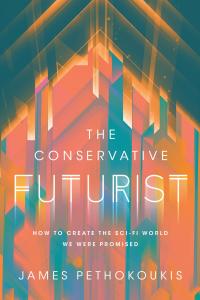
America was once the world’s dream factory. We turned imagination into reality, from curing polio to landing on the Moon to creating the internet. And we were confident that more wonders lay just over the horizon: clean and infinite energy, a cure for cancer, computers and robots as humanity’s great helpers, and space colonies. (Also, of course, flying cars.) Science fiction, from The Jetsons to Star Trek, would become fact.
But as we moved into the late 20th century, we grew cautious, even cynical, about what the future held and our ability to shape it. Too many of us saw only the threats from rapid change. The year 2023 marks the 50th anniversary of the start of the Great Downshift in technological progress and economic growth, followed by decades of economic stagnation, downsized dreams, and a popular culture fixated on catastrophe: AI that will take all our jobs if it doesn’t kill us first, nuclear war, climate chaos, plague and the zombie apocalypse. We are now at risk of another half-century of making the same mistakes and pushing a pro-progress future into the realm of impossibility.
But American Enterprise Institute (AEI) economic policy expert and long-time CNBC contributor James Pethokoukis argues that there’s still hope. We can absolutely turn things around—if we the people choose to dream and act. How dare we delay or fail to deliver for ourselves and our children.
With groundbreaking ideas and sharp analysis, Pethokoukis provides a detailed roadmap to a fantastic future filled with incredible progress and prosperity that is both optimistic and realistic. Through an exploration of culture, economics, and history, The Conservative Futurist tells the fascinating story of what went wrong in the past and what we need to do today to finally get it right. Using the latest economic research and policy analysis, as well as insights from top economists, historians, and technologists, Pethokoukis reveals that the failed futuristic visions of the past were totally possible. And they still are. If America is to fully recover from the COVID-19 pandemic, take full advantage of emerging tech from generative AI to CRISPR to reusable rockets, and launch itself into a shining tomorrow, it must again become a fully risk-taking, future-oriented society. It’s time for America to embrace the future confidently, act boldly, and take that giant leap forward.