Ronnie and Nancy began as...
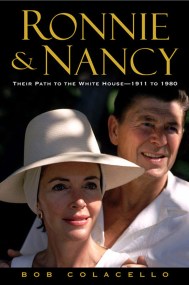
Ronnie and Nancy began as a two-part Vanity Fair article, assigned to me in l997 by editor in chief Graydon Carter, who thought our readers would be interested in taking a look back at the personal and social side of the Reagans' life, particularly in contrast to what was going on in the Clinton's White House and marriage at the time. Thrilled by the prospect of writing about a subject that combined my interests in society and politics, I immediately flew to Los Angeles and, over lunch at the Bel-Air Hotel, asked Mrs. Reagan if she would cooperate with me. We had known each other since 1981, when I was introduced to her and her husband by their good friends Betsy and Alfred Bloomingdale at a dinner at Le Cirque in New York. She and I seemed to hit it off immediately, probably because she had heard nice things about me from another close friend of hers, Manhattan man-about-town Jerry Zipkin, and also because her daughter-on-law, Doria Reagan, was working as my secretary at Interviewmagazine.
Not long after, she invited me to a State Dinner and was interviewed by Warhol and me for an Interview cover story; after she left the White House, we remained on friendly but not intimate terms. When I approached her about my VF assignment, she readily agreed to let her friends talk to me but cautioned that she herself had stopped giving interviews since her husband fell ill with Alzheimer's disease. I asked if she minded me taking a few notes as we ate; after several minutes of my trying to juggle a pen and a fork, she took pity and said it would be okay to tape record our lunch. Nine months, many lunches and dinners with her, and 75 interviews with Reagan friends, colleagues, and administration officials later, I handed in a 35,000 word story, which the magazine ran in two parts in its July and August 1998 issues.
A few days after the second part appeared, I received a letter from Warner Books editor in chief Jamie Raab, asking if I'd like to have to lunch to discuss expanding my article into a book. I signed a two year contract that November, thinking that since I had done so much research already, I could produce a full-length double biography in a snap. How idiotic I was. The thing about a biography, I figured out when it was too late to turn back, is that you can spend as much time researching it as your subject has lived — in this case 176 years, if one combines the lives of Ronnie and Nancy. What's more, in the Reagans' case, so much had been written about him, that just reading it all took months. On the other hand, so little had been written about her — the sole biography was by the dubious sensationalist Kitty Kelley — that one would almost have to start from scratch. I began by checking into the Bel Air Hotel, which is just around the corner from the Reagans house and those of most of their close friends, who I set about re-interviewing one by one over lunch at the hotel. Every other day for months, I drove out to the Reagan Library in Simi Valley, where I copied thousands of pages of White House documents. I also began collecting oral histories of Kitchen Cabinet members and officials of Reagan's gubernatorial administration from various branches of the University of California.
When I did as much as I could in California, I headed for Washington for several weeks of additional research and interviews with former White House and cabinet officials, Georgetown hostesses, and journalists who had covered the Reagans. In New York, my hometown, I tape-recorded several dozen more Reagan friends, including Brooke Astor, who received me in white gloves and a black hat in her own apartment, and the designer Bill Blass, who died of lung cancer a few weeks after he graciously gave several hours of his precious time. I visited General Alexander Haig, Reagan's first Secretary of State, and former Canadian prime minister Brian Mulroney and his wife Mila at their houses in Palm Beach, where I was on Vanity Fair assignment. I saw George Shutlz, Reagan's second secretary of state, in his office at the Hoover Institute on the Stanford campus, William Clark, his first national security advisor, in his tiny law office in Paso Robles, and Nancy Reynolds, the Sacramento aide closest to Nancy Reagan, in her retirement adobe in Santa Fe. In the end, I interviewed more than 200 sources, all but a handful on the record, ranging from old Hollywood stars such Ann Rutherford and Arlene Dahl to Potomac bigwigs such as Washington Post publisher Katharine Graham and onetime Democratic Party chairman Robert Strauss.
On subsequent trips to Los Angeles, Mrs. Reagan opened some of her unseen personal papers to me including scrapbooks she and her mother kept during their acting careers. She also included me in the private affairs surrounding her public appearances, including small lunches with George W. Bush, John McCain, and Rudy Giuliani after speeches they gave at the Reagan Library. At a reception in her honor at the 2000 Republican National Convention in Philadelphia, she introduced me to her stepbrother, Dr. Richard Davis, who proved to be one of my most valuable sources. I met her nemesis, former White House chief of staff Donald Regan, at another reception for her after the christening of the USS Ronald Reagan, and watched the two of them speak to each other for the first time in more than a decade. Unfortunately, Regan died before I could make a return trip to Virginia, where he had retired and taken up landscape painting.
As my November 2000 deadline approached, I took a leave of absence from Vanity Fair, sold my New York apartment, and moved full time to a rented house facing the Atlantic in the Hamptons. A year and one extension later, my little bungalow resembled a storeroom at the Reagan Library, and I had managed to eke out my prologue and the first three of a planned 30 chapters on my dining room table. The wisest decision I made was to rent half a hangar at the East Hampton Airport to house my mountain of material. Spreading out meant speeding up; still it took me until the end of 2003 to get Ronnie and Nancy married in Chapter 10. Despairing of never seeing the light at the end of the tunnel, and already having written more than my contracted for 125,000 words, I begged Jamie Raab to cut the tunnel in half by splitting the book into two volumes, just as we'd done with the original Vanity Fair article. And so, on May 21, 2004, I handed in an 800-page manuscript, consisting of 17 chapters, culminating in Reagan's election to the presidency in 1980. Fifteen days later, Ronald Reagan died, and the rush was on to push publication up from January 2005 to October of this year. With the help of my longtime VF editor, Wayne Lawson, whom Warners hired on a freelance basis, and two interns who organized my more than 2,000 footnotes, we managed to make it happen.
Now, the only thing that remains is for me to answer the question I've been getting from the day I signed the contract to do this book: How can you go from writing about Andy Warhol to writing about Ronald Reagan? My answer is simple: both Warhol and Reagan are archetypal American figures. Both came out of poor families in the Middle West and, through a combination of ambition, discipline, talent, and timing, rose to the top of their chosen field. Both, too, were visionaries of sorts, who were never taken seriously by the intelligentsia but nonetheless managed to change the course of art history and political history respectively.
Copyright © 2004 Robert Colacello